
The Productivity Power of a Simple Writing Ritual
This one tweak may change the way you write forever

I’m a big fan of daily rituals. These systematic habits help us keep our laziness in check. When we build habits the behaviors happen automatically— whether we’re ready or not — whether we feel like it or not.
As writers we need rituals more than ever. Our work is cerebral. The distractions are many and the motivations are few. We need a small foreman to tap us on the shoulder and tell us to get back to work.
If we wait until we feel we’re ready to write, it will be a cold day in hell before that book gets finished.
In walk rituals — your daily lifeboat to writing productivity.
With simple, self-prescribed writing rituals, we put our brains into working mode. We don’t wait until we’re in the zone before we head off to work at the gas station. We get up. We go to work. Like the post office — rain, sleet, or snow.
As writers, we’re given both the gift and the curse. The gift is we’re able to do our best work, to practice our calling — the work that matters most. The curse is that we’re left to self-motivate.
And without motivation the writing lingers. NOT writing is much easier than writing. NOT writing is everywhere. If we want to find an excuse to avoid the work, we’re thirty seconds from a good one.
There’s no writing boss.
We’ve got to get out lazy bones over to the keyboard, phone, or notebook, and get to work with no one telling us to do so. Maybe it’s time to call in the reinforcements.
It’s all you
So, here we are. We’ve got to self-motivate and it would be a good idea if we wrote every day. Not every writer does this, but it would be a good idea if we did.
Steven Pressfield talks a bit about writing rituals in The War of Art.
Pressfield’s got an entire routine he rolls through each time he sits to write. There’s even a cannon involved (no joke).
What if we could make the ritual quick and painless? What if there was a way to hire an artificial foreman and the whole process took one second? I’d argue we don’t need to take the ritual so far as Pressfield (although you’re welcome to) while still enjoying the benefits.
I use a single object to ritualize my writing session.
For mobile writing, I changed my phone’s wallpaper to a typewriter — my clear reminder to get working. I see it and I write when I can. But when writing at my desk it’s harder to get started, there are so many distractions I use a tiny ritual to put myself in writing mode.
My Writing Ritual
I have a little Buddha figurine I keep at my desk. At the end of the writing day, I lay the figure face-down. When I sit at my desk for a writing session the first thing I see is the flipped figurine.
I don’t know about you, but I hate staring at obvious disorder.
I see this little guy, face-down on my desk and I made a rule to myself that I can’t stand him up until I start writing for the day. I do a lot of mobile writing, but when I get an opportunity to use a real monitor and keyboard I jump at the chance.
This figurine-flip has been a nice little reward, making writing an automatic behavior which relies less on my willpower and more to do with the anxiety of having a flipped-over Buddha on my desk.
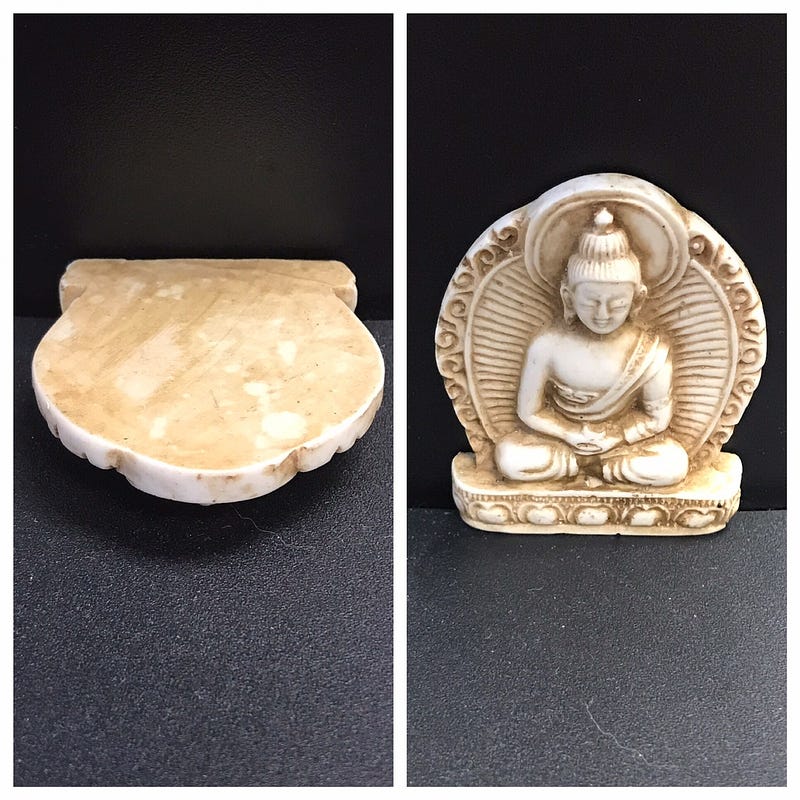
The negative becomes a positive motivator.
Once I’m done at my desk I knock my little statue over again, so it’s re-set for the next day. As soon as I approach my desk the next time, the ritual begins again… and again. I don’t have to remind myself to write. The ritual does it for me. My little, artificial foreman, yelling at me to get back to work.
Sometimes it’s best to use things which bother us as a well to propel us forward to do our best work. Here’s a post I wrote about negative motivation:
What’s your writing ritual?
It doesn’t take much — just a small talisman or a one-click behavior. All you need is an object out of place. Something that bugs you until you straighten it will do just fine.
Maybe you spin in your chair three times, or put on a special pair of shoes.
The writing ritual can also double as a good luck charm to help bring the muse when you feel stuck.
The object or ritual doesn’t matter.
The importance lies in taking the behavior away from the weak force of willpower. When we build a writing habit attached to a simple object outside ourselves, there’s no more willpower.
We’re punching the clock at the gas station. Writing’s our vocation.
It’s time to get to work. The book won’t write itself.
We’re waiting for you.
August Birch (AKA the Book Mechanic) is both a fiction and non-fiction author from Michigan, USA. A self-proclaimed guardian of writers and creators, August teaches indie authors how to write books that sell and how to sell more of those books once they’re written. When he’s not writing or thinking about writing August carries a pocket knife and shaves his head with a safety razor.
(Enroll in My Free Email Masterclass: Get Your First 1,000 Subscribers)


