
What Does Post Halving Mining Activity Tell Us About Bitcoin’s Next Price Move?
Early supply insights from a veteran miner.
The live streams have ended, the counters have reset and the shows are over. Halving is done for another four years.
It seems all I have done for the last few weeks is talk about it, whether it was webinars, articles, or even by phone. Everybody, it seemed, wanted to know what will happen next. And by the word “next”, it was usually short for “what price will Bitcoin be after the halving?”
Well, where Bitcoin goes from here in terms of the exchange rate against [insert preferred local fiat currency here] remains to be seen, especially since the halving occurred in one of the most unusual and fastest-changing financial landscapes mankind has ever witnessed.
But although it’s probably too early to make sense of the demand variables (being less than 24 hours after the event at the time of writing) that could, directly and indirectly, affect the price of the Orange Coin, it’s not too early to see some of the indicators from the supply side.
Or, to put it another way, to see the effect from a Bitcoin miner’s point of view. After all, in many ways, we get a bird’s eye view of what is happening ‘behind the scenes’ as — and sometimes even before — it filters through to the broader markets.
Mining pedigree
Although I’ve been doing this for some years now, this is my first halving as a ‘proper’ miner, having previously dabbled with GPUs in various formats in my early days of experimenting with it.
Of course, since ASICs (Application Specific Integrated Circuits — the dedicated machines designed to run and support the Bitcoin network) were not widely deployed until around 2016, this will also be the first halving for many other serious miners too.
Before it happened, we seemed reasonably sure what we’d do once it occurred, at least judging by conversations we held in various forums. That is, switch off old, inefficient machines and only run the new ones that should, in theory, remain profitable as long as price remains stable or increases slightly.
In my own case, I am running a combination of previous-generation machines such as Bitmain’s famous S9 (delivering around 14.5 Th/s each) and Whatsminer’s newer M20s (delivering 68 Th/s) as well as several other variants in between. At the time the halving took place, all were running profitably, even (just!) the S9s.
My machines are all based in Siberia, but I have 24-hour virtual access to them and am provided with a neat little dashboard, courtesy of f2pool.com. I get to see all the numbers I want including hashrate, revenues in Bitcoin, difficulty levels, and so on. But the one I have been keeping a close eye on in both the days leading up to the halving and since is the ‘Last 24 hour Bitcoin mined’ figure.
This number usually remains fairly consistent between each 14-day difficulty adjustment except where a machine may slightly under or over-perform from time to time. Every 24 hours the spoils of my machines’ labor are transferred to my wallet. It’s been a routine I’ve enjoyed being a part of for some time.
But suddenly, those numbers are changing. And dramatically so.
Post Halving Effects
At block height 630,000, the Bitcoin protocol reduced mining block rewards by 50%, exactly as programmed. Now that we’re on the other side of it, what’s changed?
Well, the first thing to notice is that we’re all still here and Bitcoin is still running like it’s another day at the office.
I mention this because there was a school of thought that the resulting drop in hash rate as miners turned off old equipment would result in a network vulnerability. The argument was that a ‘51% attack’ (so-called where superior hash power from a hostile source hijacks the blockchain and takes control of transactions) could occur as a result.
However, this was never really a very convincing argument and I’m not sure anyone actually believed this was likely to happen. You’d need significant financial resources to get the equipment, some serious co-ordination to time the window of opportunity and a cast-iron resolve to deliver it. And all of this would have to be done in secret until the appropriate time came to reveal yourself. It’s a tricky proposition.
And even if someone really did go to the trouble of doing this, you’d have to ask, why bother? All that money to break something that will more than likely be reversed in a block or two? To prove a point?
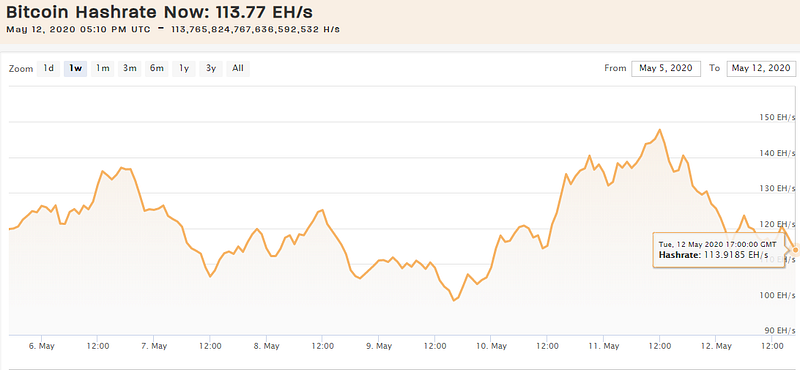
In the 24 hours since the halving occurred, Bitcoin’s hashrate has fallen from 147.8063 EH/s to 113.9185 EH/s, a reduction of 22.92% from the recent peak. In fact, it has been steadily falling all day, reaching a new daily low as I type and it’s possible it’ll drop more. But, even so, I think we can safely rule out any chance of that 51% attack happening anytime soon.
But it’s clear that the full effect of the halving is still not known.
You see, unless you’re a miner, you may not have realized that it occurred right in the middle of the 14-day difficulty adjustment period — literally on day seven — so all miners have to wait until around May 19th to see what that adjustment will actually be. It’s entirely possible, and even quite likely in my opinion, that some mining decisions will be postponed until it is clear what this means in real terms, even if it requires knowingly mining at a loss in the meantime.
Of course, any miner worth his salt knows that it’s not going to be a return to the profitability we enjoyed before, but somehow just knowing that even a portion of this reduction will be offset by an unknown amount due to the adjustment in difficulty is the reason for a strange kind of hope that it might be.
In other words, the 50% reward reduction may only be a 40% reduction once those calculations are done, and perhaps, although extremely unlikely, even less.
And, after all, what if I switch off my machines, thereby dropping the hashrate slightly, and no-one else does? Conversely, surely I should wait for everyone else to do it first, so I can benefit from the inevitable lower difficulty?
The truth is, the constant dance between hashrate and difficulty is addictive at the best of times, but now that someone has changed the tempo, well, we need to take a short time to find our new groove. In the meantime we’ll all just wait and see who does what.
By the next adjustment, it’ll become very clear very quickly what that will be.
The cost of minting new Bitcoin
Those who have read some of my other articles know that I don’t subscribe to the whole “price of Bitcoin is based on the production price of Bitcoin” argument.
For me, it doesn’t make economic sense. You’re effectively saying I should pay you X amount because it cost you X-10% (that 10% being your margin) amount to produce?
Why should I care about your production costs? Surely that’s YOUR problem. I’ll only pay what the market says I should pay. True, the two can, and often do, have a correlation, but it shouldn't be the sole basis of price setting. Supply and demand will take care of that for you.
I mention this because the cost of producing one Bitcoin after the halving has effectively risen from roughly $7,500 to roughly $15,000 at a stroke. There are lots of variables in this, but these numbers are based on my own experience and calculations and I’m confident they’re pretty damn close. Should Bitcoin users have to pay $15,000 a Bitcoin because that what it costs us to mint it? Of course not.
But you can bet that supply and demand will work out their own levels in due course. Perhaps it’ll be in the miner’s favor, perhaps not, but in the medium to long term, a parity (or profitability) will be reached one way or the other.
This means that right now, on paper at least, no miners at all are making money, except those at the very top tier or those using the very latest equipment.
Look at these post-halving profitability figures from asicminervalue.com taken this evening on May 12th 2020 using $0.07 per KwH for electricity, a fairly reasonable price:
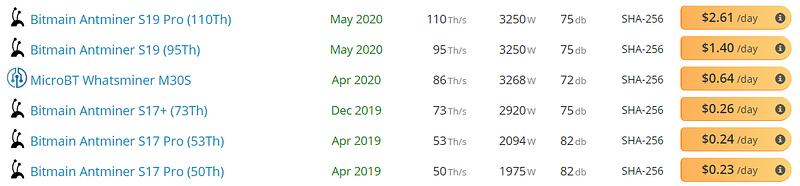
This means of the eighty-four SHA-256 algorithm ASICs (The ones that run Bitcoin’s algorithm) listed on this site, only 6 are currently profitable, and even then, only marginally so.
Worse, since these machines are so new, most mining operations will only have a few of these, if any, and they will have paid top dollar to own them. There are also rumors of reliability issues with Bitmain’s new Sx model, although I have not personally experienced any of that.
This tells us that either miner will continue to run at a loss (unlikely) or they will upgrade their equipment faster, meaning possible dumping of Bitcoin to finance it.
But I wouldn’t be surprised if this is more pronounced after the next difficulty adjustment next week. We’ll see.
The real driver? The human condition
The facts and figures above are interesting and create a basis for debate, but they hardly offer any concrete evidence either way. At best, we have a ‘wait and see until next week’ scenario when Bitcoin may, or may not, be sold off by miners in different amounts after they may, or may not, switch off their equipment, assuming they haven’t already done so.
However, there is one factor that miners can already see that users and investors are not yet privy to. This is the sheer suddenness of supply reduction.
We humans have trouble visualizing certain things, even if we know them to be true. Consider the time when someone told you that the paint on the wall was wet and not to touch it. Did you then touch it anyway to make sure, almost on impulse? Why? What on earth were you trying to prove?
The same logic applies here. It’s different to know that you are running out of something compared to the moment you actually run of it. Most of us have even experienced this first hand with all the panic buying that occurred recently.
We went shopping as usual to get our tins of beans from the huge pallet of tins of beans that is always there. Except for this time they weren’t. So we stared at it and looked around a bit. Perhaps they’re in a different place? There must be some mistake, after all, they’re always there.
Of course, you’d heard that there might be lower than usual supplies of beans, but, well, them not being there makes it suddenly real, doesn’t it?
At the moment the halving happened, almost all miners saw their dashboards turn from ‘profitable’ green to ‘loss-making’ red. We expected that, but it was still a shock to actually see it.
But what we are having to get used to now is that new, incredibly S-L-O-W rate that our ‘Bitcoin mined’ figure is rising. Damn, it’s hard to get a whole Bitcoin now. Really hard.
And guess what? The market hasn’t got this yet. The market still thinks there’s as much Bitcoin as there ever was because miners are still selling at their old rate at the moment. But this won’t happen forever. One day, it’s conceivable that you’ll go to buy your Bitcoin and there won’t be any, figuratively speaking. You knew there would be 50% less than before, but somehow it wasn’t real.
Until you stood there looking at that empty pallet.
The bottom line
We can talk charts and business decisions all day, but the reality is that markets are driven by sentiment, confidence, and a whole bunch of other human factors. Yes, Bitcoin’s fundamentals are excellent, yes, it makes sense on a logical basis and offers a number of advantages that more and more people are discovering every day.
But the shock of actually seeing how slow that production rate now is — even though I knew exactly what to expect — is quite something.
And I can’t help thinking I won’t be the only one.
Want free access to articles, analysis, podcasts and training webinars? Why not subscribe to the ‘Bitcoin and Global Finance’ newsletter?
If you found this article helpful, you may also like these:
If you don’t own any Bitcoin yet, read this. As each day goes by this becomes more important … and harder to do.
We all know it’s more everyday, but is it thousands, millions or billions? You might be surprised.
Even a decade ago it was close to impossible for the man in the street to protect their wealth in a financial crisis. Now, it’s easy.
Disclosure: The author of this opinion piece has been heavily involved with Bitcoin for several years and holds a substantial portfolio, including Bitcoin. He also has a mining operation running the SHA 256 algorithm based in Siberia and is a published author on the subject of promoting the understanding of cryptocurrency. Jason is an analyst at Quantum Economics.
Disclaimer: Investing in any asset class is risky. The above should not be taken as financial advice, nor construed as so. Always do your own research before investing or consult with a professional financial planner.