
How Many People Actually Use Bitcoin?
The answer may be more complex than you think

While researching another Bitcoin article recently, I did a couple of lazy Google searches on this very question hoping to find a generally accepted and reasonably accurate answer. However, I was quickly disappointed.
Fortunately, it was not a key part of that article, but I made a mental note to come back and try and make sense of all the conflicting data that exists on the internet to get the best answer idea of what that number might be as at February 2020.
It turned into an addictive side project involving transaction levels, wallets, users, research data, a detailed examination of the blockchain itself, and, in the end, the conclusions were as fascinating as they were unexpected.
So, if, like me, you’ve ever wondered how far we’ve come in the eleven years since Bitcoin was created, this may satisfy your curiosity.
Even if you don’t necessarily like the answer.
What does ‘using’ actually mean?
I decided to go for the broadest definition first of all and work backwards. In other words, anyone who currently holds Bitcoin, whether actively spending it or not, would be counted initially and we’d qualify the data afterwards.
This means long terms HODLers would also be included in the first pass. A HODLer, incidentally, is the name given to people who hoard their coins rather than spend them and was derived from the famous drunken ramblings of an early adopter who consistently misspelt the word ‘HOLD’ on a public forum late one evening. The typo became an instant meme in the world of crypto and has stuck ever since.
From there, it should be possible to come up with an estimate of how many people are actively using it on a day to day basis, which would include actually buying and selling of goods and services as well as trading.
But if that’s the case, then why is this exercise apparently so difficult? After all, one of the advantages of Bitcoin (or, arguably, disadvantages if you're using it for nefarious purposes) is that the blockchain is visible to anyone at any time. Transactions and wallets, though entirely anonymous, can be viewed, analysed and counted with some precision.
Why, then, can we not get a precise figure at any moment in time?
The Blockchain only gives us so much
It’s true that using a block explorer to examine what’s happening on the Bitcoin network does provide lots of lovely juicy data both in real-time and historically.
You can see how many wallets exist, how many transactions are happening and even the amounts and fees of those transactions as they occur. It’s actually quite hypnotic and I will admit to going down the rabbit hole for a while.
However, some aspects of the data aren’t visible by design and others need to be qualified. For example, it would seem, on the face of it, that simply taking the number of wallets created (a number, in simple terms, that comes from new unique addresses with private keys generated) would provide us with the answer we’re looking for.
Alas, that is not the case.
As at midnight on 24th February 2020, we know — categorically — that 46,144,447 Bitcoin wallets had been created. We can start, at least, with an absolute number.
However, we also know that many of these are abandoned, inactive or are now forever inaccessible, but there is no way of knowing this number without finding each owner of each wallet — surely an impossible task in itself — and asking them. The wallet, and any associated coins, remain forever visible whether you can access them or not.
In addition, many users have more than one wallet. I myself have five addresses for different wallets set up for different reasons. Again, since the addresses are unique and anonymous, there’s no way of knowing how many belong to the same person.
All this tells us is that as of yesterday, the absolute maximum number of Bitcoin users can only be 46,144,447.
Well, technically, 46,144,443 allowing for the four extra address we know I have.
And therein lies the problem. We’re going to need some help.
A clue from the analysts
The organisation that carries the most weight in the cryptocurrency industry is, of course, Chainalysis. Over the years, they have produced many reports examining various aspects of the industry and consistently provide good data, some of which is in the public domain.
In one of those reports, the company concluded that active Bitcoin users make up roughly one-third of all Bitcoin owners. This conclusion appears to have been reached by combining a number of factors and is now gaining acceptance as a useful rule of thumb. For the time being, anyway.
If that’s really the case, then all we would need to do is work out how many Bitcoin owners there actually are. My next thought was that this could perhaps be done by looking at the total number of wallets with Bitcoin in them since it’s possible to get this data in real-time and directly from the blockchain.
It seemed a logical place to go next.
Can we find user numbers from wallet content data?
The wealth distribution chart breaks down the ownership of all Bitcoin by categories as follows:
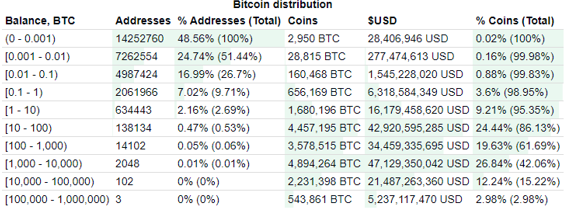
However, immediately we have a problem. The total number of addresses shown here comes to 29,653,536, whereas we already know that the total number of addresses is 46,144,447. To make matters even more complicated, the same data is split by dollar amount in a second table, providing yet another total of 32,017,087.

Since they are all generated by the blockchain directly, how can they be so different?
My best guess is that the answer lies in ‘true zero’ accounts. In other words, wallets that have precisely nothing in them appear to be excluded from the data, despite the first data line implying they are not.
In the first table, 0.001 BTC is $9.30 at today’s prices, but the dollar breakdown in the second table goes as low as $1, thereby adding another 2,363,551 addresses. Going below that $1 amount, would, logically, add the missing addresses back in, giving us the magic figure back.
Assuming this is actually the case, then using Chain analysis’ rule of thumb, we should be looking at a third of 32,017,087, giving us 10,672,362 active addresses.
However, it must be remembered that these numbers are still addresses, not users, so it not only does it give us questionable data, the rule of thumb may not even be applicable in this context. Logically speaking, therefore, the true number of actual ‘properly active’ users must be lower than this.
In fact, since it’s possible to get precise ‘active addresses’ data directly off the blockchain anyway and in real-time, we can get a better figure that way.
But it still doesn’t tell us who owns them, how many people are actually using it and how the ‘active addresses’ data is applied to the real world.
We’re going to need more help.
The 2018 Chainalysis report
The last major report by Chainalysis on users that’s publicly available was carried out in August 2018. Because of its age, the data can therefore only give us more clues rather than any absolutes.
That said, they were pretty precise with their estimates at the time, giving a global estimate of 7.1 million active users. These were split by 2.3 million using Bitcoin to make payments regularly, and 4.8 million using it to facilitate the speculative trade of cryptocurrency, ie by converting to other currencies and back again, or simply trading back and forth during volatile periods.
They also stated that an additional 6.4 million people were holding Bitcoin for the long term. On that basis, using the broad definition we started with, it means Chainalysis is looking at 13.5 million actual users worldwide at that time.
However, since the data is now 18 months old I’m not sure how much still applies. Coinbase, for example, now boasts that it has over 30 million users (not addresses) alone as of today and, presumably, each of them must have a Bitcoin address, even though we don’t know how many are ‘active’. This would imply the number must be more than this, but less than the 46 million addresses we already know is the maximum.
And what about addresses used for LocalBitcoins.com? Or in ‘big Bitcoin’ economies such as South Korea, South America or Africa where Coinbase doesn’t operate? How can we tie this apparently contradicting data together?
The Bottom Line
This examination of the data simultaneously demonstrates just how difficult it is to try and work out what the number of active users is as well as explain why there are so many conflicting answers available on the internet generally.
This is compounded by trying to come up with a truly accurate definition of an ‘active user’. If I, for example, used Bitcoin to buy some petrol on the way to work this morning, but then decided not to spend any until next month, does that make me an ‘active’ or ‘inactive’ user? Where do we draw the line?
Chainalysis will almost certainly have to have made some similar assumptions and parameters when doing their own calculations, and I’m not sure even their conclusions can be classed as any more than a broadly educated guess as a result. And they had far more resources at their disposal than me.
So, as determined as I was when I started this article to find an absolute answer, after two days of research number crunching and cross-examination of a myriad of data sources, the only two things I can say for certain are as follows:
First, it’s next to impossible to put an actual specific number on it. There’s simply too many variables, too many unknowns and too many holes in the definition itself.
If I was forced at gunpoint to come up with a number, I’d probably offer up somewhere around the 20–22 million mark as being a realistic number of active users globally as of today. However, it would come with the proviso that this is a best guess only partly based on actual data, has a generous portion of gut feeling, a wide margin of error and a flexible definition of ‘active’.
To put that in context, according to Statista.com, PayPal had 305 million active users as of December 31st 2019. (However, since PayPal started in 1998, it’s a slightly unfair comparison. A fairer one would be at the same point in PayPal's life, where it had around 75 million users.)
Second, the other thing that my research has consistently shown is that the use, accumulation and awareness of Bitcoin are growing steadily and undeniably by whichever metric you use. Whilst we tend to focus on the price alone — which fluctuates wildly as you’d expect from a nascent, uncertain tech — the underlying metrics and network effect are steadily building. It stands to reason one will catch up with the other at some point.
If nothing else, this exercise has shown that it may never be possible to know how many people are actually using it at any particular time, even with all the precise, detailed and real-time information available from the blockchain itself.
And whilst that’s frustrating from an analytical point of view, some would say that’s not a bad thing from a practical perspective.
And I, for one, would have to agree.
Want free access to articles, analysis, podcasts and training webinars? Why not subscribe to the ‘Bitcoin and Global Finance’ newsletter?
Disclosure: The author of this opinion piece has been heavily involved with Bitcoin for several years and holds a substantial cryptocurrency portfolio, including Bitcoin. He also has a mining operation running the SHA 256 algorithm based in Siberia and is a published author on the subject of promoting the understanding of cryptocurrency.
Disclaimer: Investing in any cryptocurrency is extremely risky. The above should not be taken as financial advice, nor construed as so. Always do your own research before investing or consult with a professional financial planner.