
Why You Should Own at Least 0.0025 Bitcoin
And why time is running out to get it
As I started to write this article this morning at 10 am GMT on Thursday 6th February 2020, there were estimated to be 7,762,571,088 people on the planet according to worldmeters.com, an indicator universally recognized as the most accurate currently available.
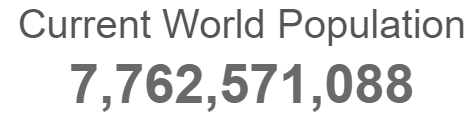
By the time you read this, this number will have increased markedly.
Yet, it is still possible for every single one of these souls to own a whole US Dollar — our agreed global reserve currency — and still have trillions of them leftover.
In fact, bringing up the US debt ticker next to the population ticker in your browser reveals a staggering truth — US Dollars are being printed at a much faster rate than the human population is expanding and by an enormous margin.
In fact, this applies to every single currency on the planet, not just dollars.
Except, that is, for Bitcoin.
The ‘simple’ maths
It is not possible for every human on the planet to own a single Bitcoin. In fact, it never was. There will only ever be 21,000,000 produced between its creation in 2009 and the end of the mining cycle in 2140. As of today’s date and time, 18,203,000 Bitcoin have been mined, some 86.681% of the total. The remaining 2,797,000 will become exponentially more difficult to produce over the next 120 years.
At the simplest level, working with those two numbers (current population vs current Bitcoin available) we can deduce that to spread Bitcoin equally across everyone on the planet, each person would get 0.00234497 Bitcoin. Or to put it another way, 234,497 Satoshi.
Just like we use cents for partial amounts of dollars, we use Satoshis for partial amounts of Bitcoin. In the future, the reality is that most of us will only ever deal in Satoshi and only a very select or very wealthy few will ever deal in Bitcoin, their value will simply be too high.
To buy that amount at today’s price, approximately $9631 per Bitcoin at the time of writing, would cost you $22.58. In other words, just $23 spent (allowing for a couple of extra Satoshi to make sure) today would guarantee that you would have more Bitcoin than the average person on the planet could own, mathematically speaking.
That’s an astonishing thought.
However, it is also a simplification that deliberately excludes a number of other factors, so, for a real number, we need to look a little deeper.
The ‘not so simple’ maths
The above numbers are ‘locked’ at the current position. Yes, there is still 2,797,000 Bitcoin to mine, but there are also more people due to arrive on the planet in the next 120 years.
The forecasts for the global population in 2140 are understandably varied but, assuming we haven’t blown ourselves up or found some other ingenious way to wipe the human race from the face of the earth, we should expect that figure to reach 12 billion by that time.
Again, using simple maths, assuming you were buying Bitcoin for your great-grandchildren and all remaining Bitcoin was successfully mined, you’d need 0.00175 Bitcoin to be safe, or $16.85 in today’s money.
Whilst that seems reassuringly lower, there are some extra considerations to throw into the mix.
First, there are a significant number of Bitcoin that has been lost and will likely never be recovered.
Whilst this seems incredible now given their value, the reality is that in the early days, Bitcoins had no value and were easily obtained. People who had done a bit of mining for fun and had amassed hundreds, if not thousands of them and simply forgot about them or lost the seed (private key). Without it, they can’t be recovered.
For example, James Howell, an IT worker based in the UK, famously mined 7,500 Bitcoin the early days and accidentally threw away the hard drive he had stored his keys on. The hard drive currently sits in a landfill in Wales and Howell has tried, unsuccessfully, to get permission from the council to excavate it.
Howell’s story is not uncommon. The internet is rife with people who have come clean about losing their early Bitcoin and, in fact, it still happens today, although the amounts concerned are, of course, much smaller given the current value.
There are a number of estimates and methodologies about estimating lost coins as it is not an exact science. The coins remain forever visible on the blockchain, they’re just permanently inaccessible. However, there’s no way to know which coins are which.
Recently, one of my preferred methodologies, that of studying coins that haven’t moved for a long time, estimates that between 3 and 3.8 million coins are either lost or locked. Around the same time, Chain analysis came up with a similar estimate of around 4 million using a combination of approaches. It seems this range could be about right.
To guarantee to ensure that we have on, or slightly over, the average amount a person will ever be able to own in the future, therefore, we’d need to adjust the maths a little.
It’s prudent to take the lower number of lost coins rather than the higher since this gives us the highest number of coins that are expected to be available. If it turns out there are less available, we’d still have a figure that would guarantee we’d still be over the overall average.
Adjusting those figures accordingly, we’d now need 0.0023188 Bitcoin to be certain of ensuring we have our minimum average amount, or $22.33’s worth.
The second consideration is that of ‘whales’. This is a term used for people or organizations who own huge amounts of Bitcoin since each time they move or sell some, it can create splashes in the market. It is estimated that around five million Bitcoin are owned by only 1,600 of these whales, many of them are early adopters who still hold on to their coin.
However, whilst this is often quoted as an issue of liquidity, this is less of a complication than it appears. For now, there is still plenty of availability of Bitcoin and even with the halving event that will be happening in just a couple of months' time reducing new supply by 50%, it’s still relatively easy to obtain as much Bitcoin as you wish. In terms of retail amounts anyway.
This will not always be the case in the future and whilst it’s true that these coins remain out of circulation, for now, I think it’s inevitable that some (if not the vast majority) of these holdings will be released into the market as the price appreciates.
That being the case, these coins should be included in the total available over time and not excluded.
Conclusion
So is it worth converting a portion of your hard-earned fiat currency into Bitcoin and how much will guarantee you’ll end up at least with the average amount possible given the numbers above?
On the second part of this question, we can be quite specific even after making some assumptions about what we know at the moment.
Whichever way you cut the numbers, you’ll need between 0.00175000 and 0.0023188 to make sure you have at least the average amount per person on the planet. That works out to be somewhere between $16.85 and $22.33 at today’s prices.
To play it safe and build in a tiny bit of margin, I’d go for a nice round number of 0.0025, which is easier to remember but does come at the cost of a heftier price tag of $24.08.
And this brings us neatly back to the first part of the question — is it worth doing?
I don’t know when we started measuring smaller expenses in terms of lattes, but this is now definitely a ‘thing’. In that spirit, I can confirm that this sum of money would buy you nearly six lattes (instead of your Bitcoin) at an average cost of $4.16. That figure, incidentally, was the average cost in 2018 according to Refinery29’s research figures and may well be slightly higher now.
Or you could buy just over two and a half beers in New York at an average cost of $8.97 each at 2019 prices.
But whether your preferred measure is coffee, beer or any other form of liquid refreshment, it’s not a great deal of money in the grand scheme of things. Is it worth forgoing a couple of days’ coffee or a round at the bar to secure a small amount of something that is, by design, the most scarce commodity in the world?
Only you can answer that. After all, I’m just a random guy on the internet presenting some numbers.
And I may well be seriously underestimating how much you like your coffee.
Or beer.
2021 special offer:
Looking to start your Bitcoin journey here and now? If you live in the UK or Europe, have ID and are over 18, you can instantly claim £10 in Bitcoin by setting up a free wallet (to store it in!) with Luno.
The code you need to enter when prompted is BPJDEANE and here’s the instructions for how to do it.
This is an exclusive and genuine offer made through my association with Luno and is only available for new customers. It is designed to allow new users the ability to experience this new financial system — something that can seem scary at first— without having to risk their own money. The app is free to use, there are no monthly fees and no further purchases are required.
You can keep the Bitcoin, exchange it for another cryptocurrency on the platform or simply move it to the Luno savings account to earn 4% interest with our compliments. Once you’ve claimed it, it’s your Bitcoin, so it’s your call!
If you enjoy reading stories like these and want to support me as a writer, consider signing up to become a Medium member. It’s $5 a month, giving you unlimited access to stories on Medium. If you sign up using my link, I’ll earn a small commission.
Want free access to articles, analysis, podcasts and training webinars? Why not subscribe to the ‘Bitcoin and Global Finance’ newsletter? Subscribers over 18, resident in Europe (see list on subscription page) & new to Bitcoin can claim £10’s worth of Bitcoin on joining! Unsubscribe at any time.
There is a Podcast version of this article with a little more detail available for free here:

If you found this article useful, you’d probably like these too:
Here’s the safest and lowest risk way to invest in Bitcoin:
Just what is likely to happen to Bitcoin in the next few years?
Have Bitcoin users grown over the last few years? What do the numbers say?

Disclosure: The author of this opinion piece has been heavily involved with Bitcoin for several years and holds a substantial cryptocurrency portfolio, including Bitcoin. He also has a mining operation running the SHA 256 algorithm based in Siberia and is a published author on the subject of promoting the understanding of cryptocurrency.
Disclaimer: Investing in any cryptocurrency is extremely risky. The above should not be taken as financial advice, nor construed as so. Always do your own research before investing or consult with a professional financial planner.


