
What Is the Best Way to Invest in Bitcoin?
The question that I’m asked the most, answered.
I’ve been writing, blogging and presenting about Bitcoin for some years now and, once people have politely listened to my non-technical and analogy based description of what it is and how it works, someone, somewhere, will always ask this question, or some variant thereof, sometimes put as bluntly as ‘How can I make money from Bitcoin?’
I should point out that I have no issues with this — it’s a fair, typically human question. We all like to make a bit money if we can, don’t we?
The simple answer is that you can make money with Bitcoin very easily, just as easily, in fact, as you could lose it. Many people have done both of these things and no doubt will continue to do so, but if you DO choose to get involved, you’d probably want to know the easiest and safest way, relatively speaking, to do it and to give you as much chance as possible of getting a return on your money. This article explores how to do that.
There are, of course, many ways of investing in Bitcoin involving various levels of risk, but in my experience most people want to dip a toe at first and see what happens, which, incidentally, is what I did myself some years ago. I think, like anyone, I just needed reassurance to see if this thing was real and whether it was worth doing. After all, I loved the theory of it all, I just wanted to make sure the practical side lived up to the hype.
For me, it did.
Bitcoin is much easier to buy these days and can be done more or less instantly. There’s some instructions for setting up a simple, free wallet to get some here and I always recommend people get a little bit, even if it’s just a few latte’s worth, so that they are part of the financial revolution that is unfolding around them. It’s great to be able to say you were one of the early adopters — and even in 2020 you still are — although Bitcoin itself is already over eleven years old.
“ORIGINAL CRYPTO GUY” SPECIAL OFFER: I’ll give you £10’s worth of Bitcoin FREE, via my sponsors, Luno, when you sign up to my newsletter by clicking here. (NOTE: check your spam folder for your confirmation email and for your code)
But that’s not really your question, is it?
Bitcoin was designed to be a medium of exchange like any currency first and foremost, but it has also become a store of value like gold. People make (and lose) money buying and selling both currencies and assets everyday, and, on paper therefore, there’s no reason why Bitcoin should be any different.
You can either buy and hold it hoping that the value relative to your native currency goes up or you can trade it backwards and forwards between those currencies taking advantage of any fluctuations between the two.
These are valid approaches and people do them routinely either directly through buying and selling using wallets or exchanges, or via trading platforms such as Etoro. If people ask me, I’m happy to discuss any of these options with them in general terms of how to do it. No-one, however, is qualified to give you return percentages, timescales or entry prices, including me.
I would say there’s one approach that, historically speaking, has so far yielded an unusually high success rate, is simple to understand and is very easy for anyone to do. It’s something called Dollar Cost Averaging.
Introducing Dollar Cost Averaging
Dollar Cost Averaging, or DCA for short, is a simple process where you routinely and religiously put a fixed amount of money into a single asset over time. It could be weekly or biweekly for example, but for most people it’s monthly. The idea is that you’re spreading your risk by buying the asset over it’s long term trend, effectively smoothing out the inevitable day to day volatility.
So, if you bought $50's worth of Bitcoin on March 15th, you’d buy another $50 on April 15th, again on May 15th and so on. Once you start, you simply don’t stop — no matter what’s going on in the market on a day to day basis — and, in theory, it becomes a sound long term investment.
The only exception to this is if it becomes clear that the asset you’ve chosen has failed and buying any more would be foolhardy. This is different, incidentally, from people saying the asset will fail — people say stuff like that all the time about pretty much anything, especially Bitcoin, and they’re not always right. Bitcoin has actually been declared dead 379 times so far in it’s history and there’s a fun little Bitcoin obituary where you can see the press articles insisting it is so. (It isn’t, by the way.)
And yet the fundamentals, network and usage rates are still growing.
Of course, DCA isn’t new and people routinely do this on many assets and investment vehicles, not just Bitcoin. However, DCA has shown exceptional returns for Bitcoin not just recently, but actually at any point in its entire history.
In other words, it makes no difference where your start point was in Bitcoin’s timeline, as long as you put the same amount each month, every month and on the same date.
For example, on the day I am writing this article, the 10th January 2020, I have put together the chart below to show what would have happened to your money if you’d started Dollar Cost Averaging $50 a month each and every month from the same date one to nine years ago. The results are as follows:
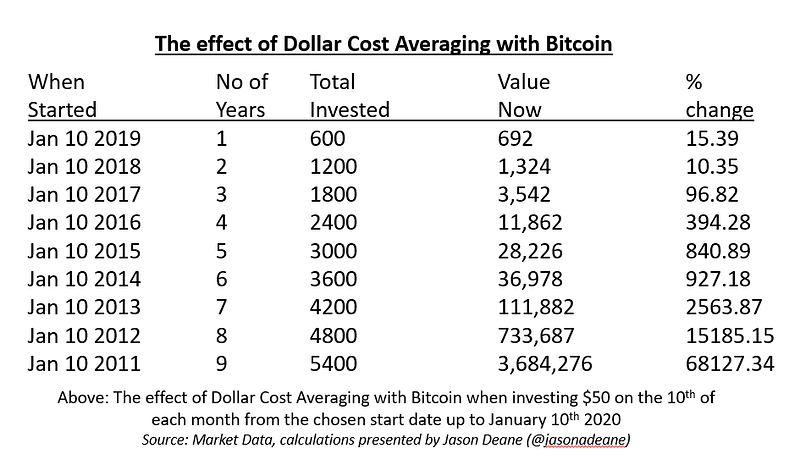
The long term trend of Bitcoin is so strong that even if you’d started right at the peak of the retail driven Bitcoin boom in late 2017/early 2018 and bought all the way down the cycle, you’d still have got a higher return on your money than you could in any bank or if you’d had it in any other currency on the planet. And, of course, you’d be well placed to benefit from any future gains, should they occur.
Of course, past performance is no guarantee for the future and even though Bitcoin is now confirmed as the best performing asset of the 2010’s (possibly ever), it doesn’t mean this will continue.
On the other hand, Bitcoin is still tiny. You may read about it a lot, you may see it in the press from time to time, but the reality is that the usage rates are absolutely minuscule compared to traditional financial instruments, literally not even a rounding error on a chart.
Adoption could take years, in which Dollar Cost Averaging will almost certainly yield an extremely good return over time, or it could go the other way and fail completely, in which case you’d lose your $50 a month for however long you put it in. That’s the risk you’d need to weigh up for yourself.
Here’s an example:
Scenario 1:
Let’s say you started today and put $50 a month into Bitcoin for two years. Your total investment would $1200 over that period. Bitcoin fails. You lose your investment completely. (Depending on the laws in your country, you may be able to claim at least an element of this loss against your tax bill.)
Scenario 2:
As above, but this time Bitcoin continues to grow using the same long term trend it has and reaches new highs, of, say $35,000 in that period. (This is an arbitrary figure used for example only. Many people forecast values much higher and much lower than this) Your investment would now be worth, conservatively, somewhere around $2000-$6000, although it’s impossible to put an actual figure on it without knowing the market movements in this time. Not bad for $50 a month.
At the end of the day, it’s your choice based on your belief in what will happen next and your appetite for risk, but since you’ve asked the question that’s my answer.
Setting up Dollar Cost Averaging
If you do decide to do some Dollar Cost Averaging, perhaps even by doing something as simple as setting up a monthly reminder on a certain day to buy a fixed dollar amount of Bitcoin, there’s a few points to remember:
First, DCA is a long term investment. You need to commit to at least a couple of years, and preferably more, going forward.
Second, try not to liquidate your holdings in the interim until you reach the end of your allotted period, unless, of course, something drastic changes.
Third, do NOT get tempted to try and change your days or amounts in reaction to movements in the markets. For example, if there’s a spike in the price on the day you’re due to buy, you might be tempted to ‘wait until tomorrow’.
As soon as you do this, you are no longer Dollar Cost Averaging. Instead, you are playing the markets and that’s a whole different skill set that few people can do well. This is far riskier. Let the numbers and the trends work for you, by being emotionless and steadfast.
Remember— It’s YOUR Money
I’m a natural risk taker, but I spend a great deal of time looking into what it is I am getting involved in, including positive and negative aspects. I’ll weigh up the pros and cons and make a call based on how much loss I am prepared to accept.
This is a sound approach and, whatever you decide to do at this point, the standard (and oft repeated) caveat of not risking more than you can afford to lose still holds true.
Take your time, research, weigh up the risks and remember that, at the end of the day, it’s YOUR money.
YOU make the call.
And whatever you decide, I sincerely wish you the best in your endeavors.
If you enjoy reading stories like these and want to support me as a writer, consider signing up to become a Medium member. It’s $5 a month, giving you unlimited access to stories on Medium. If you sign up using my link, I’ll earn a small commission.
Want free access to articles, analysis, podcasts and training webinars? Why not subscribe to the ‘Bitcoin and Global Finance’ newsletter? Subscribers over 18, resident in Europe (see list on subscription page) & new to Bitcoin can claim £10’s worth of Bitcoin on joining! Unsubscribe at any time.
Disclosure: The author of this opinion piece has been heavily involved with Bitcoin for several years and holds a substantial cryptocurrency portfolio, including Bitcoin. He also has a mining operation running the SHA 256 algorithm based in Siberia and is a published author on the subject of promoting the understanding of cryptocurrency.
If you subscribe to KOLL (Kindle Owner’s Lending Library) or KU (Kindle Unlimited) on Amazon, you can read the author’s book for Bitcoin beginners called ‘How to Explain Bitcoin to your Mum’ for free. For the month of June 2020, all books sold come with £10’s worth of Bitcoin, that can be redeemed in addition to any other offer.
Here’s how:
Disclaimer: Investing in any cryptocurrency is extremely risky. The above should not be taken as financial advice, nor construed as so. Always do your own research before investing or consult with a professional financial planner.
If you would like to more about where Bitcoin is going, try these articles: