‘Nobody’ Uses Bitcoin. So Buy It.
Remember the internet? No-one used that either.
Update 2023: While this was written in the halcyon pre-COVID days of 2019, the essence of this article is actually truer than ever and the examples are even funnier somehow. Check it out for yourself!
Recently someone told me that there was no point buying Bitcoin because ‘nobody’ uses it.
This is interesting because, for some people, myself included, this is exactly the reason why we DO buy it.
It also implies the opposite: that they’d only consider buying it when people are actually using it. ie when it’s ‘proven.’ That’s fair because if we should ever reach that point, then your hard-earned ‘fiat’ money (the stuff you have in your pocket controlled and managed by the state) is probably safer. Of course, the trade-off is that it’ll almost certainly be much more expensive to buy because precedent and the laws of economics make that very clear.
History is littered with examples of why this is the wrong thinking — assuming you want to make some money, that is. These are the people who mortgage their houses to invest in stocks when the markets are in a euphoric boom and prices have lost all sense of reality… and then lose it all in the resulting crash. Of course, the market needs these people for the cycles to work, but it’s a harsh reality.
And yes, I’ve even done it myself to a certain extent and you can read about my own idiocy here. But only once as a young, green investor. That was enough to learn you don’t buy when everyone else is.
The real best time to buy is exactly the time you don’t want to because it scares the hell out of you and the crowd are telling you it’s a big mistake. To quote Baron Rothschild:
Buy when there’s blood in the streets, even if the blood is your own.
In other words, when everything is crashing down, there’s a disaster all around, people are fighting to survive, and all hope is lost, you calmly step in and buy everything for peanuts from desperate sellers.
Of course, it’s not easy to do this. It requires enormous willpower, discipline and the ability to actually make a call when that time might be, something that most of us can only do in retrospect. Warren Buffet is a master of this, but even he doesn’t get it right all the time and for every winner, he’ll have a few losses. But those big winners are big, REALLY big, and easily cover those losses with substantial profit to spare.
As time passes it’s easy for these lessons, learned over and over again at great expense, to be lost to the next generation.
For example, we all use phones now, either cellular or land-based, but once upon a time the main objection to suffering the expense of getting one was that buyers simply didn’t know anyone who had one. Therefore, who were they going to call?
It’s easy to overlook the fact that by getting involved and getting one, they actually become the people driving the network effect and increasing its usefulness. As soon as that network gains momentum, the tech is proven and the early adopters always benefit the most.
That’s fair. They took the risk.
But there are examples even in living memory. The internet was vilified for being next to useless, full of geeks doing geeky things and nothing but a passing fad. Paul Krugman, a Nobel winning economist confidently predicted in 1998 that the impact the internet would have on the world’s economy would be no better ‘than a fax machine’s’ and that everyone would realize this by 2005 because people ‘have nothing to say to each other.’
Incredibly, he wasn’t alone in his opinion. For many people, it was not worth looking at, let alone investing in stocks that were associated with it until it was too late — and we all know what happened then.
I can personally attest to this particular tech cycle — when I set up my first internet café in 1996 (later to become a chain and then sold off some years ago), the few customers we had initially were constantly teased by the spill out from the pub next door. They’d lean on the large glass window and shout ‘geeeeekkkksss’ at the top of their voice, sometimes quite aggressively, necessitating my involvement to move them on.
But I bet those pub goers now use the internet. And use it every day.
Even people involved with the internet were terrible about selling it. Have a look at this 2-minute snippet of an interview — especially the first 30 seconds — with my old boss Bill Gates and David Letterman from the ’90s as he tried to explain its uses:
That great line from Bill Gates really sums it up beautifully:
“It’s become a place where people are publishing information, people can have their own homepage, companies are there … it’s wild what's going on”
Well, if that doesn’t make you spend a fortune on the latest 28.8k modem and 486 processor personal computer, I don’t know what will. It sounds like a party you just can’t miss.
Or not.
But the truth was the internet was a hard sell at that time. It was slow, often didn’t work and had very little on it, but it wasn’t actually the internet of the time we were so excited about — it was where it was going.
Early tech on a new concept is always shoddy, especially user interfaces, and many of us make the mistake of thinking the current status is how it’s always going to be. Even those of us involved at that time could never have predicted third-gen apps and whole new concepts such as Uber and Airbnb would ever be built on it and adopted so fast.
Bitcoin is often compared to this analogy and I use it myself in talks and articles quite regularly. But it’s not just the tech analogy, it’s the concept part as well. As strange as it now sounds, people just couldn't get their head round what it was, how it worked or what it was for. It was just TOO complicated.
Have a look of this 2-minute compilation of TV hosts trying to get their heads round the whole idea in the mid-nineties:
Of course, this is hilariously funny to us in these more enlightened times, but this struggle was repeated globally by families over dinner tables and social or business events for years before people really started to understand it and start using it. I know. I was there.
And that’s where we are with Bitcoin. The big obstacle is the concept. It’s just too far out there for many people to grasp at the moment. Magic internet money? Magic internet money that has no notes or coins, no ‘visible’ backing and can be used anywhere in the world whenever you want? Say, what?
We’re so used to centralized controls on this sort of stuff, it seems totally impossible, so we think it must be a scam, it won’t work or governments can stop it. And yet it isn’t, it just might and they can’t.
It’s true that just ten years in this tech could still be classed as experimental. It may still fail yet.
It’s true that only a small percentage of retailers actually accept it and it’s often tricky to spend that way anyway.
It’s true there are only around 35 million Bitcoin wallets in existence (source: Statista) and, as of yesterday, only 700,000 were actively moving Bitcoin around in any form. (‘active’ means any address that was involved in ANY transaction in any given 24 hour period — it does not include addresses where no transaction took place) These transactions totaled only a few billion dollars which, in terms of global adoption, is tiny. It’s too small to even be a rounding error.
But take a look at this chart showing active addresses over the last ten years.
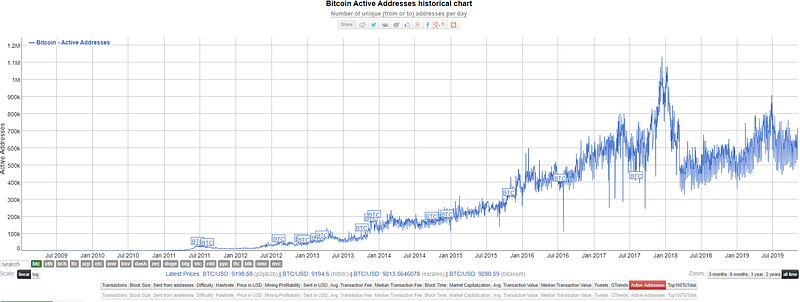
How does that compare, say, with the first ten years of internet adoption in the days of crappy technology and very little interactive material?
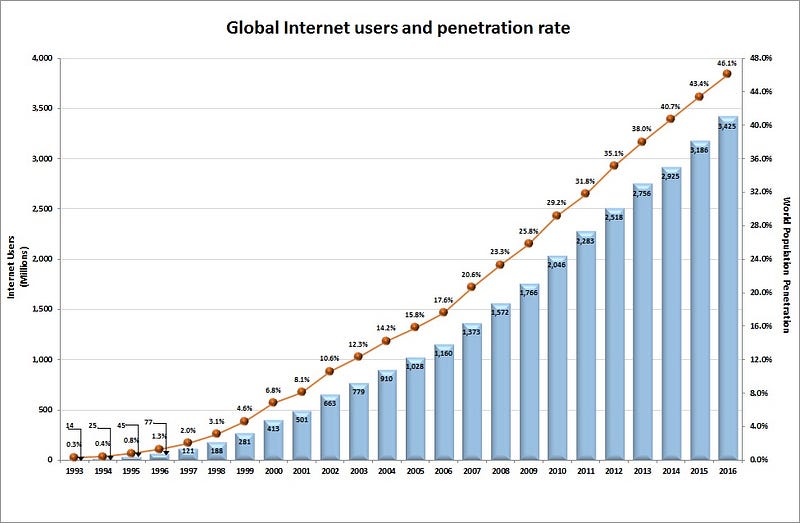
It took 23 years for the internet to get to 46% of the global population which means in 2017 (the last full year where accurate numbers are currently available) there were still more people without the internet than with it. I find that astonishing, both because we assume everyone has it (and they don’t) and also because it ONLY took 23 years to become truly global. Every tech before this has taken many decades if it ever succeeded at all.
We live, truly, in a time of new paradigms.
But how many of us bought internet stocks, like Amazon, in the early days in reality? Did we instead look at the big losses and technical issues, or listen to the crowd who said it would simply never work? Truth is, most of us did that, while the clever money hoovered up the cheap stock taking a bet on a new way of doing business. Sure, they made lots of bets and many of them didn’t play out but, again, the ones that did more than covered any losses and saw them all living very well as a result.
Bitcoin may seem expensive now from where it started, but that’s no reason not to buy a few dollar’s worth now. ‘No-one’ is using it and, as supply really starts to reduce down dramatically from next year for ever, those few, but ever growing, ‘no-ones’ who think this new way of doing business will work will want to make sure they have as much as possible.
Of course, if someone starts using it instead of no-one, then everyone will want some, resulting in higher prices and increased purchasing power for the early adopters.
And that’s when everyone else will say:
“I wish I’d bought some Bitcoin back in 2019.”
This isn’t financial advice, just a viewpoint on the argument for buying and holding Bitcoin before the tech and concept makes it to the masses. It may never do that and there are sound arguments for its failure as well as success. Do your own research!
If you’re new to Bitcoin, you may want to read my book “How to Explain Bitcoin to your Mum”, a light-hearted jargon-free way of explaining the concept, how it works, why it might or might not succeed and how to get some. Don’t forget to claim the free Bitcoin that comes with it!
Disclosure: The author holds a significant cryptocurrency portfolio which includes Bitcoin.