
What ‘Barbie’ and ‘Winnie the Pooh: Blood and Honey’ Have In Common
Or: The Brandification of Mainstream Cinema
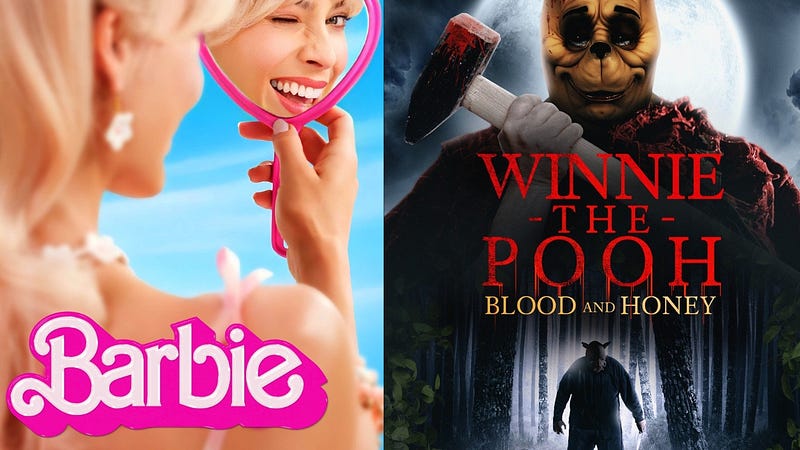
The current landscape of mainstream cinema is dominated by what has aptly been defined by filmmaker Martin Scorsese as “amusement park films”: films that rely on the spectacle of CGI and commercially successful “brands,” such as Marvel and DC, to incentivize audiences to buy a ticket.
These movies are commercially successful because they appeal to large audiences who, in most cases, are looking for a Saturday night date flick or an hour-and-a-half-long distraction for their kids.
The term “amusement park film” is accurate in describing such movies because their primary purpose is entertainment, specifically: short-lived entertainment, a form of consumption that our society is quickly becoming more and more addicted to. Once the film is over, the ride is over. Audiences are unlikely to retain anything from the experience, apart from its wow-ing, digitally-created special effects. And even those are soon forgotten once the next big commercial success to heavily rely on CGI is released, thus rendering the previous one outdated.
Amusement park films are not cinema because they are not art (which cinema is). They are entertainment.
This year, two films came out that were specifically designed to rely on an already successful brand to generate further revenue. One of them is Greta Gerwig’s Barbie, which has already generated over $1 billion in revenue at the box office. Speculations of a sequel and/or possible spin-offs are already on the way, as is usually the case for brand-based box office hits.
The other one is Winnie the Pooh: Blood and Honey, a horror flick based on the celebrated children’s book by A. A. Milne, which came out last January.
The movie grossed a surprising — or perhaps not so surprising — $5.2 million, and a sequel has already been announced, with director Rhys Waterfield teasing the public about the inclusion of a chainsaw, stating: “Winnie the Pooh will have a chainsaw […] I’m going to make that happen.” This is despite the virtually universal trashing of the first movie by audiences and critics alike, with the film holding a 3% score on Rotten Tomatoes and a 2.9 score on IMDb.
Leaving aside the supposed “merits” of each film, it is not difficult to guess that most audiences were drawn to both movies by the already commercially successful brands behind them, which have produced millions of dollars in revenue ever since they’ve existed.
Mattel, the toy manufacturing company behind Barbie, had a net income of approximately $7 billion by the end of last year, and only one month after the release of the Barbie movie, its net worth was estimated to be around $7.75 billion.
Winnie the Pooh, on the other hand, was originally adapted from A. A. Milne’s book into an animated featurette in the year 1966. The film was produced by the Walt Disney Company and distributed by Buena Vista Distribution, a subsidiary founded and entirely owned by… you guessed it: Mr. Walt Disney. After the success of the first film, Disney gradually turned Winnie the Pooh into a franchise that, over the years, has grossed millions of dollars in revenue between media adaptations, merchandise, and more.*
Both Barbie and Winnie the Pooh are not only immediately recognizable and commercially successful brands, but they are also symbols: they are brands whose presence is so overwhelming and whose visual appearance is so iconic that they have become an integral part of pop culture on a global scale. Their iconic significance is universally recognizable: one has become synonymous with hyper-femininity, with her blonde hair, blue eyes, Caucasian features, and impossibly slim yet breastful figure, setting a toxic standard of beauty for generations of women; the other is a heart-warming symbol of childhood, a chubby, goofy, honey-loving bear who enjoys going on adventures with his fellow animal friends and his beloved “hooman” Christopher Robin.
Therefore, it comes as no surprise that both Barbie and Winnie the Pooh: Blood and Honey capitalized on a clever marketing campaign. But the truly ingenious element in their marketing was the exploitation of curiosity: in the case of Barbie, this was achieved by pairing the doll — whose damaging effects on the body image and self-esteem of young girls worldwide have long been under scrutiny — with celebrated female film director Greta Gerwig, whose very existence as a successful film director — a field that has been historically dominated by men — is a feminist statement in itself.
Since the very announcement that Gerwig was going to write and direct the movie, countless people — both critics and audiences — assumed that Barbie was going to be a groundbreaking cinematic event that would (somehow) empower women, despite the doll’s more than questionable cultural impact.
In the case of Winnie the Pooh: Blood and Honey, a similar tactic was employed: the film’s premise fully exploited the contrast shock value of the beloved childhood character Winnie the Pooh clashing against the slasher horror genre. The coupling of the two things was so unthinkable that it simply tempted the public’s curiosity too much.
In the end, both techniques worked: both movies attracted millions, both produced millions in revenue, and both are already under careful corporate examination as to how they can generate even more profit.
Over the last fifteen years or so, mainstream cinema has undergone a process of brandification that heavily relies on already existing and well-established intellectual property (IP) to generate more products. Financially speaking, IP is a safety net: it reduces the risk of a flick bombing at the box office because, if nothing else, audiences will buy a ticket based on the brand only.
Naturally, the downside of this phenomenon has been the creative death of Hollywood. With most blockbusters nowadays being sequels, prequels, remakes, reboots, and the like, original ideas or original voices are being crushed into smaller and smaller corners. As author Maureen Ryan relates in her exposé book Burn It Down: Power, Complicity, and a Call for Change in Hollywood:
There is a concerted effort to strip power from writers in this business and hand it over to producers and directors who are willing to push IP over original ideas, because IP is viewed as a safer net, and that’s what sells at the corporate level.
The existence of fresh and original stories told by new and diverse writers is not only seen as a financial risk on behalf of the studios, but it is also seen as a challenge to the status quo and to the pre-approved narratives that Hollywood has built its reputation on. Because while Hollywood is definitely more inclusive nowadays than it was fifty years ago, its backbone is still that of White America (specifically, that of White Male America).
But the brandification of mainstream cinema doesn’t just speak about Hollywood’s creative stagnation, writing sloth, and discriminatory practices; it also speaks about the mainstream audience’s willingness to play along: too many people in today’s world have come to understand film as pure entertainment, and nothing else. Indeed, they have been groomed to think of film as pure entertainment by the stale and repetitive content that major studios have kept on promoting throughout the years, particularly in the last few decades.
Yes, the people have been accomplices in the brandification of mainstream cinema and, therefore, of cinema as a whole.
But the truth is that stories matter. Real, authentic stories matter. And therefore, cinema, as a vessel of story and meaning, matters. Entertainment cinema can exist, but it should never be allowed to eclipse true cinema. And that shift in consciousness must begin with you: the audience. Until then, Hollywood and other major studios will keep producing amusement park films because, let’s be honest: the audience is here for the ride.
* If you’re wondering how the profits from Winnie the Pooh were handled by Disney, considering that the copyright on the character and its entire story-verse belonged to the Milne family, that is, indeed, a very interesting and complex topic that has led to many lawsuits against Disney throughout the years. Unfortunately, I don’t have the time to delve into that, but you can refer to this link for a “quick” summary.
Want to keep reading? Check out these similar stories:
Sign up for Medium through the author’s affiliate link and get instant access to unlimited articles, or show the author your support and appreciation by buying her a coffee!


