avatarMartine Nyx

Free AI web copilot to create summaries, insights and extended knowledge, download it at here

3691

Abstract

s sexist because <i>Barbie</i> only received <b>8 Oscar nominations</b>?</p><p id="f183" type="7">Why is Greta Gerwig receiving the amount of public praise and support that, for almost a hundred years, has been — and still is — denied to other women filmmakers?</p><p id="5d07">The answer is simple: <b><i>Barbie</i></b>.</p><p id="6e71">I don’t believe I will divide the room by saying that <i>Barbie</i> is <b>by no means</b> the best work that has ever been brought to the screen by a woman filmmaker. Far from it, in fact. Yet the public’s response to Gerwig’s 2023 summer blockbuster was unprecedented — for a woman filmmaker, that is. Gerwig is now <b>the first and only</b> woman filmmaker whose film has grossed <a href="https://www.cbsnews.com/news/barbie-1-billion-box-office-historic-first-women-directors-greta-gerwig-hollywood/">over 1 billion</a> at the box office. Similarly, the general outrage at the news of Gerwig not making it among the 2024 nominées for Best Director was telluric in range and fiery in tone.</p><p id="0598">The reason why Gerwig is the only woman filmmaker in history to have gained such wide commercial acclaim is the same as why <i>Barbie</i> was so successful in the first place: the movie might not have been a great artistic achievement, but it was a <b><i>pop culture phenomenon</i></b>, boosted by the <i>pop culture icon</i> that Barbie the doll is, a toy manufactured by a company currently worth <a href="https://www.macrotrends.net/stocks/charts/MAT/mattel/net-worth">over 6 billion</a>.</p><p id="ea7b">The marketing campaign behind <i>Barbie</i> is estimated to have ranged around <a href="https://www.businessinsider.com/barbie-had-150-million-marketing-budget-2023-7#:~:text=Per%20the%20publication%2C%20rival%20studios,Warner%20Bros.">150 million</a>, which the New York Times <a href="https://www.nytimes.com/2024/01/23/opinion/social-media-tiktok-marketing.html?smid=url-share">reports</a> to be well over the film’s production budget of 145 million. By contrast, the 2008 <b><i>The Hurt Locker</i></b>, which marked the first time a woman ever received an Academy Award for Best Director (<b>Kathryn Bigelow</b>), is <a href="https://www.wsj.com/articles/SB10001424052748704187204575101502106951256">estimated</a> to have cost only 12 million in marketing and yielded a total of only 49 million at the box office.</p><p id="fdea">The unprecedented — again, for a <i>woman</i> filmmaker — commercial success of <i>Barbie</i> is proof of the fact that the general public can and <i>will</i> support women filmmakers when it wants to. The only problem is that most of the time, <i>it simply doesn’t want to</i> or <i>can’t be bothered to do so</i> unless we’re talking about a big summer blockbuster based on a multi-billion dollar toy.</p><p id="5594" type="7">The general public can and will support women filmmakers when it wants to. The only problem is that, most of the time, it simply doesn’t want to or can’t be bothered to do so.</p><p id="c791">Indeed, many of <i>Barbie</i>’s apologists who proudly define themselves as feminists (particularly women) seem oblivious to the fact that French filmmaker <b>Justine Triet</b> <i>did</i> receive a nomination as Best Director for her film <b><i>Anatomy of a Fall</i></b>, the same film that won the prestigious <b>Palme d’Or</b> at the <b>2023 Cannes Film Festival</b>, a film that I would assume most <i>Barbie</i> aficionados have not seen or have no interest in seeing, in the same way that they did not see or had no interest in seeing other films directed by women filmmakers in 2023, despite their universal cries for more female inclusion during award season.</p><p id=

Options

"fcdf">And while many argue that Gerwig’s success is a win for women filmmakers, many fail to notice the underlying hypocrisy in such a <b><i>selective</i> success</b>. Is Gerwig being praised and uplifted for her genuine talent as a filmmaker and storyteller, or simply (and exclusively) for <i>Barbie</i>? If she is being genuinely celebrated for the filmmaker that she is, then why is nobody talking about her previous films? Can anybody even <i>name</i> her previous films? As it turns out, some can’t. I recently had a conversation with a friend who was objecting to my criticism of <i>Barbie</i> and of the general cultural hype surrounding Gerwig. “She’s a great filmmaker,” they remarked. “Really?” I inquired, “What other movies that she’s made have you seen?” I was met with an awkward silence.</p><p id="be01">While Gerwig is a great filmmaker, she is not the one who’s truly being uplifted or celebrated in this entire phenomenon. What is being celebrated is a hot pink summer blockbuster that is mistakenly being perceived as a cinematic masterclass in feminism by those who have a very shallow understanding of both cinema and feminism, as well as the works of women filmmakers.</p><p id="8fd2"><b>If the public wants more inclusion and less sexist practices in the film industry, it needs to support <i>all</i> women filmmakers, and not just the one who happened to direct <i>Barbie</i>.</b></p><p id="13ea"><b>Want to keep reading? Check out these similar stories:</b></p><div id="6aea" class="link-block"> <a href="https://readmedium.com/is-there-such-a-thing-as-a-feminist-movie-47c22657af00"> <div> <div> <h2>Is There Such a Thing as a “Feminist” Movie?</h2> <div><h3>When a certain summer blockbuster took the world by storm last summer, I found the ensuing (although short-lived) pop culture phenomenon…</h3></div> <div><p>medium.com</p></div> </div> <div> <div style="background-image: url(https://miro.readmedium.com/v2/resize:fit:320/1*[email protected])"></div> </div> </div> </a> </div><div id="e190" class="link-block"> <a href="https://readmedium.com/the-problem-s-with-greta-gerwigs-barbie-72253ca0ae97"> <div> <div> <h2>The Problem(s) With Greta Gerwig’s Barbie</h2> <div><h3>Or: How Marketing and Questionable Writing Created a “Feminist Masterpiece”</h3></div> <div><p>medium.com</p></div> </div> <div> <div style="background-image: url(https://miro.readmedium.com/v2/resize:fit:320/1*sPcbN2EduzHIDcEt-yHcOQ.png)"></div> </div> </div> </a> </div><div id="4f7b" class="link-block"> <a href="https://readmedium.com/what-barbie-and-winnie-the-pooh-blood-and-honey-have-in-common-ec67d2dbb98e"> <div> <div> <h2>What “Barbie” and “Winnie the Pooh: Blood and Honey” Have In Common</h2> <div><h3>The Brandification of Hollywood</h3></div> <div><p>medium.com</p></div> </div> <div> <div style="background-image: url(https://miro.readmedium.com/v2/resize:fit:320/1*[email protected])"></div> </div> </div> </a> </div><p id="898c"><b><i>If you enjoyed this story, please consider showing your support and appreciation to the author by <a href="https://ko-fi.com/martinenyx">buying them a coffee</a>!</i></b></p></article></body>

Greta Gerwig and Society’s Cultural Hypocrisy In Response to Women Filmmakers

The public is uplifting Greta Gerwig but ignoring the many women filmmakers who came before and after her — why?
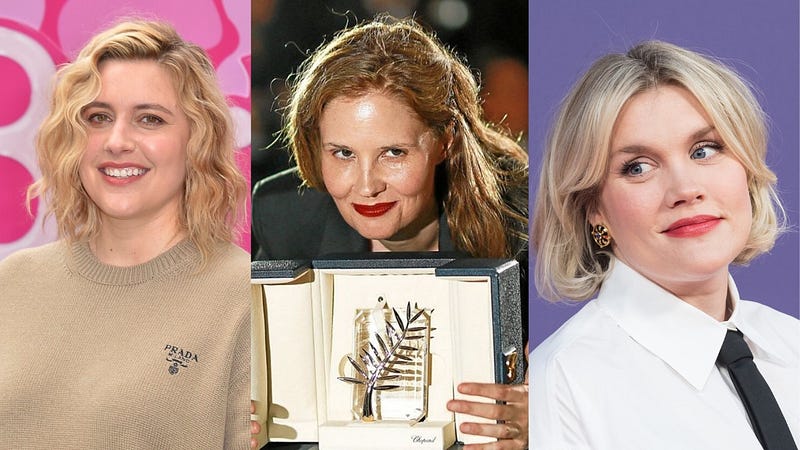
Filmmakers Greta Gerwig, Justine Triet, and Emerald Fennell | Source: AP News, Le Télégramme, and Vanity Fair

Film director Greta Gerwig did not receive a nomination for Best Director at this year’s Academy Awards for her work in Barbie. You might have heard that, as well as the extensive public outrage in response to it, particularly from those leveraging accusations against the Academy for “snubbing” Gerwig simply because she is a woman and the Academy is, apparently, a very sexist institution.

What you might not have heard, however, is how fellow women filmmakers Emerald Fennell and Sofia Coppola have also been “snubbed” by the Academy this year, with neither receiving any nominations at all for their respective works: the psychologically twisted Saltburn and the biographical Priscilla.

What you might also not have heard is how the Academy has a long history of snubbing incredibly talented and deserving women filmmakers, and that — supposed artistic merits aside — Gerwig is, by far, not the first woman in the history of the Oscars to receive such treatment. Just a year ago, actor Danielle Deadwyler voiced her criticism of the Academy’s decision to not include a single nomination for the historical drama Till, which centers on the real-life case of the lynching and murder of 14-year-old Emmett Till. The film was written and directed by the Nigerian-American Chinonye Chukwu and was arguably one of the best and most thought-provoking films of the year. Yet, it received no nominations. Needless to say, the public (and social media in particular) was mostly silent about this “snobbery.”

The Academy has a long history of snubbing incredibly talented and deserving women filmmakers, and Gerwig is, by far, not the first woman in the history of the Oscars to receive such treatment.

Over the 94 years that the Academy of Motion Picture Arts and Sciences has been bestowing annual awards to filmmakers, only three women have ever received the accolade of Best Director: Kathryn Bigelow in 2009, Chloé Zhao in 2020, and Jane Campion in 2021. To be clear, that is a ratio of three to seventy-four, or 4.05%. The number of women filmmakers who have either been “snubbed” or lost to their male counterparts is astounding.

Only three women have ever received an Academy Award for Best Director: Kathryn Bigelow in 2009, Chloé Zhao in 2020, and Jane Campion in 2021.

So, why are we not hearing about this in the news?

Why are the same masses who have been ignoring women filmmakers for years suddenly storming the Internet and calling out the film industry as sexist because Barbie only received 8 Oscar nominations?

Why is Greta Gerwig receiving the amount of public praise and support that, for almost a hundred years, has been — and still is — denied to other women filmmakers?

The answer is simple: Barbie.

I don’t believe I will divide the room by saying that Barbie is by no means the best work that has ever been brought to the screen by a woman filmmaker. Far from it, in fact. Yet the public’s response to Gerwig’s 2023 summer blockbuster was unprecedented — for a woman filmmaker, that is. Gerwig is now the first and only woman filmmaker whose film has grossed over $1 billion at the box office. Similarly, the general outrage at the news of Gerwig not making it among the 2024 nominées for Best Director was telluric in range and fiery in tone.

The reason why Gerwig is the only woman filmmaker in history to have gained such wide commercial acclaim is the same as why Barbie was so successful in the first place: the movie might not have been a great artistic achievement, but it was a pop culture phenomenon, boosted by the pop culture icon that Barbie the doll is, a toy manufactured by a company currently worth over $6 billion.

The marketing campaign behind Barbie is estimated to have ranged around $150 million, which the New York Times reports to be well over the film’s production budget of $145 million. By contrast, the 2008 The Hurt Locker, which marked the first time a woman ever received an Academy Award for Best Director (Kathryn Bigelow), is estimated to have cost only $12 million in marketing and yielded a total of only $49 million at the box office.

The unprecedented — again, for a woman filmmaker — commercial success of Barbie is proof of the fact that the general public can and will support women filmmakers when it wants to. The only problem is that most of the time, it simply doesn’t want to or can’t be bothered to do so unless we’re talking about a big summer blockbuster based on a multi-billion dollar toy.

The general public can and will support women filmmakers when it wants to. The only problem is that, most of the time, it simply doesn’t want to or can’t be bothered to do so.

Indeed, many of Barbie’s apologists who proudly define themselves as feminists (particularly women) seem oblivious to the fact that French filmmaker Justine Triet did receive a nomination as Best Director for her film Anatomy of a Fall, the same film that won the prestigious Palme d’Or at the 2023 Cannes Film Festival, a film that I would assume most Barbie aficionados have not seen or have no interest in seeing, in the same way that they did not see or had no interest in seeing other films directed by women filmmakers in 2023, despite their universal cries for more female inclusion during award season.

And while many argue that Gerwig’s success is a win for women filmmakers, many fail to notice the underlying hypocrisy in such a selective success. Is Gerwig being praised and uplifted for her genuine talent as a filmmaker and storyteller, or simply (and exclusively) for Barbie? If she is being genuinely celebrated for the filmmaker that she is, then why is nobody talking about her previous films? Can anybody even name her previous films? As it turns out, some can’t. I recently had a conversation with a friend who was objecting to my criticism of Barbie and of the general cultural hype surrounding Gerwig. “She’s a great filmmaker,” they remarked. “Really?” I inquired, “What other movies that she’s made have you seen?” I was met with an awkward silence.

While Gerwig is a great filmmaker, she is not the one who’s truly being uplifted or celebrated in this entire phenomenon. What is being celebrated is a hot pink summer blockbuster that is mistakenly being perceived as a cinematic masterclass in feminism by those who have a very shallow understanding of both cinema and feminism, as well as the works of women filmmakers.

If the public wants more inclusion and less sexist practices in the film industry, it needs to support all women filmmakers, and not just the one who happened to direct Barbie.

Want to keep reading? Check out these similar stories:

If you enjoyed this story, please consider showing your support and appreciation to the author by buying them a coffee!

Cinema
Film
Barbie
Greta Gerwig
Feminism
Recommended from ReadMedium