We will face a full-blown international economic crisis soon — here is how you prepare for it
In this post, I reflect on the impending economic crisis that looms over us. Young individuals are among the most vulnerable in such a case of an international economic crisis. What can we do as individuals to prepare for an economic crisis? How can we cope with volatility and uncertainty? I argue that we should establish our own game of asset creation for the long term.
This post is a continuation of my journey of creating a doodle magazine. It continues from my last five posts, which you can find here, here, here, here, and here. I will continue creating Fahri’s Doodles magazine — despite all the challenges and constraints I currently face in my day job. This next section of my magazine will perhaps be called “Living Resourcefully”. The title of this post also could be: “Fahri’s Doodles — Part 6: Living Resourcefully”. However, the impending risk of an economic crisis prompted me to change the title and the direction of my journey. In this post, I will focus on possible strategies for young professionals or new graduates to cope with such a crisis.

A tough, tough job market: You need persistence, resilience, and resourcefulness
Graduates nowadays face a challenging and changing labor market. It is a perfect storm out there. We hear sobering news about the labor market almost every week. Our labour markets can no longer be counted on for delivering prosperity and prospects for a good life or secure employment. Nowadays, it is harder and harder to find a good job for successful graduates. Even those with good masters degrees face the risk of unemployment for months before they find a good opportunity. Youth unemployment is already more than double of adult unemployment. Although we are not yet experiencing an economic crisis worldwide, austerity already dominates the main discourse, limiting opportunities for young people and leading to intensified competition for existing jobs.
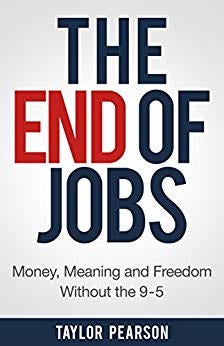
Advanced university degrees, unfortunately, do not ensure employability anymore. They have become abundant and less valuable. The number of high-quality graduates has skyrocketed, yet the number of jobs available is going down. Taylor Pearson has written a best-seller book about this phenomenon: The End of Jobs.
The job markets are also becoming less regulated — it is easier for companies to hire and fire employees. The contracts become shorter and shorter. In fact, ‘zero hour contracts’ have already become the new reality. This means employees of today are more insecure than ever in their financial and economic positions. The middle class is in decline — employees work harder than ever, yet they earn less. The wages are in decline. The career ladder is broken. Job security is largely gone.
The crisis is on the horizon: What can you do?
As the trade wars between the US and China get worse, we are closer than ever to a risk of a full blown international economic crisis.
We know economic expansion and growth will not continue indefinitely, and we are going through cycles. It seems the cycles have now turned downward — tough times might be ahead of us.
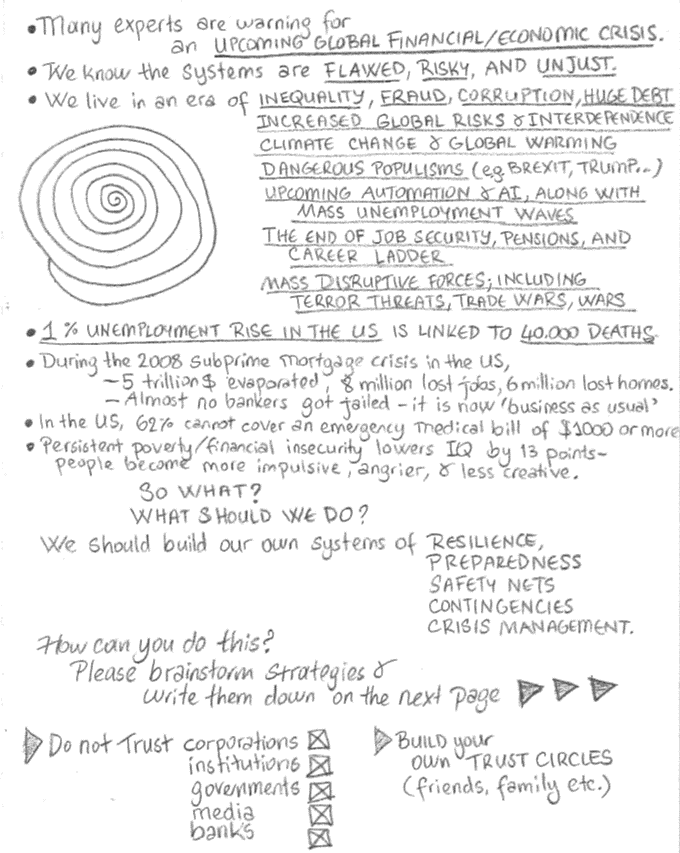
Unfortunately, the signs over the horizon are worrisome. I do not have faith in the international economic system — it is not sustainable and it is built on inequality. Personally, I am expecting a full-blown economic crisis soon.
Whether a crisis occurs or not, it is always a good idea to prepare ourselves for a crisis.
So, how do we cope then?
We need to increase our anti-fragility to minimize the impact of a financial crisis on our personal lives.
First, use this as an opportunity to reinvent yourself. Focus on re-designing and improving your life and your career. Sharpen your skills and expand your knowledge. Read new books, listen to podcasts, keep a diary, create lots of ideas, and follow up on your curiosities and hobbies. Pursue new experiences and incorporate adventure into your life. To live an extraordinary life, you need to avoid mediocrity. Design yourself new challenges every day — these might be physical, mental, creative, emotional, or spiritual challenges. Take stock, learn, pivot, act, experiment, and improve.
Some of the most successful leaders or investors — as well as innovative start-ups — emerged during periods of economic crises. Perhaps this is a good time to change your habits and make a better version of yourself. You can develop more frugal habits, learn and experiment with new life and work skills, and finish MOOCs in your fields of interest. Volunteer for your local organizations. Attend free courses, seminars, and conferences that are available on the Internet or in your city. Do not lose faith in yourself. Remember - if it does not kill you, it will make you stronger.
Second, start saving more. Pay down your debts — in particular, your credit card debt — as much as you can. The more you can avoid interest charges or late fees, the better. Try to put aside some liquid savings or emergency fund that you want to keep for the rainy days ahead. Pay attention to your budget. Make sure you closely look at your bank account and analyse your income and the details of your spending and costs — study them item by item. Can you cut your costs? Can you minimize some of your monthly bills? Can you cancel some of your subscriptions? Where can you save more? Can you cook at home? Can you make coffee at home instead of buying it outside? Can you cut back on entertainment and travel? Identify some action points and implement them. Start saving more each day and keep track of your savings. Make frugality a habit.
Third, try to diversify your streams of income. Brainstorm on possible ways of earning extra income. Can you get a second job? Can you do part-time? Can you do online freelance work? Can you try online teaching or mentoring? Can you sell your possessions that you no longer use? Can you do Uber or Airbnb?
Please look at the strategies and ideas below. Please choose the top 7 strategies you will implement from the list below.
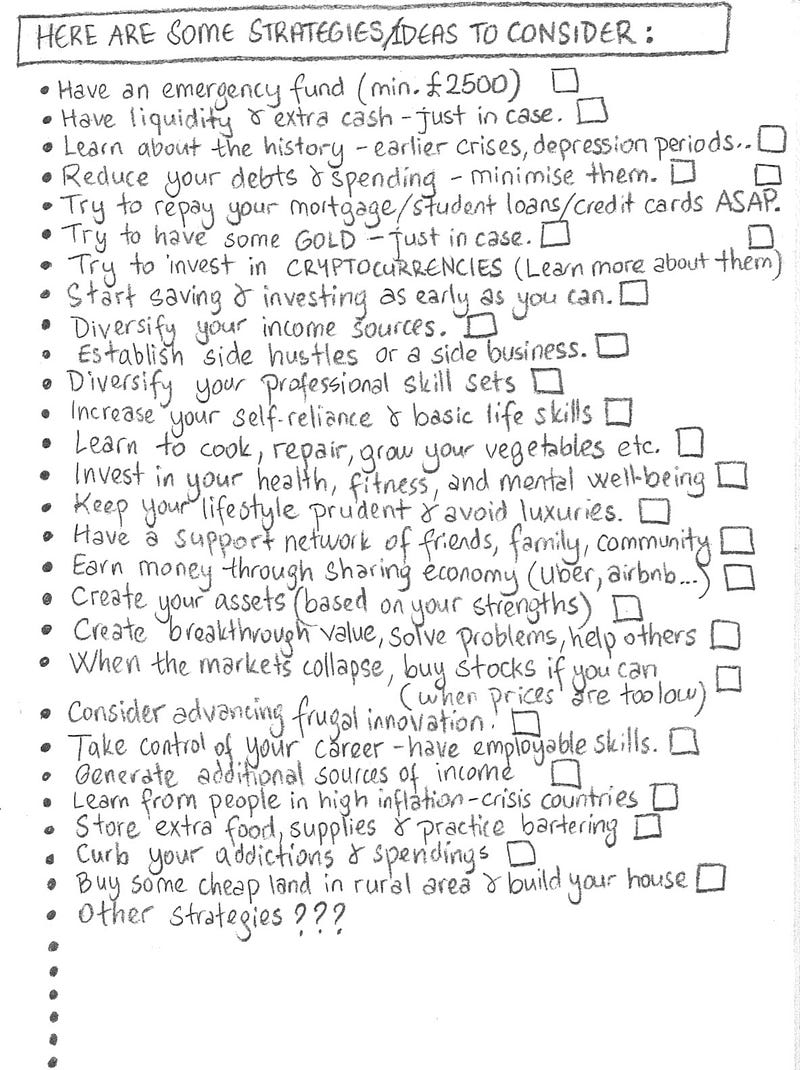
You can embrace uncertainty by being more resourceful and strategic. The more you become prepared, the easier you will get over difficult times. So, you need to think and act like an entrepreneur. Entrepreneurs are extremely resilient, resourceful, and creative. How can you improve these qualities in your life?
Now, I want you to continue brainstorming and produce more ideas.
The more ideas you can come up with, the better.
The more specific and detailed you can make your actions, the better.
You can use the worksheet below or start a fresh page on your diary.
Now, look back at your lists.
Which ideas and actions look sustainable, achievable, practical, and clever?
Please go deeper and expand on these ideas. Come up with a list of practical action points. Rank these action points and assign timeframes for them.
What will you be doing starting today?
What will you be doing this week?
What will you be doing over the next 10 weeks?
Create a roadmap and a strategy.
Think Big and Act Big: Establish your Own Game
We live in an uncertain and unpredictable world. This is not going to change any time soon. We simply do not know how the future will turn out. The best way to predict the future is to create it ourselves.
To create the future that you want and to avoid becoming vulnerable, you need to establish your own game instead of playing the game of others. This means you need to create your own assets for the long term.
The times of crisis might provide you the ultimate opportunity to make a creative and an entrepreneurial jumpstart. You could tap into your curiosities and hobbies to enrich your life. You could use your passion to create assets for your future. As the gig economy or freelance work is booming, you can tap into this economy and engage in some side hustles which will bring you additional sources of income. You can design unique Airbnb experiences in your city, host people, and share your passions with them. The possibilities are endless.
You can also experiment with entrepreneurship even if you do not have any capital. Nowadays, you can become an entrepreneur if you have a laptop, a mobile, and an Internet connection. See the book titled “The $100 Startup” to explore more. The idea is to discover your strengths and reflect on your ambitions. Discover a need in the market or a problem that you want to solve. Learn from the best entrepreneurs in your field or in related fields (read their books, watch their videos, or listen to their interviews). Invest in your learning and development every day. After you craft a promising idea that you are passionate about, you take action and go forward. Quick and dirty action is always better than perfect planning — you will learn your craft along the way. Make sure you carve out time in your schedule to build your systems, products, or assets. Focus on one asset or product at a time. See how it works and improvise as necessary. Along the way, you might as well fail and learn from your failures. Any creator fails every now and then. You need to bounce back and get back to work. You will expect immediate results. Remember that you are playing a long term game. The name of the game is asset creation. You need to be working consistently — every day if possible — to create your assets.
I am not the first person to give this advice. Mark McGuinness has an excellent post on why you should forget the career ladder and start creating assets. It is
Let’s summarize the main messages of this post again:
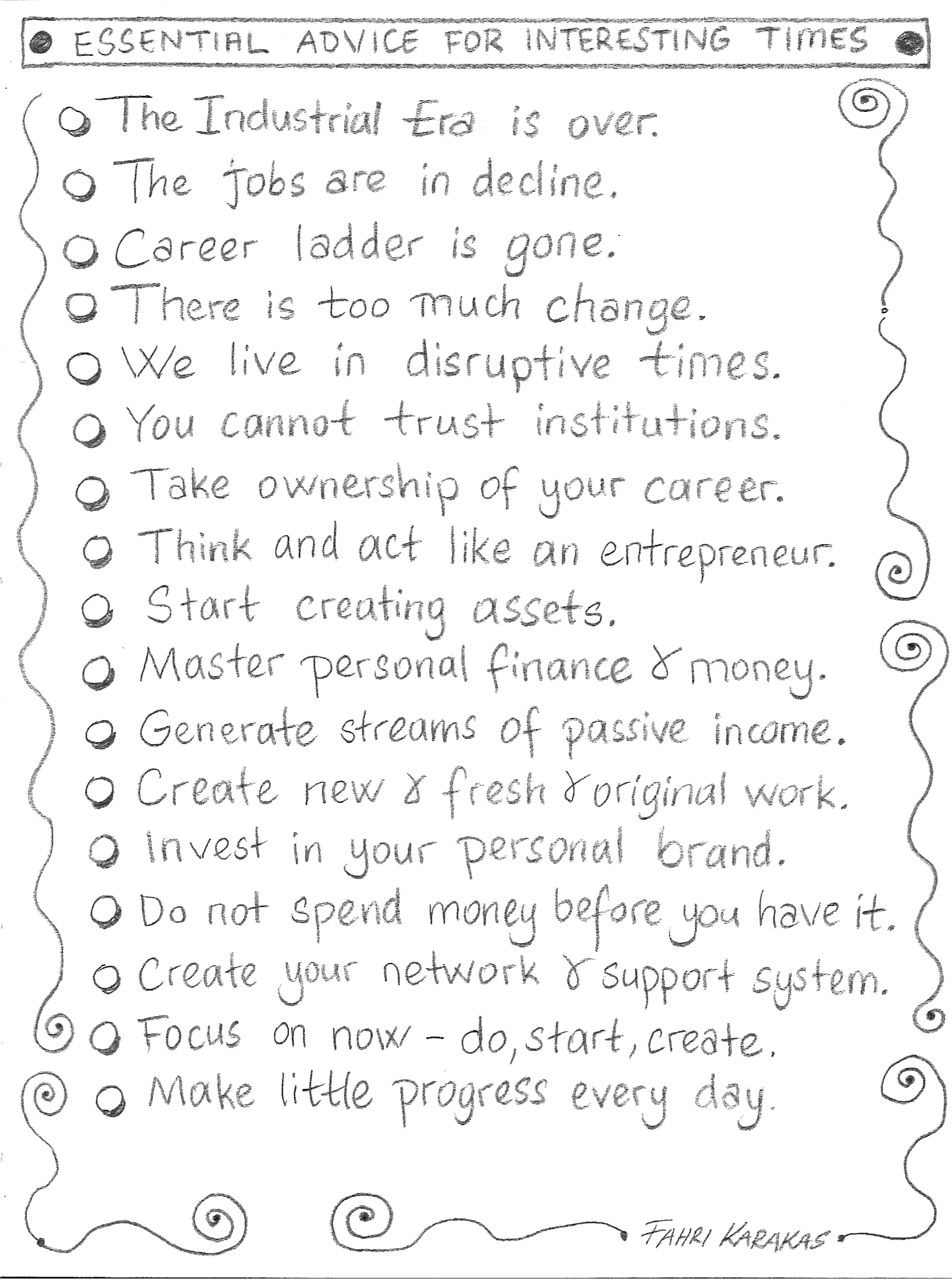
Please work on creating your 20 ideas and identifying your 10 small actions for going forward.
Asset creation is the name of the game you should be playing
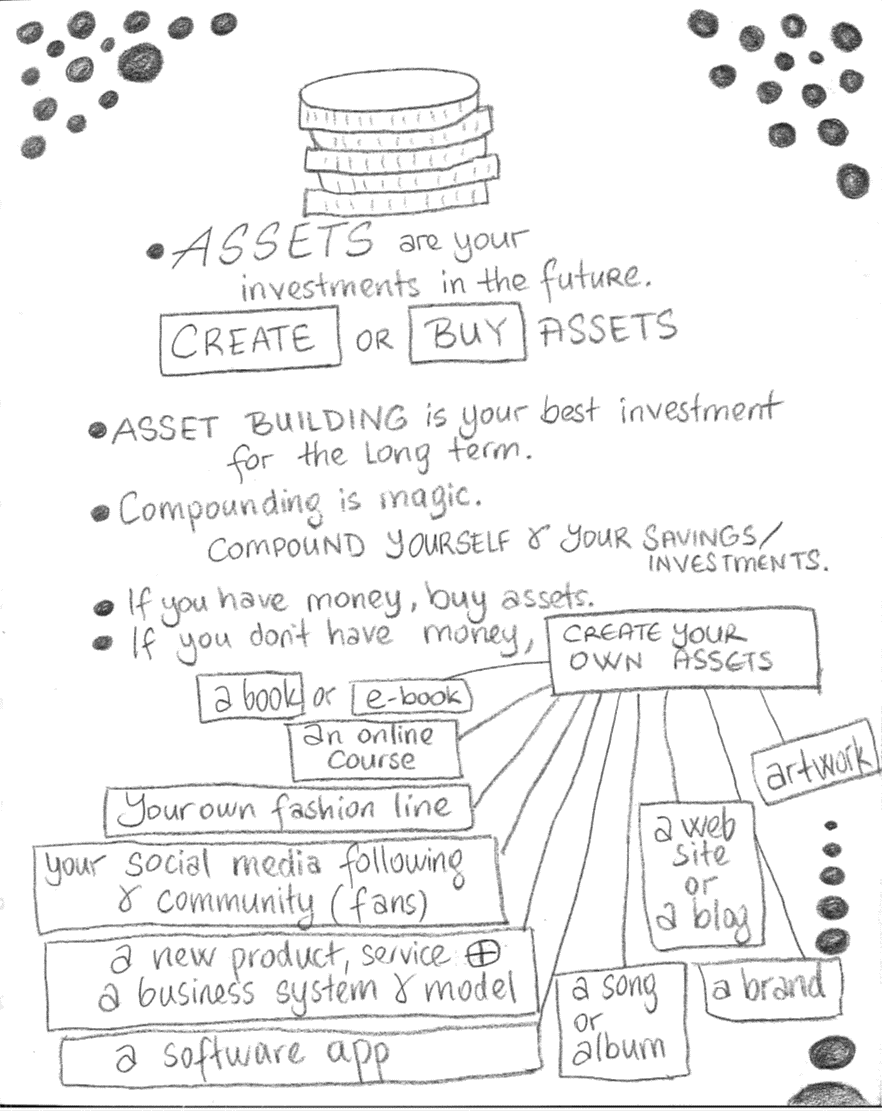
Would you like to create your own rap song? Your own lifestyle brand? Your own app? Your own crime novel? Your own podcast? Your own YouTube channel? Your own blog? Your own product or service or business?
Please come up with at least 20 different ideas.
Although your initial reaction to an emerging economic crisis might be to play it more safely, I suggest that you take bolder actions towards entrepreneurship and value creation.
The moments of crisis are also moments of opportunities. It all depends on how you frame it. You need to have a mentality of abundance and resourcefulness. Instead of focusing on ‘austerity’, focus on how you will solve tough problems using your creativity, intelligence, and talents. Provide yourself more opportunities for adventure, excitement, flow, and ambition.
If you focus on how you can help and add value to the lives of the most number of people, you will thrive in the long term. You have the opportunity to change the world, add value, and build wealth if you play the long term game. If you have ideas that could contribute to the solution of any wicked problem — such as inequality or climate emergency — you can implement and scale these ideas exponentially. You can access revolutionary technologies, collective intelligence, and interdisciplinary perspectives to design your solutions at this day and age. You can even shoot your ideas over the moon. There is no limit.
What will you create?
How will you build your assets and relationships?
How will you create breakthrough value?
How will you contribute to the lives of other people?
Fahri Karakas is the author of Self-making Studio. You can explore more here.