
We need to pop our bubble — a guide to find freedom online
Have you ever felt stuck? Like they are no more good ideas.
I mean, you know that there is more, but YouTube doesn’t show it to you.
It’s a symptom of what I call the algorithm bubble.
The algorithm bubble happens in the parts of your digital environment that are controlled by algorithms. And it manifests itself when the algorithm is only serving you with a specific type of content.
Here’s how are typical social media algorithm works:
- It serves you random-ish content
- It looks at what it is you click on and interact with
- And it serves you more content like the one of what you interact with
This is excellent, because it means, theoretically at least, that you don’t have to swim through the mass of content that exists online to get to the stuff you really want to see.
In theory, you only have to open the app. And boom. You are served with what you prefer.
In practice, it’s a bubble prison.
Because if your feed is invaded by the same content. Over and over again. The algorithm is going to keep serving you with the same content. It might even get more specific in time. To the point where every video you watch is but a clone of the last one.
This is just one of the many problems that arises from this algorithm system.
Being who we are, humans are quite bad at diversity. We end up, often without realizing it, stuck in a corner of the internet, with an algorithm that serves us stuff we want to see.
It might be cute videos of pets. It might be productivity tips. It might be scientific conferences. It might be extreme political or religious rambles.
This regurgitation is not good for us.
We need to pop our bubbles.
I do not pretend to know how algorithms really work, technically. It’s more complex that I can grasp right now.
I hope there are technical solutions being build. Technical solutions that would bring a bit of genuine serendipity in our digital environments.
In the meantime, though, the solutions I have to offer are manual. They require you to be in charge. They require a minimum of self-discipline. And they need to become habits, rather than something you do once and forget about.
Push and Pull.
I like to divide my bubble popping techniques into two buckets: PUSH and PULL.
We’re going to push stuff away. And pull stuff towards us.
So instead of making our homes into a specific bubble, and consuming only from this bubble, we travel from one to another, building a unique path.
Pushing Techniques — or how to re-centre your algorithmic environment
If we are to become masters of algorithms, we need to speak their language.
Algorithms understand three things:
- What you usually click and interact with
- What you recently clicked and interacted with
- What people like you usually click and interact with (ie. people who consume the same content as you)
We have very little control over other people, would they be like us or not. So we’re going to focus on our behaviour.
Here are the actions that matter the most, in order of importance:
- Refraining from clicking
- Using the ‘not interested’ button
- Cleaning up your history
- Following and unfollowing easily
I cannot stress enough the importance of the click.
Once you click on a puppy video, I can almost guarantee that 25% of your feed will be dedicated to puppy videos. If this is what you want to use social media for, perfect! But if it’s not, and that, like me, you find it almost irresistible to know why this good boy adopted a litter of kitties… but that you really have better things to do… then it’s not a good thing.
If, by mistake, or because one day you were tired, and you allowed yourself a couple of hours of cuteness, you did click on a video. And that now, it’s a complete distraction-invasion… Use the ‘not interested’ button.
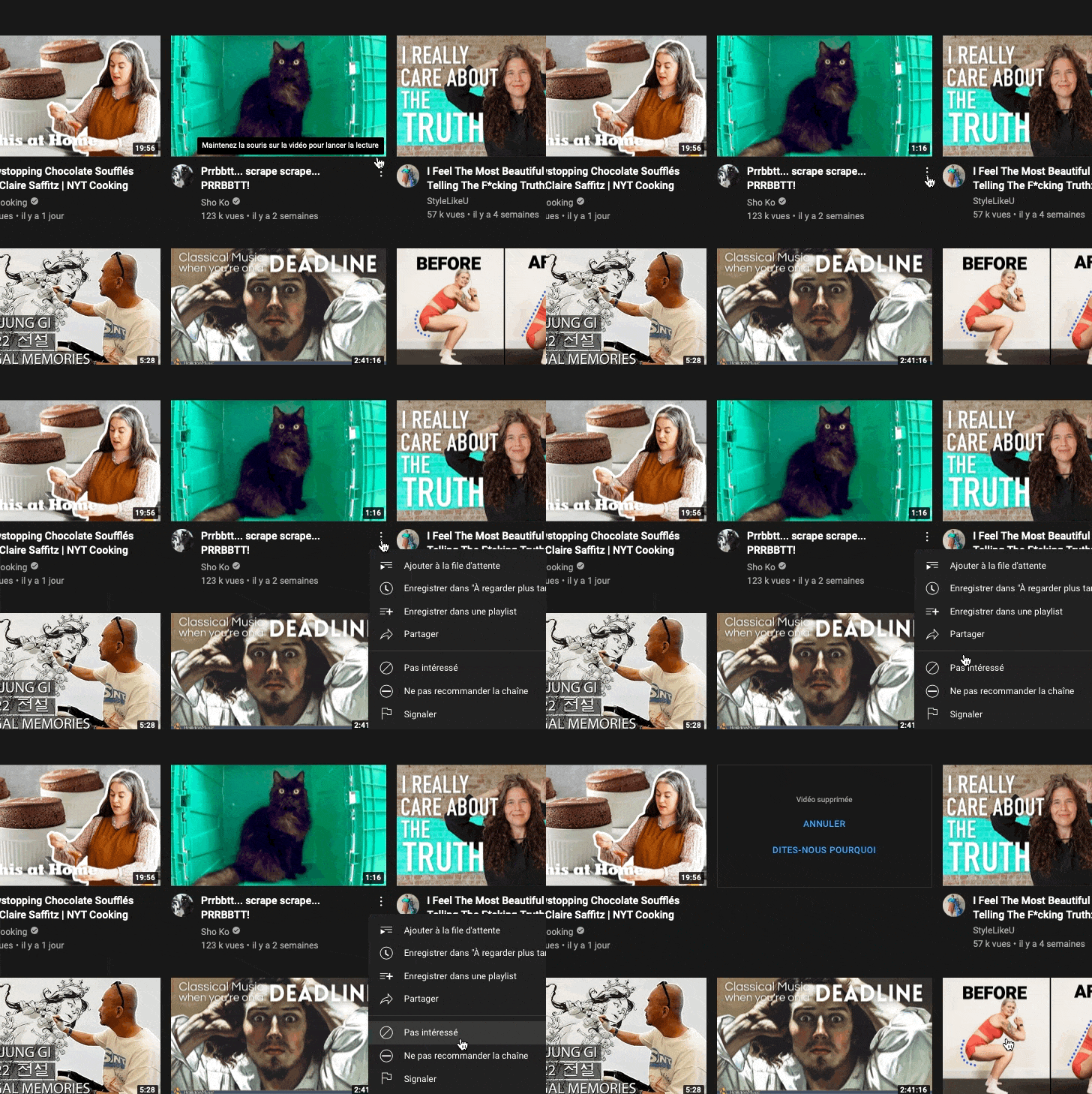
You might have to do this a couple of times, to clean up your feed entirely.
Alternatively, you can also use the ‘Do not recommend this channel’, to get rid of entire channels from your feed.
Another very effective technique is to clean up your history.
I don’t necessarily recommend to completely delete it, it is useful to keep track of what you watch, so you can find it again easily. But have a look there, and see if what you are actually watching is a reflection of what you want your feed to show you.
The YouTube mobile app is especially sneaky. Because videos are playing from your feed, they end up in your history. It counts as a click!
Finally, don’t be shy, follow and unfollow as your interest change and grow.
This is might not have an enormous impact on your feed, but it will keep your subscription feed focussed on what YOU want. And even if it does kind of hurt to see your numbers go down as a creator, it shouldn’t become your problem.
Pulling techniques — or how to increase your serendipity potential
Pushing is good, but we also want to attract certain types of content to us.
Some bubbles are stronger than others. The puppy bubble is ultra-contagious, I’m guessing because it’s a subtle combination of an abundance of this type of content, the easy distraction it gives, and our human need for cuteness.
So, depending on the bubble you are trying to attract, you’re going to need to put more work.
These are the actions that move the needle:
- Clicking on what you want to see more of
- Asking people what they are watching and consuming the content they recommend
- Using search more often
- Trying out a new content source
- Starting from scratch again
Yes, what you actually click on and interact with is still the most important thing you can do. What I want is to encourage the algorithm to show me interesting things. And so every time it does give me a glimpse of a new bubble, I click.
But, mostly, what you need to do to attract new content to you, is to by-pass the algorithm. Finding other ways to get exposed to new content.
Like actual people.
Asking my friends, and people I meet in general, what it is they are consuming and like at the moment is not only a great way to get to know them better, and a fantastic conversation topic; but also a way for you to discover new things. Things you don’t even know exist yet.
But you can also use another algorithm : the search one.
I like searching for topics by entering keywords I’ve recently learned. It’s like opening doors to new bubble.
It’s also quite interesting to see that the channels which come up in search are not the same from the ones that pop up on your feed.
Or you can start using a new content source all-together.
When I started using Medium for example, I was exposed to new ideas.
Or, if really you need a complete refresh, you can always start from scratch again, by creating a new account.
It’s a bit extreme, and it requires a lot of teaching. But hey, it works too.
Keep in mind
This is all good to do right now, but it is something you should keep doing as you grow. Because what interest you today, is not what will interest you tomorrow. Nor should it be.
So instead of strict teaching tools, those should be used for flexibility. Making the algorithm work for you.
And if you want to take this to another level entirely, I recommend you start using more non-algorithmic sources.Such as Wikipedia.
Where you get to start somewhere, and follow your interest, one hyperlink after another.
If you enjoyed this story, you will enjoy:


