
Why you should learn useless things
« — I don’t put useless things inside my mind. I don’t want to know anything that won’t help me in the near future. »
When he said that, at first, it shocked me. Then I remembered that I was quite fond of this dialogue between Watson and Sherlock in Arthur Conan Doyle’s A Study in Pink.
Upon realizing that Holmes is not familiar with the Solar System, Watson cannot contain his surprise. And so Holmes replies:
“I consider that a man’s brain originally is like a little empty attic, and you have to stock it with such furniture as you choose. A fool takes in all the lumber of every sort that he comes across, so that the knowledge which might be useful to him gets crowded out, or at best is jumbled up with a lot of other things, so that he has a difficulty in laying his hands upon it. Now the skilful workman is very careful indeed as to what he takes into his brain-attic. He will have nothing but the tools which may help him in doing his work, but of these he has a large assortment, and all in the most perfect order. It is a mistake to think that that little room has elastic walls and can distend to any extent. Depend upon it there comes a time when for every addition of knowledge you forget something that you knew before. It is of the highest importance, therefore, not to have useless facts elbowing out the useful ones.”
“But the Solar System!” [Dr. Watson] protested.
“What of the deuce is it to me?” he interrupted impatiently: “you say that we go round the sun. If we went round the moon it would not make a pennyworth of difference to me or to my work.”
Soooooo… Should we, or should we not, learn useless things? That’s the question I’ve been pondering this past week. And it’s an important one, because depending on where you stand, you’re going to spend your time differently.
There is a practical case for purely action-driven learning
When it comes to language learning, for example, knowing just the minimum tends to make speaking much easier. Because, as Sherlock argued, your attic is not crowded by every grammatical details. And, at least at first, not being aware of your mistakes makes you less self-conscious. Which truly helps to speak.
And this example is transferable to a bunch of other situations:
- When you’re starting a business
- When you’re learning to play an instrument
- …
Knowing ‘just enough’ to take action seems like a good idea. And so I would agree.
But then it’s not all about taking action, is it?
The reason why there is a case for this approach in the first place is because our ‘Unconscious Incompetence’ makes us susceptible to the Dunning-Kruger Effect. In other words, we don’t know what we don’t know. And that makes us foolishly confident.
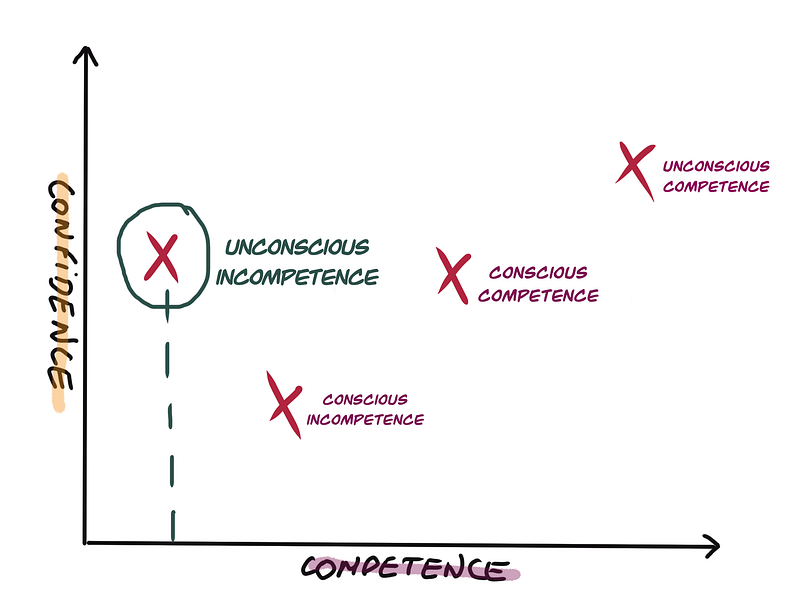
But this effect doesn’t make us competent, and it certainly doesn’t last either. It’s just a nice initial boost.
For serious learning, more knowledge is always better.
There is a bigger case for curiosity and diversification
We can even call it a multi-layered case with buttercream on top. And that’s a very yummy cake.
1. Our ‘unconscious incompetence’ makes us blind.
Not knowing what we don’t know might give us a boost. But it also makes us blind to what we have to do in order to progress.
Going wide in our learning is going to reduce our blindness.
2. Our brains need intellectual food.
The more we learn, the easier it becomes to learn. It’s like a workout.
No matter the material.
3. It’s easier to add new connections when there is already an established net
The more we learn, the easier it becomes to learn. Not just because our brains are getting stronger, but because we simply just know more stuff.
Memorization and new connections are easier to make when we can link the new information to something we already know.
4. There is no such thing as ‘Useless knowledge’
Knowledge is context. What might be useful in a given situation will be totally irrelevant in the next.
And we can’t quite plan exactly what kinds of situations we will end up in.
5. The more you know, the more confident you become
I believe confidence is linked with learning. After all, we feel confident when we KNOW what to do, or what to say, or how to react…
Actually, I believe confidence is relative, expanding and accelerating. Meaning it starts in a specific field (I feel confident doing this), it can bleed into other areas (This is not so different from I already know), and it’s accelerating because the more you know, the more it bleeds.
6. This last one might be just me. But this is a kind of person I’d rather be.
Diversified. Curious. The kind of person who feels comfortable asking questions on a butt-load of different topics. The kind of person excited about old forgotten books.
Funny thing, I was writing this article when I read Clive Thompson’s genius introduction to the LOC Serendipity.
That’s who I’ve always wanted to be. And the more I learn, the closer I get to that ideal.
I’d like to finish with a question.
What’s something you know, something that could be considered useless, but that you use at some point of your life?
And by ‘use’ here, I don’t necessarily mean that it changed your life. But maybe, one day, you actually had the answer. Or maybe, simply, like me, one day, it made you understand something weird.
You should read:
Hi, I’m Circé, I’m a French teacher turned creator and I write here about creativity, learning, and systems. Every week, I also share gem nuggets of thinking, writing, and systems in Pépites.


