
Note-taking — The system I’m choosing to follow after years of testing
When I first heard about the idea of a note-taking system, it was from the mouth of a French entrepreneur I greatly admire. And I was in the midst of growing my first business, hunting for the tiniest bit of hack and tip.
I didn’t even think. I copied and pasted the system.
The idea was so elegant. The system so simple.
Keeping trace of every idea in an app, and assigning them tags for later use, so you never have to start from a blank page ever again. Creating a sort of personal Google.
Little did I know, this would only be the beginning of a very long adventure with note-taking systems.
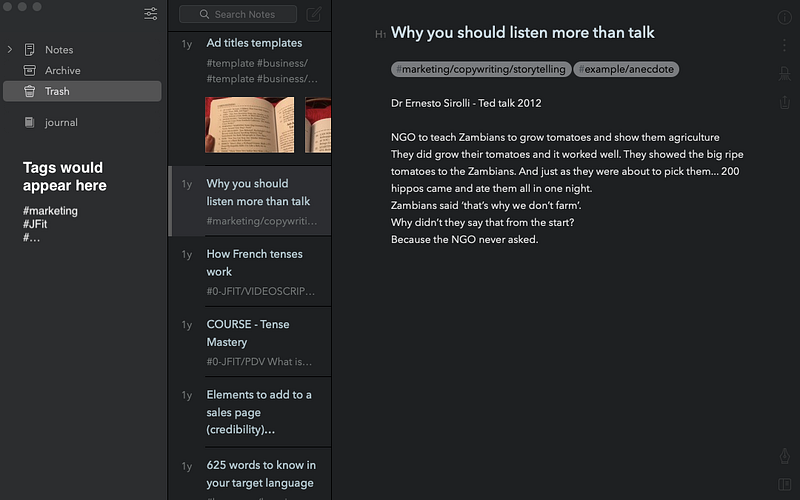
My first system was simple
→ Take notes in Bear. → Stick some tags. → Move on.
So for the next couple of months, every bit of information that came my way, I stored. And I stored a lot.
Stories. Facts. Examples. Ideas. Quotes. Everything I could get my hands on.
A year in, and I had collected about 900 notes. Now, there is a lot of gold in these notes, but there is about ten times as much trash.
My system was grossly overcrowded. I hardly ever used it for anything other than adding new notes.
You see, I had stumble unto my first mistakes:
- Not being selective enough about what to store
- Not thinking about retrieval
- Not using what I have stored for something
The system wasn’t working for me. It was time to change the system.
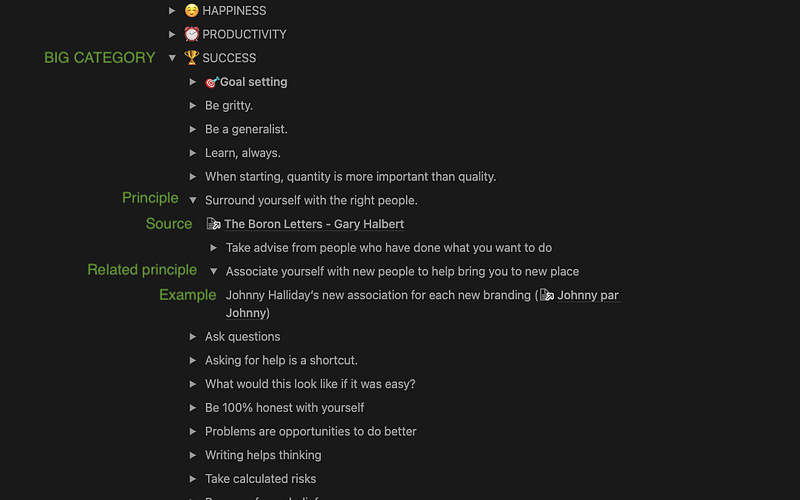
My second system was complex
I did some research. And learned two words:
- Notion
- Second Brain
Fine, technically three.
These keywords unlocked a whole new YouTube bubble. Filled with seemingly smart people talking about complex personal systems.
Most of them mentioned “Zettelkasten”. A word that looked a little bit too much like one I should know from my 10 years of unsuccessful German classes.
But here is the gist of it:
Fleeting notes (taking quick notes) Literature notes (rewriting the notes in your own words) Permanent notes (compiling notes from all your other notes to create truly unique notes you can then use)
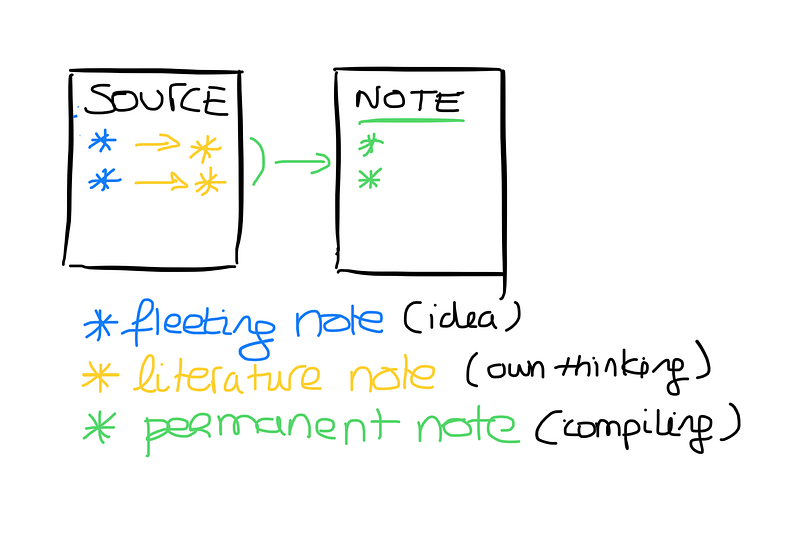
So I did just that.
I would take notes on sources. Re-write those notes with my own words. And then organize the new concepts in what I called the Knowledge Tree.
Everything was linked. Easy to retrieve.
But boy, oh boy, was it a long system. And all the time I was spending reviewing and transforming notes, I wasn’t spending creating anything new.
In fact, I was burning my creative energy on the system.
And here started my era of tests. My goal was to automate and speed up the process.
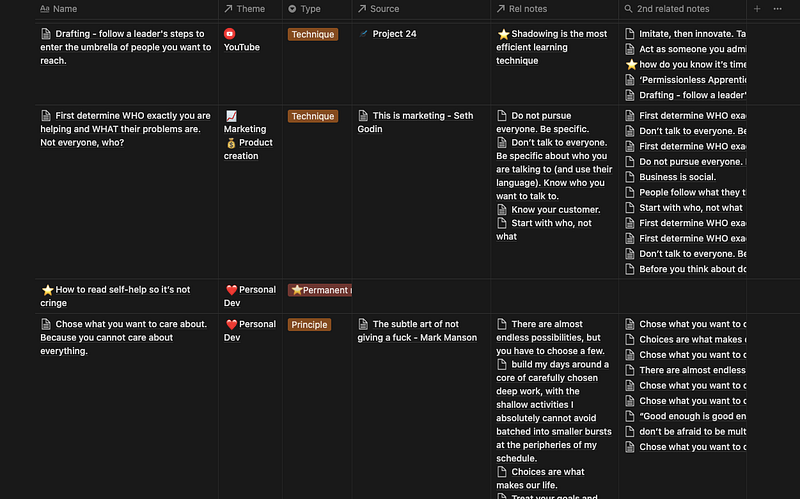
My third system was ever-changing
This is how I came up with, surely, one of the most complex note-taking systems in Notion.
Each note I would take was a single idea, and had about 10 different properties, some of them being:
- A type (quote, fact, principle, idea…)
- A source (automatically added depending on where I added the note from)
- An author (pulled from the source)
- A theme (which was actually used to then compile notes into theme pages)
- Related notes
- 2nd level related notes (the related note of the related notes)
- Status (processed or not processed — this was a complex automated formula)
- Related content (if I was to reference this note into an article or a podcast)
- Random number (to pull a random note)
- …
A note would belong to a source. But also to a theme.
This allowed me to automate the ‘retrieval’ of the process. I had pages that were automatically written with notes on productivity, neatly organized into the type of notes they were.
So I could look at:
- Principles of productivity
- Facts about language learning
- Stories about personal development
- …
Or find weird connections between notes with the 2nd level of related Notes. The concept of ‘Permissionless Apprenticeship’ suddenly became related to this quote from Jazz Musician Clark Terry “Imitate, Assimilate, Innovate”, and concepts about polymathy.
The system itself was complex. The note-taking was easy.
Because I would only have to take the notes, and then assign them the missing properties.
It was Zettlekasten on steroids. A very powerful system. … that I could never seem to stop tweaking.
Adding new types of notes: like questions, and ‘permanent notes’.
With each new tweak, came hours of adjusting and updating of the old notes. And a lot of questions about the type of idea.
‘Is this a principle, or a technique?’ ‘Does that belong to productivity?’ ‘Should I create a new category for this?’
Once again, I was spending a lot of time on the system. And not a lot of time creating.
It feels like a heartbreak. But I’ve spent enough time on this. Time to go back to the basics.
Will system #4 be a winner?
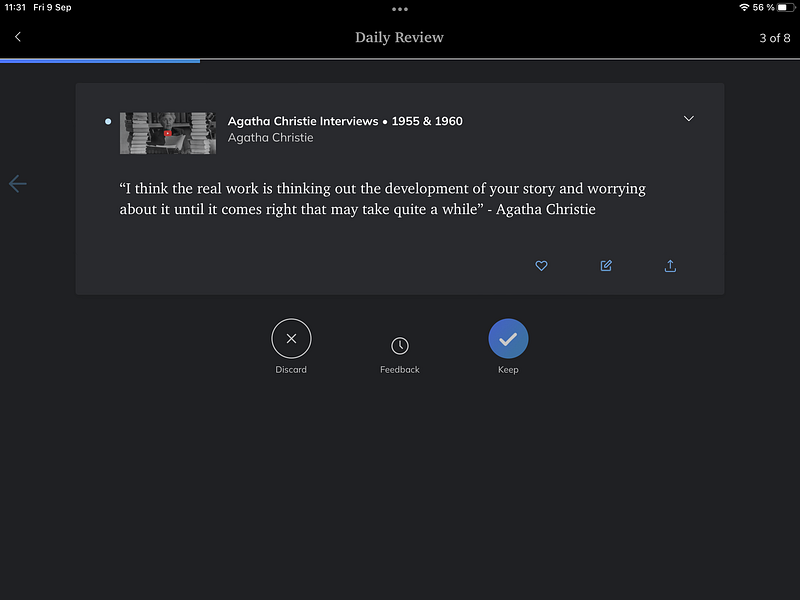
I’ve decided to focus entirely on creation. And I’ve delegated the organization of my sources to Readwise.
Actually it happened after I did this challenge.
My notes are now mostly highlights. Readwise is organizing them in Notion, so I can still reference the sources.
But everything I do from here is with the purpose of action.
If I want to think, I use my journal. And use the Daily Highlights of Readwise to prompt ideas to ponder. And if the thinking is good, I turn the idea into an article, a podcast, a course…
It’s easy to get blinded by the shiny tools. I know something about it. I help entrepreneurs with wonderful tools like Podia, Mailchimp and MailerLite.
And one thing I keep repeating is that ‘it’s not because a functionality exists that you have to use it’.
Clearly, I’m not immune to the shiny object syndrome. I like systems. I like thinking about systems.
So this sort of adventure is likely to happen to me again.
Do I consider all this time frolicking around in Notion to create complex systems a ‘waste of time’?
No. Because I’ve learned a lot.
First in terms of technique. Having a complex project, even one that ends up not working out, is always the best way to learn practical tools. I’ve worked with Notion, Bear and a few other apps.
No amount of watching tutorials on YouTube would have given me this level of mastery.
Then, I’ve learned a lot about note-taking. Which is nothing more than a sub-topic of learning. And learning about learning is always a good thing for… well anyone really… but even more so for a teacher, a writer and a content creator like myself.
I’ve also learned about the complexity of systems. How what can seem like perfection in theory, always comes with a set of issues. What is the price of complexity, even in the backend.
And as if that wasn’t enough, I also met people and ideas which I’m sure will spark new kinds of adventures.
Which you can make sure to follow here!
This article contains affiliate links


