
FOOD
Warm, Creamy Kadhi — Humble and Comforting
A comfort food need not be fancy
I love to write about comfort foods — see here and here. Just my way of exploring exactly what makes something worthy of that label. Sure, a lot of foods are comforting but some foods are just more so. And they come in as many varieties as there are cuisines.
Comfort food doesn’t have to look good. Look at the Koshary photo here. Or that picture of curd rice here (okay, that’s been ‘beautified’ and it doesn’t look anything like what people usually make at home. Who keeps stock of pomegranate seeds for when the hankering for curd rice hits). Consider the humble mac-n-cheese. Comfort galore, but will it win any sexiest-dish-of-the-year awards? Likely not. Unless some celebrity chef decides to deck it all up, comfort food looks, well, rustic, home-style, simple, folksy and all of the above.
And yet, the pictures look yummy. Why? Because we slather that image with oodles of nostalgia, of all those other senses beyond the eyes, of how it made us feel that day when we had it, when it defined comfort for us.
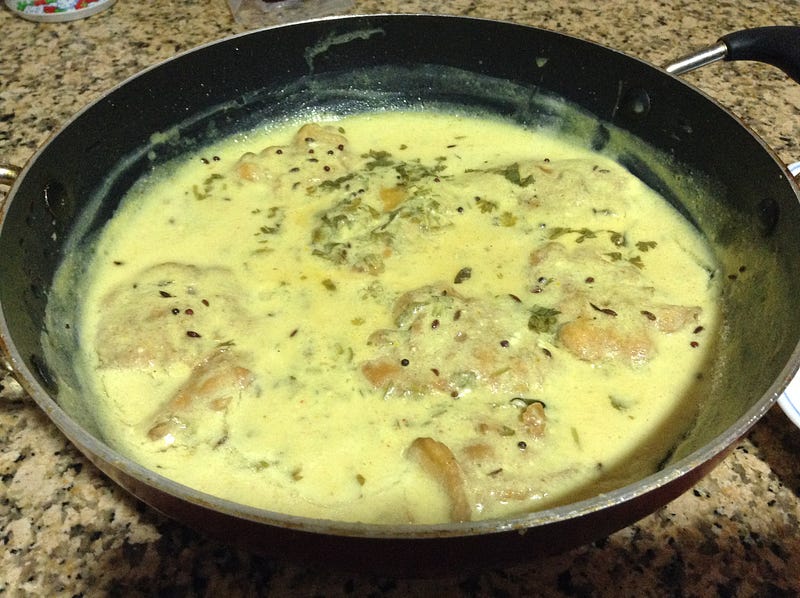
Take that picture up there. It is a pot of kadhi-pakora. A mildly spiced yogurt-based gravy dish, thickened with chickpea flour, with onion fritters (pakoras) dunked in it, soaking up the flavors.
I choose the word ‘gravy’ begrudgingly. Refer to this piece to understand how the English language falls woefully short in its ability to describe Indian foods.
There are as many variants of kadhi as there are regions in India. Kadhi-pakora as described above is typically made up north in Punjab. As you move southwards, to say, Gujarat, the pakoras disappear and the kadhi becomes thinner and sweeter. Further south, say down the coast near Goa, they use kokum as a souring agent and coconut milk as the base. Similarly, the Sindhis in the west do away with the yogurt entirely, using tamarind as the souring agent instead.
Until the 15th century when the barbarians came from Europe casting their avaricious eyes on this land, Indian food did not have tomatoes, potatoes or chilies. Today one cannot imagine Indian cuisine without these, especially North Indian cuisine. Anyone who has had a nice alu-gobhi or butter chicken or chili paneer can attest to the fact that Indian cooks wrought miracles with these new ingredients.
This is what makes me believe that kadhi is a far older dish because the cows have been around much longer, giving gallons of milk, which would very quickly sour into tub-loads of yogurt in the tropics. Which is probably why there are so many regional variations. This dish has had a few more centuries to travel and percolate into each area and be adapted based on local produce, needs and palates.
My first encounters with kadhi were both inside and outside the home. Outside, when we would go to a Gujarati restaurant and order, what else, the thali — that plateful of unlimited delights. And one of the bowls at the periphery of the plate would have the Gujarati kadhi, thin, pale yellow, with cumin seeds floating on the surface and sweet with a slight tang. Inside the home, (I realized later) kadhi would get made whenever we ended up with more yogurt than we could deal with, going sour and fast. That’s when our take on kadhi would happen. No pakoras, but thick, creamy, brighter with the turmeric, lots of cumin and some carom, a couple of slit green chillies, with sliced onions and mushed-up tomatoes for some bulk.
It is a fairly simple preparation. You mix sour yogurt or buttermilk with some chickpea flour, add some spices, bring everything to a low boil and let it all come together. Important to know the ratio of yogurt to the flour. Too much and it will set to pudding consistency. Not enough and it will remain too watery. Neither situation is a disaster that you cannot adjust and come back from. But it just makes it a wee bit more complicated. For spices, I typically use turmeric, red chili and a dash of black pepper in powdered form, with cumin, carom, mustard seeds going in whole. There will be curry leaves as well as cilantro (coriander leaves). If I don’t have the time or the inclination to fry those onion fritters, I will simply sauté some sliced onions and tomatoes to give it a heartier base.
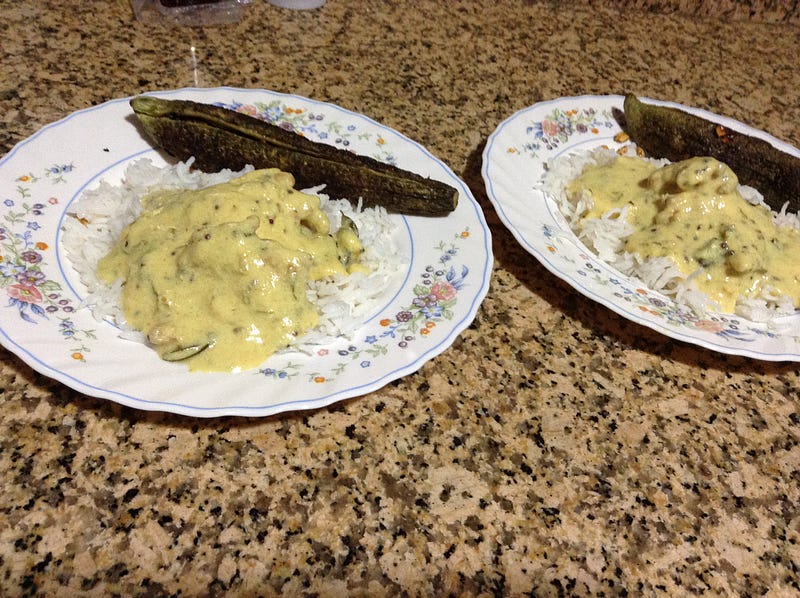
This then is had with a nice amount of steamed rice. You can do basmati if you wish. Of course, you don’t need to, this is comfort food, no need to get all fancy.
When had like this, it becomes ‘kadhi-chawal’, chawal being the Hindi word for rice. You may have made kadhi-pakora, but once you bring rice into the equation the pakoras are outranked and don’t get top billing anymore, even if you treasure them on the plate.
Get in there with your fingers. Gobble up a few mouthfuls. Sit back and let the contentment wash over you. Set aside enough time for a siesta.