
FOOD
There Is No Curry in Indian Food
Blame it on the English language’s inability to find the appropriate words
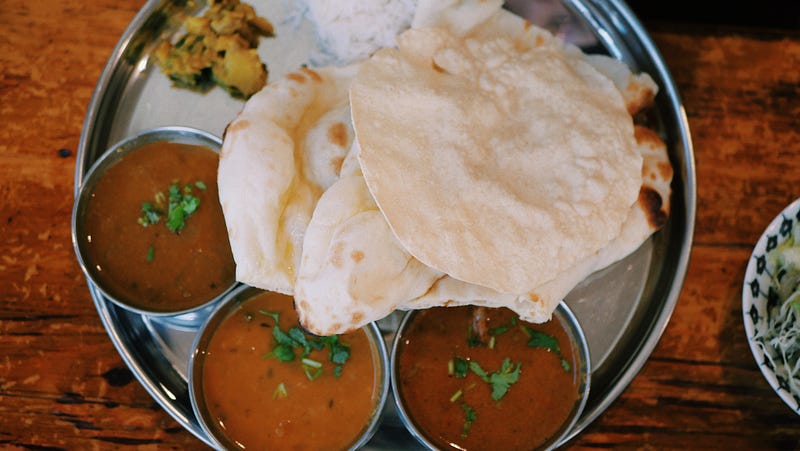
The English culinary vocabulary has a few words to describe a savory dish of liquid consistency. It could be a broth, a stew, a sauce or a gravy. The key point of difference here is the viscosity of the liquid. Other words like soup, chowder, puree and stock help to bridge gaps in the thickness continuum.
When applied to Indian food, all these are usually replaced by a catch-all, curry. And that is where the English language butts headlong into the wall of Indian cuisine only to bounce off impotently. English is left sitting on the ground, cradling its cracked skull in despair. Indian cuisine shrugs and goes about its business.
Let me also note here that labeling the food of 1.4 billion people by an all-encompassing word ‘Indian’ is as asinine as bundling everything from Polish to French to Scottish to Scandinavian foods under ‘European’. But for now, let us leave it as it is. It will change.
Okay. Now let’s go back to this word, curry.
You will not see this word in any Indian restaurant menu. Let me amend that. In any self-respecting Indian restaurant menu.
Because nobody in India consumes curry. It does not exist.
Now, lest you take this as a challenge and try to bring up some obscure menus with a listing of curries, let me add a caveat. If the word ‘curry’ exists in a menu, especially as the heading of a list of dishes, this restaurant is, in order of likelihood, a Thai restaurant, a British restaurant trying to show off their international-ness, or a quasi-Indian restaurant trying to pander to a Brit diner.
What happened is this.
When the first Europeans came over — ostensibly to trade in spices but eventually to plunder — they had no available words in their lexicon to deal with the wondrous variety of flavors they encountered.
So they picked up a 2-syllable word (as much as they could handle without wilting) from one of the many languages they overheard, as this word seemed to be mentioned a lot around food.
They may not have even realized that people were speaking to them in different languages — it was probably all ‘Indian’ to them.
This word is typically rendered in English as ‘kari’. In Tamil, this word can mean charcoal or black pepper — and in some contexts — meat, differentiated only in how the letter ‘R’ is pronounced.
You can see how this word might have been heard repeatedly in kitchens and led the foreign gawkers to believe that it was all the same word and referred to whatever the chef was preparing at the time.
For Western cuisines that use bread as their main carb source, the Indian (and other Asian) usage of rice itself is a step into the void. (Sure, Texans may stuff rice into a burrito. But this usage leaves the Indian scratching his head — they are putting chawal into a roti??)
Then they encounter the various dishes that Indians use to mix the rice with.
Let us take the common dal. Dal is usually described in English as lentil soup. But no Indian will slurp on dal from a bowl, on its own, like they would do all points west of the Arabian Sea. The Indian will instead pour the dal onto his rice, mash it nicely into a homogenous mass and gobble little balls of it, all the while not using anything but his fingertips. This is no less fascinating to the western audience than watching a turbaned, half-naked boy climbing up a standing rope and disappearing.
When the meal moves to other dishes like sambhar and kadhi flanked by other, chunkier dishes like chhole and rajma, the hapless observer is completely flummoxed. Let us call this person Joe. “They then proceeded to dip their flatbread into a chickpea stew,” Joe describes to his native audience listening in rapt fascination. Or that “they poured the dark gravy over rice, used their fingertips to mix the two well, and ate little balls of the rice-and-gravy mixture, now and then reaching out for a bite of the lentil crisp”.
In this world, sambhar is a sauce or gravy, while rasam would be a broth. Take a look at Wikipedia’s definition of sambhar. “…a lentil-based vegetable stew or chowder based on a broth made with tamarind.” Clearly, the writer is hoping that stitching multiple patches will cover up the gaps in the language fabric.
A typical Tamilian meal will serve the rasam course after the sambhar course. The idea of having a course of sauce followed by a broth would feel excessive and convoluted to Joe. Because, in Western meals, the liquids get thicker and thicker as the meal progresses — soup hands over to sauce which gives in to gravy.
Dessert is manageable as long as it is restricted to gulab jamuns (fried dough of milk solids soaked in rose-flavored sugar syrup) or kulfi (traditional Indian ice-cream, usually served in a clay pot). When it gets to kheer and payasam, the language gives up and walks off in a huff.
‘Pudding’ may just about work for thicker dishes like phirni but trying to force-fit the word onto that cup of semiya payasam takes a toll.
But I foresee change.
The English-speaking world (and I refer to those that only speak the one language) is slowly waking up to the delights of Indian food.
Some are already exploring worlds beyond saag, tikka masala and vindaloo. And when I typed this, the proofing tool allowed tikka, masala, and vindaloo without the red squiggly underlines. It didn’t let saag through though. I still count this as progress. It gives me hope that the day is not far when words like dal and sambhar and kadhi will obtain entry into the English language party.
They may end up walking into the ballroom as they are, head held high, oozing exotic charm, like a director of best foreign film at the Oscars after-party. Think ‘Biryani’.
Or they may need to go through an extreme makeover, poured into a lacy, cocktail dress and decked with a spiky, orange wig, to try and fit into local sensibilities. Like ‘khichdi’ mutating into ‘kedgeree’.
Or they could become a plus-one and sashay in on the arms of a familiar who is ‘on the list’. Like ‘naan’ bread and ‘chai’ tea.


