
Food
The Comfort of Curd-Rice
This simple dish that ends many a South Indian meal and is the epitome of comfort food
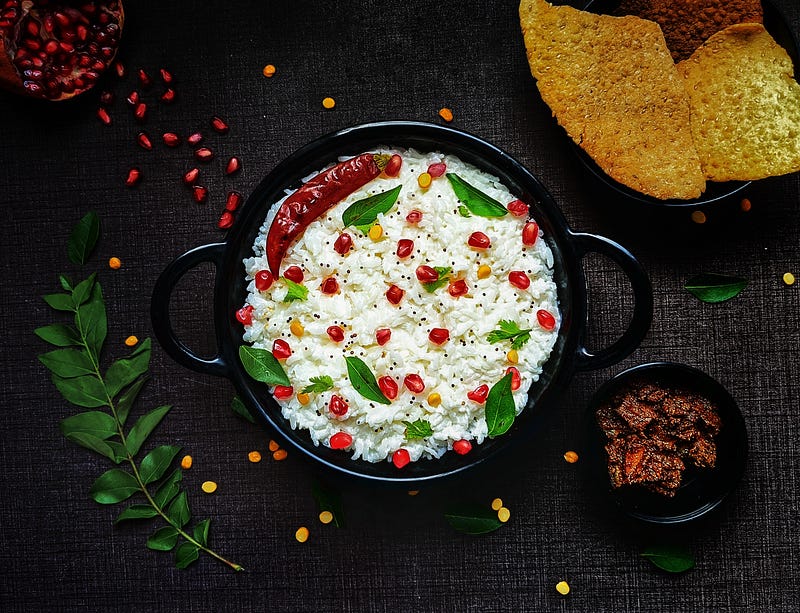
The premise is basic. There is yogurt or ‘curd’ as it is called across wide swathes of India. And rice. Then there are seasonings. And yet this ranks as a veritable comfort food in the southern part of India. Because in its simplicity lies its deliciousness.
First, let us clarify the yogurt vs curd question. Technically, yogurt (spelt yoghurt in some countries) is milk fermented using bacteria, of which there are few different kinds. A quick look at the labels of the various yogurt brands in the market will show you a few 2-word Latin names, most having lactobacillus as the 1st word. Curd is what you get when you curdle (and therein the connection!) milk with an acidic substance like vinegar or lime juice and drain off the liquid. In the Indian context, these curds are then set to produce the beloved cottage cheese, paneer. But nobody calls this pre-paneer substance ‘curd’. Instead, the word ‘curd’ is typically used to describe what technically is yogurt. Millions of households across the country use the bacterial starter, from yesterday’s yogurt, to ferment today’s milk that has been properly boiled and cooled to where the heat won’t kill the live cultures. They then let it sit in a corner of the kitchen and over the next few hours, the hot and humid climate sufficiently activate the bacteria to work their reproductive magic into yogurt. For the rest of this story, we will refer to this as curd. Because that’s what it is called by the people who make and consume this food.
This concoction of curd and rice is an essential component of a proper South Indian meal and typically signifies the end of the savory part. Now, most meals will not make this as a separate dish but will simply serve some curd and rice and allow each person to mix them to his or her desired consistency and taste. However, when you hyphenate the two words on paper and roll them off the tongue quickly enough for the consonants to run into each other, a completely different dish is born. This is now ‘curd-rice’ or ‘thayir-saadam’ (Tamil).
We talked about the curd. Let us leave it for now but before moving on, note that it needs to be at the right level of sourness. A couple of missteps too far in either direction and you are either having bland milk-rice or a mouth-puckering sour mash.
Let us now talk about the rice. This is not Basmati or any of its other long-grain cousins. Basmati has its applications and it is rightfully venerated as pre-eminent among rice varieties, but it has no place in any self-respecting thayir saadam. This is a simple dish with simple charms and basmati will simply make everyone uncomfortable, like a princess dropping into a peasant’s hut unannounced for tea. The only thing to note is that whichever non-basmati, non-long-grained rice is used, it needs to be cooked well into mashable territory. Because mashing the rice is an important step in the preparation.
The rice needs to be mashed such that only the odd grain stays intact while the rest is halfway into mashed-potato territory. There really is no better way to do this than with your bare hand — the right one please, we are Indians. Then the curd is added. Keep in mind that mashed rice tends to absorb more liquid so add about a tenth more curd than you think is sufficient. You will probably need to add some more before we are done. Mix and mash well with hand and salt to taste. We are looking for a loose consistency that jiggles a bit when you shake the bowl but doesn’t really flow easily when you tip it. This is also safe kitchen practice, because, well, tip happens.
You may also want to add some milk if the curd is too sour or if you have a few hours between prep and consumption, and it is an exceptionally hot day.
Next comes the seasoning. This is what sets a proper thayir-saadam apart from a mix of curd and rice. The absolute musts are mustard seeds, curry leaves, chopped green chillies, dry red chillies, chopped ginger, asafetida and urad dal (split, husked black lentils). Mustard seeds are crackled in hot oil and the rest is added one by one and sautéed till done right. This means till the lentils are lightly browned, the curry leaves and green chilies are blistered, the red chillies turn a duller, darker red and the ginger has settled down after the initial jumping up in the pot. Add the seasoning to the rice mix and incorporate.
This is all it needs. But there are times when one feels the need for more color. Hence garnish. A sprinkle of finely chopped cilantro is always good. A sprig in the middle of the plate is fine. Maybe even a slit raw green chili for that shocking streak of color. But absolutely no carrot slices or pomegranate seeds or tomatoes shaped like roses. The picture above does have those pomegranate seeds, but you don’t need them. Their tangy sweetness popping in your mouth every now and then is a distraction. And please, no shredded cabbage or boiled peas, ever! I am looking at you, faux South Indian restaurant in Punjab.
Serve it with some pickle, ideally lime or mango, glistening red beside the deep white of the rice. Maybe even some pappadum, though the true-blue Tamilian might look askance.
This simple dish is a great end to a regular meal with its array of spicy dishes as it is considered ‘cooling’, especially during these hot months, and good for digestion (the probiotics, the ginger, the asafetida). It was also a convenient food for those train journeys of yore, when families would carry six meal-times worth of food in large steel tiffin-carriers, while the train clickety-clacked its way across the country, ferrying kids and parents to and from their summer-vacation destinations. It could withstand the forty hours of unrefrigerated storage without spoiling (though beyond the 40th hour, the sour pong would be fairly noticeable), was easily prepared amid the rush of packing and helped calm down the cranky kids with rice-induced naps.
Simple, rustic, filling. Hallmarks of a true comfort food.


