avatarCol Jung

Free AI web copilot to create summaries, insights and extended knowledge, download it at here

12961

Abstract

ces rise because of adoption. People are transacting with it, with cryptocurrencies increasingly becoming a mainstream fixture in our financial world. As Sylvain Saurel argues time and time again, <a href="https://readmedium.com/few-understand-that-bitcoin-is-money-not-just-another-technology-e2e3319b5d30">Bitcoin is money</a>, not just another technology. Its rise in value is almost <a href="https://readmedium.com/bitcoin-has-now-entered-in-the-positive-feedback-loop-that-will-drive-its-price-to-a-new-ath-5fe8c8a567ce">inevitable</a>.</p><p id="8711">Some recent highlights:</p><ul><li><b>Explosion in institutional adoption.</b> Take <b>MicroStrategy</b>, a NASDAQ-listed company, <a href="https://readmedium.com/former-bitcoin-hater-microstrategy-points-the-way-to-follow-for-big-companies-in-the-future-eca8d488c705">recently made Bitcoin</a> its primary treasury reserve asset after stockpiling 625 million worth of BTC. <b>Square</b> <a href="https://squareup.com/us/en/press/2020-bitcoin-investment">did the same</a> in early 2020 October. A former <a href="https://www.forbes.com/sites/billybambrough/2020/10/30/a-former-goldman-sachs-hedge-fund-chief-has-predicted-apple-and-microsoft-will-buy-bitcoin-within-five-years/?sh=5987ddd213c4">Goldman Sachs hedge fund manager</a> predicts some of the world’s biggest companies — like <b>Apple and Microsoft </b>— are gearing up to add Bitcoin to their balance sheets. (Recently even Elon Musk showed interest— more on that later.) Any of these large S&amp;P 500 companies parking just a tiny portion of their excess cash into BTC would cause prices to substantially pump. Finally, <b>Fidelity Investments</b>, one of the largest fund managers in the world, <a href="https://www.bloomberg.com/news/articles/2020-08-26/fidelity-launches-inaugural-bitcoin-fund-for-wealthy-investors">launched an ETF</a> for qualified investors and suggested holding 5 percent BTC in their portfolios.</li><li><b>Large-scale consumer adoption.</b> Take <b>PayPal</b>, which <a href="https://www.forbes.com/sites/billybambrough/2020/10/23/paypal-just-gave-346-million-people-a-new-way-to-buy-bitcoin-but-theres-a-nasty-catch/?sh=39bebc02b610">announced in late 2020 October</a> that it will allow its 346 million users to buy and spend Bitcoin and a handful of other major cryptocurrencies. <b>Square’s</b> financially-revolutionary CashApp has already allowed users to buy and sell Bitcoin since 2018. Together, PayPal and Square are currently buying up almost all of the newly mined Bitcoin, ensuring supply remains low well into the future. Afterward PayPal’s announcement, <b>Virgin Galactic</b>’s chairman remarked that:</li></ul><p id="4065" type="7">…every major bank is having a meeting about how to support bitcoin. It’s no longer optional.</p><p id="9c1d">Ultimately, Bitcoin’s intrinsic value derives from adoption, acceptance and usage. As the first cryptocurrency, BTC had the first-mover’s advantage. Moreover, the bigger BTC became, the more valuable it became due to the compounding nature of its <a href="https://www.investopedia.com/terms/n/network-effect.asp">network effect</a>.</p><p id="6f45">Having justified its value to a sufficiently large number of people worldwide — individual, retail and now institutional — Bitcoin by the end of 2020 is now too large to fail. Its price action is still volatile, but far less than the 2017 bull run, where there were 30–40% drawdowns.</p><p id="24ef">In the current bull run, the bears only manage 5–15% corrections before the immense buying pressure quickly elevates BTC to prior levels. This brings us to the next point: <b>demand for Bitcoin in the face of dwindling supply</b>.</p><h1 id="7c35">4. Economic —Record High Demand for Bitcoin</h1><figure id="60b7"><img src="https://cdn-images-1.readmedium.com/v2/resize:fit:800/1*zpS11tW5p17JZaHeMGIVhw.png"><figcaption>Image source: <a href="https://news.bitcoin.com/in-the-daily-bitcoin-begging-nem-foundation-fights-to-survive-huobi-prime/">Bitcoin.com</a>.</figcaption></figure><p id="2227">Finally, there’s simply not enough Bitcoin to satisfy demand.</p><ul><li><b><i>Low Supply:</i></b> According to <a href="https://insights.glassnode.com/bitcoin-liquid-supply/">Glassnode</a>, 78% of circulating Bitcoin is illiquid, leaving only 4.2 million out of the 18.7 million Bitcoins currently in the system available for buying and selling. Essentially, there are a record number of large and small HODL’ers — BTC owners who, having realised the potential of BTC holdings, refuse to sell. There are also 3–5 million Bitcoins that have been lost forever, due to people losing their keys and so forth. <b>This puts pressure on Bitcoin mining to satisfy our record levels of demand right now.</b></li><li><b><i>High Demand:</i></b> However, <b>PayPal</b> and <b>Square</b> are buying up over 90% of the 900 newly-mined Bitcoin each day. Moreover, there are only 3 million or so BTC left to mine. Capped at 21 million, the supply is deflationary — there’s less and less left every day. While these fintechs gobble up newly-mined BTC for their millions of customers, an increasing number of <b>large institutions</b> are fighting for circulating BTC for their investment portfolios. Some project a few of the largest S&amp;P 500 companies (e.g. Apple, Microsoft or Tesla) will want to get in on the action in 2021. Adding insult to injury, we’ve seen very little interest from <b>retail investors</b>, unlike the 2017 bull run. All of this can only mean one thing: prices go up!</li></ul><figure id="4e94"><img src="https://cdn-images-1.readmedium.com/v2/resize:fit:800/1*33ibazbxvwOqSCzV-_DOvQ.png"><figcaption>In a Twitter conversation with Microstrategy CEO Michael Saylor, Elon Musk entertains the possibility of parking some of Tesla’s reserve cash into BTC. An increasing number of institutional investors are looking to BTC to increase shareholder value. Saylor, a once-BTC-skeptic, has moved 1.3b of assets into Bitcoin. Source: <a href="https://news.bitcoin.com/in-the-daily-bitcoin-begging-nem-foundation-fights-to-survive-huobi-prime/">Twitter</a>.</figcaption></figure><h1 id="7a99">How to invest and trade the 2020-21 bull run</h1><figure id="143a"><img src="https://cdn-images-1.readmedium.com/v2/resize:fit:800/1*ida5PRSphP00IYfYmyDMjQ.png"><figcaption>Bitcoin has well and truly lift off since 2020 Nov, a month after I initially published this article. Image source: eToro’s charts.</figcaption></figure><p id="5df2">You’ve now made the decision to profit from Bitcoin’s current bull run. What’s your strategy? You’ll want to decide on one before you get in, because trading a volatile asset without a strategy is the surest way to lose your money.</p><p id="2fb5">Here are three strategies:</p><ol><li><b>Buy & Hold.</b> Buy as much Bitcoin as you can before the price hits 20,000. If you’ve missed this boat, it’s okay to get in on the action while the price is still under 35–40,000. Then hold onto it until the end of the bull run, projected to be around Q4 2021. Expect large drawdowns along the way. Don’t stress, this is part of the journey. You’re not swing trading, you’re holding the price hits a certain target around a certain time. This strategy is by far the easiest and most passive option, and the most sensible for inexperienced investors. <i>(2021 Jan edit: actually, this is a very sensible strategy even for experienced investors and traders.)</i></li><li><b>Buy & Hold; buy more during big corrections.</b> If you’ll have spare cash during the coming year, add to your position during big corrections. This is the most sensible option for the majority of people who plan to add more money to their brokerage throughout the year.</li><li><b>Buy & Hold; time the big corrections.</b> This one is very difficult to pull off. Historically, BTC price tended to reach around 160–170% of the previous drawdown’s low point before experiencing a large drawdown. This strategy involves exiting a portion of your BTC position around this point, and re-entering at a lower price. <b>2021 Jan edit: This strategy is very risky — there is a high statistical probability you will be better off with Strategies #1 & 2.</b></li></ol><p id="1a4f">In any case, here’s a concrete example to illustrate the 3rd strategy:</p><ul><li>As of 2020 Dec 10, the last big correction was ~16,500.</li><li>Hold your BTC until the price goes up 150%. That’s around 40,000.</li><li>Start selling off some of your BTC at 40,000. For example, close 5% of your position at 40,000, another 5% at 40,500, another 5% at 41,000 and a final 5% at 42,000. You’ve now sold off 20% of your holdings in anticipation of a big correction.</li><li>At 45,000, BTC commences a large correction <i>(but again, the risk is this might not happen, or happens earlier or later)</i>. Let’s say BTC pulls back 30–40% <i>(although again, the risk is the drawdown is much smaller)</i>, giving you an opportunity to buy in at significantly discounted prices.</li></ul><p id="abad">For the majority of people, the 1st and 2nd strategies (buy & hold; add more during corrections) is absolutely the way to go. Given how the current bull run is progressing (as of Jan 2021), I would say the 3rd strategy is akin to gambling.<b> Be rational and sensible.</b></p><p id="4958">For the impatient, be aware that historically the majority of bull runs are <i>boring</i>, where we BTC trades sideways most of the time before quick and sharp pumps.</p><figure id="a487"><img src="https://cdn-images-1.readmedium.com/v2/resize:fit:800/1*dQ9sRw3Ol8WpPFybdwcZDw.png"><figcaption></figcaption></figure><figure id="6e20"><img src="https://cdn-images-1.readmedium.com/v2/resize:fit:800/1*hycffDFcrEfi9LKihf9-2w.jpeg"><figcaption>The bit Bitcoin moves tend to be dramatic and quick, followed by extended periods of slow pullbacks and/or consolidation. Source: <a href="https://twitter.com/bitharington/status/1339925115954491398">Twitter</a>.</figcaption></figure><p id="6e4f">Finally, please manage your risk.</p><p id="6302">Past cycle performance does not guarantee the future.</p><p id="e8e1">I expect an admirable performance from bitcoin over the next two years assuming macroeconomic factors continue to provide tailwind support.</p><p id="7221">However when the US Federal Reserve signal some sort of bearish pivot in response to inflationary pressures— which I believe is inevitable at some point given the unprecedented sheer level of stimulus and balance sheet expansion —that’s the time to wind down the equities and crypto party.</p><p id="5a98">We’re currently in a ten-year secular bull market. Enjoy it while it lasts. Keep your eyes on the pulse.</p><h1 id="819b">Where to buy Bitcoin</h1><p id="0fdf">I personally use</p><ul><li><b>eToro</b> — all-in-one platform for stocks, crypto and commodities.</li><li><b>Binance</b> — world’s largest exchange. Buy <a href="https://readmedium.com/understanding-why-crypto-exists-677a32b4e3bb">real crypto</a> and transfer to your own <a href="https://medium.datadriveninvestor.com/new-to-crypto-heres-what-you-need-to-know-2022-guide-c1da32866837">self-custodial wallet</a>. Join <a href="https://accounts.binance.com/en/register?ref=X7LBTYDM">here</a> and get 5% of fees forever.</li><li><b>Nexo</b> — leading CeFi lending platform with crypto saving accounts. Sign up <a href="https://nexo.io/ref/khchmqekem">here</a> for up to 50 free BTC.</li><li><b>Crypto.com</b> — <a href="https://medium.datadriveninvestor.com/what-is-crypto-com-credit-build-wealth-like-the-rich-6be53b492834">lending</a>, <a href="https://medium.datadriveninvestor.com/what-is-crypto-com-earn-build-your-crypto-wealth-2c0a434c7185">saving</a> and <a href="https://col-jung.medium.com/how-big-is-crypto-coms-ecosystem-2022-guide-b6ef069106e2">exchange</a> all in a <a href="https://col-jung.medium.com/intro-to-buying-selling-on-crypto-com-70838b049a97">nice app</a>. Sign up <a href="https://www.crypto.com/app/col">here</a> and get 25 CRO free when signing up for a Ruby Steel or above <a href="https://medium.datadriveninvestor.com/crypto-com-visa-cards-up-to-8-cashback-on-daily-purchases-c4bb0e46539c">VISA card</a>.</li></ul><h1 id="6471">FAQ about Bitcoin</h1><h2 id="7595">What is Bitcoin?</h2><p id="93ec">A <b>blockchain</b> is a digital ledger that records transactions between two parties in a permanent and verifiable way without the need for a middleman like a bank. Within blockchains, transactions are grouped into <b>blocks</b> and linked together with cryptography.</p><p id="661d"><b>Bitcoin</b> is the world’s first commercial application of blockchain and is</p><ul><li>a <b>method of exchange</b> (like cash)</li><li>used as a <b>store of value</b> (like gold)</li><li>speculated upon as a <b>financial instrument</b> (like stocks)</li></ul><p id="7fd3">As a digital method of exchange, Bitcoin solved the infamous <a href="https://www.investopedia.com/terms/d/do

Options

ublespending.asp">double spending problem</a>.</p><h2 id="1745">What’s special about Bitcoin?</h2><p id="3db3">In short, blockchain is a revolution in technology and bitcoin is a revolution in money.</p><p id="8b71">Bitcoin is unique in the history of mankind because — until now — humans have never known something that <a href="https://readmedium.com/few-understand-that-bitcoin-is-money-not-just-another-technology-e2e3319b5d30">simultaneously combines</a> the following three properties:</p><ol><li><b>digital</b></li><li><b>scarce</b></li><li><b>decentralised</b></li></ol><p id="83a3">Gold is scarce and decentralised, but not digital. Stocks may be scarce and digital, but they’re centralised. Fiat money is certainly not scarce — central banks continue to pump billions more of it into our economies as we speak! Bitcoin ticks all the boxes.</p><p id="a756">Philosophically, Bitcoiners believe that Bitcoin gives power back to the people. When governments and central banks control the supply of money and can change its real value at a whim by printing more of it at will, they exert economic power over us. Bitcoin’s decentralisation bypasses that tomfoolery and its scarcity preserves value. This is a revolution in money.</p><h2 id="fe1e">Management of Bitcoin</h2><p id="a282">The governance of Bitcoin differs from traditional corporate governance.</p><ul><li>Bitcoin relies on algorithms, open source code and a network of developers to manage the network. Bitcoin relies on a <a href="https://cointelegraph.com/explained/proof-of-work-explained"><b>proof of work</b></a> algorithm of secure and verify transactions and to create new Bitcoins. High-powered computers (i.e. <b>Bitcoin <a href="https://www.investopedia.com/tech/how-does-bitcoin-mining-work/">miners</a></b>) compete with each other to confirm transactions by solving cryptographic math puzzles. Winning miners are rewarded with new BTC for their efforts.</li><li>As Bitcoin is decentralised and open source, there is no central authority that presides over its evolution, unlike governments and banks with fiat money. BTC’s source code was written by an unknown person/entity called Satoshi Nakamoto. Developers who commit changes to the source code need to consider whether their changes are in line with Bitcoin’s vision, meet minimum standards of inclusion and align with the consensus of other contributors.</li></ul><h2 id="ad74">Financials and Valuations</h2><p id="e1cb">As Bitcoin isn’t a cash generating asset, traditional metrics like earnings, revenue, P/E, P/B, etcetera, don’t apply to BTC. Instead, we look at other numbers like:</p><ul><li><b>Hash rate</b>. This is the number of those math puzzles the Bitcoin network can solve each second. Higher the hash rate, the more secure the network is. BTC’s current hash rate is 125 TH/sec — an increase of 32% YoY.</li><li>Bitcoin dominance versus <a href="https://news.bitcoin.com/altcoins-why-over-5000/"><b>altcoins</b></a>. This measures the market share of Bitcoin versus all other cryptocurrencies. Currently, BTC dominance is 65%.</li><li>Confirmed transactions per day. A new block is confirmed by miners every 10 minutes. The BTC network processes 347K transactions per day — an increase of 6% YoY.</li></ul><h2 id="74db">Investment risks</h2><ul><li>Low adoption. This is the single biggest existential risk facing Bitcoin. Thankfully, many are long-term bullish on BTC precisely because its institutional and retail adoption is showing no signs of slowing down. Bitcoin is here to stay.</li><li>Regulation. The banning of BTC by governments is an example of this. However, it is incredibly unlikely that every government will collude together to ban BTC. The bigger risk is governments begin creating their own digital currencies to rival BTC — something that they can control.</li><li>51% attack. This is an attack on the BTC network whereby a group of miners collude together to control more than 50% of the hash rate. They could prevent new transactions from being confirmed, reverse transactions and double spend. A scenario like this is extremely unlikely, but technically possible.</li></ul><p id="e89a">Shout outs to <a href="https://ssaurel.medium.com/">Sylvain Saural</a> and <a href="https://www.etoro.com/people/tommyrogulj">Tomislav Rogulj</a> for their insights.</p><h1 id="d526">Calculation Appendix for Annualised Return Rate</h1><p id="ff2b">Understanding the <a href="https://readmedium.com/the-power-of-compound-interest-850ab4517506">Power of Compound Interest</a> can transform your life.</p><p id="58c9"><b>Annualised return rates </b>can be calculated as follows. For an asset that cost <b>C</b>, the final price <b>F </b>— after compounding <b>n</b> years at <b>annualised rate of return r </b>— is given by:</p><figure id="f502"><img src="https://cdn-images-1.readmedium.com/v2/resize:fit:800/1*GOl5145YW_h6gE8CYR4kvw.png"><figcaption>Check out my sister article on the <a href="https://readmedium.com/the-power-of-compound-interest-850ab4517506">Power of Compound Interest</a> for an insightful take on compound interest and investing.</figcaption></figure><p id="c3bb">Applying this to Bitcoin gave:</p><figure id="d058"><img src="https://cdn-images-1.readmedium.com/v2/resize:fit:800/1*ufN0N9ScFwqW65EJeS8HaQ.png"><figcaption></figcaption></figure><h1 id="9fd3">Final Words</h1><p id="94a6">The 2017-18 Bitcoin bull run and subsequent crash was fuelled by retail investors FOMO-ing into a speculative asset bubble.</p><p id="d5eb">In 2020, Bitcoin’s has matured fundamentals. Its 3rd post-halving bull run is underway, supported by increasing institutional adoption; trickling supply caused by <a href="https://www.investopedia.com/terms/b/bitcoin-whale.asp">Bitcoin whales</a> and large companies like PayPal and Square (ultimately feeding BTC into the hands of ordinary people); and its status as a safe haven asset in the face of record ongoing stimulus.</p><p id="d64d">As a retail investor, you want to be fully-positioned before BTC hits 20,000. The price is projected to reach between 60,000 to 325,000 by Q4 2021. You’ll then exit, taking a very healthy profit.</p><p id="51e7">If you’re in the game for the long-run, simply <a href="https://en.wikipedia.org/wiki/Hodl">HODL</a> and buy more during the dips.</p><p id="9bb1">Bitcoin’s finite supply of 21 million BTC, continued growth in network effects and its basis for a new decentralised financial system that <a href="https://readmedium.com/understanding-why-crypto-exists-677a32b4e3bb">separates money from politics</a> should see its value continue to rise over the coming years.</p><p id="8fff">For those who want to take a deeper look at the <b>power of compound interest</b>, please see <a href="https://readmedium.com/the-power-of-compound-interest-850ab4517506">this article</a> for a visual comparison between different asset classes.</p><p id="2f86">Are you curious to learn about the cryptocurrency space beyond just bitcoin? Check out my articles <a href="https://col-jung.medium.com/whats-the-deal-with-cryptocurrencies-7c250d9c7457">here</a>, <a href="https://medium.datadriveninvestor.com/new-to-crypto-heres-what-you-need-to-know-2022-guide-c1da32866837">here</a>, <a href="https://readmedium.com/understanding-why-crypto-exists-677a32b4e3bb">here</a>, <a href="https://entrepreneurshandbook.co/web3-gaming-what-do-blockchain-crypto-nfts-the-metaverse-offer-5ffbb870e018">here</a> and <a href="https://medium.datadriveninvestor.com/solana-polygon-6-killer-use-cases-9687b70487e0">here</a>.</p><p id="ef44">Interested in generating strong passive income with cryptocurrency? I’ve got you covered <a href="https://col-jung.medium.com/how-to-generate-passive-income-with-cryptocurrencies-fbca623b2b4f">here</a> and <a href="https://col-jung.medium.com/cryptocurrency-passive-income-on-the-binance-smart-chain-babff31a45f6">here</a>.</p><p id="ecbe">Cheers and enjoy.</p><p id="0dc1">Follow me on <a href="https://twitter.com/col_jung">Twitter</a> &amp; <a href="https://www.youtube.com/c/CryptoFilmmaker">YouTube</a> for regular analyses and guides.</p><h1 id="f670">My Crypto Articles</h1><ul><li>Unlock <b>unlimited access</b> to Medium by joining <a href="https://col-jung.medium.com/membership">here</a>.</li><li><a href="https://medium.datadriveninvestor.com/macro-101-for-crypto-investors-da13d5806990">When Will the Bear Market End? Macro 101 for Crypto Investors</a></li><li><a href="https://medium.datadriveninvestor.com/new-to-crypto-heres-what-you-need-to-know-2022-guide-c1da32866837">A Review of the Cryptocurrency Market in 2022</a></li><li><a href="https://entrepreneurshandbook.co/web3-gaming-what-do-blockchain-crypto-nfts-the-metaverse-offer-5ffbb870e018">Web3 Gaming — What do Crypto, NFTs &amp; Metaverse offer?</a></li><li><a href="https://entrepreneurshandbook.co/how-ftxs-collapse-will-reshape-crypto-will-solana-survive-bfa36fa5c904">FTX’s Collapse &amp; Solana’s Long-term Impact</a></li><li><a href="https://medium.datadriveninvestor.com/solana-polygon-6-killer-use-cases-9687b70487e0">Polygon &amp; Solana — 6 Killer Crypto/NFT Use Cases</a></li><li><a href="https://readmedium.com/a-brief-history-of-nft-marketplaces-ed25252478e6">A Brief History of NFT Marketplaces</a></li><li><a href="https://readmedium.com/the-power-of-compound-interest-850ab4517506">Compound Interest is the 7th Wonder of the World</a></li><li><a href="https://col-jung.medium.com/how-to-generate-passive-income-with-cryptocurrencies-fbca623b2b4f">How to Generate Passive Income with Crypto</a></li><li><a href="https://col-jung.medium.com/cryptocurrency-passive-income-on-the-binance-smart-chain-babff31a45f6">Crypto Passive Income on BNB Chain</a></li><li><a href="https://readmedium.com/stepn-past-present-and-future-65139f0d3f31">Move &amp; Earn Crypto — 6 Month Review of STEPN</a></li><li><a href="https://medium.datadriveninvestor.com/pancakeswaps-new-high-apy-staking-pools-what-you-need-to-know-876aafb46138">PancakeSwap’s High APY Pools — What’s the Catch?</a></li><li><a href="https://col-jung.medium.com/cardano-ada-staking-passive-income-2022-guide-c840a24923a0">Cardano</a>, <a href="https://col-jung.medium.com/avalanche-avax-staking-passive-income-guide-2022-edition-e3fbfa1d743e">Avalanche</a>, <a href="https://col-jung.medium.com/solana-sol-staking-passive-income-guide-2022-edition-b1bb4fd4f988">Solana</a> Staking Guides (2022)</li><li><a href="https://col-jung.medium.com/how-high-can-cardano-ada-go-crypto-price-predictions-9de753634a17">Cardano</a>, <a href="https://col-jung.medium.com/how-high-can-avalanche-go-crypto-price-analysis-6dbc88780050">Avalanche</a>, <a href="https://col-jung.medium.com/how-high-can-solana-go-crypto-price-analysis-57f1a051245f">Solana</a> Price Predictions (Bull Market)</li><li><a href="https://col-jung.medium.com/2021-crypto-bull-run-calculations-445bdd2c3b1d">How to Make Crypto Price Predictions</a></li><li><a href="https://col-jung.medium.com/how-to-make-realistic-cryptocurrency-price-predictions-436f3f6f54e3">Top 3 Price Prediction Mistakes</a></li><li><a href="https://medium.datadriveninvestor.com/crypto-com-visa-cards-up-to-8-cashback-on-daily-purchases-c4bb0e46539c">Crypto VISA Cards — Cashbacks for Every Purchase?</a></li><li><a href="https://medium.datadriveninvestor.com/what-is-crypto-com-credit-build-wealth-like-the-rich-6be53b492834">How to Build Wealth like Smart Money</a></li><li><a href="https://medium.datadriveninvestor.com/what-is-crypto-com-earn-build-your-crypto-wealth-2c0a434c7185">Is Crypto.com’s Earn Program Worth It?</a></li><li><a href="https://readmedium.com/forget-banks-earn-20-on-your-usd-in-defi-on-the-terra-blockchain-2b1d2844574">Understanding Terra’s Anchor Protocol</a></li><li><a href="https://col-jung.medium.com/crypto-income-with-launchpad-idos-solchicks-chicks-experience-on-trustswap-bd948736d3d4">How to Participate in Initial DEX Offerings</a></li><li><a href="https://col-jung.medium.com/mathematics-of-memecoin-investing-crypto-analysis-44f578756136">Memecoin Speculation — Is It Worth It?</a></li><li><a href="https://col-jung.medium.com/why-shiba-inu-shib-cant-reach-1-crypto-reality-check-484ed3844333">Why SHIB Can Never Reach 1 (or even close)</a></li><li><a href="https://readmedium.com/want-to-retire-early-invest-in-bitcoin-cf445f7a716f">Want to Retire Early? Buy Bitcoin</a></li><li><a href="https://medium.datadriveninvestor.com/biden-vs-trump-whos-better-for-the-stock-market-65d13fd97870">Democrats vs Republicans — Which Party Better for Markets?</a></li></ul><h1 id="1003">Crypto Sign Up Bonuses</h1><ul><li><b>Binance — 5% off fees forever </b>(<a href="https://accounts.binance.com/en/register?ref=X7LBTYDM">link</a>)</li><li><b>Nexo — 25 free BTC</b> with 100 deposit (<a href="https://nexo.io/ref/khchmqekem">link</a>)</li><li><b>Crypto.com — $25 free CRO</b> with a Jade Green VISA Card (<a href="https://www.crypto.com/app/col">link</a>)</li></ul></article></body>

Want to Retire Early? Include Bitcoin in Your Investment Portfolio

Annualised return of 230% over 10 years. Get ready for a stellar 2021
Image source: The Conversation.

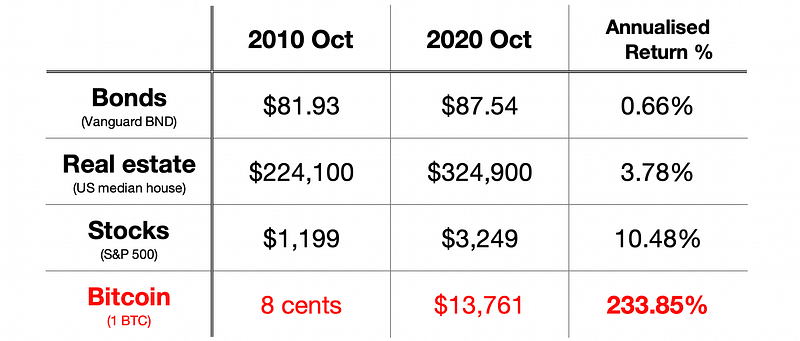
Ten years ago, if you put aside $4 for that cup of Starbucks tall coffee into Bitcoin, you’d be sitting on a whopping $688,050 today. Insane right?

That’s an annualised return of 234%. Compare that with:

This made Bitcoin’s return orders of magnitude above equities, real estate and bonds. To see this better, we can standardise the above figures and compare how each of these assets have grown from a hypothetical investment of $100.
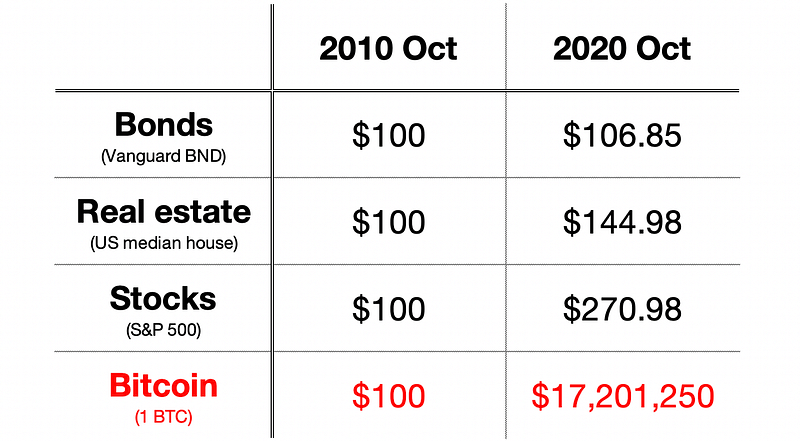
Check out the sister article on the Power of Compound Interest.

A single dollar put into Bitcoin in 2010 could get you a house today. A hundred dollars and you could retire right now, whatever your age.

Join Medium here and gain unlimited access to the best crypto & investing articles and guides on the internet.

In this article I’ll explain why why Bitcoin is a revolution in money, why its price (volatility-aside) reliably increases at a phenomenal rate, and how to get in on the action as an investor.

Want free bitcoin?

Get $25 free BTC on Nexo with $100 deposit (link) and $50 free BTC on Celsius with a $400 deposit (link).

Update 2021 Apr: I have written a sequel article covering the entire cryptocurrency space beyond just bitcoin.

Update 2021 Jun: I am now publishing regular crypto videos on YouTube.

Why Bitcoin in primed to explode in 2021

There’s a combination of mathematical, economic, financial and consumer behavioural reasons why Bitcoin should rocket up towards the moon in 2021.

In short, Bitcoin’s long-term price action is mathematically predictable due to its four-year “halving cycles”. Moreover, there is a severe shortage of tradable Bitcoins in the market as

  • PayPal and Square buy up almost all of the newly-mined BTC;
  • large institutional investors fight for BTC as a safe haven asset in the face of unrelenting stimulus by central banks worldwide;
  • ordinary retail investors like you and I join in on the party.

1. Mathematical — 3rd Bitcoin Halving Bull Run

Like gold, bitcoin is scarce.

There is a finite amount of it —in fact, 21 million, to be exact.

This scarcity pushes Bitcoin prices to rise, and so far we’ve seen it rise roughly linearly on a log-scale, which mean prices actually increase in an exponential fashion. All other asset classes (bonds, stocks, real estate etc.) increase in price linearly. In other words, while other investments grow steadily, Bitcoin grows at an expanding rate. This is jaw-dropping.

Like gold, bitcoin can also be mined.

To extend the life of Bitcoin and ensure it remains a deflationary asset, Bitcoin creator Satoshi Nakamoto wrote into Bitcoin’s code that the reward given to miners is halved every 210,000 blocks, or roughly every four years. This unique feature of BTC divides its timeline into distinct four-year epochs.
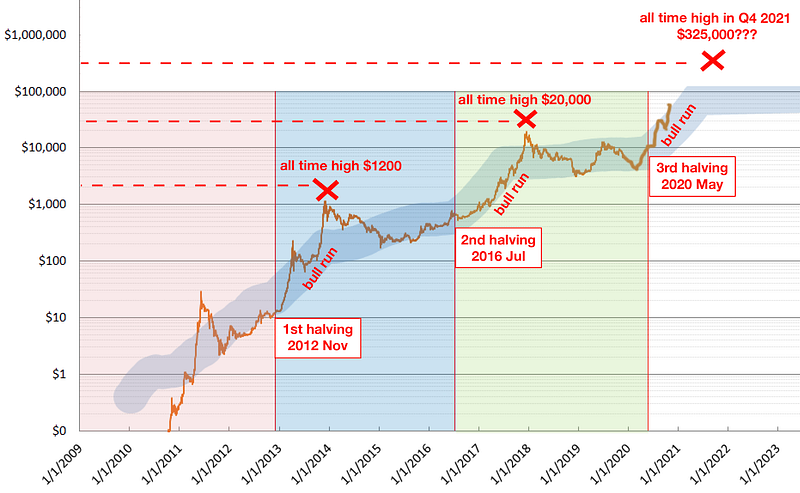
Bitcoin’s price rises in 4-year cycles due the “Halvening” events. Moreover, the price of 1 BTC increase approx. linearly on a logarithmic scale. This means it takes around the same amount of time for the price to jump from $1 to $10 as from $10 to $100. That is, prices are increasing exponentially.

Historically, each halving event has resulted in a bull run where prices skyrocket over the length of a year. These cyclic events are the post-halving bull runs.

  • 1st halving (2012): Bitcoin did a 10X in the post-halving bull run, increasing an order of magnitude from the $100 range to $1200.
  • 2nd halving (2016): Bitcoin did a 20X in the post-halving bull run, increasing an order of magnitude from the $1000 range to $20,000.
  • 3rd halving (2020): Since the halving in May ($10,000), the price of a BTC has gone up to $15,000 at the time of writing.

We’ve just begun (or will shortly be in) the latest post-halving bull run, projected to last until Q4 2021.

Price Targets

The price projection is anywhere between $60,000 to $100,000 for the diminishing returns thesis or $280,000 for the Stock-to-Flow model. Some analysts are predicting even higher — around $400,000. I’d say the lower bound (and this is a rather bearish outlook) is $60,000, which assumes the party will end prematurely due to unforeseen events or central banks reigning in the fun early.

Still, that’s a 4–25 fold increase over the next year, which would continue Bitcoin’s reputation as the best performing asset by far.
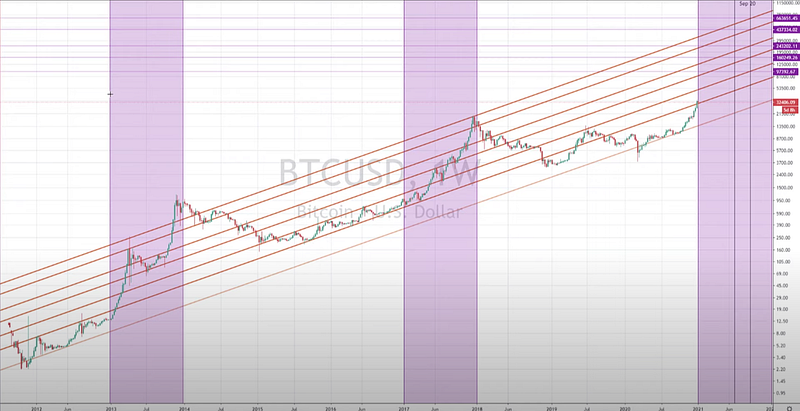
Price action during all previous bull runs, which will help inform price projections for the current cycle. Source: Conquer Trading & Investing.

The graph below compares all 3 halving bull runs with starting prices standardised. We’re still in the early stages of the 3rd halving run.
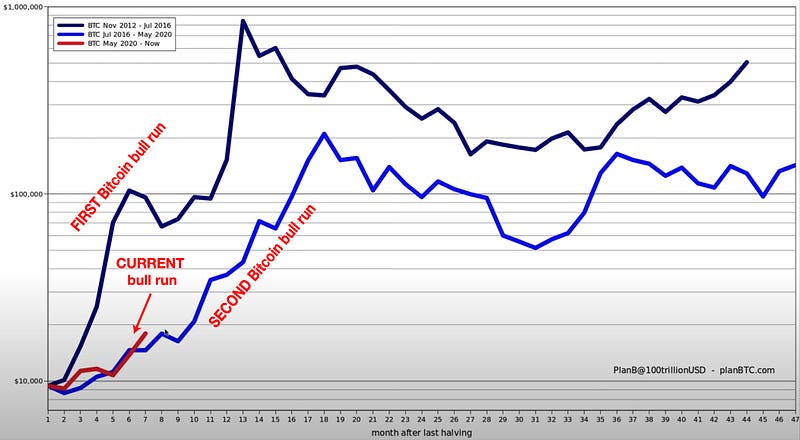
All post-halving bull runs with starting price standardised. As one can see, there’s still a long way to go until the new All Time High. Source: Jordan Lindsey

If you miss out, you will have to wait until the next halving event in 2024. Time is of the essence.

Future 2021–22 Drawdowns

After the current run’s complete, you’ll want to jump out of Bitcoin for a couple of years due to drawdowns that have historically erased 85% off the All Time High (ATH).
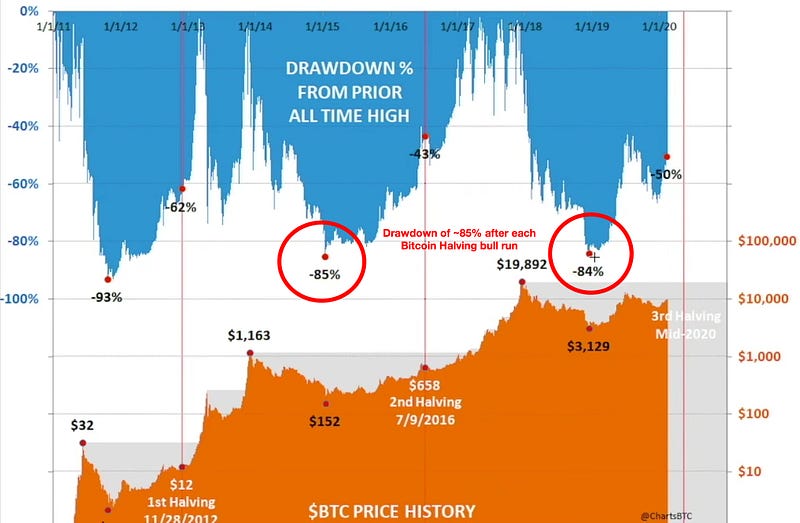
A multi-year bear market phase historically follows each bull run, where up to 85% of gains are erased. The next bear phase is projected to begin around the end of 2021. Source: Jordan Lindsey

With that said, some believe Bitcoin’s rise has been so powerful that we’re in a super cycle where there won’t be a drawdown after 2021. That is, the price will continue to head in a stable fashion towards the $500,000 to $1 million mark.

Time will tell.

You can read more about halvings and price predictions here, here, here, here, here, here and here.

2. Financial — Inflation Hedge in the age of COVID-19
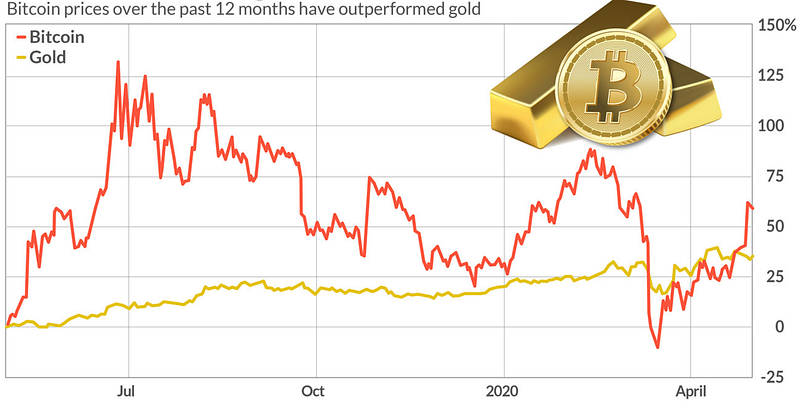
Image source: MarketWatch.

The second reason for Bitcoin’s price rise is its reputation as a safe haven reserve asset.

As COVID-19 ravages economies, central banks around the world continue to pump extra cash into the economy. Around a quarter of all US dollars in circulation were printed in 2020 alone. The G10 countries have already committed to $300 billion of monthly QE for 2021.

All of this will push investors to park their money into safe haven assets to hedge against inflation and government tomfoolery. That safe haven has traditionally been gold, but is now includes Bitcoin, which can be thought of as digital gold. According to JPMorgan, older investors tend to go for gold, while more younger and fintech-savvy investors go for Bitcoin. The big difference is Bitcoin performs better than gold by orders of magnitude.

Robert Kiyosaki summarises the situation as:

“When the value of the dollar goes down, they print more of it. And people save it! Talk about losers. Get it through your head: it’s worth less and less and less. Whereas for Bitcoin, the more expensive [it] gets, they print less of it. It’s called the Halving. So the price goes up, but the quantity goes down. Meanwhile, the value of the dollar comes down, but they print more of it…why would you save it?”

3. Consumer Behavioural — Mainstream Adoption
Image source: PayPal via How Stuff Works.

Scarcity and inflation-hedging alone can’t account for Bitcoin’s skyrocketing prices. Otherwise, explains Charlie Morris, the price of gold would rise to infinity if we suddenly shut down gold mining. The third reason for Bitcoin’s price rise is maturing mainstream adoption by individuals and institutions.

Bitcoin prices rise because of adoption. People are transacting with it, with cryptocurrencies increasingly becoming a mainstream fixture in our financial world. As Sylvain Saurel argues time and time again, Bitcoin is money, not just another technology. Its rise in value is almost inevitable.

Some recent highlights:

  • Explosion in institutional adoption. Take MicroStrategy, a NASDAQ-listed company, recently made Bitcoin its primary treasury reserve asset after stockpiling $625 million worth of BTC. Square did the same in early 2020 October. A former Goldman Sachs hedge fund manager predicts some of the world’s biggest companies — like Apple and Microsoft — are gearing up to add Bitcoin to their balance sheets. (Recently even Elon Musk showed interest— more on that later.) Any of these large S&P 500 companies parking just a tiny portion of their excess cash into BTC would cause prices to substantially pump. Finally, Fidelity Investments, one of the largest fund managers in the world, launched an ETF for qualified investors and suggested holding 5 percent BTC in their portfolios.
  • Large-scale consumer adoption. Take PayPal, which announced in late 2020 October that it will allow its 346 million users to buy and spend Bitcoin and a handful of other major cryptocurrencies. Square’s financially-revolutionary CashApp has already allowed users to buy and sell Bitcoin since 2018. Together, PayPal and Square are currently buying up almost all of the newly mined Bitcoin, ensuring supply remains low well into the future. Afterward PayPal’s announcement, Virgin Galactic’s chairman remarked that:

…every major bank is having a meeting about how to support bitcoin. It’s no longer optional.

Ultimately, Bitcoin’s intrinsic value derives from adoption, acceptance and usage. As the first cryptocurrency, BTC had the first-mover’s advantage. Moreover, the bigger BTC became, the more valuable it became due to the compounding nature of its network effect.

Having justified its value to a sufficiently large number of people worldwide — individual, retail and now institutional — Bitcoin by the end of 2020 is now too large to fail. Its price action is still volatile, but far less than the 2017 bull run, where there were 30–40% drawdowns.

In the current bull run, the bears only manage 5–15% corrections before the immense buying pressure quickly elevates BTC to prior levels. This brings us to the next point: demand for Bitcoin in the face of dwindling supply.

4. Economic —Record High Demand for Bitcoin
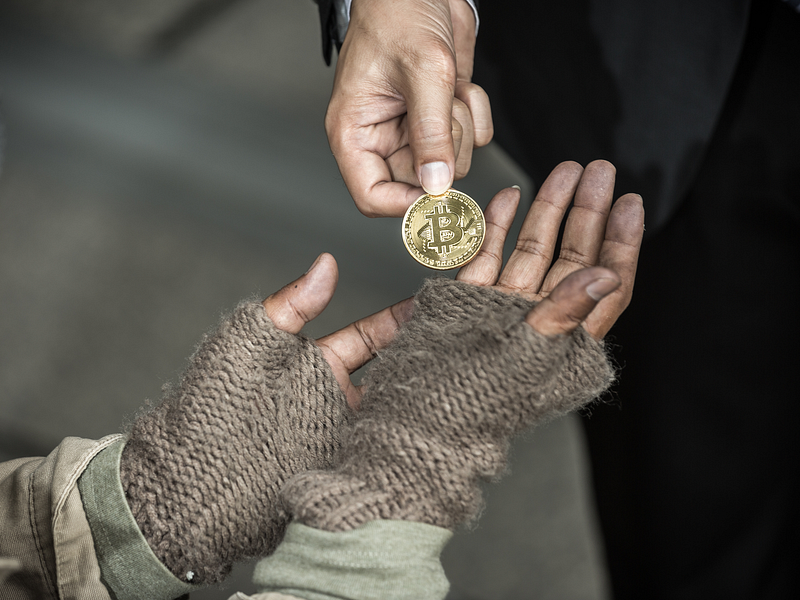
Image source: Bitcoin.com.

Finally, there’s simply not enough Bitcoin to satisfy demand.

  • Low Supply: According to Glassnode, 78% of circulating Bitcoin is illiquid, leaving only 4.2 million out of the 18.7 million Bitcoins currently in the system available for buying and selling. Essentially, there are a record number of large and small HODL’ers — BTC owners who, having realised the potential of BTC holdings, refuse to sell. There are also 3–5 million Bitcoins that have been lost forever, due to people losing their keys and so forth. This puts pressure on Bitcoin mining to satisfy our record levels of demand right now.
  • High Demand: However, PayPal and Square are buying up over 90% of the 900 newly-mined Bitcoin each day. Moreover, there are only 3 million or so BTC left to mine. Capped at 21 million, the supply is deflationary — there’s less and less left every day. While these fintechs gobble up newly-mined BTC for their millions of customers, an increasing number of large institutions are fighting for circulating BTC for their investment portfolios. Some project a few of the largest S&P 500 companies (e.g. Apple, Microsoft or Tesla) will want to get in on the action in 2021. Adding insult to injury, we’ve seen very little interest from retail investors, unlike the 2017 bull run. All of this can only mean one thing: prices go up!
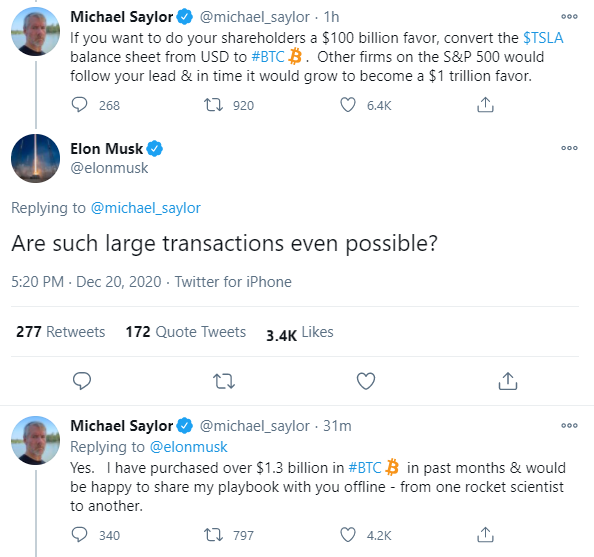
In a Twitter conversation with Microstrategy CEO Michael Saylor, Elon Musk entertains the possibility of parking some of Tesla’s reserve cash into BTC. An increasing number of institutional investors are looking to BTC to increase shareholder value. Saylor, a once-BTC-skeptic, has moved $1.3b of assets into Bitcoin. Source: Twitter.

How to invest and trade the 2020-21 bull run
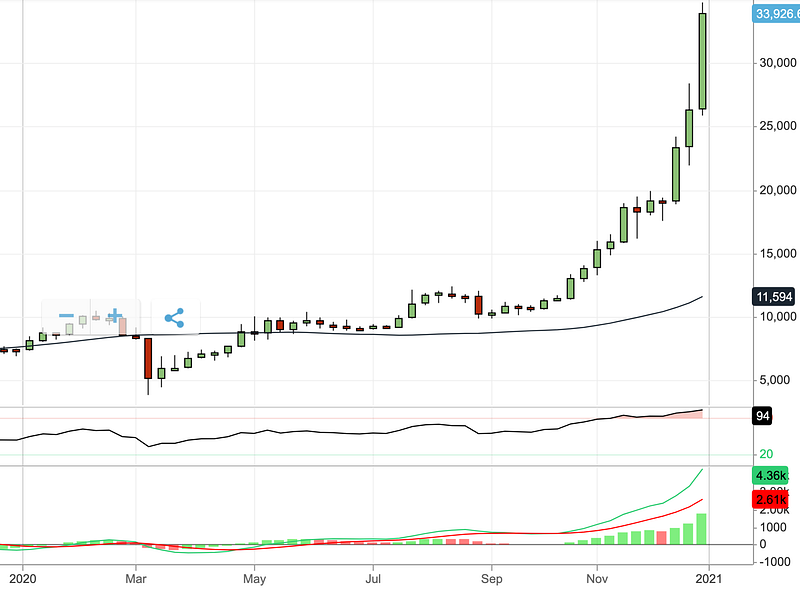
Bitcoin has well and truly lift off since 2020 Nov, a month after I initially published this article. Image source: eToro’s charts.

You’ve now made the decision to profit from Bitcoin’s current bull run. What’s your strategy? You’ll want to decide on one before you get in, because trading a volatile asset without a strategy is the surest way to lose your money.

Here are three strategies:

  1. Buy & Hold. Buy as much Bitcoin as you can before the price hits $20,000. If you’ve missed this boat, it’s okay to get in on the action while the price is still under $35–40,000. Then hold onto it until the end of the bull run, projected to be around Q4 2021. Expect large drawdowns along the way. Don’t stress, this is part of the journey. You’re not swing trading, you’re holding the price hits a certain target around a certain time. This strategy is by far the easiest and most passive option, and the most sensible for inexperienced investors. (2021 Jan edit: actually, this is a very sensible strategy even for experienced investors and traders.)
  2. Buy & Hold; buy more during big corrections. If you’ll have spare cash during the coming year, add to your position during big corrections. This is the most sensible option for the majority of people who plan to add more money to their brokerage throughout the year.
  3. Buy & Hold; time the big corrections. This one is very difficult to pull off. Historically, BTC price tended to reach around 160–170% of the previous drawdown’s low point before experiencing a large drawdown. This strategy involves exiting a portion of your BTC position around this point, and re-entering at a lower price. 2021 Jan edit: This strategy is very risky — there is a high statistical probability you will be better off with Strategies #1 & 2.

In any case, here’s a concrete example to illustrate the 3rd strategy:

  • As of 2020 Dec 10, the last big correction was ~$16,500.
  • Hold your BTC until the price goes up 150%. That’s around $40,000.
  • Start selling off some of your BTC at $40,000. For example, close 5% of your position at $40,000, another 5% at $40,500, another 5% at $41,000 and a final 5% at $42,000. You’ve now sold off 20% of your holdings in anticipation of a big correction.
  • At $45,000, BTC commences a large correction (but again, the risk is this might not happen, or happens earlier or later). Let’s say BTC pulls back 30–40% (although again, the risk is the drawdown is much smaller), giving you an opportunity to buy in at significantly discounted prices.

For the majority of people, the 1st and 2nd strategies (buy & hold; add more during corrections) is absolutely the way to go. Given how the current bull run is progressing (as of Jan 2021), I would say the 3rd strategy is akin to gambling. Be rational and sensible.

For the impatient, be aware that historically the majority of bull runs are boring, where we BTC trades sideways most of the time before quick and sharp pumps.

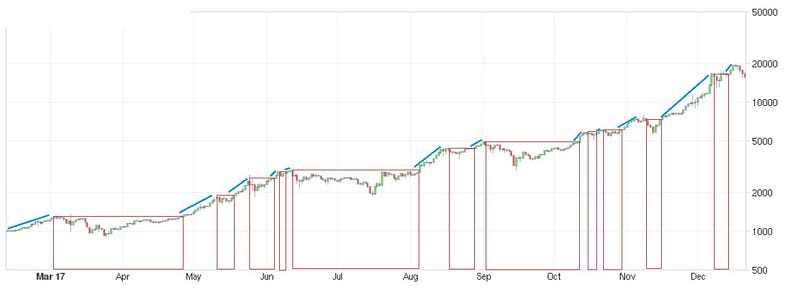
The bit Bitcoin moves tend to be dramatic and quick, followed by extended periods of slow pullbacks and/or consolidation. Source: Twitter.

Finally, please manage your risk.

Past cycle performance does not guarantee the future.

I expect an admirable performance from bitcoin over the next two years assuming macroeconomic factors continue to provide tailwind support.

However when the US Federal Reserve signal some sort of bearish pivot in response to inflationary pressures— which I believe is inevitable at some point given the unprecedented sheer level of stimulus and balance sheet expansion —that’s the time to wind down the equities and crypto party.

We’re currently in a ten-year secular bull market. Enjoy it while it lasts. Keep your eyes on the pulse.

Where to buy Bitcoin

I personally use

  • eToro — all-in-one platform for stocks, crypto and commodities.
  • Binance — world’s largest exchange. Buy real crypto and transfer to your own self-custodial wallet. Join here and get 5% of fees forever.
  • Nexo — leading CeFi lending platform with crypto saving accounts. Sign up here for up to $50 free BTC.
  • Crypto.comlending, saving and exchange all in a nice app. Sign up here and get $25 CRO free when signing up for a Ruby Steel or above VISA card.

FAQ about Bitcoin

What is Bitcoin?

A blockchain is a digital ledger that records transactions between two parties in a permanent and verifiable way without the need for a middleman like a bank. Within blockchains, transactions are grouped into blocks and linked together with cryptography.

Bitcoin is the world’s first commercial application of blockchain and is

  • a method of exchange (like cash)
  • used as a store of value (like gold)
  • speculated upon as a financial instrument (like stocks)

As a digital method of exchange, Bitcoin solved the infamous double spending problem.

What’s special about Bitcoin?

In short, blockchain is a revolution in technology and bitcoin is a revolution in money.

Bitcoin is unique in the history of mankind because — until now — humans have never known something that simultaneously combines the following three properties:

  1. digital
  2. scarce
  3. decentralised

Gold is scarce and decentralised, but not digital. Stocks may be scarce and digital, but they’re centralised. Fiat money is certainly not scarce — central banks continue to pump billions more of it into our economies as we speak! Bitcoin ticks all the boxes.

Philosophically, Bitcoiners believe that Bitcoin gives power back to the people. When governments and central banks control the supply of money and can change its real value at a whim by printing more of it at will, they exert economic power over us. Bitcoin’s decentralisation bypasses that tomfoolery and its scarcity preserves value. This is a revolution in money.

Management of Bitcoin

The governance of Bitcoin differs from traditional corporate governance.

  • Bitcoin relies on algorithms, open source code and a network of developers to manage the network. Bitcoin relies on a proof of work algorithm of secure and verify transactions and to create new Bitcoins. High-powered computers (i.e. Bitcoin miners) compete with each other to confirm transactions by solving cryptographic math puzzles. Winning miners are rewarded with new BTC for their efforts.
  • As Bitcoin is decentralised and open source, there is no central authority that presides over its evolution, unlike governments and banks with fiat money. BTC’s source code was written by an unknown person/entity called Satoshi Nakamoto. Developers who commit changes to the source code need to consider whether their changes are in line with Bitcoin’s vision, meet minimum standards of inclusion and align with the consensus of other contributors.

Financials and Valuations

As Bitcoin isn’t a cash generating asset, traditional metrics like earnings, revenue, P/E, P/B, etcetera, don’t apply to BTC. Instead, we look at other numbers like:

  • Hash rate. This is the number of those math puzzles the Bitcoin network can solve each second. Higher the hash rate, the more secure the network is. BTC’s current hash rate is 125 TH/sec — an increase of 32% YoY.
  • Bitcoin dominance versus altcoins. This measures the market share of Bitcoin versus all other cryptocurrencies. Currently, BTC dominance is 65%.
  • Confirmed transactions per day. A new block is confirmed by miners every 10 minutes. The BTC network processes 347K transactions per day — an increase of 6% YoY.

Investment risks

  • Low adoption. This is the single biggest existential risk facing Bitcoin. Thankfully, many are long-term bullish on BTC precisely because its institutional and retail adoption is showing no signs of slowing down. Bitcoin is here to stay.
  • Regulation. The banning of BTC by governments is an example of this. However, it is incredibly unlikely that every government will collude together to ban BTC. The bigger risk is governments begin creating their own digital currencies to rival BTC — something that they can control.
  • 51% attack. This is an attack on the BTC network whereby a group of miners collude together to control more than 50% of the hash rate. They could prevent new transactions from being confirmed, reverse transactions and double spend. A scenario like this is extremely unlikely, but technically possible.

Shout outs to Sylvain Saural and Tomislav Rogulj for their insights.

Calculation Appendix for Annualised Return Rate

Understanding the Power of Compound Interest can transform your life.

Annualised return rates can be calculated as follows. For an asset that cost C, the final price F — after compounding n years at annualised rate of return r — is given by:
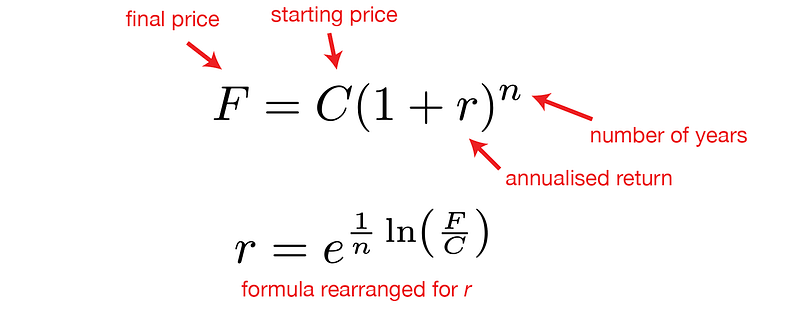
Check out my sister article on the Power of Compound Interest for an insightful take on compound interest and investing.

Applying this to Bitcoin gave:

Final Words

The 2017-18 Bitcoin bull run and subsequent crash was fuelled by retail investors FOMO-ing into a speculative asset bubble.

In 2020, Bitcoin’s has matured fundamentals. Its 3rd post-halving bull run is underway, supported by increasing institutional adoption; trickling supply caused by Bitcoin whales and large companies like PayPal and Square (ultimately feeding BTC into the hands of ordinary people); and its status as a safe haven asset in the face of record ongoing stimulus.

As a retail investor, you want to be fully-positioned before BTC hits $20,000. The price is projected to reach between $60,000 to $325,000 by Q4 2021. You’ll then exit, taking a very healthy profit.

If you’re in the game for the long-run, simply HODL and buy more during the dips.

Bitcoin’s finite supply of 21 million BTC, continued growth in network effects and its basis for a new decentralised financial system that separates money from politics should see its value continue to rise over the coming years.

For those who want to take a deeper look at the power of compound interest, please see this article for a visual comparison between different asset classes.

Are you curious to learn about the cryptocurrency space beyond just bitcoin? Check out my articles here, here, here, here and here.

Interested in generating strong passive income with cryptocurrency? I’ve got you covered here and here.

Cheers and enjoy.

Follow me on Twitter & YouTube for regular analyses and guides.

My Crypto Articles

Crypto Sign Up Bonuses

  • Binance — 5% off fees forever (link)
  • Nexo — $25 free BTC with $100 deposit (link)
  • Crypto.com — $25 free CRO with a Jade Green VISA Card (link)
Finance
Investing
Bitcoin
Economics
Data Science
Recommended from ReadMedium