Voting Comes With Responsibility
Are voters ready to make an informed decision in the next election?
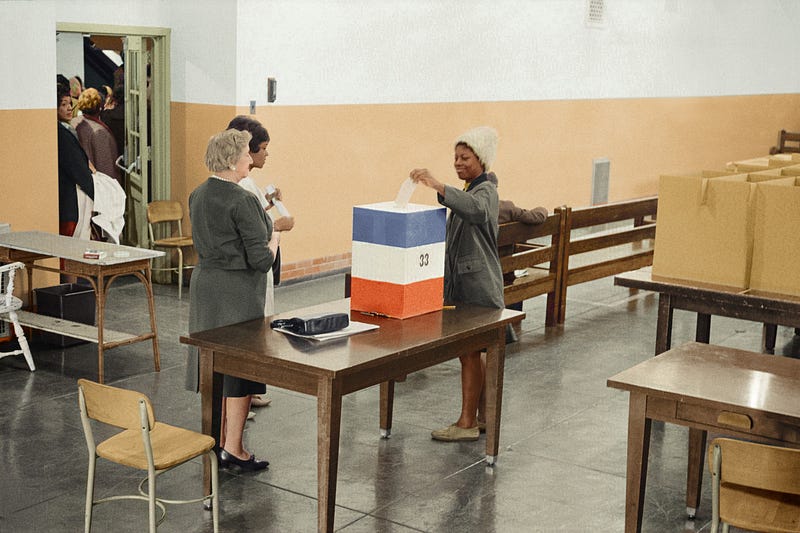
As we near election day, its approach travels like a storm on the horizon. Every American history book includes examples of incivility in government. But it seems that in this election and the last election cycle, the volume of our nation’s discourse has risen to dangerous heights, drowning out the reasoned discussion of issues. The good news about strong loyalty is that people follow their leaders, and with better leaders, we could journey to better places.
The meaning of free speech
According to Armand Derfner, a civil rights attorney, voting “is the ultimate expression of a person’s point of view.” Free speech allows us to challenge injustice, but there are instances when rhetoric can perpetuate injustice and even harm. There is a concerted effort underway to exclude certain people from political and community life in our time. Still, those people are not necessarily black, Jewish, gay, etc., but targeted because they are political nonconformists.
Politics is not a gentle endeavor
For many Americans, conversations about politics have become stressful experiences that they prefer to avoid, exacerbating during the presidential election campaign. Concerns seem to focus on the need for reliable information and the dangers posed by the easy availability of seductive misinformation. And for a good reason. The severity of our current political fault lines keeps appearing, expressing opinions in ways that are inflammatory and unconvincing. Under the current climate, there is no incentive for candidates to behave more civilly. It seems that some words used with frequency have become so familiar that we no longer examine what we know about them. Words breathe life, made of bones, cloaked with flesh, and ligament. Yet, we’ve become almost immune to the barbs, words that are aimed to demonize rather than to persuade.
Election campaigns can be quite unclear
They are aimed more at lifting a candidate’s star personal qualities and aptness for leadership than laying out the details of the policy. Short and sharp soundbites are catchy and aim to grab voters’ attention. Obama became the candidate of ‘change’, inspired a generation with his positive, upbeat message. Appealing to Americans who believed the country was in decline, Trump, Reagan, and Clinton used “Make America Great Again.”
But this should not be misconstrued for a hopeful sign about the political system itself. Motivations are strong for politicians and pundits to take a one-sided, closed-minded stance. Often, we are treated to candidates shouting each other down on the prime-time debate stage or exchanging insults via rapid-fire tweets, with media headlines following every keystroke. Political parties declining to reach across the aisle, while protestors and supporters hurl slurs at each other, is akin to watching a prizefight, awarding points to well-placed barbs delivered as if they were blows.
Drawing on Katherine M. Gehl and Michael E. Porter, who co-authored, The Politics Industry: How Political Innovation Can Break Partisan Gridlock and Save Our Democracy, specific strategic changes to the rules of the game in elections would create healthy competition, and innovation. In short, business, in pursuing its short-term interests, has become a key participant in the political-industrial amalgam.
Competition in politics takes place on two primary levels: competition to win elections and competition to pass or block legislation. Democrats and Republicans differentiate themselves by dividing up voters according to ideological and one-sided interests. They target equally exclusive groups of supporters and special interests to minimize overlap. This separation enhances supporters' loyalty and reduces accountability. In business practices, customers have the power to penalize rivals for inferior products and services by taking their business elsewhere. Not so in politics. Both parties center on competing to strengthen the division by demonizing the other side instead of providing practical solutions that would most likely require cooperation.
Informed decision-making
In the year of 1787, James Madison spent the year before the Constitutional Convention reading books on the history of failed democracies — such as the assembly in Athens. In helping to draft the Constitution, he was resolute in avoiding the fate of those “ancient and modern confederacies.” Madison supposed that Athenian citizens were influenced by ambitious politicians who had played on their emotions. He believed that enlightened journalists would ultimately promote the “commerce of ideas.” He had faith that citizens would take the time to read complicated arguments, allowing levelheaded reason to spread across the new republic.
Many voters are convinced that politicians are selling them out
Public support for both parties is waning. And much of the partisanship is negative, meaning that party identification is driven mostly by loathing for the other side. There is no incentive for candidates to behave more civilly. This stark reality of political discourse is at the forefront of social media. Political opinions, expressed on social media, are nearly all in Demonization Mode, which people process emotionally. Rabble-rousing posts based on passion, voyage farther, and faster than discourse based on reason. Rather than encouraging debate, mass media undercut it by creating echo chambers in which some people see only those views they already support. The posts shared are not angled to changing the mind of someone who disagrees. Instead, they are written to appeal to people who already agree, with the result of reinforcing opinions and locking down minds.
Disagreeing without being disagreeable
Political discourse relies on the persuasive and manipulative functions of language. Positively, name-calling, snarky posts, and personal attacks do not contribute to the promotion of democracy. Building a free and fearless discourse isn’t about protecting the way of righteous moral minorities who will one day be vindicated by history. No, to defend free exchange is already, intrinsically, to support the right to be wrong. It is about the freedom to persuade — and to be convinced.
As a progressive, you can attain points with other progressives by labeling others as tyrants, but that is unlikely to prove swaying to conservatives or libertarians, similarly, with conservatives marking others as brutes or libertarians labeling others as statists. The thing is, that if we treat those with whom we disagree as having immoral intent, then that prevents us the trouble of having to listen to the essence of what they are saying.
While many like to believe that they have access to the facts, the truth is that we all see the world around us not as it is, but as we want it to be. As an example, Republicans watch Fox while Democrats watch MSNBC, and from that citing authorities and citations to supporting arguments. The point is that beliefs dictate what we see and how we see.
Critical thinking
Some voters are predisposed to biased decision-making based on social identities and partisan loyalties, not honest scrutiny of reality.
When heated rhetoric is in the air, emotional responses to the crisis of the day threaten to overtake rational deliberation. The debate becomes less flexible, as leaders have trouble pursuing conciliatory tactics in a climate of affront. Critical thinking is open to all ideas and arguments, even those with which they may oppose. Analytical thinking is devoid of judgment on points until examined with the employment of logic and reasoning. Such an act is fair-minded and allows for a message to be neither inherently wrong nor flawed if it differs from one's own thought. Critical thinking accepts the notion for the possibility of changing a current view on an issue when logic and evidence supports doing so.
Voting comes with responsibility. If we pay attention, research statements, and facts, we may be able to parse declarations made by candidates, research political validity through neutral fact-checking, and engage in other means to determine how we will cast our votes.
If you liked this piece, consider reading more of my writing.
Thank you!