
ENVIRONMENT
UN Decade on Ecosystem Restoration Has Started. Wanna Join?
Everybody can contribute.
The United Nations have declared the next decade 2021–2030 to be the ‘Decade on Ecosystem Restoration’. And the people who follow my work will understand that I’m mighty happy with this attention for the most important action of our times.
Why is it important, you ask?
Well, there is one truth. One truth only. And that is we are diverse humans on a planet that’s being destroyed by human greed and our limited ambitions to design human systems that optimize abundant natural laws.
We built our systems, such as economies, societies, and health on scarcity. Stupidly. Creating one human product without creating more qualitative value at the same time.
And if we don’t manage to align our human systems with the planetary, intrinsically abundant natural laws, our grandchildren will have no future.
I often write about nature-based solutions. Because that’s where it starts. The alignment of human systems and natural systems. We need to design systems that have benefits for humans (fulfilling basic needs for all) and that will allow Mother Nature to be regenerative as well.
Restoration and Production
The United Nations recognizes that we have to restore. We have to protect. And we have to make sure the land and all the products we make will be regenerative. Able to restore themselves over time. That’s what Mother Nature is teaching us.
But restoration not embedded in a community’s economy is doomed to fail. You see it in areas where there’s poaching. If people aren’t able to meet their basic needs, they will not see the complete picture anymore. They will take what they can get to feed their children.
Our new economies and societies will therefore be local areas of human inclusivity connected to the land. The natural produce. The goodies Gaia gives us. For us to use without abuse. No exploiting the abundance. But creating more abundance with the abundance given to us.
And the good news is, large groups of people are working on it. In all kinds of fields. Business models are becoming systemic and based on synergy. Material science is working on new materials that are biodegradable in soil, freshwater, saltwater, and even air. They are even finding ways to make their materials regenerative with micro-organism processes, such as fermentation.
Economists are redesigning economies with the Doughnut of Kate Raworth. Amsterdam is onto it as a city. New Zealand and Bhutan are onto it as countries designing a larger dashboard than just GDP. They are putting the health of humans and the planet central. They are creating a wellbeing economy.
Large Scale Ecosystem Restoration
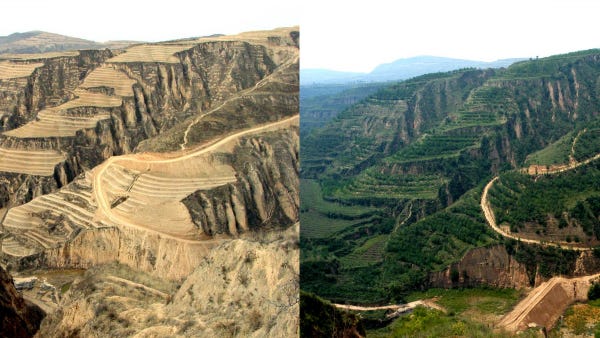
In many areas of the world, ecosystem restoration is happening on a large scale. In China, the Loess Plateau, an area the size of my country The Netherlands, has been restored in 15 years.
In India, the sacred mountain of Arunachala has been reforested.
In Indonesia, we are working on restoring huge areas of wetland with mangrove forests to keep us safe from the sea and produce healthy food (fish and mangrove products) in the process.
In many countries, farming is embracing regenerative practices to restore farmland and have healthy produce while at the same time restoring the soil and the water cycles.
It is the way to go. And it starts with the sectors that have the closest links between human systems and natural systems. Where we can see the links most easily. Where the materials of our products to fulfill basic needs are easiest to imagine being biodegradable.
And produced with local, abundantly available materials such as bamboo, industrial hemp, nettles, seaweed, and other goodies from nature.
Start with Your Garden
We are in transition, my friends. We are on our way to align the economy with ecology and the human spirit. We are changing our human systems on a large scale by doing ecosystem restoration projects. We are changing business with many entrepreneurs creating startups with a purpose. We are changing governments and laws.
What can you personally do, you ask? Well, a lot.
- The transition needs us to be clear on what we really want in life. Stuff? Products we do not need? Skip buying them. Support the local farmers. Join Community Supported Agriculture (CSA).
- Learn. Start a permaculture course and put your hands in the soil. You will learn how to create your own edible garden. But you’ll learn much more! Everything I have talked about in the last 2 years, is part of the systemic design lessons of permaculture.
- Someone asked me, what can I do in an apartment without a balcony and garden? Well, be creative. Walls can have hanging plants. A few pavement tiles can be removed to plant some climbers. Everything helps.
- Start a community garden. All the space to restore ecosystems, build social glue in your area and have food for your children.
- We need to teach ourselves and our children to be wise humans on a beautiful planet that can definitely support us if we design better systems.
And the good news is that all of your gardens together will contribute to ecosystem restoration big time! Don’t ever think you are small and don’t have any influence. Look at the influence one small virus has on our system. We are never too small to make a difference!
If you redo your garden in line with Gaia’s abundant laws and symbiotic micro-organisms and inspire one other person to do the same, we will get there in no time!
Happy gardening my friends.
Thank you, Mike, for adding your wise energy to my words. If you want to connect, you can find me somewhere on this beautiful planet. My hands in the soil and my gaze focused on the stars. Or you can find me via Linktree.
© Désirée Driesenaar


