
avatarJames Stanier

Free AI web copilot to create summaries, insights and extended knowledge, download it at here

6288

Abstract

hey treat everyone as remote. <i>Every</i> action via code, written, or spoken word should provide an equal interaction opportunity to anyone regardless of their location.</p><h1 id="1198">Actions and Initiatives</h1><p id="cd30">Companies can create this equal opportunity by performing some of the following actions and initiatives.</p><ul><li><b>Declare intent.</b> You can’t expect anyone to begin changing if you don’t talk about your intention clearly. As explored in my <a href="https://www.theengineeringmanager.com/remote-working/2020-a-year-spent-remotely/">initial post reflecting on a year spent remotely</a>, there are plenty of reasons for beginning to act like a <i>remote-first </i>company, even if that may not be your final trajectory. Tell yourself, your team, and others that you know that you are going to be changing your working practices to better support remote workers. Like our meditation example above, this message may be simple, but it isn’t straightforward. You may find yourself having to repeat this message, in combination with taking the actions that follow, for it to really sink in.</li><li><b>Shift to asynchronicity. </b>Synchronous communication is essential, but maybe not always as essential as you think. Adopt a mindset where you question all of your synchronous communication — such as video calls and instant messages — and see whether you can move to more asynchronous alternatives such as email and writing documents. Not only will this change reduce the time that you spend in meetings, which can be draining and interrupting for everyone’s flow, but it will also produce more artifacts that can be shared and read more widely at a later date.</li><li><b>Clarify time and commitment expectations. </b>Shifting to more asynchronous communication means that the time taken to close the loop may be longer. However, it’s more inclusive and often better thought through. Working with your colleagues to help them understand that this is purposeful, and most importantly, perfectly normal, is something that you’ll need to do. State your intention that it’s okay to not read communications not specifically important to an individual. Also, say that it’s okay to take until the end of the week to read and comment on a proposal. The net effect is increased autonomy and flow.</li><li><b>Choose appropriate tools to support remote collaboration. </b>I often take for granted that we are already avid users of Google’s office suite, which has excellent collaboration and commenting capabilities. The same is true for Github, Slack, Miro and Figma, and others. However, some companies still make it extremely difficult to collaborate effectively, such as by emailing around local copies of documents which then require a copy to be made and so on, until you reach <i>final_version_7_FINAL.doc.</i> Champion better tools and demonstrate them to your colleagues to drive bottom-up change. Ask those with the power to make decisions and spend budget to help you.</li><li><b>Habitually produce artifacts. </b>With everything that you do, ask if you should be creating a useful artifact for the future. Whether that’s recording a meeting so that people can watch it asynchronously later, or writing up that design document to develop your thoughts with others, or creating that <a href="https://adr.github.io/">Architecture Design Record</a>, <i>create them. </i>Artifacts are <i>so</i> useful so that you understand where you’ve come from, where you are currently going and where, eventually, you want to get to.</li><li><b>Instill meeting and video call etiquette. </b>Don’t be like the Cabinet Room. Request participants to each use their own camera and microphone, and mute when not talking. If useful, write up your agenda and thoughts beforehand so that the meeting can run efficiently. Use a spotter to check for people on the call who aren’t being heard and invite them into the conversation.</li><li><b>Broadcast information to the widest possible group. </b>Think about who is hearing, seeing, and reading your communication. Could it be useful to a broader group of participants, even if it’s just optional information that they can read if they’re interested? If so, don’t repeat yourself in the future; broadcast it immediately at a wider level. A DM could become a message in the team’s chat room. A team chat room message could instead go out to the whole department. Remember that people can just not read something if they don’t want to. That’s fine.</li><li><b>Continually take visible action. </b>Most importantly, just keep doing all of these things continually. Soon your habits will catch on and others will follow.</li></ul><h1 id="b43f">Homework</h1><figure id="5215"><img src="https://cdn-images-1.readmedium.com/v2/resize:fit:800/0*AjVeTZrnZyyfCKUm"><figcaption>Photo by <a href="https://unsplash.com/@kellysikkema?utm_source=medium&amp;utm_medium=referral">Kelly Sikkema</a> on <a href="https://unsplash.com?utm_source=medium&amp;utm_medium=referral">Unsplash</a></figcaption></figure><p id="c5dc">Now, on to the exercise. Pencils at the ready.</p><p id="8d9d">Spend some time thinking about your own workplace, department, or team.</p><p id="554b">How would you rate yourselves against the <i>intention</i> of treating everyone as remote when compared to the continual <i>actions and habits </i>that you are taking?</p><p id="02ec">Is there a void here? What needs to be done to change that? Also, assuming you’re reading this sometime around the time that it was written, how have these habits changed when you compare your workplace now to how it was before the COVID-19 pandemic?</p><p id="3c6e">Think about some changes that you can implement right away to close the gap between intention and action. Then do them.</p><p id="7437">In articles to follow in this <a href="https://www.theengineeringmanager.com/remote-working/">remote working</a> series, we’ll unpack all of the rules and approaches in finer detail. If you want to follow along for the ride, <a href="http://eepurl.com/cSMExr">sign up for my newsletter</a> and I’ll let you know when there are new posts available.</p><p id="6b60">Did you enjoy this article? You might also like James Stanier’s book, <i>Effective Remote Work</i>, now in beta from The Pragm

Options

atic Bookshelf:</p><div id="6b7d" class="link-block"> <a href="https://pragprog.com/titles/jsrw/effective-remote-work/"> <div> <div> <h2>Effective Remote Work</h2> <div><h3>The office isn't as essential as it used to be. Flexible working hours and distributed teams are replacing decades of…</h3></div> <div><p>pragprog.com</p></div> </div> <div> <div style="background-image: url(https://miro.readmedium.com/v2/resize:fit:320/0*vp9-njqG4mwdz_GP)"></div> </div> </div> </a> </div><p id="76c7">Do you want to help us create better books? Read our books while they are still in beta and leave feedback for the author on the <a href="https://devtalk.com/books/effective-remote-work">book’s forum page</a>.</p><h1 id="6cc5">Further Reading</h1><p id="298b">Also by James Stanier:</p><div id="d825" class="link-block"> <a href="https://readmedium.com/conducting-1-to-1s-b25dc1f898e9"> <div> <div> <h2>Conducting 1 to 1s</h2> <div><h3>Build Strong Relationships and Identify Future Superstars</h3></div> <div><p>medium.com</p></div> </div> <div> <div style="background-image: url(https://miro.readmedium.com/v2/resize:fit:320/0*M1KQVKO6Kkw-xyPC)"></div> </div> </div> </a> </div><div id="b706" class="link-block"> <a href="https://readmedium.com/giving-feedback-f94b8e75ea60"> <div> <div> <h2>Giving Feedback</h2> <div><h3>Easy, Right?</h3></div> <div><p>medium.com</p></div> </div> <div> <div style="background-image: url(https://miro.readmedium.com/v2/resize:fit:320/1*sdRDAmeJu9o4BeC__NkIRQ.png)"></div> </div> </div> </a> </div><div id="f2f6" class="link-block"> <a href="https://readmedium.com/managing-upwards-f3e710b5830b"> <div> <div> <h2>Managing Upwards</h2> <div><h3>Upwards?</h3></div> <div><p>medium.com</p></div> </div> <div> <div style="background-image: url(https://miro.readmedium.com/v2/resize:fit:320/1*TpILWcakmqmLCMeWWmIj3A.jpeg)"></div> </div> </div> </a> </div><div id="a8b8" class="link-block"> <a href="https://readmedium.com/bringing-your-whole-self-to-work-4bf091340750"> <div> <div> <h2>Bringing Your Whole Self to Work</h2> <div><h3>Wow, This Is So Much More Tiring than Programming…</h3></div> <div><p>medium.com</p></div> </div> <div> <div style="background-image: url(https://miro.readmedium.com/v2/resize:fit:320/0*WLYp2B6leG5y3oHC)"></div> </div> </div> </a> </div><div id="8791" class="link-block"> <a href="https://readmedium.com/performance-reviews-31026c423643"> <div> <div> <h2>Performance Reviews</h2> <div><h3>It’s That Time of Year Again…</h3></div> <div><p>medium.com</p></div> </div> <div> <div style="background-image: url(https://miro.readmedium.com/v2/resize:fit:320/1*VHGMue5KQzy7shkcuV4Gzg.png)"></div> </div> </div> </a> </div><div id="2f6e" class="link-block"> <a href="https://readmedium.com/doing-interviews-48a2bf55f930"> <div> <div> <h2>Doing Interviews</h2> <div><h3>The Other Side of the Table</h3></div> <div><p>medium.com</p></div> </div> <div> <div style="background-image: url(https://miro.readmedium.com/v2/resize:fit:320/1*if1_F2OY2fgCLLsZznyNqw.png)"></div> </div> </div> </a> </div><div id="920c" class="link-block"> <a href="https://readmedium.com/feeling-productive-23b2568996de"> <div> <div> <h2>Feeling Productive</h2> <div><h3>Why Do I Feel Like I Get Nothing Done?</h3></div> <div><p>medium.com</p></div> </div> <div> <div style="background-image: url(https://miro.readmedium.com/v2/resize:fit:320/0*UfH-y1zRpo03kqeO)"></div> </div> </div> </a> </div><div id="e85b" class="link-block"> <a href="https://readmedium.com/attracting-people-to-work-for-you-7a1d33c39ced"> <div> <div> <h2>Attracting People to Work For You</h2> <div><h3>It’s Not Just the Technology</h3></div> <div><p>medium.com</p></div> </div> <div> <div style="background-image: url(https://miro.readmedium.com/v2/resize:fit:320/0*GpiBeRGWcqrobBfT)"></div> </div> </div> </a> </div><p id="78d3"><i>Become An Effective Software Engineering Manager </i>on Medium:</p><div id="7e54" class="link-block"> <a href="https://readmedium.com/table-of-contents-e8bf453fe2b4"> <div> <div> <h2>Become an Effective Software Engineering Manager</h2> <div><h3>Become an Effective Software Engineering Manager — by James Stanier (0 / 96)</h3></div> <div><p>medium.com</p></div> </div> <div> <div style="background-image: url(https://miro.readmedium.com/v2/resize:fit:320/1*sZWA2wjCR6nEwnOk6qSejg.jpeg)"></div> </div> </div> </a> </div><p id="c568"><i>Story originally published at <a href="https://www.theengineeringmanager.com/remote-working/treat-everyone-as-remote/">https://www.theengineeringmanager.com</a> on January 20, 2021.</i></p></article></body>

Image by By fizkes on Shutterstock

Treat Everyone as Remote

Second-Class Citizens

📚 Connect with us. Want to hear what’s new at The Pragmatic Bookshelf? Sign up for our newsletter. You’ll be the first to know about author speaking engagements, books in beta, new books in print, and promo codes that give you discounts of up to 40 percent.

As a remote worker, you may experience the feeling that you are several steps removed from the rest of the physically co-located company. This feeling manifests day in and day out. You have the nagging suspicion that discussions and decisions are happening in person without your input. You notice a worryingly empty email inbox during challenging periods and strangely quiet chat rooms. When joining a meeting via video call — you see ten tiny figures sitting around a conference room table, sharing one microphone.

This is when remote working sucks. You feel like an other; unlike so-called normal staff — perhaps even like a lesser member of the company. This situation isn’t right. However, don’t attribute these issues to malice. After all, for decades we have been used to working together in offices. Old habits die hard, especially if they aren’t challenged.

I remember a long time ago when the magnetic hub of our company was our HQ in Brighton. The anecdote in mind happened when we were hiring rapidly after receiving a funding round. We had monthly induction sessions for new starters that walked them through what the company did, the software we built, how we marketed it and sold it — all of that good stuff. These inductions were organized well, planned and practiced, and generally speaking were a fun, informative experience.

That is, except for the month when we started onboarding some engineers in our smaller Stuttgart office. They would turn up to the meeting, join the video call, and wait for the person leading the session in Brighton to join. But they never did. Messages were sent that were unanswered. Everyone’s laptops were closed. No malice, just forgetfulness. But that forgetfulness, repeated daily, compounds into larger frustrations about being remote in comparison to other members of staff who are not.

Equality

Photo by Andrew Moca on Unsplash

We should aim to treat everyone equally. But equality requires a mindset shift. The title of the article says it all, really: treat everyone as remote.

That’s how you solve the problem of any worker in your company feeling like they are remote. You simply act as if everyone is, thus canceling out the prefix: if everyone is treated like a remote worker, then really, they’re all just workers. Equal. No longer do the remote workers need to continually put in additional effort to gather missed information, to remind people they are still there, or that their timezone is different. Instead, they do their work just like everyone else and interact with others like everyone else.

Even though this is simple, it isn’t straightforward. It’s a little bit like if you’ve ever tried to meditate. It’s simple: just continually focus on your breathing. But it’s not straightforward: your mind wanders and you get caught up in thoughts. You bring your attention back to your breath and guess what, your mind is generating thoughts again.

Treating everyone as remote requires a mindset shift in every individual in the entire company. It means that every action and interaction should be done in such a way that equally benefits somebody regardless of whether they are present in a physical office or not. At the time of writing, we’re living through the largest remote working experiment in the technology industry: a global pandemic.

Following is a screenshot of the first remote cabinet meeting of the UK government from March 2020. At this point the country had been put under the first initial lockdown measures, indicating that everyone who was able to work from home should do so. In what should now be a familiar sight, the meeting was being conducted via Zoom.

Most participants of this call are remote and are therefore acting in the correct way to treat everyone as remote.
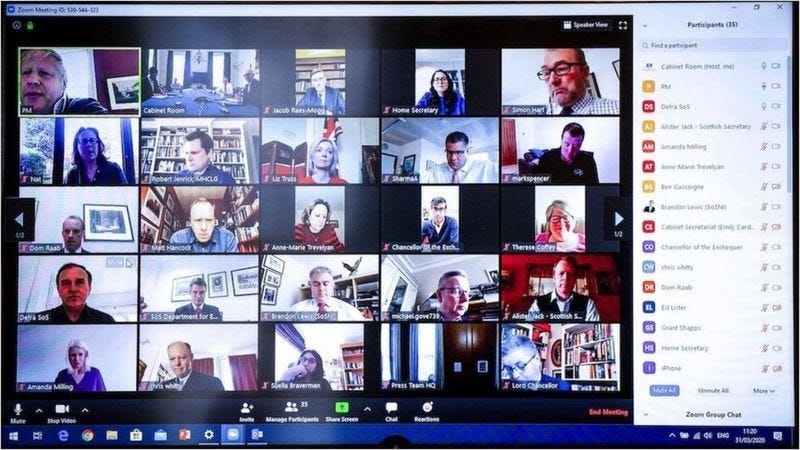
However, one group of participants are not abiding by this rule. On the top row, second from left, the Cabinet Room has joined the meeting via a traditional meeting room AV setup: one fixed camera and a microphone in the middle of a shared table.

Whereas all other participants have a microphone and camera each, allowing them to properly see and hear each other. In contrast, understanding the facial expressions of the person sitting farthest away on the Cabinet Room table requires some serious CSI enhance! magic. Do you reckon that everyone else on this call got frustrated with not being able to see or hear them properly? Do you think that they may have experienced, perhaps for the first time, one of the frustrations of being a remote worker when others do not treat everyone as remote? Ah, yes. That.

The first big thing for truly supporting remote workers is that the entire company needs to adopt a mindset where they treat everyone as remote. Every action via code, written, or spoken word should provide an equal interaction opportunity to anyone regardless of their location.

Actions and Initiatives

Companies can create this equal opportunity by performing some of the following actions and initiatives.

  • Declare intent. You can’t expect anyone to begin changing if you don’t talk about your intention clearly. As explored in my initial post reflecting on a year spent remotely, there are plenty of reasons for beginning to act like a remote-first company, even if that may not be your final trajectory. Tell yourself, your team, and others that you know that you are going to be changing your working practices to better support remote workers. Like our meditation example above, this message may be simple, but it isn’t straightforward. You may find yourself having to repeat this message, in combination with taking the actions that follow, for it to really sink in.
  • Shift to asynchronicity. Synchronous communication is essential, but maybe not always as essential as you think. Adopt a mindset where you question all of your synchronous communication — such as video calls and instant messages — and see whether you can move to more asynchronous alternatives such as email and writing documents. Not only will this change reduce the time that you spend in meetings, which can be draining and interrupting for everyone’s flow, but it will also produce more artifacts that can be shared and read more widely at a later date.
  • Clarify time and commitment expectations. Shifting to more asynchronous communication means that the time taken to close the loop may be longer. However, it’s more inclusive and often better thought through. Working with your colleagues to help them understand that this is purposeful, and most importantly, perfectly normal, is something that you’ll need to do. State your intention that it’s okay to not read communications not specifically important to an individual. Also, say that it’s okay to take until the end of the week to read and comment on a proposal. The net effect is increased autonomy and flow.
  • Choose appropriate tools to support remote collaboration. I often take for granted that we are already avid users of Google’s office suite, which has excellent collaboration and commenting capabilities. The same is true for Github, Slack, Miro and Figma, and others. However, some companies still make it extremely difficult to collaborate effectively, such as by emailing around local copies of documents which then require a copy to be made and so on, until you reach final_version_7_FINAL.doc. Champion better tools and demonstrate them to your colleagues to drive bottom-up change. Ask those with the power to make decisions and spend budget to help you.
  • Habitually produce artifacts. With everything that you do, ask if you should be creating a useful artifact for the future. Whether that’s recording a meeting so that people can watch it asynchronously later, or writing up that design document to develop your thoughts with others, or creating that Architecture Design Record, create them. Artifacts are so useful so that you understand where you’ve come from, where you are currently going and where, eventually, you want to get to.
  • Instill meeting and video call etiquette. Don’t be like the Cabinet Room. Request participants to each use their own camera and microphone, and mute when not talking. If useful, write up your agenda and thoughts beforehand so that the meeting can run efficiently. Use a spotter to check for people on the call who aren’t being heard and invite them into the conversation.
  • Broadcast information to the widest possible group. Think about who is hearing, seeing, and reading your communication. Could it be useful to a broader group of participants, even if it’s just optional information that they can read if they’re interested? If so, don’t repeat yourself in the future; broadcast it immediately at a wider level. A DM could become a message in the team’s chat room. A team chat room message could instead go out to the whole department. Remember that people can just not read something if they don’t want to. That’s fine.
  • Continually take visible action. Most importantly, just keep doing all of these things continually. Soon your habits will catch on and others will follow.

Homework

Photo by Kelly Sikkema on Unsplash

Now, on to the exercise. Pencils at the ready.

Spend some time thinking about your own workplace, department, or team.

How would you rate yourselves against the intention of treating everyone as remote when compared to the continual actions and habits that you are taking?

Is there a void here? What needs to be done to change that? Also, assuming you’re reading this sometime around the time that it was written, how have these habits changed when you compare your workplace now to how it was before the COVID-19 pandemic?

Think about some changes that you can implement right away to close the gap between intention and action. Then do them.

In articles to follow in this remote working series, we’ll unpack all of the rules and approaches in finer detail. If you want to follow along for the ride, sign up for my newsletter and I’ll let you know when there are new posts available.

Did you enjoy this article? You might also like James Stanier’s book, Effective Remote Work, now in beta from The Pragmatic Bookshelf:

Do you want to help us create better books? Read our books while they are still in beta and leave feedback for the author on the book’s forum page.

Further Reading

Also by James Stanier:

Become An Effective Software Engineering Manager on Medium:

Story originally published at https://www.theengineeringmanager.com on January 20, 2021.

Jwsr
Remote Work
Programming
Management
Recommended from ReadMedium