
When To Rail Against Our Differences And When To Roll With Them
Do we push ourselves to do things the NT way, or roll with our own divergent neurology?

Oftentimes, we neurodivergent (ND) folks struggle to meet neurotypical (NT — or neuronormative) expectations.
Sometimes we don’t have much choice about whether we do so, due to the potential repercussions of not conforming. Other times, we place those expectations upon ourselves, due to internalized ableism and stigma, or because we’ve become so accustomed to doing so.
Sometimes we’re pushing against this significant weight of NT expectations, making things harder for ourselves, because we’ve come to believe we must do things the NT way, not our own way.
Sometimes it’s easier (and more productive) just to roll with our neuro-differences, and our different ways of doing things, rather than fighting against them.
…but how can we tell the difference between times when it’s necessary to perform NT, and when it’s healthier to just do things our own, unique way?
A little anecdote
For example: washing the dishes.
I used to think I had to do the dishes all at once. If they started to pile up, I would feel overwhelmed, and end up doing none.
Now what I often do is get everything ready, filling the sink with soapy water. Each time I’m in the kitchen (while I’m waiting for my coffee to brew, or heating up my oatmeal in the microwave), I wash a few dishes.
Sometimes I end up washing them all… or at least, a significant portion gets done by the end of the day, so they don’t pile up.
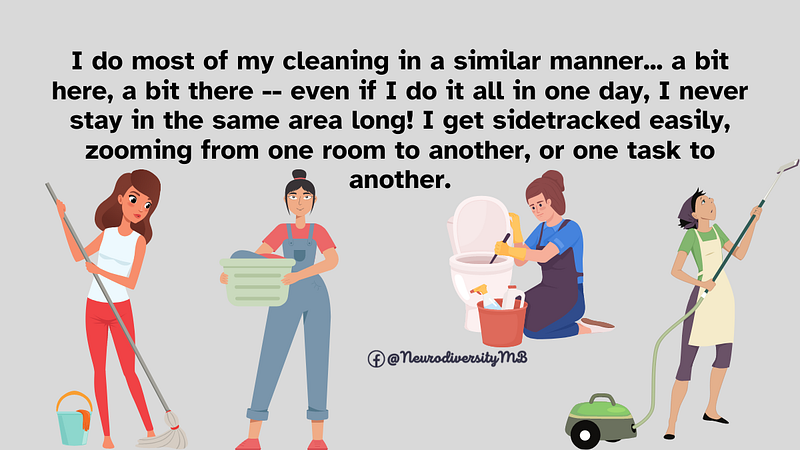
I do most of my cleaning in a similar manner: A bit here, a bit there — even if I do it all in one day, I never stay in the same area long! I get sidetracked easily, zooming from one room to another, or one task to another.
It all gets done (eventually), so why does it matter in which order I do things? I’ve come to realize: it usually doesn’t.
When I stop fighting my natural way of doing things, I usually get more accomplished. More importantly, I tend to feel better about the whole process at the end of it.
Play it cautious or take a chance?
Before you assess whether you should stick with the common way of doing things, or change it up to better suit your neurology, consider your motives for doing so.
- Are you wanting to do what’s expected of you to make others happy?
- Is doing things the usual way causing you difficulty?
- Do you have an unrealistic expectation of yourself?
- Are you trying to force yourself into a box into which you do not fit, because you think you’re supposed to do things the way others do?
- What are the potential drawbacks to maintaining the status quo?
- What are the possible downsides of shaking it up a bit?
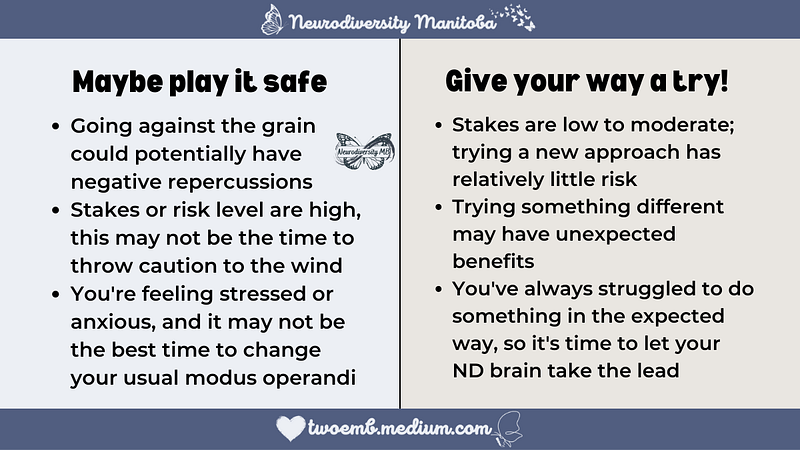
Maybe play it safe
- Going against the grain could potentially have negative repercussions
- Stakes or risk level are high, this may not be the time to throw caution to the wind
- You’re feeling stressed or anxious, and it may not be the best time to change your usual modus operandi
Give your way a try!
- Stakes are low to moderate; trying a new approach has relatively little risk
- Trying something different may have unexpected benefits
- You’ve always struggled to do something in the expected way, so it’s time to let your ND brain take the lead
Roll with it
Why did I go to all the trouble breaking this down?
A significant contributing factor to the discomfort, anxiety, or stress I hear about from my clients comes from being expected (or expecting their children) to do things a certain way, “like everybody else”, and feeling like a failure when we can’t neurotypical like a neurotypical can.
When we try to be someone we’re not, we can set ourselves up for failure. If we do fail, we often berate ourselves for not measuring up to some arbitrary standard.
When we embrace our differences, we give ourselves opportunity to discover the strengths that come from doing things in ways which work best for us.
© Jillian Enright, Neurodiversity MB
Related Articles
When you join medium, as a member you’ll have access to unlimited reads for only $5 per month. If you use my referral link, I’ll earn a small commission, and you’ll earn my undying gratitude.
If you’d prefer give a one-time tip, you can support my writing on Ko-Fi — also, it’s free to follow me on Facebook and LinkedIn!