SPACE NEWS
To Go Where No Flat-Pack Furniture Has Gone Before
In space, no one can hear you scream at confusing instructions
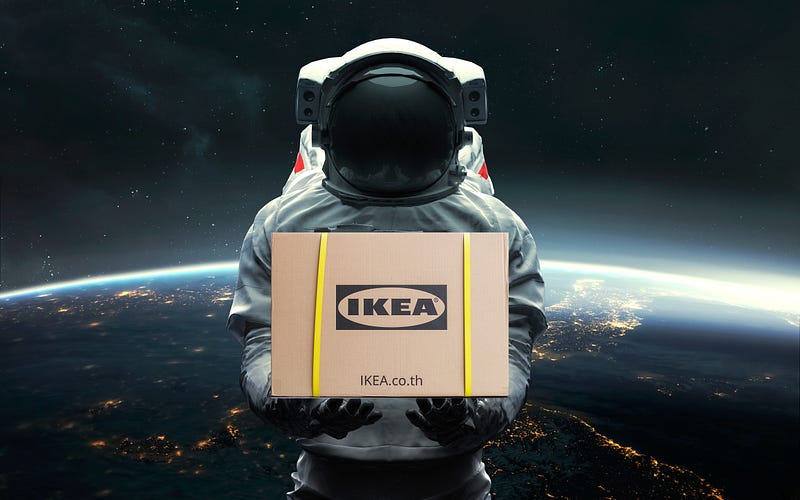
Earth-orbiting satellites usually end their lives in a fiery reentry — but a tiny CubeSat scheduled for launch by the European Space Agency later this year might put off a warmer glow than most in its final moments.
That’s because WISA-Woodsat is made mostly out of plywood.
It’s the brainchild of Jari Mäkinen, a writer and broadcaster from Finland who co-founded a company called Arctic Astronautics, which markets fully functional replicas of orbit-ready CubeSats.
The new satellite drew a swift rebuke from Sweden’s national space agency, SkyKEA, which has been developing similar technology.
“It’s no surprise the Finns would try to antler in on our territory,” a spokesman said. “They’re jealous, all they have over there is reindeer. Have you ever heard of the Finnish Bikini Ski Team? Of course not. Then they use plywood when particle board with quality synthetic veneer creates a far superior ambiance.”
The Swedes’ program differs from CubeSat in that satellites are transported to the International Space Station in flat-pack form, then assembled and launched by the astronauts.
Their initial attempt, SPÅCENGÖIN-1, failed when a faulty parts packet tore open and scattered the contents throughout the station. It took the crew three weeks to find all 12,241 SVENKA | DALSELV Wood Screws #101385 — Dimensions: 82.74 mm (L) x 4.83 mm (D), the last when cosmonaut Yuri Nayte stepped on it.
“I didn’t think it would hurt so much while weightless,” said American and avid 254 Mile High Club member Barbarella Armstrong. “I’ve been serving with Russians a long time, but he used interesting new words. Hopefully he’ll show me how they work in zero-g.”
She described the episode as “frustrating,” but that the crew “appreciated the meatballs.”
In the end, the project was scrubbed — by the time all the parts had been retrieved, astronauts discovered they had misplaced the enclosed hex wrench and no spares were included.
“Yes, there have been some growing pains at SkyKEA,” the agency spokesman added. “But we’ve learned from our föøkåpps and are moving forward with a second launch. We won’t give up — we’re 100% committed to closing the budget-friendly minimalist-style Scandinavian-aesthetic satellite gap. There’s no way we let the market be cornered by a bunch of Rudolph fuckers.”
John Werth is a Medium Top Writer in Satire who describes his writing style as “You’d read this if I were famous.” He finds writing more tiring than exercise, so he compensates by not exercising.
If by some miracle you have room in your inbox, consider filling it with a subscription to get my stories. Even better, if you use this link to sign up for Medium yourself I’ll get a commission. Thanks!