
Time Is Free Yet It Comes With a Price Tag
Make the seconds and hours count by asking some crucial questions
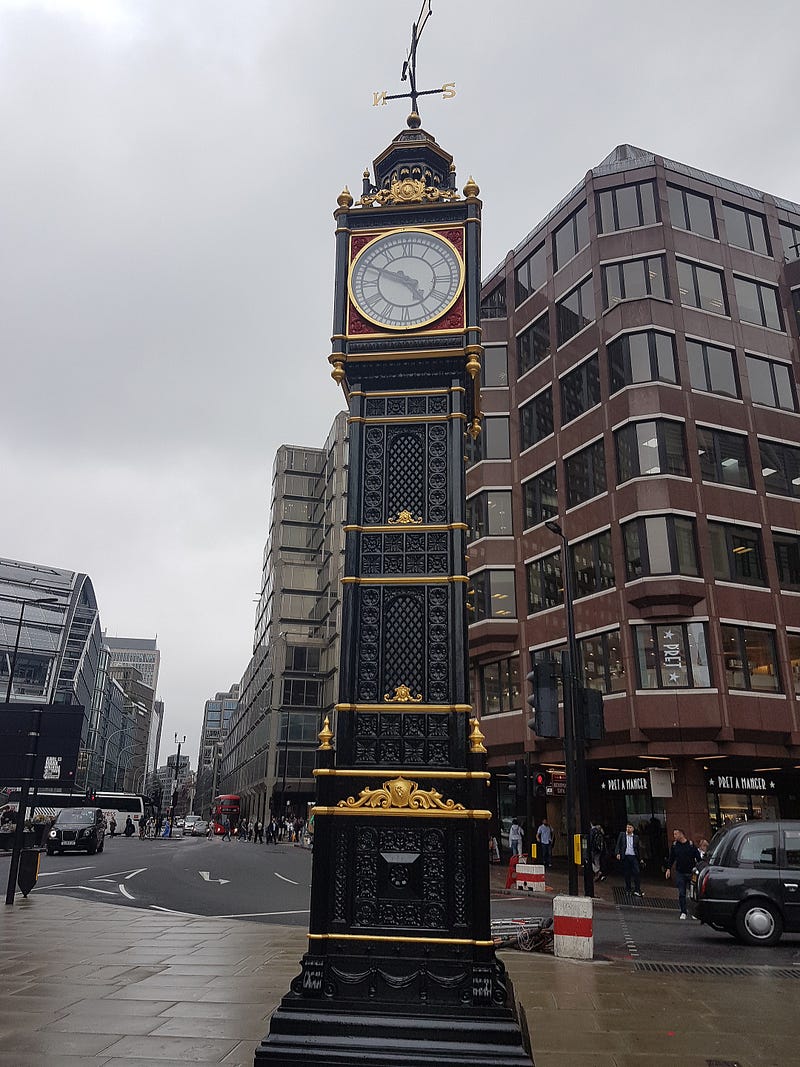
When I visited London in September 2019, I was looking forward to seeing one of its most famous landmarks, Big Ben, the iconic clock tower.
Big Ben is the name given to the bell inside the tower, which is called Elizabeth Tower. Unfortunately, it was covered in scaffolding thanks to refurbishment work — which did take away the beauty and grandeur. I was disappointed, not having the opportunity to hear it chime.
Then I saw Little Ben. I wasn’t aware of its existence, how many people are? It stands in the middle of a traffic island. It’s a miniature version of Big Ben made of cast iron. Who said big is always better? The little version was just as if not more symbolic of time.
Time is a commodity
Every place I visited, there was a clock somewhere along the way. Once you notice a recurring theme, you can’t help but think it’s a message. This is what I wrote in my journal after seeing Little Ben: Time, the most precious commodity of all.
Imagine if you knew how much time you had left, how differently would you live your life? Do the little things, do the big things — time will always be lost, what else do you have to lose?
The clock, with its ticking hands, made me stop and standstill. I came back from that trip a changed person with a new perspective on life.
Growth is essential
Why is it that we only notice how time flies by? How our lives fly by, how the years fly by?
We see it when our children grow. We see it when others comment on our children: Look how big they have grown, they almost as tall as you. But, with time, we fail to observe if we are growing. Do we say to ourselves and our spouses: Look at us, look how much we have grown in the past two years.
To give justice to the time we have — growth is essential.
Seems like it’s also physical growth we have an interest in. As adults, we don’t grow physically anymore, except maybe horizontally. We seem to ignore other growth as well — like the growth of the mind. We live by the adages with no meaning at all, accepting them as the truth, when they are just opinions. Accepting them without thought limits our ability.
You can’t teach an old dog new tricks. Good things come to those who wait.
Like really? The mind is only as flexible as you make it to be.
Questions we must ask
Questions on growth should be a priority to ourselves and our partners. If we are not asking these questions, we are not conscious of progress.
And with no progress, there’s stagnation. We end up stuck while time keeps moving forward.
➰How have we grown over the last year, or in the last five years? ➰Did we have any growth? ➰If yes, in which area of life did we grow? ➰How significant was the growth? ➰Did it change our lives? ➰If yes, what impact did it have? ➰What growth strategies can we put in place now?
The time is now
If you haven’t grown, there is always time to start now. It’s about being honest with yourself and your relationships.
I have rocked the boat one too many times, trying to implement growth in my life without including others. I thought it was an individual goal. But I was wrong. It has to be mutual, to want to grow together for the better.
There is a quote that goes — Either I grow with you, or I outgrow you.
This is where the problems lie. Who doesn’t want to grow? I have asked this many times, and I was naive, surprised even, to learn that not everyone is willing to change or wanting to grow. They would rather prefer to remain stuck — where they feel comfortable. And that’s okay too, for them. I prefer to get out of my comfort zone.
Think of discomfort as currency — it’s the price you pay to learn some pretty crucial things — Lilly Singh
I have learned not to allow myself to be bogged down by those who resist change and growth. It comes down to the company you keep. Whether we believe it or not, you are the average of the five people you spend your time with.
It’s easy to spot. You have to notice your thinking and the decisions you make and decide if they are greatly influenced by the people and the environment surrounding you.
How to make the most of time
There is an old pendulum wall clock in my husband’s family, dating back a few generations, an antique. Ironically, more value is placed on a clock’s value than on time.
Harvey Mackay says, Time is free, but it’s priceless. You can’t own it, but you can use it. You can’t keep it, but you can spend it. Once you’ve lost it you can never get it back.
Time and growth are continuing factors that we cannot control. Or can we? Anyone else feels like time speeds up the older you get?
Time can speed up or slow down, depending on what you are doing and how you feel about it. New memories make an experience feel longer, while familiar memories don’t. As you age, you tend to do more routine, familiar actions, and thus, the experiences and memories don’t last, making time fly.
So how can one slow down the perception of time as we age? We can learn new things, seek new experiences — we can grow.
To Conclude
We don’t get to choose how much time we have, we all get the same 24 hours. Growing older is not a choice, yet, we accept it. Growing in all other aspects is.
Choose wisely and time will always be on your side.
Thank you for reading.
If you want to read more of my writings, you may read the following articles published in The Masterpiece.


