
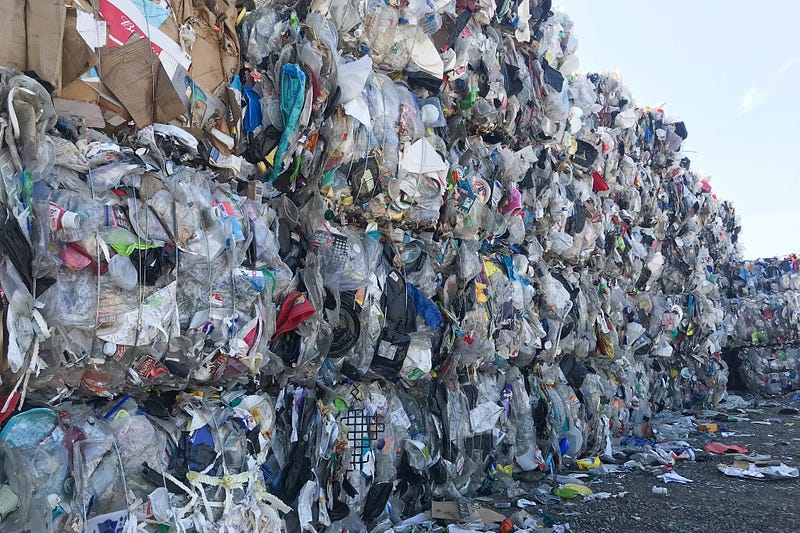
These Bacteria Can Eat Plastic!
And that opens up some really great opportunities to attack our plastic waste dilemma!
I don’t know about you but I have been doing my very best in trying to reduce my use and purchase of products packaged in plastic or items made of plastic and other unnatural materials.
In these times of rapid climate change and global warming, it just seems like a “must-do”. Especially as I’ve always come from the point of view of “Think globally but act locally”.
This is something I can do to help halt global warming.
And if everyone else did their little bit, it would actually have a huge effect.
But there is so much industrial messaging and advertising that seeks to sabotage this effort making it a never-ending uphill battle.
For industry, it’s always all about profit.
So what’s a concerned citizen to do?
There's lots of great solutions suggested in Paul Hawkins's book, Regeneration, in the chapter on plastics.
How about new technological solutions? We always love it when scientists and engineers come up with brilliant ideas and designs to help solve complicated problems.
And what about Nature? Does Nature have any interesting solutions for these man-made products that are thought to be non-biodegradable?
What if some insect or microorganism could eat the stuff and transform it into useful organic material?
When I was taking an Entomology course as an undergraduate, I learned about a beetle that ate lead. It was called the lead borer beetle! And of course, they were playing with us. No such beetle actually exists!
But is there anything that can eat and digest plastic?
Yes!
And I’m not playing with you.
It’s a bacteria called Comamonas testosteroni.
And that’s what we’re going to learn about today.
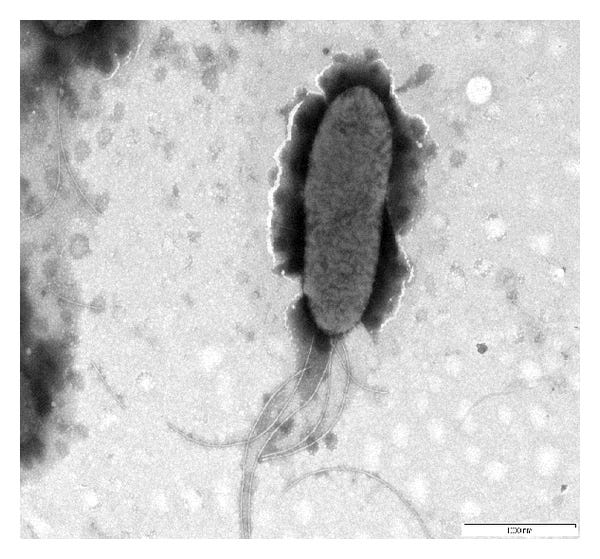
As you can see in the photomicrograph above, Comamonas species are placed in the category we call bacilli, the biological term for elongated or rod-shaped bacteria. You can also see several long tail-like filaments extending from one end. These are called flagella and are what help to propel the bacteria by rapidly moving back and forth in a fish-like sinuous motion.
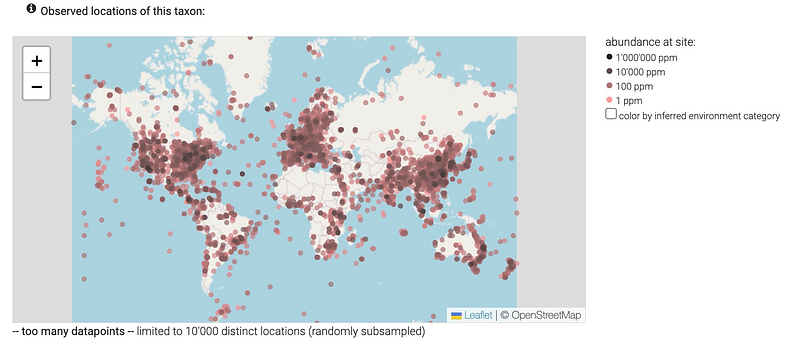
It is found all across the world but is concentrated more in temperate regions, as seen in this map.
C. testosteroni was given that name because it can consume and decompose testosterone. In nature, it is found growing in soils, water or on plants.
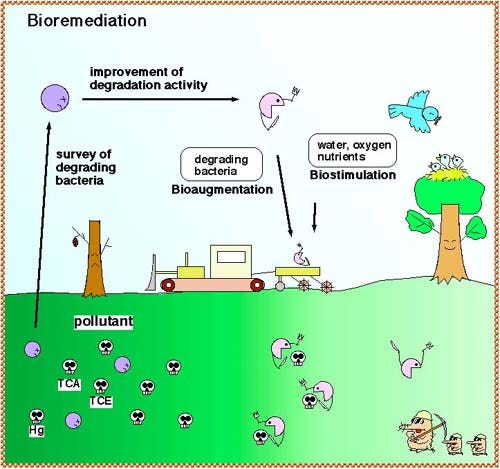
The reason we are interested in this little beastie is that it is one of the organisms that can be used in bioaugmentation.
Bioaugmentation
Bioaugmentation is when you add bacteria or other microorganisms to help speed up the degradation of a contaminant.
Bioaugmentation is the accelerated removal of undesired compounds from contaminated hazardous waste sites or bioreactors by using indigenous or allochthonous wild-type or genetically modified organisms. (copied from Source #4)
Over 20 years ago, researchers isolated a strain of C. testosteroni named I2 from sludge and demonstrated that it could mineralize 3-chloroaniline (3-CA).
I’m sorry, you just lost me! It did what to what?!
Ok. Let’s back up a bit.
3-CA is also called M-CA and is a chemical that is made from another chemical compound called M-nitrochlorobenzene by treating it with various other chemicals. It is a light amber or colourless liquid and its main uses are as azo dyes and pigment intermediates, drugs, pesticides, pesticide chemicals and herbicides.
Interestingly enough, it is also used medicinally in the production of antipsychotic drugs such as chlorpromazine hydrochloride and perphenazine.
I think you’re starting to get the picture. 3-CA is not something found in Nature. It’s mostly one of the nasty guys! And it’s not something you want in your water supply!
When something is mineralized, that means it has been broken down into chemicals that are no longer harmful and are available as nutrients for other organisms.
That’s a good thing!
So C. testosteroni can mineralize 3-CA.
That’s a good thing!
What the researchers did was add C. testosteroni grown in the laboratory to sludge containing 3-CA to see if it could clear the hazardous chemical from the sludge.
In their initial lab experiments, they were able to show that the added bacteria were still present in the sludge after 45 days and within 2 weeks of its addition, all the 3-CA was degraded. No degradation was observed in the control sludge that had not been inoculated.
Unfortunately, when they scaled this up to larger volumes, only 50% degradation of 3-CA was observed and the composition of the community of microorganisms found in the sludge had been significantly altered.
From these results, they concluded that:
…bioaugmentation, even with a strain originating from that ecosystem and able to effectively grow on a selective substrate, is not permanent and will probably require regular resupplementation.
Ok, so it’s not quite perfected yet.
But someday soon!
Hey, I thought this article was about bacteria that eat plastic!
Eating Plastic

Again, one step backward before we take two steps forward.
Bioengineers have a few favourite bacteria that they like to work with. One of those is E. coli. And believe me, they have done a ton of work breeding and genetically altering this bacteria.
But it has a drawback when it comes to engineering it to help rid us of many of the noxious, toxic man-made compounds found in the environment. That drawback is that it really likes to eat different sugars.
The compounds we want to get rid of are not sugars!
Given the abilities of modern biotechnology engineers, I don’t doubt that they could probably come up with a strain of E. coli that didn’t prefer sugar but who knows how long that will take!
Wouldn’t it be great if we could find microorganisms that didn’t default to sugars and are already consuming some of these substances we want to get rid of?
Like plastic?
And now we come back to C. testosteroni.
The paper published in Nature Chemical Biology from Dr. Ludmilla Aristilde’s laboratory by Rebecca Wilkes describes one such bacteria and it is another strain of C. testosteroni, KF-1.
Many of the strains of C. testosteroni lack the genes necessary to digest sugars and instead, rely on aromatic organic compounds as their primary food source. KF-1 is one such strain.
Wilkes and colleagues looked at KF-1’s ability to digest three specific compounds:
- 4-hydroxybenzoate (4HB)
- Vanillate (VAN)
- Terephthalate (TER)
The first two are naturally occurring aromatic compounds related to lignin, a critical structural compound that plants make to strengthen their cell walls and resist rotting.
The third one, terephthalate, is used principally as a precursor to PET, a chemical used to make clothing and plastic bottles and one we all know.
Here’s a little cartoon summarizing their experiments
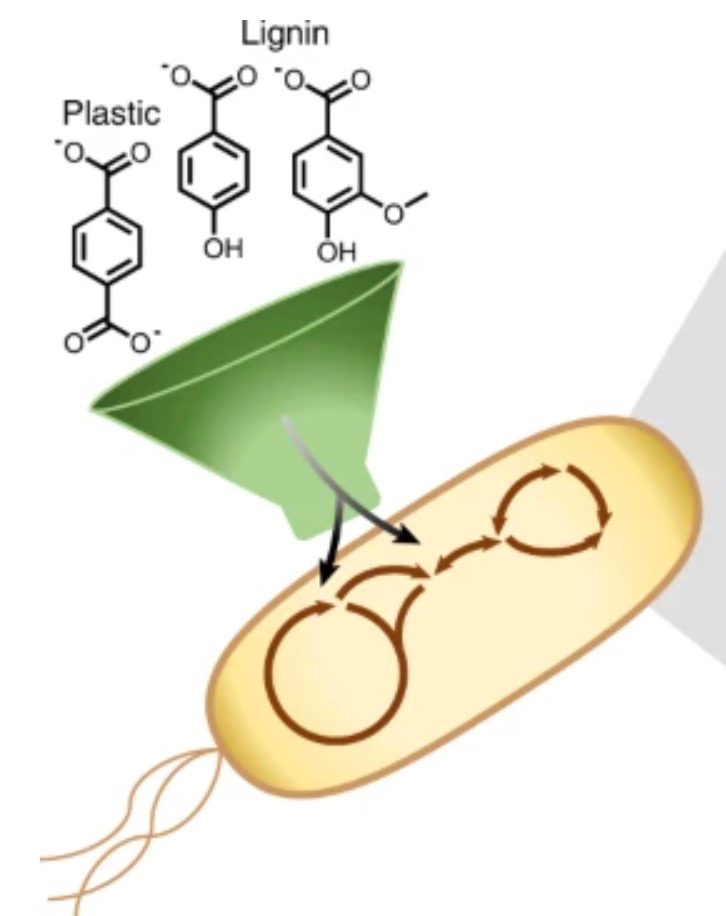
Ok, as far as the experiments go, they used very detailed methods to look at the biological pathways KF-1 used to metabolize these substances and that is just waaaay too detailed to even begin to summarize here.
And for our purposes, it’s not really important.
Of course, if you’re an aspiring bioengineer, you will certainly enjoy reading about all those metabolic pathways 😄
The results of their experiments are pertinent to all of us because plastic waste is a major problem. It’s in our landfills, on our beaches, tossed onto the sides of the road by careless consumers and a major source of carbon release affecting climate change.
So anything that can help us get rid of plastic and recapture its carbon is a really good thing!
And turning it back into substances that are non-toxic and that other organisms can eat and digest is a super bonus!
So here’s what they uncovered.
Results
3-CA was able to use all three compounds as its primary source of food. And there was only a 30% difference in growth rates between 4HB, VAN and TER. That’s fairly small.
If KF-1 was grown in cultures that contained all three compounds, it only used VAN and TER after it ate up all the 4HB! So it definitely had a favourite!
And when given only VAN and TER, it showed different uptake and growth rates.
But it consumed both without any obvious difficulty.
So there you have it.
A bacterium that can eat plastic.
plastic waste is a major problem. It’s in our landfills, on our beaches, tossed onto the sides of the road by careless consumers and a major source of carbon release affecting climate change.
To quote the Wilkes paper,
These inherent characteristics highlight the potential of C. testosteroni as an emerging cellular chassis, but it has remained a relatively untapped organism compared to model species such as E. coli
To clarify another bit of jargon, a cellular chassis is a term used for a microorganism that is used in biotechnology applications to do the work or make a product.
In this case, it’s bioaugmenting plastic waste!
And now you know all about that.
Pretty neat, eh?
Oh, and just one more thing. C. testosteroni can infect people and has been implicated in bacteremia-related septic shock, endocarditis, and meningitis. Rare but it does happen.
Researchers isolated it from a wound and grew it in a petri dish. The left side of the dish shows it growing on agar that contains sheep’s blood as the nutrient source.
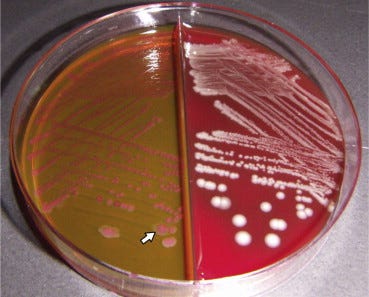
So it’s not entirely without risk.
Until next time,
Rich
If you enjoyed this article, here are a few others you might like:
If you’d like to get my newsletter sign up here. Updates come out every few weeks alerting you to what I just published and also include short pieces about nature and what I’m reading.
Sources:
- Plastic Waste-Eating Bacteria Break Down Ring Carbon Compounds by ?? in GEN (Feb 2023)
- Complex regulation in a Comamonas platform for diverse aromatic carbon metabolism by Rebecca A. Wilkes et al., in Nature Chemical Biology (Feb 2023)
- Comamonas testosteroni by Jason Carr in JCarr Biomed (July 2020)
- Bioaugmentation of Activated Sludge by an Indigenous 3-Chloroaniline-Degrading Comamonas testosteroni Strain, I2gfp by Nico Boon et al., in Applied and Environmental Microbiology (July 2000)
- 3-Chloroaniline — Reference Information in ChemBK.
- Comamonas testosteroni infection in Taiwan: Reported two cases and literature review by Tung-Lin Tsui et al., in J. of Microbiology, Immunology and Infection (Feb 2011)


