avatarRich Sobel

Free AI web copilot to create summaries, insights and extended knowledge, download it at here

12248

Abstract

here are several proteins that are specifically found in the membranes of magnetosomes.</p><p id="a960">Going into detail about how this is done is beyond the scope of this article so suffice it to say that these membranes and proteins are what we can redesign and alter using modern molecular genetics to make them effectively target a tissue or compound of interest.</p><div id="08c4"><pre><span class="hljs-attribute">A</span> little mathematical fun. The head of a pin is <span class="hljs-number">1</span>.<span class="hljs-number">5</span> mm (<span class="hljs-number">1</span>.<span class="hljs-number">5</span> million nm) across the top. Magnetosomes range from <span class="hljs-number">30</span><span class="hljs-number">120</span> nm in width. That means depending <span class="hljs-literal">on</span> their size, you could make a line of <span class="hljs-number">12</span>,<span class="hljs-number">000</span><span class="hljs-number">50</span>,<span class="hljs-number">000</span> magnetosomes across the head of a pin!</pre></div><p id="e1eb">It turns out that there are lots of different bacteria that make magnetosomes and different bacterial species make them in shapes that are unique to their species.</p><h1 id="11c0">Evolution of Magnetotactic Bacteria</h1><p id="7122">So you can see that the bacteria have invested a lot of energy and effort to not only make these magnetosomes but also to arrange them very specifically and shield them against conditions and chemicals which would promote their degradation.</p><p id="d7c8">According to the <i>survival of the fittest</i> principle of evolution, that wouldn’t happen unless the return for the energy invested increases their chances of survival.</p><p id="1e6c"><b>So, what are the benefits to the bacteria that make magnetosomes?</b></p><p id="458f">It turns out that bacteria with magnetosomes don’t like to be in the upper layer of water near the oxygen-rich surface. The oxygen is toxic to them. Aligning with and following the geomagnetic field lines of the earth leads them down and away from the surface into the sediments below where they were first discovered, away from that death trap.</p><p id="5129">Mystery managed!</p><h1 id="9cea">Turning magnetosomes into useful tools</h1><p id="a9f2">Think about it for a moment (magnetic pun intended!).</p><div id="100d"><pre>Note: The magnetic moment is <span class="hljs-keyword">the</span> magnetic strength <span class="hljs-keyword">and</span> orientation <span class="hljs-keyword">of</span> <span class="hljs-keyword">a</span> magnet <span class="hljs-keyword">or</span> other object that produces <span class="hljs-keyword">a</span> magnetic field. The term magnetic moment normally refers <span class="hljs-built_in">to</span> <span class="hljs-keyword">a</span> <span class="hljs-keyword">system</span>’s magnetic dipole moment, <span class="hljs-keyword">the</span> component <span class="hljs-keyword">of</span> <span class="hljs-keyword">the</span> magnetic moment that can be represented <span class="hljs-keyword">by</span> <span class="hljs-keyword">an</span> equivalent magnetic dipole: <span class="hljs-keyword">a</span> magnetic north <span class="hljs-keyword">and</span> south pole separated <span class="hljs-keyword">by</span> <span class="hljs-keyword">a</span> very small distance. From Wikipedia.</pre></div><p id="b96e">Magnetosomes are tiny, they resist degradation and they’re a natural biological product.</p><p id="3653">From the very moment they were discovered and their properties revealed, the possibility arose of using them as tools in biotechnology. But there are several challenges that need to be overcome.</p><p id="052d"><b>Challenge #1: Producing sufficient quantities!</b></p><p id="30bf">Experiments looking at how to grow large amounts of magnetosome-containing bacteria showed that 2 common strains were relatively easy to grow in mass culture: <i>Magnetospirillium magneticum</i> strain AMB-1 and <i>Ms. gryphiswaldense</i> strain MRS-1.</p><p id="629d">Great! Challenge #1 accomplished.</p><p id="895c"><b>Challenge #2: Extract and purify.</b></p><p id="ca73">You all know about how French coffee presses work, right? You add coffee grounds into the glass container, pour in some hot water, wait a bit and then press down the plunger with a filter on it and voila, you have coffee!</p><p id="e411">Well, a similar device exists for breaking up cells and it’s called the French pressure cell press. It’s a bit more complicated than the coffee maker but does a similar thing. You pour in your batch of cells, set the pressure you want and then push down on the plunger and voila, you have a mixture with all the cells broken up and their internal parts available for collection.</p><figure id="7fe1"><img src="https://cdn-images-1.readmedium.com/v2/resize:fit:800/1*5U7OS9HTHd1nOWnuDaC3yg.jpeg"><figcaption>One of the popular models of the French Pressure Cell Press</figcaption></figure><p id="55ac">To get the magnetosomes, you just take the broken cell suspension, apply a magnet to the outside of the container to capture the magnetosomes and then gently wash everything else away.</p><p id="2f92">Take away the magnet and that leaves you with a highly purified batch of magnetosomes. Pretty cool, eh?</p><p id="fd61">And now you can do stuff with them.</p><h1 id="098a">Some examples of employing magnetosomes as tools</h1><p id="3f64">In this section, we’ll look at some of the many ways that magnetosomes are being tested in various biotechnological and biomedical applications. These include bioremediation, cancer treatment, cell capture and separation, food safety, medical imaging and others.</p><h2 id="38be">Bioremediation</h2><p id="655e">Do you remember the periodic table of elements you studied in high school chemistry? I sure don’t!</p><p id="b627">Well, it turns out that on that table, there is a whole category of elements called transition metals. You’ve probably heard of some of them: Cadmium, Selenium, Zinc, Iron, Chromium, Lead, Mercury, and a whole bunch more.</p><p id="35b3">It turns out that many of these transition metals are actually toxic to living beings. And some are actually essential. The toxicity is often related to the amount or concentration of the chemical present and an organism’s own particular sensitivity to it.</p><p id="62f7">But it is never a good thing when the concentrations are high and if that is causing environmental problems or damage, then whenever possible, we want to either remove the chemical or alter it into a non-toxic form.</p><p id="62e2">If we use an organism such as a bacterium or plant to help us do that, then the process is called bioremediation.</p><p id="1c33">One of the magnetotactic bacteria was genetically modified to have a molecule in its membrane that bound cadmium. Then it was exposed to cadmium in its culture media. After growing for a while, the bacteria were magnetically removed and significant amounts of cadmium were removed with it. Cadmium is not attracted to magnets.</p><p id="247e">Similar results were obtained with magnetotactic bacteria grown in the presence of selenium. The selenium was found concentrated in small internal sacs and almost 70% was removed from the medium when the bacteria were recovered magnetically.</p><p id="a220">While these studies are still just beginning, they show great promise for future use of magnetotactic bacteria for environmental bioremediation.</p><h2 id="7054">Magnetosome targeted hyperthermia for cancer therapy</h2><p id="6d4d">Warning! This part is a bit technical. I’ve tried to simplify it but if I make it too simple you won’t understand how it works. So, please bear with me.</p><p id="b218">Magnetic fields can be used to generate force and to produce heat. Generating heat is our ticket to targeted treatment.</p><p id="3c49">When excess heat is produced, it is called hyperthermia and it can kill cells.</p><p id="ddc1">If we can get magnetosomes or nanomagnetic particles inside cancer cells, then we can expose the cells to a high frequency alternating magnetic field. This would cause them to produce enough heat to generate highly toxic chemicals inside the cells called reactive oxygen species. The reactive oxygen chemicals would cause enough damage to the cells so that they would self-destruct and die.</p><p id="797b">Got that?</p><p id="b09d"><b><i>If it gets too hot, cells die!</i></b></p><p id="b6c3">This year, Jiaojiao in Dr. Yu Cheng’s laboratory published a paper that shows they figured out how to do that!</p><p id="3c66"><b>They called their technique mechanical-thermal induction therapy (MTIT)</b>.</p><p id="53ad">First, they modified the magnetic nanoparticles by adding zinc to them as they were being synthesized. This increased the ability of the particles to generate both force and heat.</p><p id="62b5">They added these zinc-modified particles to U87 brain cancer cells grown in culture and within 3 days 85% of the cancer cells had incorporated the particles!</p><p id="af96">When they exposed the cells to the rotating magnetic force <b><i>over 90% of them were killed!</i></b></p><p id="1c65">That’s pretty good! If you had a tumour that weighed 1 pound (16 ounces), it would now weigh 0.1 pounds or 1.6 ounces.</p><p id="35fe">Now for a crucial experiment. Would the particles be taken up by normal cells and kill them just as efficiently?</p><p id="847f">That would be a bad thing*.</p><p id="5419">They tested them on both common brain cells called astrocytes and common connective tissue cells called fibroblasts. Both normal cell types incorporated the particles and toxic effects were seen in both cell types when the MTIT treatment was applied.</p><p id="bca4">But….</p><p id="58c1">The toxicity was significantly less than that observed in the cancer cells! Those are two critical words: <b>significantly less!</b></p><p id="fab6">And now the fun starts!</p><p id="9285">They grew U87 tumours in mice and injected them with their magnetic nanoparticles. After about 3 weeks, the tumours in the MTIT treatment group were completely eliminated. In two other control treatments, the tumours either did not suffer any damage or were reduced in size. But not eliminated!</p><div id="5ea5"><pre><span class="hljs-comment">* A note about controls vs treatments: In scientific experiments, you have what you are testing (the treatment) and then you have controls, which are essential. Controls repeat the conditions of the treatment without actually applying the whole treatment. </span></pre></div><div id="8a48"><pre>For <span class="hljs-keyword">instance, </span>the controls of the experiment might <span class="hljs-keyword">be </span>tumours injected <span class="hljs-keyword">but </span>then not <span class="hljs-keyword">subjected </span>to MTIT. <span class="hljs-keyword">Or </span>it could <span class="hljs-keyword">be </span>tumours not injected <span class="hljs-keyword">but </span><span class="hljs-keyword">subjected </span>to MTIT. If the results do not <span class="hljs-keyword">differ </span><span class="hljs-keyword">between </span>controls <span class="hljs-keyword">and </span>treatments, then the treatment is deemed ineffective. </pre></div><div id="bc26"><pre>In <span class="hljs-keyword">the</span> <span class="hljs-keyword">case</span> above, there is <span class="hljs-keyword">a</span> marked <span class="hljs-built_in">difference</span> between treatment <span class="hljs-keyword">and</span> controls so they deemed <span class="hljs-keyword">it</span> was worth continuing down this experimental path.</pre></div><p id="dff2">Similar results were obtained using cultured breast cancer cells and tumours, although slightly different conditions were required to eliminate them.</p><p id="7726">This means it is worth further investigating and developing these treatments.</p><p id="666d">But…</p><p id="4a6c">Ok, this is not yet at the stage where we can actually use it to treat tumours in people but I like to think about where this is headed and how it might help in the future.</p><p id="bd82">Currently, for tumours that can’t be surgically removed, we have two types of treatments, chemotherapy and radiation and they both have serious

Options

detrimental side effects, both short-term and long-term.</p><p id="a76e">The problem is, neither one of them can be targeted to just the tumour cells! Which is why the side effects on normal surrounding tissues can be so drastic. If we could take a nanoparticle that requires specific activation and inject it only into the tumour, while there might be some slight leakage to surrounding cells, it would be quite small compared to all the non-tumour cells that are exposed to radiation or chemotherapy treatments!</p><p id="351f">So you can see why we’re excited by this kind of bio-nanotechnology!</p><h2 id="9270">Cell capture and separation</h2><p id="3ed3">We often need to separate out a particular cell from a mixture of many different types.</p><p id="2fc7">There are several instances of using magnetotactic bacteria in separating out a particular type of cell.</p><p id="9494">Cells in our immune system, such as leukocytes, use a process called phagocytosis to ingest other cells. If they encounter magnetic bacterial cells, they ingest them.</p><p id="57ca">If we take a mix of leukocytes, some that were exposed to the magnetic bacterial cells and some that were not, and then expose them to a magnet, about 95% of the leukocytes that have ingested the magnetic bacteria inside them will be separated from those that weren’t exposed.</p><p id="bb0d">There are also ways to attach various other molecules or antibodies that bind to specific cells to the magnetic particles. Then using methods similar to the one described above, the cells those compounds recognized can be separated from mixed cell populations.</p><p id="9642">Masayuki Takahashi et al., genetically modified <i>Ms. magneticum</i> AMB-1 so that it expressed a protein called <a href="https://en.wikipedia.org/wiki/Protein_G">protein G</a> on the surface of the magnetosomes. Protein G binds to antibodies.</p><p id="05b6">They were able to use the purified protein G-magnetosomes to extract B cells and T cells from whole blood to a purity of more than 96%!</p><p id="6b92">Hey, if you don’t know what B cells and T cells do, read this post and book.</p><div id="de48" class="link-block"> <a href="https://readmedium.com/do-you-know-about-the-superheroes-inside-you-6a954cdbc1ce"> <div> <div> <h2>Do You Know About the Superheroes Inside You?</h2> <div><h3>Super fun and super informative! A review of the book, “Superheroes Inside Me” and a conversation with the author.</h3></div> <div><p>medium.com</p></div> </div> <div> <div style="background-image: url(https://miro.readmedium.com/v2/resize:fit:320/1*eNHRdmEg521WgIaX9LBTwg.jpeg)"></div> </div> </div> </a> </div><h2 id="fb68">Using magnetosomes to make food safer</h2><p id="2778">There are several common pathogens that infect food. Knowing if they have done that <i>before</i> we consume the food would be helpful.</p><p id="e18b"><a href="http://www.bccdc.ca/health-info/diseases-conditions/vibrio-parahaemolyticus"><i>Vibrio parahaemolyticus</i></a> is a pathogen found in foods and causes many gastrointestinal, foodborne illnesses.</p><p id="55da">When magnetosomes were modified with an antibody complex that would recognize <i>V. parahaemolyticus</i>, they recognized and captured the pathogen in foods that contained it making for a very effective test.</p><p id="2b3a">Similar tests were devised for the detection of <i>Staphylococcus aureus</i> enterotoxin in contaminated milk and <i>Salmonella</i> in artificially contaminated food samples such as milk, eggs and pork.</p><h2 id="814f">Enhancing magnetic resonance imaging (MRI)</h2><p id="c283">Magnetosomes are showing great promise in their ability to increase the contrast in MRI images. Increased contrast means better images and more accurate diagnoses.</p><p id="595e">This has been demonstrated in MRI imaging tests that included pancreatic cells, brain cells, mammalian cells, and breast cancer cells.</p><h2 id="940a">A few more applications</h2><p id="d841">“The nano-sized fine magnetic particles offer vast potential in new nano-techniques,” says Atushi Arakaki.</p><p id="6dd7">In Schüler’s lab they, “ reprogrammed the bacteria to produce magnetosomes that glow green when irradiated with UV light and at the same time display novel biocatalytic functions.”</p><p id="4ccb">Other labs have used magnetosome magnetite crystals in recovery or detection of DNA, drug delivery and enzyme immobilization.</p><p id="ea4b">Some of the additional problems that will need to be overcome to increase our ability to use magnetosomes include:</p><ul><li>Producing particles that are accepted or ignored by our immune system so they can do the job for which we have programmed them.</li><li>We need to continue to devise ways to direct them to the target(s) of interest.</li><li>For a company to want to produce them, they need to be economically profitable.</li></ul><h2 id="1f33">The future for magnetosomes looks bright</h2><p id="0257">New ideas and techniques are rapidly being invented and improved upon. We’ve already seen uses for magnetosomes in cancer therapy, cell separation, DNA isolation, bioremediation, medical imaging and food safety.</p><p id="068a">And that’s just the tip of the iceberg!</p><p id="d500">I think it is safe to say that the utilization of magnetic particles and magnetosomes is just beginning and I predict that we will see many more applications as we gain proficiency in magnetosome particle modification and production.</p><p id="f895">In the classic scientific way of understating the potential, <a href="https://onlinelibrary.wiley.com/doi/full/10.1002/smll.201906922">a publication from Dirk Schüler’s lab </a>concludes with the following statement:</p><p id="cd27"><i>“engineered magnetosomes are highly promising as building blocks for more complex nano‐ and mesostructures with enhanced properties for many biotechnological and biomedical applications.”</i></p><p id="64c1">It always amazes me how something so small and simple can have such huge downstream ramifications. When Blakemore and Bellini first described magnetotactic bacteria in the mid 20th century, I’m sure they didn’t immediately think, “Oh, we can use these guys to help treat cancer!”</p><p id="58c2">It was the knowledge generated from careful, painstaking experimentation and examination over many years (almost half a century) that has made such things possible.</p><p id="65e7">And is yet, another shining example of why we don’t want to unnecessarily restrict our scientists in the research paths their interests and passion take them down. Yeah, sometimes it might take them down a dead-end but it might also lead them to the pot of gold at the end of the rainbow.</p><p id="2688">Can you predict which it’s going to be? I sure can’t!</p><p id="380b">And just for a little fun, here are some lab geeks with magnetotactic bacteria and too much time on their hands!</p> <figure id="4adf"> <div> <div> <img class="ratio" src="http://placehold.it/16x9"> <iframe class="" src="https://cdn.embedly.com/widgets/media.html?src=https%3A%2F%2Fwww.youtube.com%2Fembed%2F3uUL4ooM6KI%3Ffeature%3Doembed&amp;display_name=YouTube&amp;url=https%3A%2F%2Fwww.youtube.com%2Fwatch%3Fv%3D3uUL4ooM6KI&amp;image=https%3A%2F%2Fi.ytimg.com%2Fvi%2F3uUL4ooM6KI%2Fhqdefault.jpg&amp;key=a19fcc184b9711e1b4764040d3dc5c07&amp;type=text%2Fhtml&amp;schema=youtube" allowfullscreen="" frameborder="0" height="480" width="854"> </div> </div> </figure></iframe></div></div></figure><p id="5af1">Until next time,</p><p id="5c49"><i>Rich</i></p><p id="309e">Hey! If you enjoyed this article then please subscribe to my email newsletter that alerts you to my latest articles. And get a free ebook, <a href="http://biology4everyone.com/">here</a>.</p><h1 id="a84a">Sources used for this article:</h1><ol><li><a href="https://science.sciencemag.org/content/190/4212/377"><b>Magnetotactic Bacteria</b></a><b>, </b>R. Blakemore, October <i>1975</i>, Science 190:377–79</li><li><a href="https://www.ncbi.nlm.nih.gov/pmc/articles/PMC293838/"><b>Ultrastructure of a Magnetotactic Spirillium</b></a>, D. L. Balkwill, D. Maratea and R. P. Blakemore, March <i>1980</i>, J Bacteriol, 141(3):1399–408.</li><li><a href="https://www.researchgate.net/publication/43762364_The_discovery_of_magnetotacticmagnetosensitive_bacteria"><b>The Discovery of Magnetotactic/Magnetosensitive Bacteria</b></a><b>, </b>Richard B. Frankel, January <i>2009</i> Chinese Journal of Oceanology and Limnology 27(1)</li><li><a href="https://digitalcommons.calpoly.edu/cgi/viewcontent.cgi?article=1293&amp;context=phy_fac"><b>Magnetite and Magnotaxis in Microorganisms</b></a>, Richard B. Frankel and Richard P. Blakemore, <i>1989</i>, Bioelectromagnetics 10: 233–237.</li><li><a href="https://www.researchgate.net/publication/330975634_Biology_and_Physics_of_Magnetotactic_Bacteria"><b>Biology and Physics of Magnetotactic Bacteria</b></a>, Fernanda Abreu and Daniel Acosta-Avalos, <i>2019</i>, Chapter in InTech Open.</li><li><a href="https://jnanobiotechnology.biomedcentral.com/articles/10.1186/s12951-019-0469-z"><b>Engineered Magnetosomes Fused to Functional Molecule (Protein A) Provide a Highly Effective Alternative to Commercial Immunomagnetic Beads</b></a>, Junjie Xu et al., March <i>2019</i>, J Nanobiotechnology 17:37</li><li><a href="https://onlinelibrary.wiley.com/doi/epdf/10.1002/advs.201902933"><b>Programmable ROS‐Mediated Cancer Therapy via Magneto‐Inductions</b></a>, Jiaojiao Wu et al., May 2020, Adv. Sci. 1902933</li><li><a href="https://royalsocietypublishing.org/doi/10.1098/rsif.2008.0170"><b>Formation of magnetite by bacteria and its application</b></a>, Atsushi Arakaki et al., September <i>2008</i>, J R Soc Interface 5: 977–999.</li><li><a href="https://www.researchgate.net/publication/15180236_Electron_Microscopic_Studies_of_Magnetosomes_in_Magnetotactic_Bacteria"><b>Electron Microscopic Studies of Magnetosomes in Magnetotactic Bacteria</b></a>, D A Bazylinski et al., April <i>1994</i>, Microsc Res Tech 27:389–401</li><li><a href="https://www.newsbreak.com/news/0OYB5Byl/genetic-programming-compels-bacteria-to-produce-useful-magnetosomes"><b>Genetic Programming Compels Bacteria to Produce Useful Magnetosomes</b></a>, Frank-Dietrich, March <i>2020</i>, GEN.</li><li><a href="https://doi.org/10.3390/molecules23102438"><b>Applications of Magnetotactic Bacteria, Magnetosomes and Magnetosome Crystals in Biotechnology and Nanotechnology</b></a><b>, </b>Mini-Review by Gabriele Vargas et al., in <a href="https://www.mdpi.com/journal/molecules/special_issues/BN">Special Issue: Biogenic Nanomaterials: Versatility and Applications </a>ed. Clayton Jeffryes and Si Amar Dahoumane, Molecules 2020, 25(9) September <i>2018</i>, Molecules, 23: 2438</li><li><a href="https://books.google.ca/books?id=PuBQBAAAQBAJ&amp;pg=PA251&amp;lpg=PA251&amp;dq=microbiologist+Richard+P.+Blakemore&amp;source=bl&amp;ots=7AqhqJn_HS&amp;sig=ACfU3U1gUR_IyGAjlYzF1vReLR8GJz-Veg&amp;hl=en&amp;sa=X&amp;ved=2ahUKEwj14f273eTpAhV-HjQIHRLQAIwQ6AEwEnoECAkQAQ#v=onepage&amp;q=microbiologist%20Richard%20P.%20Blakemore&amp;f=false"><b>Magnetotaxis</b></a>, U. Lins and D.A. Bazylinski, Chapter 18 in <a href="https://www.elsevier.com/books/topics-in-ecological-and-environmental-microbiology/schmidt/978-0-12-383878-0">Topics in Ecological and Microbiology</a>, Editors: Thomas Schmidt Moselio Schaechter, September <i>2011</i>, pp 251–263.</li><li><a href="https://www.ncbi.nlm.nih.gov/pubmed/19197981"><b>Direct Magnetic Separation of Immune Cells From Whole Blood Using Bacterial Magnetic Particles Displaying Protein G</b></a>, Masayuki Takahashi, Biotechnol Prog, Jan-Feb <i>2009</i>, 25:219–26.</li><li><a href="https://onlinelibrary.wiley.com/doi/full/10.1002/smll.201906922"><b>A Versatile Toolkit for Controllable and Highly Selective Multifunctionalization of Bacterial Magnetic Nanoparticles</b></a>, Frank Mickoleit Clarissa Lanzloth Dirk Schüler, April, <i>2020</i>, Nano.Micro Small, 16.</li></ol></article></body>

https://www.pinterest.co.uk/pin/79798224617642032/

Did You Know That Some Bacteria Make Mighty Miniature Magnets?

Scientists are devising a multitude of ways to manufacture and employ these tiny particles as biomedical and biotechnological tools!

Did you know that some bacteria move in a very specific direction, right along the earth’s magnetic field lines?

How do they do that?

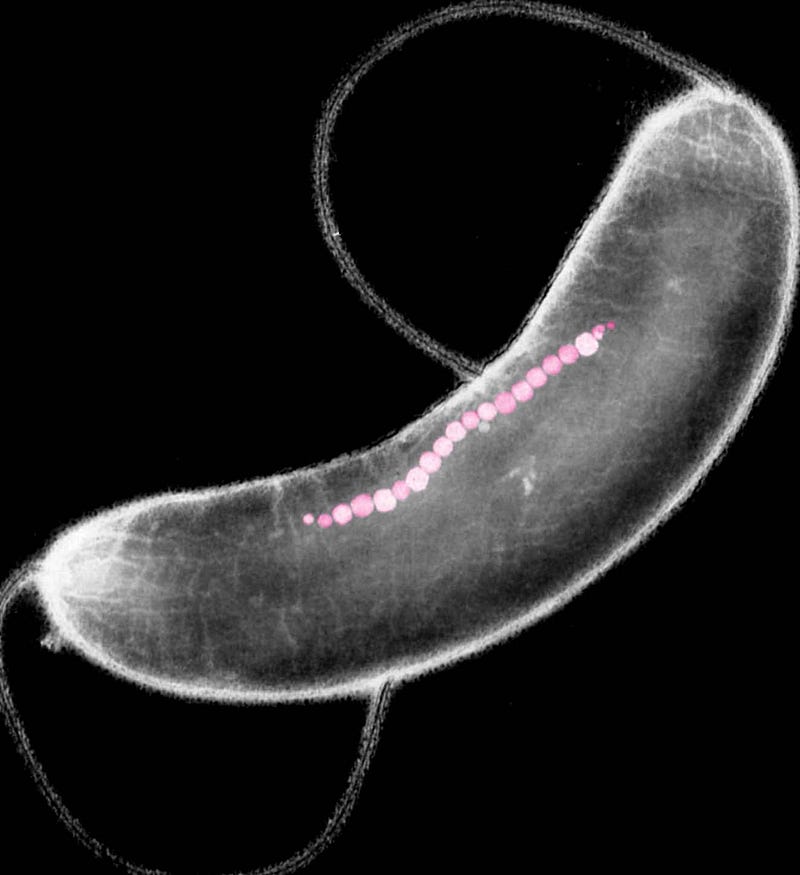
They make and use their own magnetic nanoparticles called magnetosomes and they’re made by several different kinds of bacteria.

magnetosome derivation: the word ending “some” or “somes” is often used in biology and comes from the Latinized form of Greek sōmatikos “of the body,” from sōma (genitive sōmatos) “the body”. So magnetosomes are just bodies that are magnetic.

We’ve known about them for over half a century and since their discovery, scientists have been studying, learning and experimenting with them.

It’s gotten to the stage where we can use them as tools to help us fight and maybe one-day cure diseases like cancer.

Lots of other different animals use magnetic particles to help them navigate but we can’t grow animals like birds and bats and harvest them for their magnetic structures and substances. It’s just not ethically ok to do that.

But bacteria? That’s a different kettle of fish.

In this article, you’ll learn all about bacterial magnetosomes.

  • When they were discovered and who discovered them.
  • The properties of magnetosomes.
  • Why we think they evolved in bacteria and how bacteria use them.
  • How we can use modern genetics to turn them into useful tools that help with medical imaging or into weapons of mass destruction against cancer and other harmful cells in our bodies.

So point your compass due North and let’s follow where these magnetosomes take us.

Discovering magnetotactic bacteria

Credit for the discovery of bacteria that were sensitive to magnets went initially to Richard P. Blakemore, now in the Dept of Microbiology, Emeritus Professor of Molecular, Cellular, and Biomedical Sciences, University of New Hampshire, Durham, NC.

The Woods Hole research center is where Blakemore did his initial research. It is also where the pivotal discoveries were made that I talked about in the article about Horseshoe Crabs.

As a graduate student in microbiology at the University of Massachusetts, Blakemore collected bacteria from marsh sediments in Woods Hole and noted that they responded to magnetic fields. Blakemore’s 1975 publication in Science was the first-ever report of bacteria that contained tiny structures inside them that acted like magnets.

What he observed was:

“Bacteria with motility directed by the local geomagnetic field have been observed in marine sediments. These magnetotactic microorganisms possess flagella and contain novel structured particles, rich in iron, within intracytoplasmic membrane vesicles. Conceivably these particles impart to cells a magnetic moment. This could explain the observed migration of these organisms in fields as weak as 0.5 gauss.”

A taxis is a "reflex translational or orientational movement by a freely motile and usually simple organism in relation to a source of stimulation (such as a light or a temperature or chemical gradient)." Taken from here. 
So magnetotactic organisms orient their movements along a magnetic field.

He also took pictures of these bacteria with an electron microscope and saw the particles inside the cells that seemed to be responsible for directing the movement.
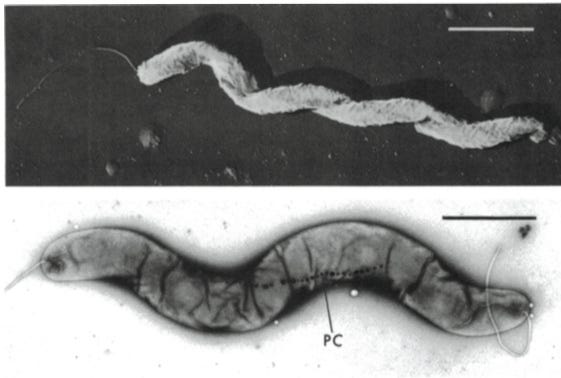
Taken from Ultrastructure of a Magnetotactic Spirillium, D. L. Balkwill, D. Maratea and R. P. Blakemore, March 1980, J Bacteriol, 141(3):1399–408. The bars in the figures are 1 micrometre in length

Over the years Blakemore continued to study these bacteria and laid the foundation for all the subsequent modern work that we’ll talk about below.

What Blakemore didn’t know was that a medical doctor, Dr. Salvatore Bellini, had discovered similar bacteria 17 years earlier but had not published the findings! 
In 1958, Bellini was working at the Institute of Microbiology at the University of Pavia, Italy when he serendipitously discovered the magnetosensitive bacteria while examining water samples from sources around Pavia for pathogens. For more details see this paper by Richard Frankel.

So let’s learn a bit more about magnetosome particles.

Properties of magnetosomes
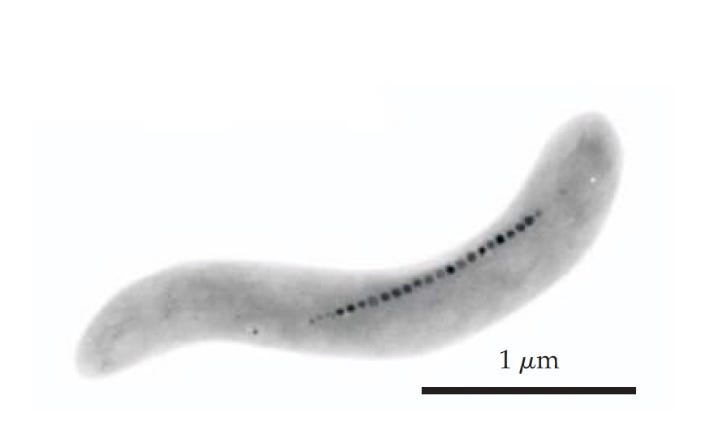
Taken from www.FB.COM/Trustthemedtechs

The picture above shows a line of magnetosomes inside a bacterial cell. As you can see, they are highly organized and uniform in shape and size.

Further studies by Richard B. Frankel, a colleague and collaborator of Blakemore’s provided information about their composition, structure, and even identified the minerals that form them.

Magnetic types

Frankel showed that there are two general types of magnetosomes; one type has its core made up of a crystal of magnetite (Fe3O4, one of the forms of iron oxide). It is a black ore of iron that forms opaque crystals and exerts strong magnetism.

The other type is made up of iron-sulphur compounds and can be either griegite (Fe3S4), which forms black, rather porous, strongly magnetic microscopic grains or pyrrhotite (Fe7S8). There are also ones made up of non-magnetic pyrite but those aren’t relevant to us.

Once crystals form, the cells package them within a biological membrane that contains phospholipids and a set of magnetosome specific associated proteins.

When iron oxides are exposed to water, they often form the rust with which we’re all familiar. So why don’t the magnetite crystals just become rust?

The membrane that envelops them prevents that. It repels water and other substances that would hydrate and degrade the crystals into rust.

Arrangement of particles inside the cell

How does the cell keep them so highly arranged as in the straight line above? The picture below answers that question.
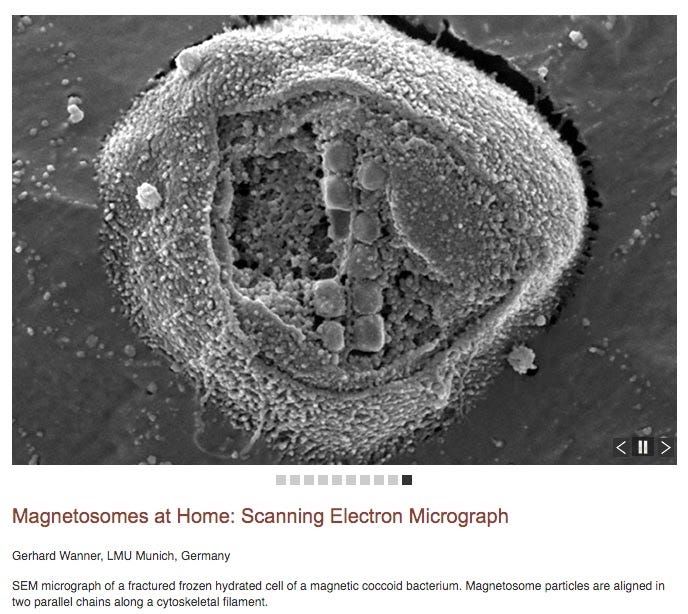
The magnetosomes in this scanning electron microscope picture are the vertical line of particles extending from the bottom to the top of the cell and if you look closely, you can see that they are attached to a kind of “backbone” structure that anchors them in place.

That backbone is formed from the same molecules that organize the cell’s entire structure.

And there is a reason for this arrangement.

When the particles are arranged in a straight line they behave just like a compass needle!

It turns out that if too many magnetosomes are produced in relation to the cell size, then they begin to form a circle and the compass needle guidance effect is lost.

Size and shape

Magnetosome crystals are produced in a variety of shapes with high chemical purity and few crystal defects. As shown in the figure below, the shapes are very consistent within each bacterial species but differ between species.

The three most common shapes are cubic, elongated prisms that appear rectangular and bullet- or tooth-shaped. And they range in size from about 35 to 120 nanometres.
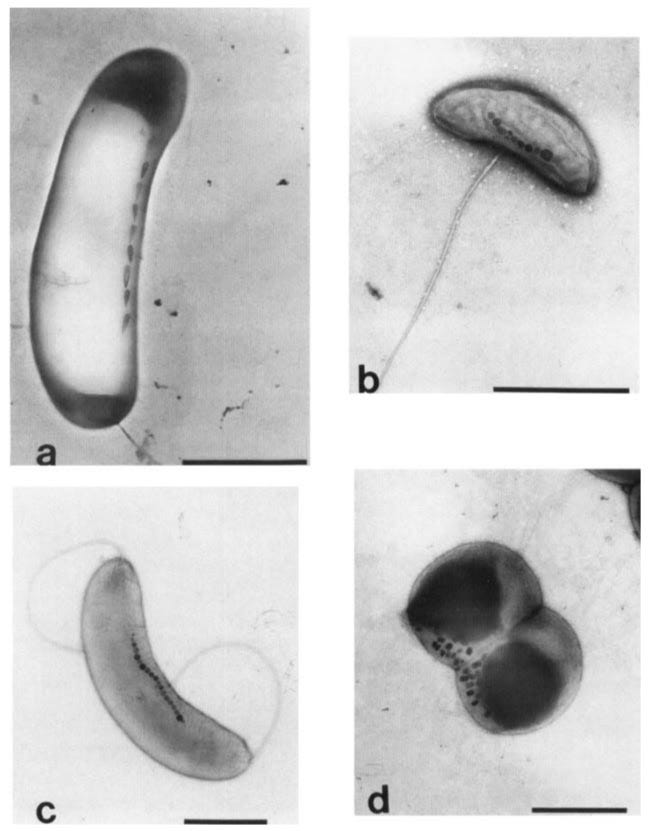
Transmission electron microscope pictures of 4 different types of bacteria with magnetosomes. The bars in the bottom right corners are 1 mm. Figure 2 from Frankel and Blakemore, 1989.

The size is very important because it was found that crystals smaller than 30 nm do not remain stably magnetic at normal temperatures. Magnetosomes in the normal size range are also the smallest crystals of magnetite and greigite that are permanently magnetic at ambient temperatures that don’t need to be induced to form a magnetic field.

Magnetosomes produced by bacterial cells are enclosed in the same material that makes up the cell membrane. And this is one of the beautiful features of them. There are several proteins that are specifically found in the membranes of magnetosomes.

Going into detail about how this is done is beyond the scope of this article so suffice it to say that these membranes and proteins are what we can redesign and alter using modern molecular genetics to make them effectively target a tissue or compound of interest.

A little mathematical fun. The head of a pin is 1.5 mm (1.5 million nm) across the top. Magnetosomes range from 30120 nm in width. That means depending on their size, you could make a line of 12,00050,000 magnetosomes across the head of a pin!

It turns out that there are lots of different bacteria that make magnetosomes and different bacterial species make them in shapes that are unique to their species.

Evolution of Magnetotactic Bacteria

So you can see that the bacteria have invested a lot of energy and effort to not only make these magnetosomes but also to arrange them very specifically and shield them against conditions and chemicals which would promote their degradation.

According to the survival of the fittest principle of evolution, that wouldn’t happen unless the return for the energy invested increases their chances of survival.

So, what are the benefits to the bacteria that make magnetosomes?

It turns out that bacteria with magnetosomes don’t like to be in the upper layer of water near the oxygen-rich surface. The oxygen is toxic to them. Aligning with and following the geomagnetic field lines of the earth leads them down and away from the surface into the sediments below where they were first discovered, away from that death trap.

Mystery managed!

Turning magnetosomes into useful tools

Think about it for a moment (magnetic pun intended!).

Note: The magnetic moment is the magnetic strength and orientation of a magnet or other object that produces a magnetic field. The term magnetic moment normally refers to a system’s magnetic dipole moment, the component of the magnetic moment that can be represented by an equivalent magnetic dipole: a magnetic north and south pole separated by a very small distance. From Wikipedia.

Magnetosomes are tiny, they resist degradation and they’re a natural biological product.

From the very moment they were discovered and their properties revealed, the possibility arose of using them as tools in biotechnology. But there are several challenges that need to be overcome.

Challenge #1: Producing sufficient quantities!

Experiments looking at how to grow large amounts of magnetosome-containing bacteria showed that 2 common strains were relatively easy to grow in mass culture: Magnetospirillium magneticum strain AMB-1 and Ms. gryphiswaldense strain MRS-1.

Great! Challenge #1 accomplished.

Challenge #2: Extract and purify.

You all know about how French coffee presses work, right? You add coffee grounds into the glass container, pour in some hot water, wait a bit and then press down the plunger with a filter on it and voila, you have coffee!

Well, a similar device exists for breaking up cells and it’s called the French pressure cell press. It’s a bit more complicated than the coffee maker but does a similar thing. You pour in your batch of cells, set the pressure you want and then push down on the plunger and voila, you have a mixture with all the cells broken up and their internal parts available for collection.
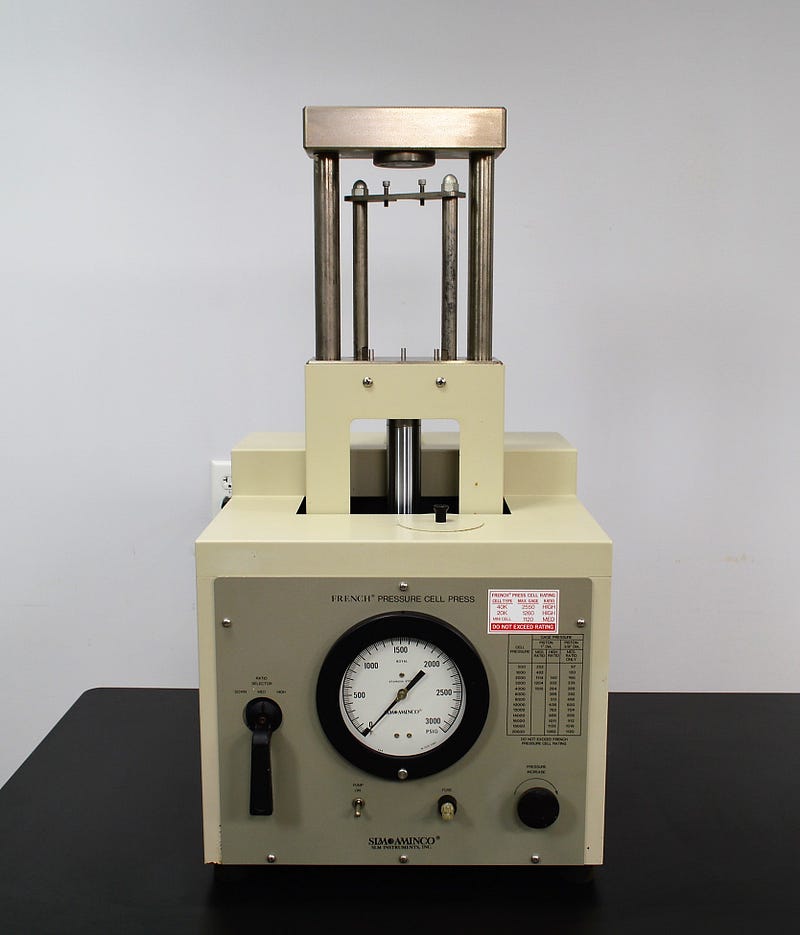
One of the popular models of the French Pressure Cell Press

To get the magnetosomes, you just take the broken cell suspension, apply a magnet to the outside of the container to capture the magnetosomes and then gently wash everything else away.

Take away the magnet and that leaves you with a highly purified batch of magnetosomes. Pretty cool, eh?

And now you can do stuff with them.

Some examples of employing magnetosomes as tools

In this section, we’ll look at some of the many ways that magnetosomes are being tested in various biotechnological and biomedical applications. These include bioremediation, cancer treatment, cell capture and separation, food safety, medical imaging and others.

Bioremediation

Do you remember the periodic table of elements you studied in high school chemistry? I sure don’t!

Well, it turns out that on that table, there is a whole category of elements called transition metals. You’ve probably heard of some of them: Cadmium, Selenium, Zinc, Iron, Chromium, Lead, Mercury, and a whole bunch more.

It turns out that many of these transition metals are actually toxic to living beings. And some are actually essential. The toxicity is often related to the amount or concentration of the chemical present and an organism’s own particular sensitivity to it.

But it is never a good thing when the concentrations are high and if that is causing environmental problems or damage, then whenever possible, we want to either remove the chemical or alter it into a non-toxic form.

If we use an organism such as a bacterium or plant to help us do that, then the process is called bioremediation.

One of the magnetotactic bacteria was genetically modified to have a molecule in its membrane that bound cadmium. Then it was exposed to cadmium in its culture media. After growing for a while, the bacteria were magnetically removed and significant amounts of cadmium were removed with it. Cadmium is not attracted to magnets.

Similar results were obtained with magnetotactic bacteria grown in the presence of selenium. The selenium was found concentrated in small internal sacs and almost 70% was removed from the medium when the bacteria were recovered magnetically.

While these studies are still just beginning, they show great promise for future use of magnetotactic bacteria for environmental bioremediation.

Magnetosome targeted hyperthermia for cancer therapy

Warning! This part is a bit technical. I’ve tried to simplify it but if I make it too simple you won’t understand how it works. So, please bear with me.

Magnetic fields can be used to generate force and to produce heat. Generating heat is our ticket to targeted treatment.

When excess heat is produced, it is called hyperthermia and it can kill cells.

If we can get magnetosomes or nanomagnetic particles inside cancer cells, then we can expose the cells to a high frequency alternating magnetic field. This would cause them to produce enough heat to generate highly toxic chemicals inside the cells called reactive oxygen species. The reactive oxygen chemicals would cause enough damage to the cells so that they would self-destruct and die.

Got that?

If it gets too hot, cells die!

This year, Jiaojiao in Dr. Yu Cheng’s laboratory published a paper that shows they figured out how to do that!

They called their technique mechanical-thermal induction therapy (MTIT).

First, they modified the magnetic nanoparticles by adding zinc to them as they were being synthesized. This increased the ability of the particles to generate both force and heat.

They added these zinc-modified particles to U87 brain cancer cells grown in culture and within 3 days 85% of the cancer cells had incorporated the particles!

When they exposed the cells to the rotating magnetic force over 90% of them were killed!

That’s pretty good! If you had a tumour that weighed 1 pound (16 ounces), it would now weigh 0.1 pounds or 1.6 ounces.

Now for a crucial experiment. Would the particles be taken up by normal cells and kill them just as efficiently?

That would be a bad thing*.

They tested them on both common brain cells called astrocytes and common connective tissue cells called fibroblasts. Both normal cell types incorporated the particles and toxic effects were seen in both cell types when the MTIT treatment was applied.

But….

The toxicity was significantly less than that observed in the cancer cells! Those are two critical words: significantly less!

And now the fun starts!

They grew U87 tumours in mice and injected them with their magnetic nanoparticles. After about 3 weeks, the tumours in the MTIT treatment group were completely eliminated. In two other control treatments, the tumours either did not suffer any damage or were reduced in size. But not eliminated!

* A note about controls vs treatments: In scientific experiments, you have what you are testing (the treatment) and then you have controls, which are essential. Controls repeat the conditions of the treatment without actually applying the whole treatment. 
For instance, the controls of the experiment might be tumours injected but then not subjected to MTIT. Or it could be tumours not injected but subjected to MTIT. If the results do not differ between controls and treatments, then the treatment is deemed ineffective. 
In the case above, there is a marked difference between treatment and controls so they deemed it was worth continuing down this experimental path.

Similar results were obtained using cultured breast cancer cells and tumours, although slightly different conditions were required to eliminate them.

This means it is worth further investigating and developing these treatments.

But…

Ok, this is not yet at the stage where we can actually use it to treat tumours in people but I like to think about where this is headed and how it might help in the future.

Currently, for tumours that can’t be surgically removed, we have two types of treatments, chemotherapy and radiation and they both have serious detrimental side effects, both short-term and long-term.

The problem is, neither one of them can be targeted to just the tumour cells! Which is why the side effects on normal surrounding tissues can be so drastic. If we could take a nanoparticle that requires specific activation and inject it only into the tumour, while there might be some slight leakage to surrounding cells, it would be quite small compared to all the non-tumour cells that are exposed to radiation or chemotherapy treatments!

So you can see why we’re excited by this kind of bio-nanotechnology!

Cell capture and separation

We often need to separate out a particular cell from a mixture of many different types.

There are several instances of using magnetotactic bacteria in separating out a particular type of cell.

Cells in our immune system, such as leukocytes, use a process called phagocytosis to ingest other cells. If they encounter magnetic bacterial cells, they ingest them.

If we take a mix of leukocytes, some that were exposed to the magnetic bacterial cells and some that were not, and then expose them to a magnet, about 95% of the leukocytes that have ingested the magnetic bacteria inside them will be separated from those that weren’t exposed.

There are also ways to attach various other molecules or antibodies that bind to specific cells to the magnetic particles. Then using methods similar to the one described above, the cells those compounds recognized can be separated from mixed cell populations.

Masayuki Takahashi et al., genetically modified Ms. magneticum AMB-1 so that it expressed a protein called protein G on the surface of the magnetosomes. Protein G binds to antibodies.

They were able to use the purified protein G-magnetosomes to extract B cells and T cells from whole blood to a purity of more than 96%!

Hey, if you don’t know what B cells and T cells do, read this post and book.

Using magnetosomes to make food safer

There are several common pathogens that infect food. Knowing if they have done that before we consume the food would be helpful.

Vibrio parahaemolyticus is a pathogen found in foods and causes many gastrointestinal, foodborne illnesses.

When magnetosomes were modified with an antibody complex that would recognize V. parahaemolyticus, they recognized and captured the pathogen in foods that contained it making for a very effective test.

Similar tests were devised for the detection of Staphylococcus aureus enterotoxin in contaminated milk and Salmonella in artificially contaminated food samples such as milk, eggs and pork.

Enhancing magnetic resonance imaging (MRI)

Magnetosomes are showing great promise in their ability to increase the contrast in MRI images. Increased contrast means better images and more accurate diagnoses.

This has been demonstrated in MRI imaging tests that included pancreatic cells, brain cells, mammalian cells, and breast cancer cells.

A few more applications

“The nano-sized fine magnetic particles offer vast potential in new nano-techniques,” says Atushi Arakaki.

In Schüler’s lab they, “ reprogrammed the bacteria to produce magnetosomes that glow green when irradiated with UV light and at the same time display novel biocatalytic functions.”

Other labs have used magnetosome magnetite crystals in recovery or detection of DNA, drug delivery and enzyme immobilization.

Some of the additional problems that will need to be overcome to increase our ability to use magnetosomes include:

  • Producing particles that are accepted or ignored by our immune system so they can do the job for which we have programmed them.
  • We need to continue to devise ways to direct them to the target(s) of interest.
  • For a company to want to produce them, they need to be economically profitable.

The future for magnetosomes looks bright

New ideas and techniques are rapidly being invented and improved upon. We’ve already seen uses for magnetosomes in cancer therapy, cell separation, DNA isolation, bioremediation, medical imaging and food safety.

And that’s just the tip of the iceberg!

I think it is safe to say that the utilization of magnetic particles and magnetosomes is just beginning and I predict that we will see many more applications as we gain proficiency in magnetosome particle modification and production.

In the classic scientific way of understating the potential, a publication from Dirk Schüler’s lab concludes with the following statement:

“engineered magnetosomes are highly promising as building blocks for more complex nano‐ and mesostructures with enhanced properties for many biotechnological and biomedical applications.”

It always amazes me how something so small and simple can have such huge downstream ramifications. When Blakemore and Bellini first described magnetotactic bacteria in the mid 20th century, I’m sure they didn’t immediately think, “Oh, we can use these guys to help treat cancer!”

It was the knowledge generated from careful, painstaking experimentation and examination over many years (almost half a century) that has made such things possible.

And is yet, another shining example of why we don’t want to unnecessarily restrict our scientists in the research paths their interests and passion take them down. Yeah, sometimes it might take them down a dead-end but it might also lead them to the pot of gold at the end of the rainbow.

Can you predict which it’s going to be? I sure can’t!

And just for a little fun, here are some lab geeks with magnetotactic bacteria and too much time on their hands!

Until next time,

Rich

Hey! If you enjoyed this article then please subscribe to my email newsletter that alerts you to my latest articles. And get a free ebook, here.

Sources used for this article:

  1. Magnetotactic Bacteria, R. Blakemore, October 1975, Science 190:377–79
  2. Ultrastructure of a Magnetotactic Spirillium, D. L. Balkwill, D. Maratea and R. P. Blakemore, March 1980, J Bacteriol, 141(3):1399–408.
  3. The Discovery of Magnetotactic/Magnetosensitive Bacteria, Richard B. Frankel, January 2009 Chinese Journal of Oceanology and Limnology 27(1)
  4. Magnetite and Magnotaxis in Microorganisms, Richard B. Frankel and Richard P. Blakemore, 1989, Bioelectromagnetics 10: 233–237.
  5. Biology and Physics of Magnetotactic Bacteria, Fernanda Abreu and Daniel Acosta-Avalos, 2019, Chapter in InTech Open.
  6. Engineered Magnetosomes Fused to Functional Molecule (Protein A) Provide a Highly Effective Alternative to Commercial Immunomagnetic Beads, Junjie Xu et al., March 2019, J Nanobiotechnology 17:37
  7. Programmable ROS‐Mediated Cancer Therapy via Magneto‐Inductions, Jiaojiao Wu et al., May 2020, Adv. Sci. 1902933
  8. Formation of magnetite by bacteria and its application, Atsushi Arakaki et al., September 2008, J R Soc Interface 5: 977–999.
  9. Electron Microscopic Studies of Magnetosomes in Magnetotactic Bacteria, D A Bazylinski et al., April 1994, Microsc Res Tech 27:389–401
  10. Genetic Programming Compels Bacteria to Produce Useful Magnetosomes, Frank-Dietrich, March 2020, GEN.
  11. Applications of Magnetotactic Bacteria, Magnetosomes and Magnetosome Crystals in Biotechnology and Nanotechnology, Mini-Review by Gabriele Vargas et al., in Special Issue: Biogenic Nanomaterials: Versatility and Applications ed. Clayton Jeffryes and Si Amar Dahoumane, Molecules 2020, 25(9) September 2018, Molecules, 23: 2438
  12. Magnetotaxis, U. Lins and D.A. Bazylinski, Chapter 18 in Topics in Ecological and Microbiology, Editors: Thomas Schmidt Moselio Schaechter, September 2011, pp 251–263.
  13. Direct Magnetic Separation of Immune Cells From Whole Blood Using Bacterial Magnetic Particles Displaying Protein G, Masayuki Takahashi, Biotechnol Prog, Jan-Feb 2009, 25:219–26.
  14. A Versatile Toolkit for Controllable and Highly Selective Multifunctionalization of Bacterial Magnetic Nanoparticles, Frank Mickoleit Clarissa Lanzloth Dirk Schüler, April, 2020, Nano.Micro Small, 16.
Biotechnology
Pharmaceutical
Biology
Science
Technology
Recommended from ReadMedium