The Woman Who Lived to (Almost) 105 and (Always) Left ’em Wanting More
Making fun of old people is frowned on, but Zelda was out to make you laugh. What would she say about ageism?
Free AI web copilot to create summaries, insights and extended knowledge, download it at here
4060
Abstract
homophobia, or racism which are aimed at members of a particular sub-group, everyone is vulnerable…that is, if they’re lucky enough to <i>become</i> “old.”</p><p id="7abb">Ageism is a civil rights issue and, as such, should not be tolerated in an egalitarian society, says Palmore. Take it from someone old enough to have already fielded an <a href="https://readmedium.com/when-are-you-old-enough-to-understand-ageism-c8181165b48">ageist pinch </a>or two, you won’t like it!</p><p id="a143">That said, my anti-ageist ardor goes beyond the <a href="https://readmedium.com/when-are-you-old-enough-to-understand-ageism-c8181165b48">personal</a>. Obliterating — or at least attempting to battle — this last allowable prejudice, means that my children’s elderhood might be safer, healthier, more inclusive and multigenerational. That kind of future would also bode well for my grandsons.</p><h1 id="f849">Worth Going to War</h1><p id="64f8">Recently, <a href="https://www.nytimes.com/2022/04/23/health/ageism-levy-elderly.html?searchResultPosition=1">the New York Times </a>reported that gerontological research of the last twenty years has given a new urgency to anti-ageism campaigns throughout the world.</p><p id="c836">When we absorb negative messages about ageing — which we do unconsciously from the time we see our first crotchety old lady in a cartoon—it can shorten our lives by as much as 7.5 years, according to Yale psychologist and epidemiologist, Becca Levy, who has published more than 140 articles over 30 years and a new book, <a href="https://www.amazon.com/Breaking-Age-Code-Beliefs-Determine-ebook/dp/B0995X5JNC">Breaking the Age Code</a>. As the <i>Times</i> reports, Levy’s work demonstrates…</p><p id="cebd" type="7">that ageism results in more than hurt feelings or even discriminatory behavior. It affects physical and cognitive health and well-being in measurable ways and can take years off one’s life.</p><p id="c090"><b><i>A good reason to pay attention, no?</i></b> So how do we become vigilant to ageist actions and influences? So many are unseen and unconscious. And how to wrestle with questions of perspective? Maybe it’s okay for a witty much-older woman like Zelda, who almost made it to 105, to poke fun at the fact that some old people forget what day it is.</p><p id="83c2">Zelda <i>was</i> old. She never thought about <i>being</i> “old” — whatever <i>that</i> meant — until her mid-nineties. She had an incredible memory and a voracious appetite for humor and inspiration. A Borscht Belt wannabee at heart, she ingested good material and made it her own. She honed routines, she proudly told her “young” friend Melinda, on her 3-mile morning walk, rehearsing stories and songs, recalling memorable sayings.</p><p id="f4bc">She took her act to assisted-living centers in the area. She performed for family and friends — poolside, after a tennis game, or in your living room. You just had to ask once.</p><p id="6bd1">Often during chit-chat, she offered an “<a href="https://www.merriam-webster.com/dictionary/apropos">apropos</a>” — a predigested, tidbit she retrieved from memory that related to the conversation. Talk about your dog, and she’ll tell you the one about the Chihuahua who did karate on command.</p><p id="b510">Zelda was pushing 100 when my grandsons visited in Florida. In retrospect, I was a victim of my own internalized ageism: I was anxious about how my young grandsons would react to and tolerate someone “that old.”</p><p id="4d59">I needn’t have worried. Within minutes of “hello,” she regaled a 11-, 9-, and 5-year-old with funny songs and dirty jokes — some about being old. The youngest still remembers the poem, in which Zelda turned her back to the “audience,” slapped her own behind, and recited the punchline:</p><p id="3d3f" type="7">“The golden years can kiss my ass!”</p><p id="7b58">Maybe Zelda, being that old, earned the right to make old-person jokes. Maybe it’s like a black person using the n-word, or a gay man using the f-word? Maybe not. Personally, I’m not comfortable with <i>that
Options
</i> either.</p><p id="f11d">Maybe, at 78, <i>I </i>am old enough to tell an old-person joke, too. But to be on the safe side, I’ll start screening Zelda’s jokes. Or, is it enough to credit her and say they are of “a time”?</p><p id="d1df">The more I read about and begin to understand just how insidious and deeply entrenched ageism is, the more my wiser self — my <i>inner old lady</i> — tells me that it’s better to look elsewhere for “material.”</p><h1 id="b0e6">Re-Viewing, Again</h1><p id="93cb">This piece was inspired by a few days of thinking around <a href="https://readmedium.com/a-mothers-day-rumination-about-the-best-gift-i-ever-gave-my-mother-ee02ae80a295">mother’s day</a> — about how, as we age, we see people in a different light — in that instance, our mothers.</p><p id="0263">But it’s good to re-view <i>any</i> close relationship — child, parent, sibling, friend, special other. Each second, third, fourth look, you’ll see something new to behold, something illuminated by experience and by time itself.</p><p id="2095">When I look back on Zelda’s “jokes,” I mostly miss <i>her. </i>No ideology, no awareness, no heightened consciousness trumps that.</p><p id="fa7c">We never discussed ageism. It was barely on my radar; I was “only” in my sixties then. I suspect if she were here now, reading this article, she’d want to fight it, too.</p><p id="fce1">It hasn’t been a quick or easy battle so far. Ageism is sneaky, sinister, and well-defended. But if my writing puts at least a dent in that armor, I’ll feel I did something.</p><p id="1ae5">And that’s no joke.</p><h2 id="9f48">If you dare to read other articles on ageism:</h2><div id="e1e2" class="link-block"> <a href="https://readmedium.com/when-are-you-old-enough-to-understand-ageism-c8181165b48"> <div> <div> <h2>When Are You Old Enough to Understand Ageism?</h2> <div><h3>The last allowable prejudice just might be the most intractable. How ironic that it’s also the one that ultimately…</h3></div> <div><p>medium.com</p></div> </div> <div> <div style="background-image: url(https://miro.readmedium.com/v2/resize:fit:320/1*C4awxbMyuWZbP2bg04Jd7w.jpeg)"></div> </div> </div> </a> </div><div id="644d" class="link-block"> <a href="https://readmedium.com/have-you-unintentionally-internalized-ageism-3a1cbe02a465"> <div> <div> <h2>Have You Unintentionally Internalized Ageism?</h2> <div><h3>Every Read Is a Rorschach Test. This One Just Might Tell You Something About Yourself — and Your Future</h3></div> <div><p>medium.com</p></div> </div> <div> <div style="background-image: url(https://miro.readmedium.com/v2/resize:fit:320/1*Wa-Ne-xGwHUfcoCB3iWcbg.jpeg)"></div> </div> </div> </a> </div><h1 id="9ac8">If you like reading me…</h1><p id="7761"><a href="https://melindablau.medium.com/subscribe">Subscribe</a> to my Medium articles — you’ll get an email when I publish. Join Medium with <a href="https://melindablau.medium.com/membership">my referral link</a></p><div id="c1db" class="link-block"> <a href="https://melindablau.medium.com/membership"> <div> <div> <h2>Join Medium with my referral link - Melinda Blau</h2> <div><h3>As a Medium member, a portion of your membership fee goes to writers you read, and you get full access to every story…</h3></div> <div><p>melindablau.medium.com</p></div> </div> <div> <div style="background-image: url(https://miro.readmedium.com/v2/resize:fit:320/0*NJyTqMdZQ-20uru4)"></div> </div> </div> </a> </div><p id="c592">Follow me on social media via <a href="https://linktr.ee/melindablau">LinkTree</a>.</p></article></body>

Zelda was 92 when she first picked me up at the tennis courts because I looked “interesting.” Once when I marveled that she was still playing doubles until 99, she came back with “Oh, you can’t call what I play tennis,…but I get the ball back!”
I held dinner parties in Zelda’s honor whenever friends from the Northeast visited me. She was my old lady in Florida. Some Snowbirds nudge their house guests toward a Jungle Island outing or a meal at Joe’s Stone Crab. My visitors had to meet Zelda.
Zelda never disappointed. In addition to her off-color standards — songs, poems, sayings, she had a whole repertoire of old-people jokes, like this one:
So these two old guys, Bob and Ernie, are sitting on a bench at a bus stop in Miami. After a few minutes of uneasy silence, Bob turns to Ernie and says, “T-G-I-F!”
Ernie answers, “S-H-I-T.”
Bob looks puzzled, so Ernie spells it out: “So happens it’s Thursday.”
I laughed when Zelda first told that joke. I chuckled each time I heard her tell it to friends. I even repeated it a few times myself. It’s good one and — for someone who doesn’t usually remember jokes — an easy one. But I’m wondering if the ageist police might give me a summons for retelling it.
Although the term ageism was first used in 1969 by Robert Butler, it took a while before cultural understanding began to shift. Twenty-one years later, when gerontologist Erdman Palmore published his first white paper on the subject (Ageism: Negative and Positive), he says, “most people had still never heard of it and there was little research on it.”
In 2001, Palmore devised an ageism “scale,” listing overt and subtle ways old people are insulted, mistreated, discriminated against, negatively perceived, rejected — say, for a job, a loan, or housing. None are surprising, but one gave me pause: “Told a joke that pokes fun.” (All 20 items of the scale can be seen here.)
What about if an OLD person tells a joke that pokes fun at something that old people do — like forgetting?
In 2015, Palmore, again reviewing ageism research, cites reasons we must continue to study and be vigilant against ageism. Among them, is the most obvious reason to care:
If you live long enough, you’ll be targeted, too. Unlike sexism, homophobia, or racism which are aimed at members of a particular sub-group, everyone is vulnerable…that is, if they’re lucky enough to become “old.”
Ageism is a civil rights issue and, as such, should not be tolerated in an egalitarian society, says Palmore. Take it from someone old enough to have already fielded an ageist pinch or two, you won’t like it!
That said, my anti-ageist ardor goes beyond the personal. Obliterating — or at least attempting to battle — this last allowable prejudice, means that my children’s elderhood might be safer, healthier, more inclusive and multigenerational. That kind of future would also bode well for my grandsons.
Recently, the New York Times reported that gerontological research of the last twenty years has given a new urgency to anti-ageism campaigns throughout the world.
When we absorb negative messages about ageing — which we do unconsciously from the time we see our first crotchety old lady in a cartoon—it can shorten our lives by as much as 7.5 years, according to Yale psychologist and epidemiologist, Becca Levy, who has published more than 140 articles over 30 years and a new book, Breaking the Age Code. As the Times reports, Levy’s work demonstrates…
that ageism results in more than hurt feelings or even discriminatory behavior. It affects physical and cognitive health and well-being in measurable ways and can take years off one’s life.
A good reason to pay attention, no? So how do we become vigilant to ageist actions and influences? So many are unseen and unconscious. And how to wrestle with questions of perspective? Maybe it’s okay for a witty much-older woman like Zelda, who almost made it to 105, to poke fun at the fact that some old people forget what day it is.
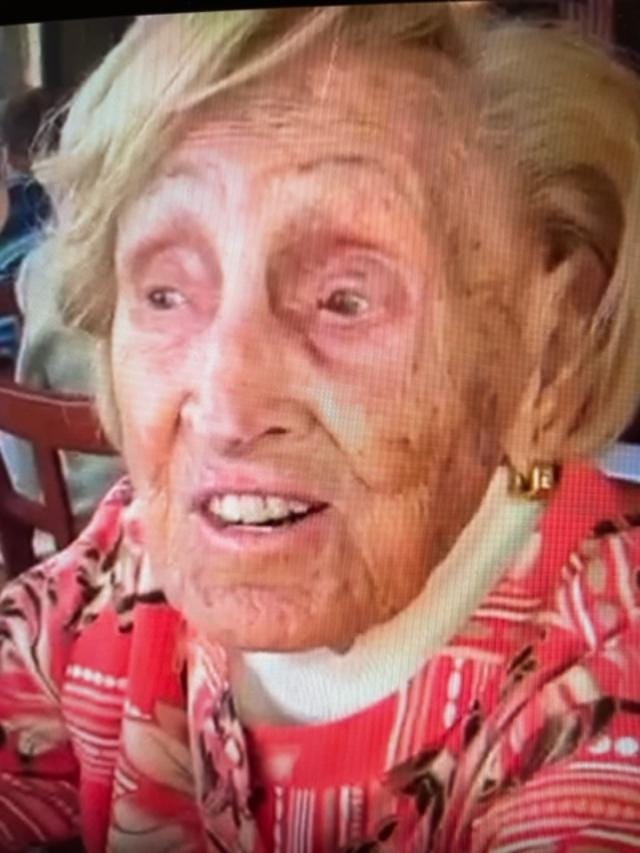
Zelda was old. She never thought about being “old” — whatever that meant — until her mid-nineties. She had an incredible memory and a voracious appetite for humor and inspiration. A Borscht Belt wannabee at heart, she ingested good material and made it her own. She honed routines, she proudly told her “young” friend Melinda, on her 3-mile morning walk, rehearsing stories and songs, recalling memorable sayings.
She took her act to assisted-living centers in the area. She performed for family and friends — poolside, after a tennis game, or in your living room. You just had to ask once.
Often during chit-chat, she offered an “apropos” — a predigested, tidbit she retrieved from memory that related to the conversation. Talk about your dog, and she’ll tell you the one about the Chihuahua who did karate on command.
Zelda was pushing 100 when my grandsons visited in Florida. In retrospect, I was a victim of my own internalized ageism: I was anxious about how my young grandsons would react to and tolerate someone “that old.”
I needn’t have worried. Within minutes of “hello,” she regaled a 11-, 9-, and 5-year-old with funny songs and dirty jokes — some about being old. The youngest still remembers the poem, in which Zelda turned her back to the “audience,” slapped her own behind, and recited the punchline:
“The golden years can kiss my ass!”
Maybe Zelda, being that old, earned the right to make old-person jokes. Maybe it’s like a black person using the n-word, or a gay man using the f-word? Maybe not. Personally, I’m not comfortable with that either.
Maybe, at 78, I am old enough to tell an old-person joke, too. But to be on the safe side, I’ll start screening Zelda’s jokes. Or, is it enough to credit her and say they are of “a time”?
The more I read about and begin to understand just how insidious and deeply entrenched ageism is, the more my wiser self — my inner old lady — tells me that it’s better to look elsewhere for “material.”
This piece was inspired by a few days of thinking around mother’s day — about how, as we age, we see people in a different light — in that instance, our mothers.
But it’s good to re-view any close relationship — child, parent, sibling, friend, special other. Each second, third, fourth look, you’ll see something new to behold, something illuminated by experience and by time itself.
When I look back on Zelda’s “jokes,” I mostly miss her. No ideology, no awareness, no heightened consciousness trumps that.
We never discussed ageism. It was barely on my radar; I was “only” in my sixties then. I suspect if she were here now, reading this article, she’d want to fight it, too.
It hasn’t been a quick or easy battle so far. Ageism is sneaky, sinister, and well-defended. But if my writing puts at least a dent in that armor, I’ll feel I did something.
And that’s no joke.
Subscribe to my Medium articles — you’ll get an email when I publish. Join Medium with my referral link
Follow me on social media via LinkTree.