
The Ultimate Beginner’s Guide to The Gym and Fitness
Everything I have learned going from 56 kgs of skin, fat, and bones to 77 kgs of mostly muscle — workout, nutrition, supplements, sleep, etc.
When I first set foot in a gym, I was a skinny fat teenager who knew absolutely nothing about fitness. Putting on some weight and looking “average” was the goal I had set out with.
It’s been close to 4 years since then and I have achieved results that I wouldn’t even have imagined in my wildest dreams when I started. Over the course of my journey so far, I gained more than 20 kgs of weight with most of it being muscle.
“Putting on some weight and looking “average” was the goal I had set out with.”
I made a ton of mistakes and learned a lot along the way. The internet and the fitness industry, in general, are filled with so much misinformation or “bro-science” that it’s extremely easy to get confused and go the wrong way.
As someone that made a lot of regrettable mistakes that greatly bogged down my progress, I want to share a comprehensive guide to help my beginner brethren out there to wade the rough waters of fitness.
I will go over the various aspects of building muscle and link relevant research to scientifically back my claims.
The Workout
It’s your first day at the gym. You are all pumped up and motivated to workout. But wait, you don’t know what to do, do you?
Tensed, you look around and spot a big guy repping out big weights. You walk up to him in awe and seek enlightenment.
“The break becomes indefinite and your glorious fitness journey comes to a screeching end.”
He tells you it’s simple, all you have to do is go hard and lift heavy ass weights. Taking his words as gospel, you try to do just that.
You end up injuring yourself and decide to take a break from the gym. The break becomes indefinite and your glorious fitness journey comes to a screeching end.
This isn’t a fictitious story. I have seen countless cases as the above. I don’t want you to become another such case. Working out isn’t as simple as just lifting “heavy ass” weights.
Understand Progressive Overload
When you challenge your body with weight or resistance, your body “adapts” by building muscle and strength.
To continually build strength and muscle, you need to continually increase the demands placed on your body or “progressively overload”.

A classic example is the story of Milo of Croton. Milo had a calf which he would lift onto his shoulders and carry around all day. Over time as the calf grew, it got heavier and Milo got bigger and stronger.
You need to progressively overload to gain strength and muscle. Lifting the same 5kg dumbbell week in week out will not cut it.
The big guy was partially right — he just said “Lift heavy and go hard” instead of “Lift heavier and go harder than last time”.
Progressive overload can mainly be achieved by increasing the number of reps, sets, or weight used. Decreasing the rest times, slowing down the reps, improving the form etc. are other methods.
Why You Should Follow a Workout Program
I absolutely love workout programs and they are great for plenty of reasons with the three major ones being:
- Ease. You can perform every workout without having to wrack your head over the sets, reps, and exercises.
- Optimal Results. Good workout programs will have optimal exercise selection, reps, sets, progressive overload schemes, training frequency, etc. so you can achieve optimal results with them.
- Progress. You can easily track and make progress.
Does this mean you should just pick some workout program off the internet and start following it? — Absolutely not, as a badly designed workout program can do more harm than good.
Follow One of The Standard Beginner Workout Programs
Luckily, there are a few standard workout programs especially for beginners that have been tried, tested, and proven to give optimal results.
These programs focus on building a solid base of full-body strength and muscle which is essential for any beginner. So all you have to do is follow the workout program and not worry about other things.
- The Alpha Destiny Novice Program — 3 days a week — Early beginner — Both strength and muscle focused. This is my absolute favorite and the one I usually recommend straight away to beginners. After a few months, most often thank and tell me how rapidly they were able to progress and make gains.
- Icecream Fitness 5X5–3 days a week — Early beginner — More muscle focused. Extremely similar to the above program with the emphasis shifted a bit more towards muscle growth.
- Starting Strength Novice Program — 3 days a week — Early to late beginner — More strength-focused. This is arguably one of the most famous beginner programs available on the internet. This is high strength-oriented, has low volume, and consists of short but intense workouts.
- Westside For Skinny Bastards — 4 days a week — More strength-focused. I am not a big fan of the name but the program is simply excellent. The major downsides are that it requires fancy equipment, has a lot of unconventional lifts, and is overwhelmingly technical.
- Reddit PPL — 6 days a week — More muscle focused — Late beginner to early intermediate. This is a late beginner cum early intermediate program that uses the Push-Pull-Legs (PPL) split. I am a big fan of the PPL split and run a PPL based program even now. I wouldn’t recommend starting off with this one right away. Run with one of the above programs for 6–12 months and then switch to this.
For beginners and early intermediates, strength is synonymous with muscle and vice versa. Just because a program is more strength or muscle focused doesn’t mean you will gain only strength or only muscle — It’s just that you might gain more strength relative to muscle or vice versa.
“For beginners and early intermediates, strength is synonymous with muscle and vice versa.”
Lift with Good Form
I can’t stress just how important good form is. Using a sloppy form or “ego-lifting” might let you lift a bit more weight and give you short-term gratification but will hinder your progress and cause injuries in the long run.
“Never add more weight at the cost of good form.”
Spend time looking up and properly learning the form of every exercise listed in the workout program. In the gym, practice the form and lift with good form. Never add more weight at the cost of good form.
Warmup Well
Don’t be in a hurry to start your workout. The warmup is extremely important. Some of the worst workouts of my life have been due to bad or rushed warmups.
A good warmup will improve the blood flow in your muscles, “grease” your joints, and prepare you mentally for the workout. I see most just walk on the treadmill for a few minutes to warm up. This is blatantly wrong.
Develop a Mind-Muscle Connection
A mind-muscle connection is where you connect and “feel” the muscles you are working. Be mindful of every rep of every exercise you perform. This goes hand in hand with good form.
A strong mind muscle connection can improve your form and vice versa.
Feel every rep, look in the mirror, visualize the muscle, flex in between sets, etc. to develop a good mind-muscle connection.
Listen to Music
I legit cannot get through a workout without some good music, usually EDM or heavy metal blasting in my ears. Music motivates me, relieves boredom, and makes me go harder on every set.

Research has also shown the same. So grab your headphones and blast some good ass music while working out.
Make the Most out Of Your “Noobie Gains”
As a beginner, the rate at which you can gain muscle and strength is at its peak and this rate tremendously slows down with time. The insane and rapid gains you can make in your first year of training are called “noobie gains”.
“Train smart, train hard and do not waste your noobie gains.”
Due to a lack of knowledge, I wasted my noobie gains and it’s easily the biggest mistake I have made. Train smart, train hard, and do not waste your noobie gains.

The Diet
Diet is one thing that is has been blown out of proportion when it comes to complexity.
Dieting is, in fact, simple and there are only four main things you need to concern yourself with — Setting up your calorie intake, consuming enough protein, eating mostly clean, and drinking enough water.
1. Deciding Your Calorie Plan and Intake Based on Your Body Composition
The food and beverages we consume are used by the body as energy for our daily activities. This energy is measured in calories. The calories you consume is your calorie intake and the calories you burn is your calorie expenditure.
Now losing or gaining weight is simple thermodynamics — Consume more than you burn or be in a caloric surplus, you gain weight. Consume less than you burn or be in a caloric deficit, you lose weight. But there’s a catch here,
You can gain weight even when you consume less than you burn.
This will work only in obese cases where the fat stores are plenty so that the body can burn them not only for energy but also to build muscle. Now choosing your calorie plan is pretty simple.
- If you are skinny fat. Use a slight calorie surplus of around 10–15%. This is ideal to slowly build muscle while not putting on excess body fat. After you gain a good amount of muscle, maybe after 6–8 months, you can go on a cut to shed off the fat — where you use a calorie deficit of around 15–25%.
- If you are skinny. Use a moderate calorie surplus of around 25–35% to optimize muscle growth. As a skinny guy, your number one priority is gaining weight and as a result, your primary goal should be hitting your calorie intake
- If you are obese. Use a moderate to a high calorie deficit of around 25–45% to lose fat and also gain muscle at the same time. As a fat guy, your number one priority is losing weight and as a result, sticking to the deficit should be your primary goal.
2. Setting it up
Now that you know what a calorie surplus is and why you need it, let’s see how to set it up.
- Find Your TDEE. Your Total Daily Energy Expenditure or your TDEE is an estimate of how many calories you burn in a day. Determining this is simple. All you have to do is use an online TDEE calculator and key in your stats.
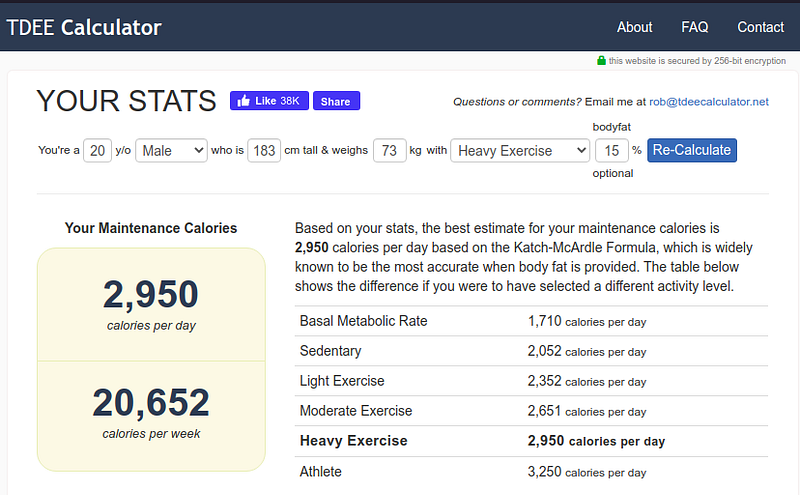
- Determine Your Daily Calorie Intake Target. As we discussed earlier, choose your calorie deficit or calorie surplus as recommended. Now that you know your TDEE, your calorie targets based on your body composition would be:
Skinny fat guy’s calorie target = 1.1 to 1.15 times your TDEE
Skinny guy’s calorie target = 1.25 to 1.35 times your TDEE
Fat guy’s calorie target = 0.55 to 0.75 times your TDEE
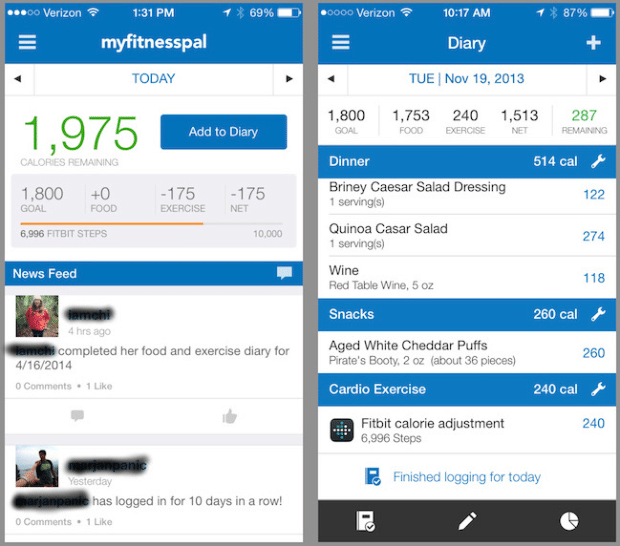
- Track Your Calories. I personally use and recommend MyFitnessPal to track your calories. All you have to do is set your targets, log whatever you eat into it, and strive to hit your daily target.
3. Consume Enough Protein
Protein is the building block of muscle, bones, cartilage, skin, etc., and is essential for tissue repair, oxygenation, digestion, regulation, etc.
The Recommended Daily Dietary Intake (RDI) of protein is 0.8g per kg of body weight — to prevent aging-related muscle loss and preserve the body’s nitrogen balance.
But when looking to build strength and muscle, higher protein intake in the range of 1.5 to 1.8g/kg/day is optimal as found by this study. Other studies have consistently shown similar results.
So consume 1.5 to 1.8g per kg of your bodyweight per day for optimal muscle protein synthesis.
Here’s a list of lean protein sources that you can include in your diet to meet your protein goals.
4. Eat Mostly Clean
So should your diet be 100% healthy? Well, No. Neither is it necessary nor is it sustainable. Here are my recommendations based on your physical composition:
- Skinny: 50% clean and 50% whatever you want. This is because eating completely clean can make it hard to hit your calorie goal and remember what I said earlier?
“As a skinny guy, hitting your calorie goal should be your number one priority.”
- Skinny Fat: 65–75% healthy and 25–3% whatever you want. This is because the calorie target is neither too less nor too much.
- Fat: 85–90% healthy and 10–15% whatever you want. This is because you will be restricting your calories and eating less healthy can leave you less satiated.
For the “eat healthily” part, I mean meals composed of mostly unprocessed foods like grains, meat, eggs, legumes, seafood, nuts, herbs, vegetables, and fruits. Below is an excellent blog post on healthy eating.
For the “eat what you want” part, go ham and indulge yourself. I personally love grabbing a small tub of delicious ice cream or some sizzling shawarma.
5. Drink Enough Water
This research paper found that just 2% dehydration can have a debilitating effect on the functioning of the brain. Other effects are diarrhea, dizziness, seizures, kidney failure, and in extreme cases coma and death.
Instead of freaking out, stay calm, and grab a glass of water.

Drinking water, in general, is important but when you consider the fact that muscle is composed of 73% water, drinking enough water becomes much more important.
Research has found that males on average require 3.7 liters of water while females on average require 2.7 liters of water per day.
But as we perspire during workouts and need water to build muscle as well, we need to drink 4 to 4.5 liters per day. I personally use a 2.2-liter water bottle and carry it around everywhere.
Aim to drink 4 to 4.5 liters of water per day. Always have a one or two liter water bottle with you.

Sleep
Growing up, staying up late in the night, and missing sleep is made out to be something “cool” isn’t it? Well, let me tell you — there’s nothing cool about wrecking your health.
“I have experienced insomnia guys and let me tell you, it’s the closest thing to hell.”
Sleep Deprivation
Sleep, in general, is of paramount importance as this study aptly titled “The Extraordinary Importance of Sleep” explains.
The effects of sleep deprivation are just debilitating — affected brain functioning, increase in blood pressure, increased risk of heart diseases, disruption of hormones, weight gain, and even death.
I have experienced insomnia guys and let me tell you, it’s the closest thing to hell and something I wouldn’t want to wish upon even my worst enemy.
Sleep is ridiculously important for your gains
Sleep plays a major role in building muscle and strength. This study compared the effects of 8.5 hours and 5.5 hours of sleep per night on muscle gains and recovery.
The results were astounding, to say the least.
The 5.5 hours group had 60% lesser muscle mass than the 8.5 hours group.
Other studies such as this have also found a positive correlation between sleep and muscle gains.
In my opinion, sleep can single-handedly make or break your fitness regime. Neither inconsistent working out nor improper eating managed to deal a blow as powerful as what a short bout of insomnia dealt my fitness routine.
“Sleep can single-handedly make or break your fitness regime”
The Takeaway
Studies have found that most adults need at least 7 hours while kids need at least 8–9 hours of uninterrupted sleep every night. I have found my sweet spot to be 8 hours — anything lesser leaves me feeling groggy.
Aim to get in 7–9 hours of quality sleep every single night
Supplements
I am not gonna say “Last but not the least” as this is last but also one that you need to give the least priority to.
Only once you have your workout, diet, and sleep routines clocked in should you even think about supplements.
“Heck, it’s there in the name. A supplement is something that can only “supplement” your fitness routine.”
Supplements Barely Matter
Supplement companies, fitness models, gym trainers, etc. will shove supplements up your face claiming that they will revolutionize your progress. No, they won’t. Not even close.
Heck, it’s there in the name.
A supplement is something that can only “supplement” your fitness routine, maybe improve your results by a percent or two, that’s all. Nothing wild.
The only Supplements Worth Looking Into
I stopped using supplements a couple of months back, did it affect my progress in any way? — Absolutely not.
Let me get it straight. You don’t need supplements. Use them only if you want that extra oomph.
Even then, most of the supplements are expensive and absolute b.s. In my opinion, there are only 3 major supplements with plenty of research to prove their efficacy:
- Creatine is a natural substance found in red meats that can improve your strength, muscle size, and muscle recovery. Research has shown that it is safe to use and that it improves athletic performance by increasing the production of ATP. The best way to supplement Creatine is in the form of Creatine Monohydrate. The potential downside: Creatine has been shown to increase DHT and DHT has been linked to hair fall. Whether or not creatine directly causes hair fall is inconclusive as of now.
- Caffeine. We all know caffeine, don’t we? The stimulant present in coffee. Caffeine has been shown to improve athletic performance and energy. I am a big fan of caffeine and use it on most days. A dosage of 200–400 mg per day is optimal for most people. Higher doses can cause dangerous side effects such as anxiety, dizziness, tremors, and in rare cases of extremely high doses, even death.
- Whey Protein and Other Protein Powders. You need to consume adequate protein right? This is sometimes hard to do especially for vegans and vegetarians. This is where whey protein comes in. A scoop of whey isolate protein powder can provide around 25g of high-quality protein. Whey is derived from milk and as long as you are lactose tolerant, it is completely safe to consume. If you are vegan, you can check out vegan protein powders.

Ending words
Phew! That was a long read, wasn’t it? If you have made it this far, thank you for reading and I hope you could get to take away something from this.
“It’s okay if you slacked during some workout, missed a meal someday, or couldn’t sleep well some night. What is not okay is making it a habit.”
Another important thing I want to tell you is to be consistent and patient. Try to be prompt with your workouts, hit your calories every day, and sleep well every night.
It’s okay if you slacked during some workout, missed a meal someday, or couldn’t sleep well some night. What is not okay is making it a habit.
“All good things take time, this is no exception.”
Don’t have unreal expectations or get impatient for results. All good things take time, this is no exception.
Put in the work, enjoy the process and the results shall automatically follow. Good luck with your journey!
Want to build the body of your dreams? Grab your FREE copy of 8 Aesthetic Workout Routines