
The Trinity Doesn’t Exist in The Bible
Another concept that Christians cooked up
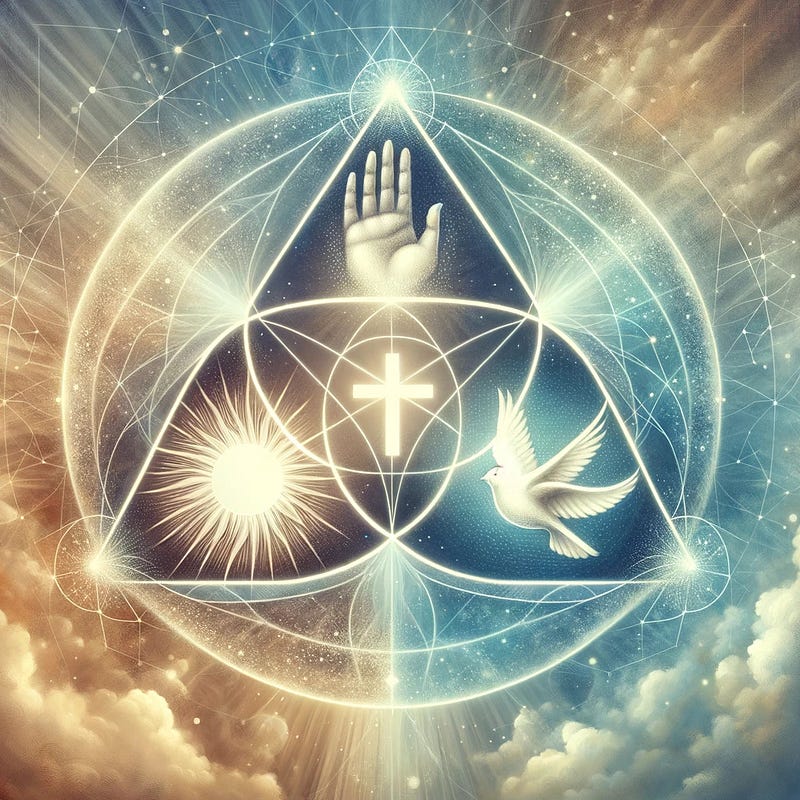
I grew up in the U.S. South, in Evangelical churches that taught about the Trinity like it was something the Bible 100% supported. In fact, many of the early Christian church debated over the nature of Christ, whether he was God, or just a prophet sent by God, or basically an enlightened human who understood the true nature of God. This same disagreement is likely part of what spurred the eventual creation of Islam hundreds of years later.
As it turns out the key verse that many Trinitarians use to confirm the existence of the Trinity was invented for the KJV and doesn’t exist in newer translations since it didn’t exist in the earliest source manuscripts. It seems to have been just added in later, likely by scribes who believed in this concept.
“For there are three that bear record in heaven, the Father, the Word, and the Holy Ghost: and these three are one. And there are three that bear witness in earth, the Spirit, and the water, and the blood: and these three agree in one.”-1 John 5:7–8
So this verse is completely fabricated, and not even included in most Bibles, but why is this a big issue? Because so much of Evangelical doctrine is based on this concept of the Trinity. I mean if we really get down to it, crusades have been fought over this concept.
But what are the key components of the belief in the Trinity?
The key elements are that the “One God” is broken up into 3 separate but equally powerful and important components, The Father, The Son, and The Holy Spirit. Christians are very touchy about not being called polytheistic, although they totally are polytheistic. This isn’t even looking over at Catholics who pray to various saints and angels, anyone who believes in the Trinity is worshipping three Gods whether they admit it or not.
The fact that there are three, almost four if you consider how high they elevate Satan as being a nemesis, they basically give him god-like status, although don’t worship him. This is the issue that Jews and Muslims have with the Christian faith, they believe that it is blasphemous to elevate other characters in the story to the level of God.
This belief posits that they are all equal, and one person, keep that in mind while we search for biblical evidence that this is or isn’t the case.
So to be fair and objective let’s first look at what other verses Evangelicals cite to back up their belief in the Trinity.
Evidence For The Trinity
“Go therefore and make disciples of all nations, baptizing them in the name of the Father and of the Son and of the Holy Spirit.”-Matthew 28:19
“The grace of the Lord Jesus Christ and the love of God and the fellowship of the Holy Spirit be with you all.”-2 Corinthians 13:14
“In the beginning was the Word, and the Word was with God, and the Word was God.”-John 1:1
14 The Word became flesh and made his dwelling among us. We have seen his glory, the glory of the one and only Son, who came from the Father, full of grace and truth.-John 1:14
These verses cites the existence of the three but doesn’t convey their equality. They cite the word of God being around in the beginning, and being part of God, and that “The Word” became his only son and dwelt on Earth. So clearly this is talking about Christ, but the question I would put forward is even if “The Word” was part of God, was it equal to God? Especially after becoming his son. Did he make it into his son, did Christ really exist prior to becoming flesh? Might this explain some of the crazy events in The Infancy Gospel of Thomas? Keep this in mind as we move forward.
16 And I will ask the Father, and he will give you another advocate to help you and be with you forever — 17 the Spirit of truth. The world cannot accept him, because it neither sees him nor knows him. But you know him, for he lives with you and will be in you.-John 14:16–17
“But when the Helper comes, whom I will send to you from the Father, the Spirit of truth, who proceeds from the Father, he will bear witness about me.” This again shows the distinct roles yet unity among the Father, Son, and Holy Spirit.-John 15:26
These verses aren’t super clear, they may be referring to the Holy Spirit coming down and being more accessible to the disciples and other Christians, but it could easily also be interpreted that this is prophesizing another prophet to be sent from God. This is exactly what Muslims believe this is saying about the coming of Mohammed.
Also again, does this show that Christ is on the same level as God as Trinitarians believe? In fact, Christ here asks God to send another, which seems to place him below God.
“I and the Father are one,”-John 10:30
Christ and God being one would possibly imply equality, although a more nuanced look at this could just be that he is part of God like how Hindus believe we are all part of Brahman. There is evidence of this in John 20:17, which we’ll cover below when Christ tells Mary that he will ascend to his father, and “your father”. Sort of putting his relationship with The Father on the same level as her.
“according to the foreknowledge of God the Father, in the sanctification of the Spirit, for obedience to Jesus Christ and for sprinkling with his blood.”-1 Peter 1:2
This verse references all three of them, but nothing in the verse implies equality between God the Father and Christ.
“Let us make man in our image, after our likeness.”-Genesis 1:26
Trinitarians like to explain away this verse as an Old Testament instance of Christ making an appearance, but you have to really go out on a limb to make that claim. The verse doesn’t mention anything about Christ, and if you actually research the Garden of Eden story and read the original Sumerian story it included multiple gods in the Garden creating mankind. In fact, the Israelites early on were polytheistic, so evidence backs up this just being a remnant of that time, and it has just been coopted by Trinitarians for their use.
Evidence Against
“Hear, O Israel: The Lord our God, the Lord is one.”-Deuteronomy 6:4
29 “The most important one,” answered Jesus, “is this: ‘Hear, O Israel: The Lord our God, the Lord is one.-Mark 12:29
Jews don’t believe that Christ was God incarnate, so it makes sense that an Old Testament aka Torah book would be pretty clearly monotheistic.
Here Christ himself quotes the above verse. Now Trinitarians may try to interpret this by saying “well yeah, Jesus and God are one, so him making a statement about God being one doesn’t matter”, mental gymnastics aside, this verse seems to be pretty clear cut that Christ is making a claim towards God being one, and it also seems separate from himself.
3 Now this is eternal life: that they know you, the only true God, and Jesus Christ, whom you have sent.-John 17:3
“Yet for us there is but one God, the Father, from whom all things came and for whom we live; and there is but one Lord, Jesus Christ, through whom all things came and through whom we live.”-1 Corinthians 8:6
“For there is one God and one mediator between God and mankind, the man Christ Jesus.”-1 Timothy 2:5
18 “Why do you call me good?” Jesus answered. “No one is good — except God alone.-Mark 10:18, Luke 18:19
The verses above seem to make a clear that Christ and God have distinct roles, and that there is “one God”, with Christ referred to as a mediator between that “one God” and mankind. In the last verse, we even see Christ himself making the statement that there is one God, seeming to separate himself from that role.
17 Jesus said, “Do not hold on to me, for I have not yet ascended to the Father. Go instead to my brothers and tell them, ‘I am ascending to my Father and your Father, to my God and your God.’-John 20:17
In this verse, Christ makes it clear that he is subordinate to God, and is ascending to him. I also find it interesting that he seems to almost put himself on the same level as Mary who he’s talking to. This gives a bit of credence to the theory of her taking over his ministry after he ascends, or to the gnostic concept that he was teaching his disciples how to be like him, basically an enlightened being conscious of the true nature of God rather than the son of God, or God incarnate.
28 When he has done this, then the Son himself will be made subject to him who put everything under him, so that God may be all in all.-1 Corinthians 15:28
22 “Fellow Israelites, listen to this: Jesus of Nazareth was a man accredited by God to you by miracles, wonders and signs, which God did among you through him, as you yourselves know.-Acts 2:22
15 The Son is the image of the invisible God, the firstborn over all creation.-Colossians 1:15
36 “But about that day or hour no one knows, not even the angels in heaven, nor the Son, but only the Father.-Matthew 24:36, Mark 13:32
In these verses Christ is mentioned as becoming “subject to God”, the image of God, and is mentioned as “a man” whom God worked through. None of these mention him as being God directly, plus in the last one, it seems he doesn’t have the omniscience of God.
Father, forgive them; for they know not what they do.-Luke 23:34
My God, my God, why hast thou forsaken me?- 27:46
Father, into thy hands I commend my spirit.-Luke 23:46
These are the final words of Christ while on the cross, all of these don’t make it sound like he is on the same level as The Father, even calling out to God who had forsaken him.
I never questioned this while I was active in the Church, but in the years since I’ve found myself actually studying canonical as well as non-canonical scriptures a lot more, trying to piece together the puzzle.
There is so much more evidence here to back up the idea of Christ being subordinate to the Father either as a lesser deity, or just as a supernatural human of sorts. I can see why many in the early church adopted that view of him rather than him being God directly.
This just goes down as one more thing that Christians shoehorned into the religion without much/or any Biblical evidence, and have repeated it constantly until they believed it was Biblically true.
Just like their concept of hell as an eternal place of torment.
Or Satan as a supreme evil.
Or their condemnation of homosexuals.
Related Articles


