Gay Couples in the Bible
A discussion of gay couples in the Bible
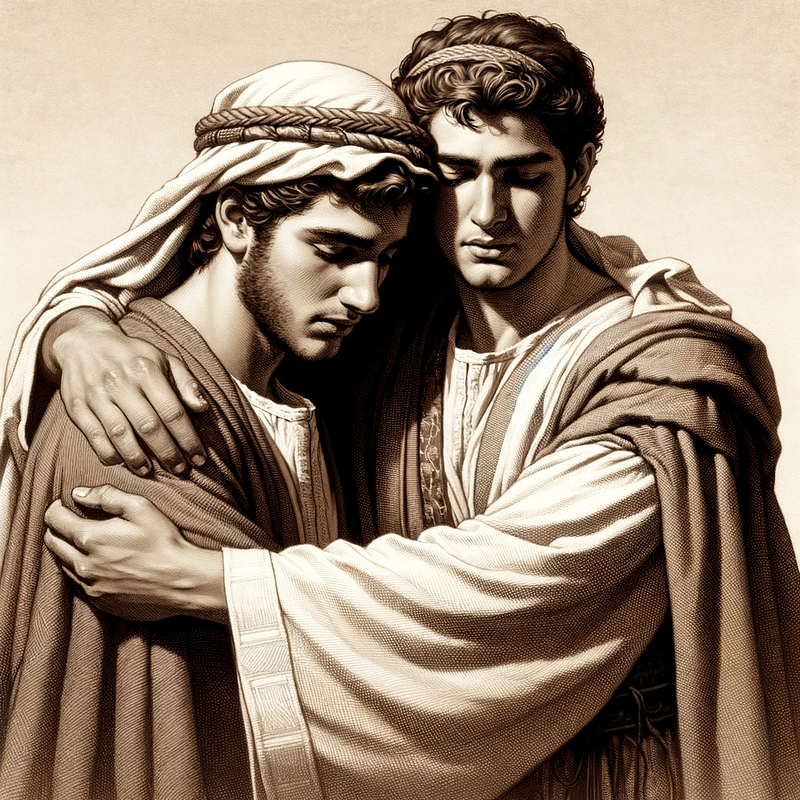
We always hear from Christians about how homosexuality is a sin, and they like to cite one of six verses to make that claim. Each of those verses has been twisted from their original languages and used for ulterior motives, as I have detailed in another piece I wrote that I’ll link at the bottom of this article. With that in mind though, what evidence do we have of homosexual couples in the Bible itself?
David and Johnathan
Let’s start with the most discussed possibility, David and Jonathan from the Old Testament. There are several verses here that show their closeness, Jonathan stripping down and showing his vulnerability to David, them kissing, and David stating his love for Johnathan was “greater than that of a woman” and that his “soul was knit” to Jonathan’s, they even made a covenant before God, with wording similar to that of wedding vows. David shows an extreme amount of grief for Jonathan when he dies, and even adopts his son as his own.
1 Samuel 18:1,3–4 1 Now it came about when he had finished speaking to Saul, that the soul of Jonathan was knit to the soul of David, and Jonathan loved him as himself. 3 Then Jonathan made a covenant with David because he loved him as himself. 4 Jonathan stripped himself of the robe that was on him and gave it to David, with his military gear, including his sword, his bow, and his belt. 1 Samuel 20:8 8 So deal kindly with your servant, for you have brought your servant into a covenant of the Lord with you. But if I am guilty of wrongdoing, kill me yourself; for why then should you bring me to your father?” 1 Samuel 23:18 18 So the two of them made a covenant before the Lord; and David stayed at Horesh, while Jonathan went to his house.
In another section we see that when Saul finds out that David had found “favor” in Jonathan’s eyes he becomes angry with him, and David fears Saul is going to kill him. So David meets up with Jonathan to make a plan, and near the end of the section, they cry together and kiss.
1 Samuel 20:3,41 3 Yet David vowed again, saying, “Your father is well aware that I have found favor in your sight, and he has said, ‘Jonathan is not to know this, otherwise he will be worried.’ But indeed as the Lord lives and as your soul lives, there is just a step between me and death.” 41 When the boy was gone, David got up from the south side, then he fell on his face to the ground and bowed three times. And they kissed each other and wept together, until David wept immeasurably.
Christians of course like to try to dismiss all of this as a “friendship”, but I think with what evidence we have here, and the fact that we know parts of the Bible were removed and edited by biased scholars against this sort of relationship…it seems pretty clear cut to me what the truth of the situation was. Let’s take a look at the verses that support this theory.

Saul and David
The next one still involves David. When he was younger he was selected to be King Saul’s armor bearer. Saul also appreciated him for his beauty and skill in playing a harp to him in private. This sort of dynamic is seen around the world in ancient cultures where older, more powerful men, sometimes warriors, would take on essentially a younger man or even boy as a partner.
When David meets Jonathan and gains a previously mentioned “favor in his eyes” we see this jealous, even murderous rage come out of Saul. Saul even calls out Jonathan and uses phrasing that would be used against a son who slept with a father’s wife, helping to show the possible dynamic between Saul, David, and Jonathan.
1 Samuel 20:30 30 Then Saul’s anger burned against Jonathan, and he said to him, “You son of a perverse, rebellious woman! Do I not know that you are choosing the son of Jesse to your own shame, and to the shame of your mother’s nakedness?
Referring to this verse.
Leviticus 18:7–8 7 You shall not uncover the nakedness of your father, that is, the nakedness of your mother. She is your mother; you are not to uncover her nakedness. 8 You shall not uncover the nakedness of your father’s wife; it is your father’s nakedness.
Upon Saul and Jonathan’s death, David grieves for them both using the term beloved.
2 Samuel 1:23 Saul and Jonathan, beloved and delightful in life, And in their deaths they were not separated; They were swifter than eagles, They were mightier than lions.

Ruth and Naomi
Ruth and her mother-in-law Naomi both are widowed and Ruth pledges loyalty to her for the rest of her life similar to a wedding vow, even using the term in the following verse “cleave,” which we see reflected in Genesis in reference to Adam and Eve.
Given this sort of relationship wouldn’t have been accepted at the time, it isn’t too much of a stretch of the imagination that they’d need to find a “beard,” and make the relationship not stand out much in society. So later on Ruth, at the instruction of Naomi, seduces this guy Boaz who has legal rights to be able to marry her as a widow.
She marries him (love is never mentioned), has a kid with him, and upon the birth of that child, the neighborhood women celebrate that Naomi…not Boaz, had a son. It seems like maybe the neighborhood women were keen on the arrangement.
Ruth 1:14,16 14 And they raised their voices and wept again; and Orpah kissed her mother-in-law, but Ruth clung to her. 16 But Ruth said, “Do not plead with me to leave you or to turn back from following you; for where you go, I will go, and where you sleep, I will sleep. Your people shall be my people, and your God, my God.
Ruth 4:16–17 16 Then Naomi took the child and laid him in her lap, and became his nurse. 17 And the neighbor women gave him a name, saying, “A son has been born to Naomi!” So they named him Obed. He is the father of Jesse, the father of David.

Centurion and Servant
In the New Testament, there is a story about a Roman centurion who comes to Jesus to ask him to heal his servant, but he uses the word “pais” which in Greek usually translates to a son or servant, but in some contexts could be referring to a lover that was younger than him. Also given that centurions weren’t allowed to marry it makes it less likely it would’ve been his son.
The amount of concern this centurion shows, as well as his willingness to throw himself down in front of a Jewish man and plead for him to heal his servant, seems out of place for what a master would do for a servant and shows that the centurion isn’t that concerned with social norms.
Matthew 8:5–10 5 And when Jesus entered Capernaum, a centurion came to Him, begging Him, 6 and saying, “Lord, my servant is lying paralyzed at home, terribly tormented.” 7 Jesus *said to him, “I will come and heal him.” 8 But the centurion replied, “Lord, I am not worthy for You to come under my roof, but just say the word, and my servant will be healed. 9 For I also am a man under authority, with soldiers under me; and I say to this one, ‘Go!’ and he goes, and to another, ‘Come!’ and he comes, and to my slave, ‘Do this!’ and he does it.” 10 Now when Jesus heard this, He was amazed and said to those who were following, “Truly I say to you, I have not found such great faith with anyone in Israel.
Jesus’ reply here in verse 10 is normally taken as the centurion’s faith in Jesus, but it could also be interpreted as his faithfulness to his partner, that he would seek out help from a Jewish man whom Romans were there to police, and risk his own humiliation by society to try to seek healing for him.
The next one will likely ruffle some feathers amongst my readers.
Jesus and The Beloved Disciple
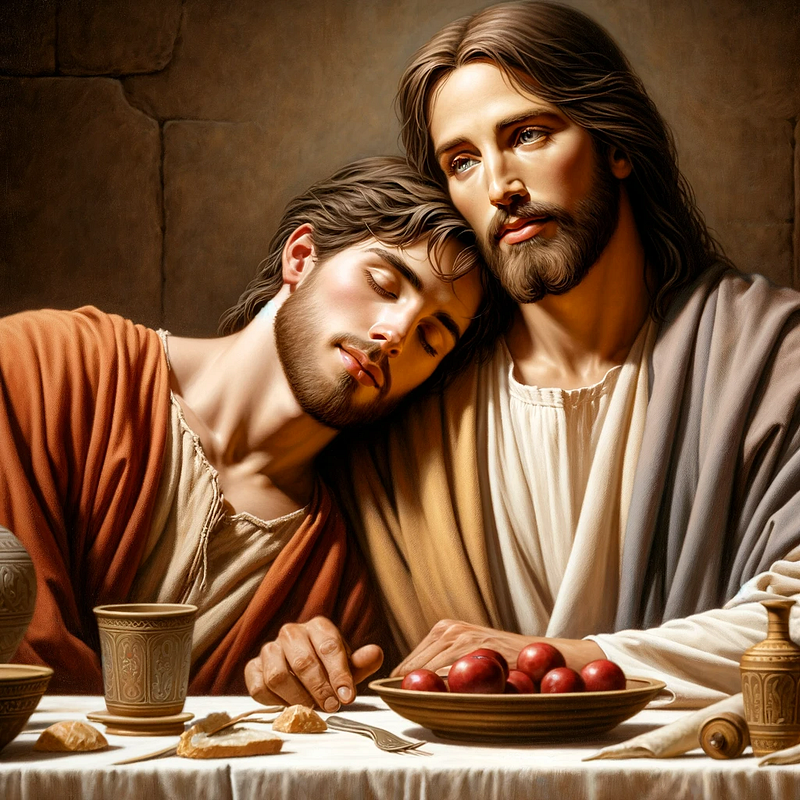
This figure is often interpreted to be the disciple “John”, not to be confused with John the Baptist. However, this character is never given a name in the gospels.
This character is never mentioned before the Last Supper but is then referenced as being at the foot of the cross, one of the two who run to Jesus’ empty tomb, and the last one referenced in the gospel of John that is following the resurrected Jesus along with his disciples.
John 13:23 23 Lying back on Jesus’ chest was one of His disciples, whom Jesus loved. John 19:26–27 26 So when Jesus saw His mother, and the disciple whom He loved standing nearby, He *said to His mother, “Woman, behold, your son!” 27 Then He *said to the disciple, “Behold, your mother!” And from that hour the disciple took her into his own household. John 21: 20–22 20 Peter turned around and *saw the disciple whom Jesus loved following them — the one who also had leaned back on His chest at the supper and said, “Lord, who is the one who is betraying You?” 21 So Peter, upon seeing him, *said to Jesus, “Lord, and what about this man?” 22 Jesus *said to him, “If I want him to remain until I come, what is that to you? You follow Me!”
It’s also possible that this character who has no name in the scriptures, may have been him as well.
Mark 14:51–52 48 And Jesus said to them, “Have you come out with swords and clubs to arrest Me, as you would against a man inciting a revolt? 49 Every day I was with you within the temple grounds teaching, and you did not arrest Me; but this has taken place so that the Scriptures will be fulfilled.” 50 And His disciples all left Him and fled. 51 A young man was following Him, wearing nothing but a linen sheet over his naked body; and they *seized him. 52 But he pulled free of the linen sheet and escaped naked.
Can any of these be absolutely proven to be gay couples? No, and I’m sure I’ll have Christians in the comments upset with this interpretation. There is however a good bit of evidence here in this “holy book” that when read without the filter of church indoctrination should make you raise an eyebrow and think that maybe we weren’t given the true full story.