Was the Devil Cast Down From Heaven, According to the Bible?
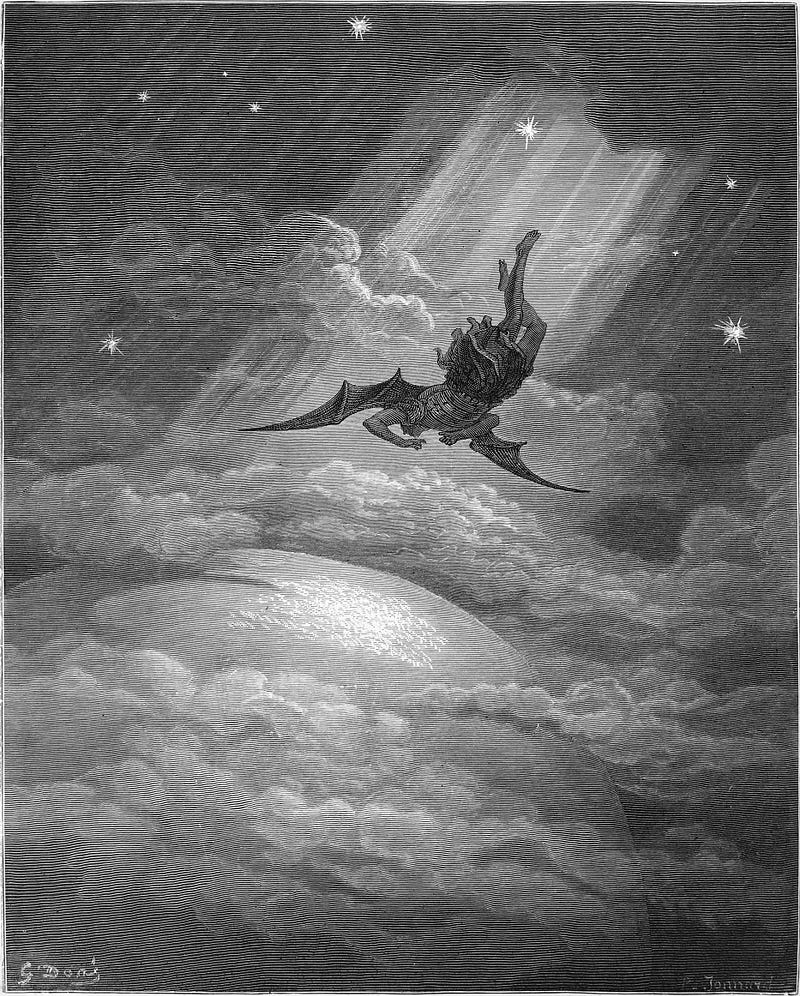
Most people, even those who didn’t ever attend church are probably familiar with the story of the fall of the devil. The story has made it’s way into western media in many ways, into shows and movies such as Dogma, Supernatural, and, of course, Lucifer.
I’ll recap for those who may not be fully sure of the story, and as a refresher for those who do remember it for the most part. As the story goes, Lucifer was god’s favorite angel, he was more beautiful (possibly meaning powerful) than the rest, but he let this pride get the best of him and decided he wanted to overthrow god and sit on his throne. So he led a rebellion of one third of god’s angels against him, there was a war in heaven and god cast him down to earth/hell, conceivably making him not as radiant or holy, and changing his appearance to appear as what we think of as demons?
I leave that last part as a question because you see, the Bible doesn’t really line that all out. It does mention in the New Testament that the devil can make himself look like an angel of light, implying that may not be his default appearance anymore:
2 Corinthians 11:13–15 14 And no marvel, for Satan himself is transformed into an angel of light.
Now let’s go back to that whole rebellion, war, and dialogue between the devil and god, and the details of what happened there.
………
We can’t, because it’s not in the Bible, at all… at least not in the way you would expect, not with how often the story is told to congregations. This entire narrative is cooked up from a few obscure verses that refer to other people, and have been twisted and reinterpreted by Christians. Not even followers of Judaism believe this, and they’re the ones who wrote the Old Testament and use it as their complete “bible.” Christians have contrived the following verses into the origin story of their big bad villain, in an effort to absolve their god from the creation and existence of evil. So let’s take a look at those verses.
The first is Ezekiel 28, really the whole chapter pertains to this, but Christians like to quote 13–19, for a good reason. Verse 12 specifies who god is talking about, and it’s not the Devil. It’s the King of Tyrus who god evidently had blessed with many riches, etc., but the guy got proud and thought too much of himself, so god takes him down a peg as he is wont to do.
Ezekiel 28:12–19 12 Son of man, take up a lamentation upon the king of Tyrus, and say unto him, Thus saith the Lord God; Thou sealest up the sum, full of wisdom, and perfect in beauty.
13 Thou hast been in Eden the garden of God; every precious stone was thy covering, the sardius, topaz, and the diamond, the beryl, the onyx, and the jasper, the sapphire, the emerald, and the carbuncle, and gold: the workmanship of thy tabrets and of thy pipes was prepared in thee in the day that thou wast created.
14 Thou art the anointed cherub that covereth; and I have set thee so: thou wast upon the holy mountain of God; thou hast walked up and down in the midst of the stones of fire.
15 Thou wast perfect in thy ways from the day that thou wast created, till iniquity was found in thee.
16 By the multitude of thy merchandise they have filled the midst of thee with violence, and thou hast sinned: therefore I will cast thee as profane out of the mountain of God: and I will destroy thee, O covering cherub, from the midst of the stones of fire.
17 Thine heart was lifted up because of thy beauty, thou hast corrupted thy wisdom by reason of thy brightness: I will cast thee to the ground, I will lay thee before kings, that they may behold thee.
18 Thou hast defiled thy sanctuaries by the multitude of thine iniquities, by the iniquity of thy traffick; therefore will I bring forth a fire from the midst of thee, it shall devour thee, and I will bring thee to ashes upon the earth in the sight of all them that behold thee.
19 All they that know thee among the people shall be astonished at thee: thou shalt be a terror, and never shalt thou be any more.
So Christians will cry foul and say it’s all allegory for the Devil, but then again they’ll claim other parts that people claim are allegory should be read as fact and the King of Tyrus was a real guy. Which one is it?
The next verse is also in the Old Testament, in Isaiah:
Isaiah 14:12–15
12 How art thou fallen from heaven, O Lucifer, son of the morning! how art thou cut down to the ground, which didst weaken the nations!
13 For thou hast said in thine heart, I will ascend into heaven, I will exalt my throne above the stars of God: I will sit also upon the mount of the congregation, in the sides of the north:
14 I will ascend above the heights of the clouds; I will be like the most High.
15 Yet thou shalt be brought down to hell, to the sides of the pit.
Now, this one seems like it is definitely pertaining to the Devil, right? Unless you read the rest of the chapter, and you can see it’s talking about the king of Babylon who had the Jews enslaved at this point. The king it is referring to is Nebuchadnezzar, which we see evidence of god’s favor and subsequent judgement in other verses such as:
Jeremiah 27:6
6 And now have I given all these lands into the hand of Nebuchadnezzar the king of Babylon, my servant; and the beasts of the field have I given him also to serve him.
Daniel 4:26-33
30 The king spake, and said, Is not this great Babylon, that I have built for the house of the kingdom by the might of my power, and for the honour of my majesty?
31 While the word was in the king's mouth, there fell a voice from heaven, saying, O king Nebuchadnezzar, to thee it is spoken; The kingdom is departed from thee.
32 And they shall drive thee from men, and thy dwelling shall be with the beasts of the field: they shall make thee to eat grass as oxen, and seven times shall pass over thee, until thou know that the most High ruleth in the kingdom of men, and giveth it to whomsoever he will.
33 The same hour was the thing fulfilled upon Nebuchadnezzar: and he was driven from men, and did eat grass as oxen, and his body was wet with the dew of heaven, till his hairs were grown like eagles' feathers, and his nails like birds' claws.
In Isaiah 14:12, when it refers to Lucifer, in most other translations it says “star of the morning (or morning star), son of the dawn.” Lucifer just means light bringer. This title was given to the king for being one of god’s chosen, but now he has fallen out of favor with god. In Isaiah 14:15, where it mentions “hell”, the original translation uses the word “Sheol”, which to the Jews is just a place of darkness and waiting after death, until the final resurrection. This stands in contrast to the Christian’s hell, a fiery place of eternal torment.
So if we realize that Lucifer here isn’t a name, but just a title god had bestowed on this particular king, that he is now mad at, and we realize “hell” should’ve just been “Sheol”, or the darkness waiting area for the dead….this whole section loses it’s “Devil’s Origin” narrative.
Really that is it….those are the sections they use to create the Devil’s backstory. The Old Testament doesn’t really paint the Devil as a villain at first. Even when he torments Job, he is doing it at the behest of god. Also, he is just referred to as Satan at that point, which is a title, not a name. It means “adversary, or accuser.” I’ve gone over this more in depth in past articles. The character of Satan changes throughout the Bible, going from a henchman of God, to more of an antithesis of God.
This shift occurred because of the Jewish people being enslaved to the Babylonians and having traits of Zoroastrianism rub off on them. Zoroastrians believe essentially in a duality of good vs evil. Ahura Mazda vs Angra Mainyu, a good god vs an evil god. They believe their god is pure good, and can’t be evil at all.
You can see how this influenced the New Testament in verses like this one:
1 John 1:5 This then is the message which we have heard of him, and declare unto you, that God is light, and in him is no darkness at all.
Yet in the Old Testament we’ve got:
Isaiah 45:7 7 I form the light, and create darkness: I make peace, and create evil: I the Lord do all these things.
See, the Jewish faith for the most part is much more monotheistic. They believe their god is essentially both good and evil, and don’t want to elevate another supernatural being to his level. Their god is just the dude up stairs that’s in charge and sometimes he may have to work you over a bit so you start acting right….sounds very much like an abusive relationship.
The Christians want to lean more into the all good god, pure light, loving everyone, more enlightened etc. (unless they’re preaching towards a group they don’t like, then they resort to the Old Testament.)
The above contradiction actually is solved if we look at some non-canonical books from early Christianity, that portray the Old Testament god as essentially the villain of the story.
There are of course more verses in the new testament referencing the Devil, but not specifically his origin story, except for two possibilities. One spoken by Jesus himself, and then a reference in Revelations.
The first one is from Luke:
Luke 10: 17–20 17 The seventy-two returned with joy and said, “Lord, even the demons submit to us in your name.”
18 He replied, “I saw Satan fall like lightning from heaven. 19 I have given you authority to trample on snakes and scorpions and to overcome all the power of the enemy; nothing will harm you. 20 However, do not rejoice that the spirits submit to you, but rejoice that your names are written in heaven.”
Christians take this as meaning that Jesus just sort of out of nowhere, mentions the original fall of the Devil from heaven. Could this just be a reference to having recently dealt with “the accuser” while he was out in the wilderness, and that he was able to command Satan like his father does?
When Jesus went out into the wilderness he was tempted by the Devil, well by Satan anyways. So in the Jewish context (which Jesus was a Jew lets remember, although Jews don’t acknowledge the New Testament), this is the same accuser angel that God uses as a henchman to put you through trials, to see if you’ll break, like he attempted with Job. Not some ultimate evil that is at war with god, again that would elevate a mere angel to near the level of god, which Jews see as blasphemy.
This brings me to another point. Why would God have cast the Devil into the world where he was about to put humans? Why would he still allow him into heaven as Christians believe from the reference in Job about Satan and other angels coming before God…why let him have free reign of Earth and visiting rights in heaven? When exactly was he cast down to Earth? Prior to the creation of man? Because the only real reference to this is in Revelations:
Revelation 12:9 And the great dragon was cast out, that old serpent, called the Devil, and Satan, which deceiveth the whole world: he was cast out into the earth, and his angels were cast out with him.
Revelations however has to do with the end times, and is also basically a psychedelic drug trip, that definitely leaves stuff up to interpretation. Also, there’s no time period specified here, whether this is supposed to be a future event or one that occurred before the time of man. This entire book of the Bible is super esoteric, and is thought to have been written around 70-100 years after Christ’s time, so fledgling Christianity had had some time to create some differing flavors of belief by this point.
Ultimately, my point with this piece is the entire narrative around the “Devil” isn’t even clear using the Bible, a book which these people claim to be without error, the living word of God even in some denominations. Yet, this story is pushed by every pastor on their congregation like it is complete canonical fact. For people like me who grew up in the church, they made the Devil a very real villain for us. They told us that he is coming after you, and going to try to trick you and make that loving god upstairs damn you to hell, to be tormented for eternity. You can imagine the mental anguish this causes so many young people who truly believe this. Having grown up in the church I had no idea the story was this contrived.