
Young Jesus
The Terror of the Townsfolk
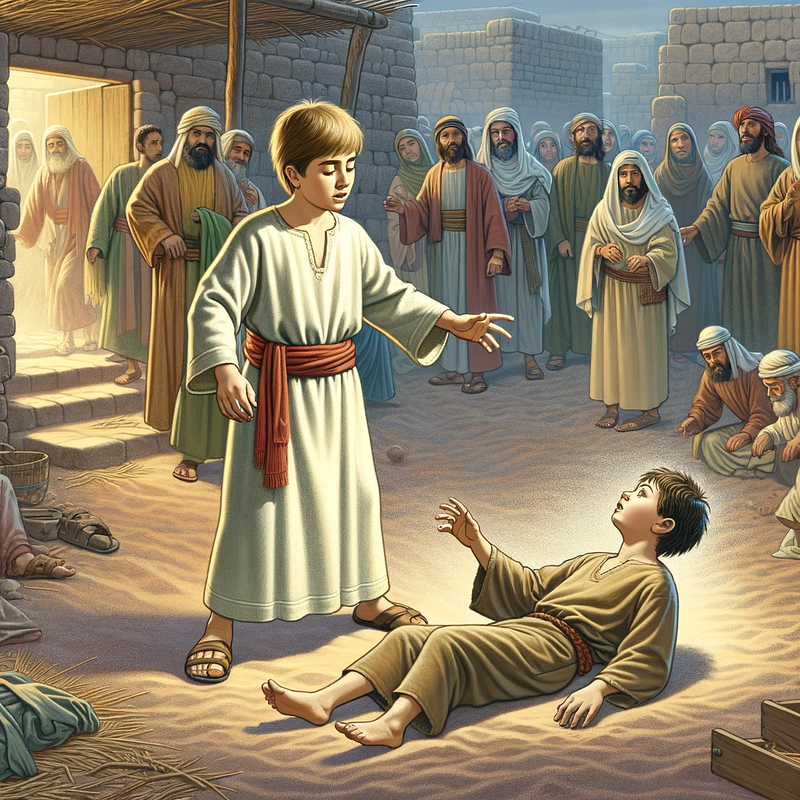
In the Bible, we only see Jesus at his birth, briefly at twelve years old and then at around thirty. Why is there such a gap in the story about him? I’d understand if after his birth he was just a normal kid and then we didn’t know anything about him until his wisdom and powers manifested. But seeing as how he was wowing people at twelve years old it seems his wisdom had at least begun to manifest at that point, but then there’s a twenty-year gap in the story.
But when did his powers manifest? Also, did he realize he was God incarnate upon his powers and wisdom manifesting?
In the canon Bible, we only have one mention of him after his birth and before the start of his ministry at thirty.
Luke 2:42-47 King James Version (KJV)
And when he was twelve years old, they went up to Jerusalem after the custom of the feast. And when they had fulfilled the days, as they returned, the child Jesus tarried behind in Jerusalem; and Joseph and his mother knew not of it. But they, supposing him to have been in the company, went a day's journey; and they sought him among their kinsfolk and acquaintance. And when they found him not, they turned back again to Jerusalem, seeking him. And it came to pass, that after three days they found him in the temple, sitting in the midst of the doctors, both hearing them, and asking them questions. And all that heard him were astonished at his understanding and answers.
Well as it turns out there is a gospel about Jesus from the ages of five to twelve, actually directly tying into this verse from the Gospel of Luke. The name of the work is the Infancy Gospel of Thomas, not to be confused with the Gospel of Thomas which is a gnostic work.
This “Infancy” gospel gives us some ideas of the precarious situation Jesus’s earthly mother and father were having to deal with raising a demi-god. Some in Christian circles will find some of the events in this story to be sacrilegious, but I would also keep in mind that we don’t fully know if Jesus was supposed to always know that he was God, or if that knowledge was revealed to him over time in his earthly form. After all, even in the Garden of Gethsemane, he asked for “this cup to be taken from me”, he wanted out of the responsibility of dying on the cross.
If he was all-knowing, and all-powerful at that moment why the doubt? Also, why ask for permission from himself essentially? Then on the cross, he lost connection to God, asking why he had forsaken him. So we don’t know the exact nature of his connection with God while he was in his earthly form.
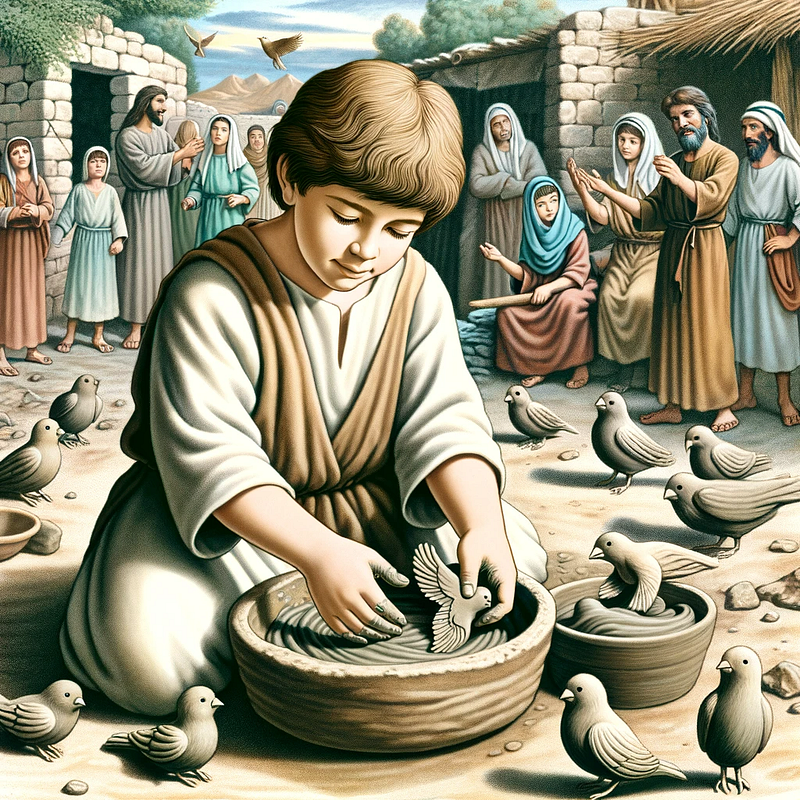
In the first chapter, we see Jesus playing in the water, and he fashions his birds out of clay and then animates them into life. This is sort of a lesser version of the Adam and Eve story of God creating man from the dirt. A kid comes along though and is pissed off that he’s doing works on the sabbath, so tells on him, then breaks the ponds of water up that Jesus has fashioned and Jesus says,
“Your fruit (will have) no root, and your shoot will be withered like a scorched branch in a violent wind!”
Then the kid withers up, seemingly having all the water sapped from his body, and dies….ok so not exactly the Jesus we know and love from the Bible, or could it be? Again, this is a child, a five-year-old child, who would likely have bits of anger flare out from time to time but is also equipped with incredible power.
We do see Jesus get angry at a few points in the Bible, but the biggest example is when he “Cleanses the temple”.
Luke 19:45–46 (KJV): “And he went into the temple, and began to cast out them that sold therein, and them that bought; Saying unto them, It is written, My house is the house of prayer: but ye have made it a den of thieves.”
So although some Christians try to act like Jesus never got angry, he did, and we all know the God of the Old Testament was wrathful as hell.
So with that in mind is it that crazy to think that a young Jesus could lash out in anger and strike a kid dead for messing up something he was working on?
Soon after making the first kid wither to death Jesus was walking with his father Joseph and someone ran by and struck him in the shoulder, Jesus then struck that person dead as well. A whole crowd from the town witnesses this and begins yelling at Joseph about his son, who up to this point seems more like the kid from “The Omen” than the Jesus we know from the Bible. Joseph says,
“Why do you say such things, and they suffer and hate us?”
Jesus then strikes the whole crowd blind, and Joseph drags him home by his ear.
Joseph then tries to bring him to a teacher, but he has a rather negative effect on Zacchaeus, what would you expect from someone being exposed to a living God?
“Take (him) away from me, brother, because I can’t bear his gaze, nor the clarity of his word. This child is simply not of this earth. He can even tame fire! Perhaps this child existed before the creation of the world. What kind of womb bore him? What kind of mother raised him? I don’t know. Woe is me, brother! He stupefies me. My mind can’t follow him. I’ve deceived myself, thrice-unhappy as I am. I thought to gain a disciple, and I’m found having a teacher.”
In the next section, Jesus seems to reverse the death and blindness he had inflicted on the aforementioned victims, although we’re not sure of the exact timeframe that has passed.
Next, he’s playing with some kids up on the rooftops and one falls and dies, the parents are quick to accuse Jesus since he had built a reputation for killing other kids it seems. Jesus then goes over and resurrects the kid so the kid can clear his name of being the perpetrator of the crime.
Then a guy is chopping wood and ends up slicing his foot bad enough that he bleeds out, Jesus rushes to his aid and heals and resuscitates him. At least at this point, he seems to just be using his God powers for good.
The next few accounts of miracles include Jesus going to get water for his mom and the container breaking, so he gathers water in his cloak and can carry it back without losing a drop.
She kissed him, saying, “Lord, my God, bless our child,”
The next accounts are of him and his father spreading seed for the harvest and producing a much greater output than usual, which allowed Joseph to give a lot to the poor. This could be seen as a precursor to the loaves and fishes story.
Then later his father, being a carpenter, tries to make something with two pieces of wood that don’t match up, so Jesus lengthens one, and tells his dad,
“Don’t grieve, but make whatever you want to.”
And Joseph embraced and kissed him, saying, “Blessed am I, that God gave this child to me
Fairly inconsequential little interactions and miracles, but it does give more depth to his relationship with his earthly parents, which I find interesting.
Unfortunately, we see his wrath come out again. Joseph brings him to another teacher since the first one seems to have possibly lost his mind after his interaction. The new teacher doesn’t like Jesus showing off and ends up striking him, to which Jesus smites him dead on the spot. Joseph then brings him home quickly and tells Mary not to let him out of her sight unless he kills some more townspeople that may provoke him.
Joseph then has the nerve to bring him to another teacher, who seems to be able to work with Jesus, and due to his understanding of Jesus, he seems to resurrect the last teacher.
And he (Jesus) said to the teacher, “Since you spoke correctly and testified correctly, the one struck down will also be saved because of you.” And immediately that teacher also was saved. And taking the child, he (Joseph) led him (Jesus) away into his house.
In the next section we see Jesus and his brother James out gathering wood, James is bitten by a venomous snake and is writhing on the ground dying. Jesus blows on the wound and instantly the snake is smote dead and James is healed.
Then there is a story about a baby dying, and the mother grieving loudly, Jesus hears her and runs over, and resurrects the baby.
And the crowd standing there was amazed, and said, “The truth is, this child is a god or an angel, because his every word becomes a deed!”
And Jesus went away again and played with the children
The last miracle in this gospel is about a builder who likely fell and died, Jesus hears the commotion and goes to him, grabs his hand, and resurrects him.
And the crowd saw and was amazed and said, “This child is from heaven, for he saved many souls from death, and he will continue to save all the days of his life.”
At the end of the gospel, the entire thing ties back into the instance we have from the canon gospels, of Jesus being twelve years old at the temple amazing people.
And his mother said to him, “Child, what have you done to us? Look, we’ve been searching for you in pain and grieving.”
And Jesus said, “Why were you looking for me? Didn’t you know that it’s necessary for me to be in the place of my Father?”
And the scribes and the Pharisees said to Mary, “You’re the mother of this child?”
She said, “I am.”
And they said to her, “Blessed are you that the Lord God has blessed the fruit of your womb, because we’ve never seen such wisdom of praise and glory of virtue.”
This gospel was likely left out of the canon due to these instances of Jesus killing people while in anger, but it’s not that big of a stretch to believe that a demi-god would accidentally, or purposely, kill people when upset given that he didn’t have a full understanding of his power, or the world yet.
This gospel dates at least to the 2nd century, a bit later than the original gospels, but not much later than books like Revelations. Even then it’s not entirely understood exactly when it originated, but given the numerous translations that exist it was widely spread among the early Christian movement.
Ultimately I find it very interesting, as it gives us more insight into what a young Jesus might have been like, as well as his interactions with his parents, brother, and other children.
Related Articles


