avatarJanice Harayda

Free AI web copilot to create summaries, insights and extended knowledge, download it at here

2554

Abstract

href="https://www.ala.org/advocacy/bbooks/bannedbooksweek/ideasandresources/freedownloads">have included </a>“anti-family,” “makes white babies feel sad,” and “promoted a homosexual lifestyle,” according to the American Library Association.</p><h2 id="7423">A wider political spectrum is getting into the act</h2><p id="718e">Most challenges to books have come from conservatives, especially those with strong religious beliefs, as they have since the days of the Puritan theocracy. Elected officials like Rep. Marjorie Taylor Greene and Gov. Ron DeSantis are leading the latest charge against titles dealing with topics such as human sexuality and critical race theory.</p><p id="1e0f">But liberals also challenge books — typically because of imagery or language they see as racist, homophobic, or anti-Semitic. A common target is <i>The Adventures of Huckleberry Finn, </i>not just for its use of the N-word but because it depicts a friendship between a white boy and a black man.</p><p id="a2cd">Some evidence suggests that in this confrontational climate, librarians’ jobs are becoming more dangerous. The director of an Idaho library resigned “after months of harassment that included the shouting of Biblical passages referring to divine punishment,” <a href="https://apnews.com/article/libraries-american-library-association-book-banning-af7c9f312266b572c3dc189b1d109de4">the AP reported </a>last year.</p><p id="2382">The verbal assaults began with a complaint about Maia Kobabe’s memoir <a href="https://en.wikipedia.org/wiki/Gender_Queer"><i>Gender Queer</i></a><i>, </i>the <a href="https://www.ala.org/advocacy/bbooks/frequentlychallengedbooks/top10">most frequently challenged book</a> in the U.S. In that case, the library didn’t even stock the book.</p><p id="edb9">In Virginia, librarians “have received threatening emails and have been videotaped on the job,” the executive director of the state library association said.</p><p id="a00a">These facts are are bleak enough. But they don’t suggest the larger harms — to children as to adults — that occur when books are forced off shelves, some noted in this story about the repeated assaults on <i>The Adventures of Huckleberry Finn</i>:</p><div id="5e98" class="link-block"> <a href="https://readmedium.com/the-harm-in-banning-huck-finn-619bfb815b49"> <div> <div> <h2>The Harm In Banning ‘Huck Finn’</h2> <div><h3>Why everyone loses when Mark Twain’s novel vanishes from bookshelves</h3></div> <div><p>m

Options

edium.com</p></div> </div> <div> <div style="background-image: url(https://miro.readmedium.com/v2/resize:fit:320/1*1ZOLnQSG5Z_7y9U92Y75HA.jpeg)"></div> </div> </div> </a> </div><p id="9974">Not all of the attempted bans lead to censorship. Sometimes teachers, librarians, or others fend off attempts to suppress books.</p><p id="05ab">But their job is getting tougher, especially in states like Greene’s Georgia and DeSantis’ Florida. And while book bans have seldom sparked debate in presidential elections, they could become flashpoint in the 2024 campaign.</p><p id="51ec"><i>You might like my related story on changes in Roald Dahl’s novels:</i></p><div id="9fa7" class="link-block"> <a href="https://readmedium.com/roald-dahl-was-a-victim-of-stupidity-not-censorship-4954eb1f12e4"> <div> <div> <h2>Roald Dahl Was a Victim Of Stupidity, Not ‘Censorship’</h2> <div><h3>Writers imprisoned by dictators are getting less sympathy than an author whose work had inane editing</h3></div> <div><p>medium.com</p></div> </div> <div> <div style="background-image: url(https://miro.readmedium.com/v2/resize:fit:320/1*i0fgfaG7lYcSq0mSb9gEiA.jpeg)"></div> </div> </div> </a> </div><p id="b387"><b><i>Jan Harayda is an award-winning journalist and critic. She has been the book editor of Ohio’s largest newspaper and a vice-president of the National Book Critics Circle. Her work has appeared in many print and online media, including the </i>New York Times<i>, the </i>Wall Street Journal<i>, the </i>Washington Post<i>, </i>Newsweek<i>, and </i>Salon<i>.</i></b></p><p id="a61c"><b><i>You might like one of my other stories:</i></b></p><div id="8b43" class="link-block"> <a href="https://readmedium.com/dont-cancel-rudyard-kipling-63ebe9b6d5f1"> <div> <div> <h2>Don’t Cancel Rudyard Kipling</h2> <div><h3>He’s been called ‘a right-wing imperialist warmonger,’ but his great ‘Rikki-Tikki-Tavi’ shows why he’s making a…</h3></div> <div><p>medium.com</p></div> </div> <div> <div style="background-image: url(https://miro.readmedium.com/v2/resize:fit:320/1*f_M_ROQEwouexAlbHZj_Xg.jpeg)"></div> </div> </div> </a> </div></article></body>

THREATENING EMAILS TO LIBRARIANS

The Scary Change In Book Bans

It goes beyond attempts by politicians to keep schools from teaching certain subjects
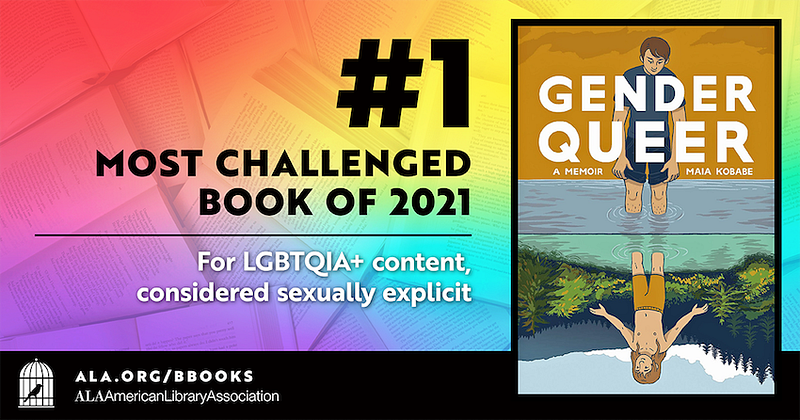
Banned Books poster from the American Library Association / Credit: ALA

Book banning is an old story. It’s been going on for centuries. In 1637 the Puritan government in Quincy, Massachusetts, banned a book its leaders saw as too critical of how the Puritans wielded power — a move historians consider the first book ban in the United States.

But book banning lately has taken a turn that alarms librarians, free-speech advocates, and others: Attempts to limit access to books are soaring.

A record number occurred in 2022, according to a new report from the American Library Association. The ALA recorded more than 1,200 challenges to books last year, the most since it began tracking complaints two decades ago.

“I’ve never seen anything like this,” Deborah Caldwell-Stone, director of the library association’s Office for Intellectual Freedom, told the Associated Press. “The last two years have been exhausting, frightening, outrage inducing.”

The nature of bans is changing

Book bans once tended to focus on a single book disliked by a parent or community resident.

In the 1950s, some libraries banned L. Frank Baum’s story of the Wizard of Oz in part for its portrayal of witchcraft. One complaint said that “the inclusion of a good witch is theologically impossible, because witchcraft is bad and, therefore, a good witch could not exist.”
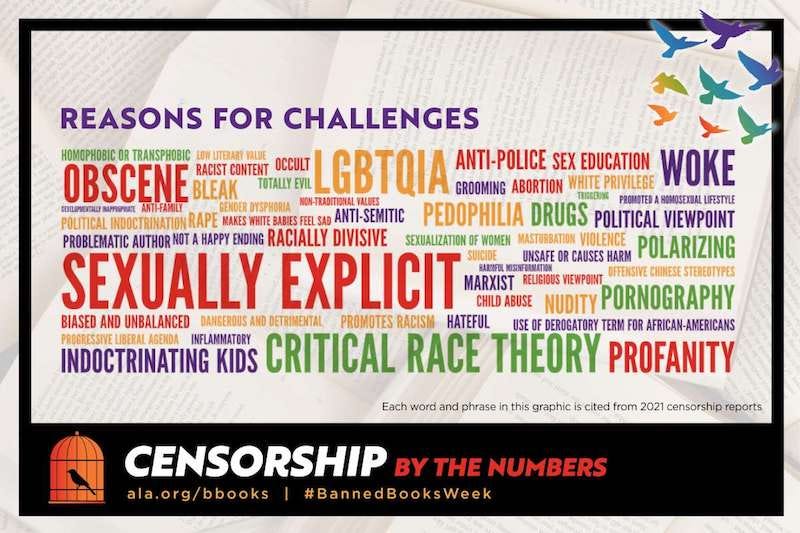
ALA poster listing common reasons for challenges to books / ALA

Now challenges are coming from well-organized national groups that may demand the removal of entire categories of books. And they involve a growing range of complaints about books. The objections have included “anti-family,” “makes white babies feel sad,” and “promoted a homosexual lifestyle,” according to the American Library Association.

A wider political spectrum is getting into the act

Most challenges to books have come from conservatives, especially those with strong religious beliefs, as they have since the days of the Puritan theocracy. Elected officials like Rep. Marjorie Taylor Greene and Gov. Ron DeSantis are leading the latest charge against titles dealing with topics such as human sexuality and critical race theory.

But liberals also challenge books — typically because of imagery or language they see as racist, homophobic, or anti-Semitic. A common target is The Adventures of Huckleberry Finn, not just for its use of the N-word but because it depicts a friendship between a white boy and a black man.

Some evidence suggests that in this confrontational climate, librarians’ jobs are becoming more dangerous. The director of an Idaho library resigned “after months of harassment that included the shouting of Biblical passages referring to divine punishment,” the AP reported last year.

The verbal assaults began with a complaint about Maia Kobabe’s memoir Gender Queer, the most frequently challenged book in the U.S. In that case, the library didn’t even stock the book.

In Virginia, librarians “have received threatening emails and have been videotaped on the job,” the executive director of the state library association said.

These facts are are bleak enough. But they don’t suggest the larger harms — to children as to adults — that occur when books are forced off shelves, some noted in this story about the repeated assaults on The Adventures of Huckleberry Finn:

Not all of the attempted bans lead to censorship. Sometimes teachers, librarians, or others fend off attempts to suppress books.

But their job is getting tougher, especially in states like Greene’s Georgia and DeSantis’ Florida. And while book bans have seldom sparked debate in presidential elections, they could become flashpoint in the 2024 campaign.

You might like my related story on changes in Roald Dahl’s novels:

Jan Harayda is an award-winning journalist and critic. She has been the book editor of Ohio’s largest newspaper and a vice-president of the National Book Critics Circle. Her work has appeared in many print and online media, including the New York Times, the Wall Street Journal, the Washington Post, Newsweek, and Salon.

You might like one of my other stories:

Books
Government
Censorship
Equality
Libraries
Recommended from ReadMedium