
The Harm In Banning ‘Huck Finn’
Why everyone loses when Mark Twain’s novel vanishes from bookshelves
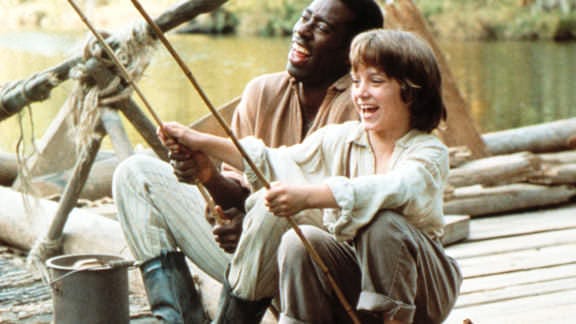
In The Green Hills of Africa, Ernest Hemingway said that “all modern American literature comes from one book by Mark Twain called Huckleberry Finn.” That’s debatable given how small a role women play in Twain’s novel compared with how large a role they play in modern American literature.
But generations of critics have agreed with Hemingway’s broader point: Adventures of Huckleberry Finn marks the beginning of a distinctly American literature, one that reflects the nation’s speech as well its besetting sin: its racial injustices. If the critics were right, we may be nearing the end of that “beginning.”
Huckleberry Finn has been one of the novels most frequently challenged at schools and libraries, often for reasons that seem absurd in retrospect, since its publication in 1885. Early critics targeted language seen as “coarse” by Victorian standards: In 1905 the Brooklyn Public Library banned the book for its use of “sweat” instead of perspiration. As scholars have noted, librarians and others faulted Twain for the sin of daring to use the language of his day.
Recent assaults on the novel have focused on its use of the N-word, and it’s easy to see why. Some authors put the racial slur only into the mouths of obvious bigots, using it to reveal their loathsome character. Huck Finn is a boy we’re supposed to like, and he uses the word more than 200 times.
In the past few years, that’s led to the removal of the book from required reading lists in the public schools in Duluth, Minnesota, and in smaller cities or districts in Virginia, Pennsylvania, and elsewhere, including Oak Park, Illinois, Hemingway’s birthplace. A common reason for its disappearance is that students say the racial slur makes them feel “uncomfortable.”
Why should you care about Huck’s ouster in Duluth, or another city that may be thousands of miles from where you live? Why does it matter when you can go to a site like Project Gutenberg and download the entire novel for free even if it disappears from library shelves or school reading lists?
A good answer came from the journalist Gil Kaufman on Vox. He wrote:
“Antonio Aiello, editorial director at the New York-based literary association the PEN American Center told MTV News, ‘When this book originally came out it was controversial because it was the story of a white boy who was friends with and went on a journey with a slave, a black man.’ At that time, it was both unheard of and against all norms of social society to tell that type of story, which, in turn, made ‘Finn’ an important piece of social commentary on American culture at the time.”
Aiello added that while Huckleberry Finn may cause discomfort, banning it because of the N-word sends the wrong message at a moment when students are increasingly aware of racism in American history:
“They need to be made uncomfortable. Instead of taking this as a teachable moment to talk about where words come from and what they mean…it’s shocking that teachers wouldn’t take that opportunity. History is not going to go away.”
The efforts to to suppress Huckleberry Finn involve a striking irony. Books for children and teenagers — especially young adult novels — have grown darker and grittier in recent years. They deal with subjects that might have been unthinkable a generation or two ago, such as rape, incest, child abuse, sex trafficking, and drug dealing or addiction.
Authors, editors, and librarians often justify the dark turn in young people’s literature by saying that children need to “see themselves” in books, or to have accurate reflections of how they think, feel, and speak. That may be true. But if so, it’s fair to ask: Why don’t children need also to see accurate reflections of how their ancestors back in Mark Twain’s day thought, felt, and spoke?
@janiceharayda is an award-winning journalist who has written for many print and online media, including the New York Times, the Wall Street Journal, and the Washington Post. She reviewed 30 books from 30 countries in the first 30 days of March 2022. You can read about her “Around the World in Books” series here:
You might also like these stories:


