
The Purple Heart Finally Came Calling On Mr. Jones
How one man waited all of his life for recognition in serving his country.
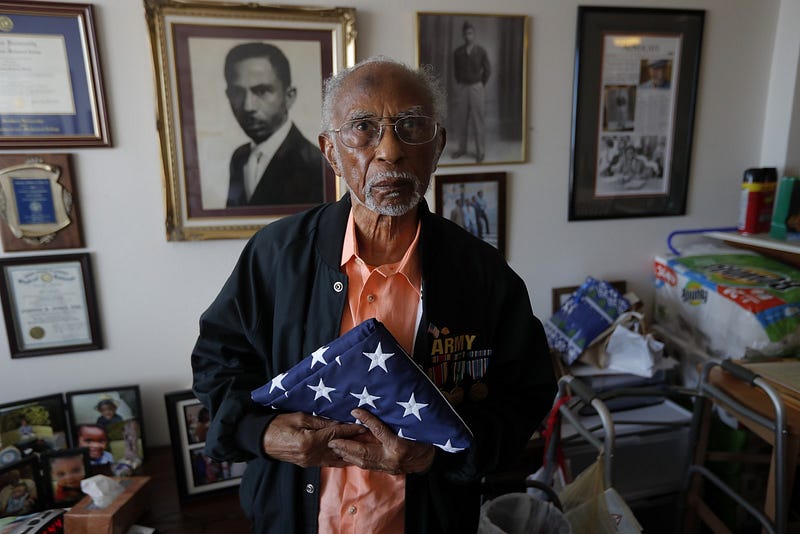
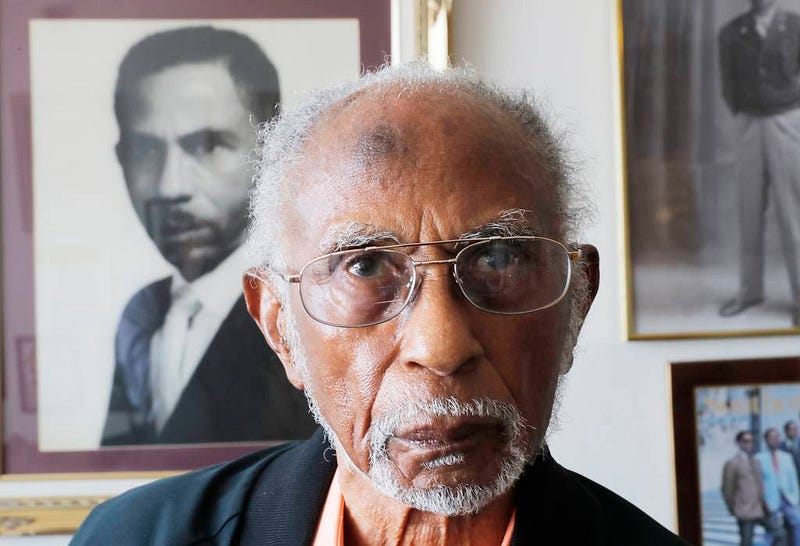
Give me my flowers why I yet live. This is an old phrase that I have always heard as a child. I used to wonder why older people would say this but now as an adult and have lived a bit, I understand these words more than ever.
So many people do ordinary things in an extraordinary manner and credits or recognition is slow in coming, if it comes at all. Better late than never is a viable solution.
Mr. Johnnie A. Jones Sr. (1919–2022) had longevity in his belt. At 102, he left a legacy that should go down in history books as Black American History is American History. He was a D-day fighter and civil rights activist Louisiana lawyer.
Today we should say to Mr. Jones, “Thank you for your service.” He was a soldier and a crusader who battled in France on D-day during World War II and received a Purple Heart. He was wounded during the invasion of Normandy, France.
Mr. Jones was born November 30, 1919 in Laurel Hill, La, and raised on a Rosemound Plantation where his parents farmed 73 acres of land and pushed him to get his education. His ticket off the farmland.
Upon their advice, he graduated from Southern University and later was drafted in 1942. He became the Army’s first Black American warrant officer and his assignment included a unit that unloaded equipment and supplies onto Normandy.
Life sometimes happens and causes a response that one carries with them for the rest of their life. This happened to Mr. Jones, during the invasion of 1944, when Jones went ashore on Omaha Beach, he was faced with a German sniper which cause him to return fire, a moment that haunted his life to the end.
That day started and continued with rough spots whereas it looked like he would not make it to the beachhead. His ship hit a mine and he was blown from the second deck to the first. Trouble seems to be everywhere and with every step that Jones took. Later during a bomb attack, he was hit by shrapnel.
As is known and documented, the military discriminated against Blacks in the worse way where they were often relegated to menial jobs beneath their capability, even in the face of putting their lives on the line and fighting for a country that cared less about their lives.
Toward the end of World War II, millions of Black Americans wore the uniforms, which included the famed Tuskegee Airmen and the 761st Tank Battalion. Fighting discrimination in the military, and upon leaving the military, the saga continued.
Returning from Europe, putting their lives on the line, Black people found themselves being forced to ride in the back of the bus and treated like second-class citizens. Mr. Jones along with fellow soldiers as they crossed the Mason-Dixon line separating North from South saw the reality that given their lives for this country mattered none to Southern white racists.
Fighting alongside other soldiers, he was not permitted to ride or sit with them on the bus but was forced to retreat to the back of the bus. Returning to the south, racism often raised its ugly head. Mr. Jones experienced hatred once again upon a trip to New Orleans to remove shrapnel from his neck and was pulled over by a white police officer who beat him for no reason, only because he was black.
Facing blatant racism triggered Mr. Jones to rise up and fight against whites who were instrumental in spewing hatred on Blacks for no reason other than living while black. His parents realized early on that their son needed the education to protect himself and others from blatant racism in the South.
He heeded the call to fight racism as it happened to him and so many other Blacks. This lead him to obtain a law degree and later was recruited in 1953 to be a part of the organizing of the Baton Rouge, Louisana’s bus boycott, defending the participants inclusive of students sit-ins in the South. This boycott preceded the Montogmery, Alabama boycott led by Rev. Dr. Martin Luther King, Jr, a few years later.
From Europe and back to America, Mr. Jones had faced much danger and was not deterred to do the right thing by fighting against racism. He was not deterred even when his car was bombed not once but twice.
From 1972 to 1976, his plight led to him serving as a state legislator in Louisiana. Age did not slow his activism down, he practiced law until he was 93. His life was an impressive activism warrior resume.
Decades later, Mr. Jones received flowers for his contribution to the war. He received the Legion of Honor award for this World War II service from the French government in 2020.
Sometimes your own do not readily recognize the true contribution to this country especially if one’s skin is of color. The French government while was a bit late also, but they beat Mr. Jones’s own country, America, in recognizing his contribution during World War II.
America, 77 years late, finally recognized Mr. Jones’s sacrifice and courage as he put his life on the line during World War II was finally recognized for his contribution at the age of 101 with a Purple Heart, awarded to U.S. members killed or wounded in action.
In conclusion, at the ripe old age of 102, Mr. Jones transitioned to a higher place in the spiritual realm but at least at 101, he received the highest honor ever for his service and courage, The Purple Heart. We can all truly say, R.I.P. Mr. Jones, you mattered.
For additional reads:


