
Judge Ketanji Brown Jackson, Black History Comes to the Supreme Court
How it took 400 plus years to elect a Black person to the Supreme Court.
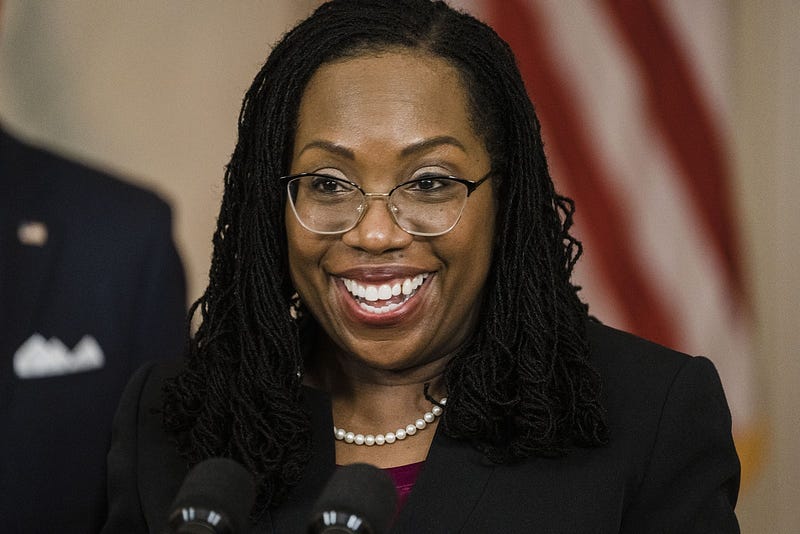
As President Biden makes history and keeps one of his campaign’s promises to nominate a Black woman to the Supreme Court has made good on his word in the face of the Voting Rights bill failure due to the efforts of the GOP.
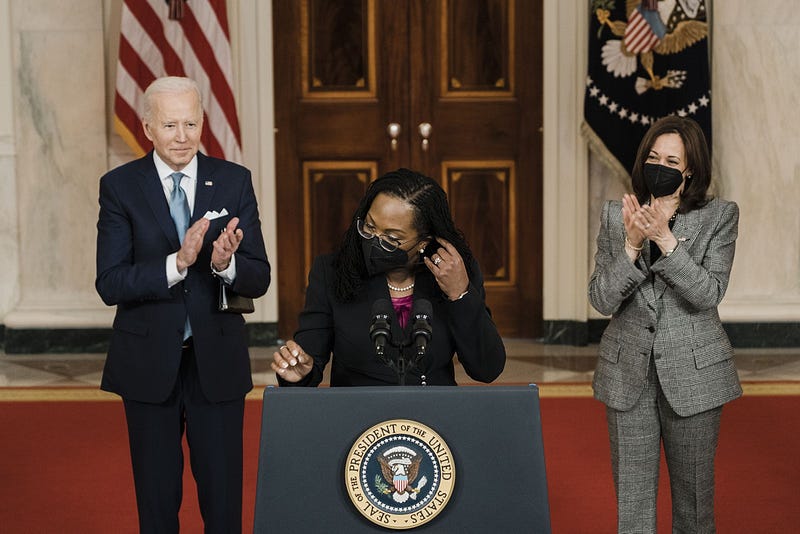
President Biden, and Vice President Kamala Harris expressed their adoration and admiration for Biden’s choice of the first Black woman, Judge Ketanji Brown Jackson, to sit on the Supreme Court, the nation’s highest court.
Judge Jackson, 51, a U.S. appeals court judge for the District of Columbia was the front runner to replace Justice Stephen G. Breyer, 83, who will be retiring at the end of his term. In this case, timing is everything, especially while the Democrats have control over the house.
Shame on America, the Supreme Court has only had two Black justices, Thurgood Marshall, a civil rights pioneer, and a leading liberal served from 1967 to 1991. Justice Marshall was instrumental in ensuring fairness within the court system pertaining to Black people and was adored for all his efforts. He was replaced by Justice Clarence Thomas, the court’s most conservative jurist who pales in comparison to the late Justice Marshall, to say the least.
Judge Jackson will join the ranks of the nine-person bench, six Republican appointed justices. Her credits include eight years as a federal district judge in Washington before her confirmation last year to the U.S. Court of Appeals by a vote of 53 to 44, received three Republican votes.
In the face of a Senate that is currently split 50–50, Vice President Harris giving the Democrats a tiebreaking vote along with some bipartisan support ensures the nomination to be practically a done deal.
Jackson’s legacy thus far extends from her intellect, character, and personal warmth, i.e. a real human being in touch with reality. She earned academic honors at Harvard College and Harvard Law School. Other recognition pertains to her positions as a federal public defender, a U.S. Sentencing Commission official, and a law clerk in three courts, inclusive of the high court under Justice Breyer.
Sometimes the apple does not fall too far from the tree. Judge Jackson’s interest in the law began with her father studying to become a lawyer and later serving as chief attorney for the Miami-Dade County school board and as her mother was a principal of a high school for the arts.
As history does not happen in a vacuum, Judge Jackson also attributes the doors of opportunity in becoming a nominee for the Supreme Court seat to the first Black woman appointed to be a federal judge, Judge Constance Baker Motley, a civil rights lawyer who was steadfast and had a courageous commitment to equal justice under the law.
Likewise, Judge Jackson’s legacy on the federal bench has shown her commitment to upholding the laws that protect people with disabilities, workers, immigrants, and freedom of speech with a perspective relative to the eyes of society most vulnerable.
During her testimony for confirmation, the public will learn more about Judge Jackson’s and her intent moving forward on issues that are faced by the common man and woman.
Of course, there will always be opposers in every situation and the antiabortion advocates are opposing Jackson’s confirmation even though she has not ruled on any cases that directly address abortion rights. Thus far there are two remaining liberal justices in support of abortion rights while the remaining justices seek to strictly limit the right to abortion or to overturn Roe vs. Wade.
Other GOP opposers are Mitch McConnell (R-KY.) and the Republican National Committee as they have labeled her based on their own ideology, as “the favored choice of far-left dark money groups,” and “a radical, left-wing activist.” Tucker Carlson had the audacity to question Judge Jackson’s credentials, without merits other than racism. Did he question Kavanaugh or Barrett’s credentials? Actions speak louder than words.
When the GOP can’t dig up dirt, then they make up dirt to dissuade an appointment. The GOP houses some of the worst and lowest of the low racist mentality and self-serving politicians who do not champion what they can do for the people but how to lie, steal and suppress anyone who does not align with their agenda, “them against us.”
Looking ahead, Judge Jackson once confirmed, will take part in two key cases involving the role of race, to restrict or outlaw affirmative action policies at colleges and universities, and the Voting Rights Act. Her legacy and razor-sharp perspective certainly will add a new voice on the bench that is definitely needed.
Alike, the GOP nominees to the Supreme Court were expeditiously conducted for Brett M. Kavanaugh and Amy Coney Barrett, President Biden’s goal is to quickly confirm Justice Jackson in a fair process, (fair to the nominee, the Senate, and the American public), and an expeditious process. The goal is to confirm quickly so that she can be sworn in as soon as Justice Breyer departs over the next month.
In conclusion, the Supreme Court needs a new perspective as the old perspective are GOP biased and anti-people. Change is good and especially with the first Black woman being appointed to the Supreme Court, the highest court in the land. The time has come for America and the Supreme Court to reflect the reality of America, the melting pot.
For additional reads:


