
Celebrating the Legacy of Emmett Ashford, First Black Umpire
How one man changed the baseball landscape in the face of racism.
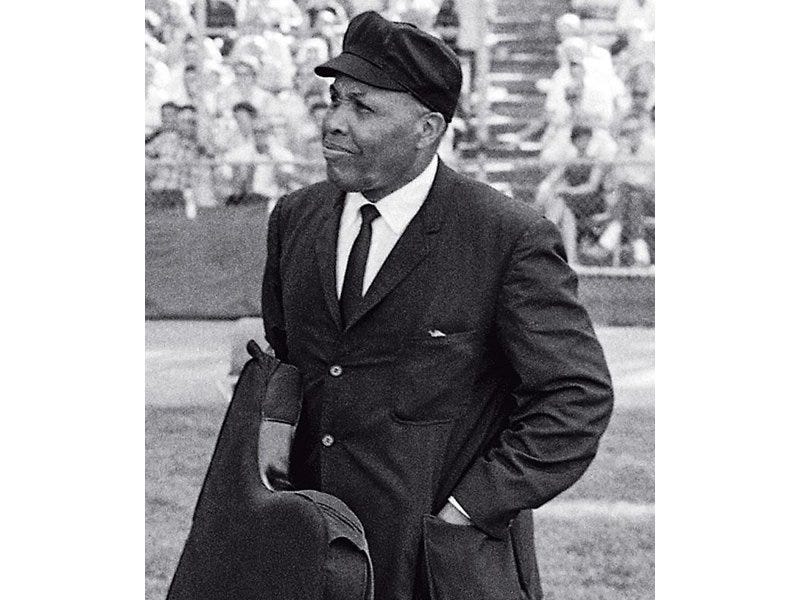
Emmett Ashford, born November 23, 1914, in Los Angeles, was the first Black umpire who has been a well-kept secret since 1966. He attended Los Angeles Junior college and later graduated from Champman University in 1941.
In the late 1930s, Ashford briefly attempted to play semipro baseball but turned to umpiring when the situation presented itself or the opportunity fell in his lap.
After serving in the Navy during World War II, he was inspired to become the first Black major league umpire while he was stationed in Corpus Christi, Texas as he heard on the radio that Jackie Robinson had broken baseball’s color barrier.
In 1951, Ashford moonlighted as a Santa Ana municipal league softball and National Night Ball League of Southern California umpire. During this time he garnered his colorful style when a batter received a base-on-balls, he coned, “Ball Fo-uh, you may proceed to first base” versus the norm calling, “Ball Four.”
Afterward, he left Santa Ana to umpire in the Southwestern International League, became the first Black umpire in the traditionally white professional baseball system, and was later offered a full-season umpiring job.
His umpiring career went on to joining the Arizona-Texas League, the Western International League in 1953, Pacific Coast League in 1954, and working for 922 games as the crew chief for Cece Carlucci.
After 12 years with the Pacific Coast League, he became quite the exuberant, showman, and energetic figure when interacting with the crowd between innings. Also, was known for his flashy wardrobe style and jewelry accessories.
His off-seasons were spent refereeing Pac-8 basketball games and college football, umpiring the Caribbean winter leagues, and running several umpiring clinics.
In 1963, Ashford was named the PCL’s umpire-in-chief, making him responsible for training crews and advising the league on disputed games or rules.
By the early 1960s, pressure came from the West Coast sportswriters to promote Ashford to the major league which led to his contract being sold to the American League, in September 1965. He made his debut at D.C. Stadium on April 11, 1966.
Recognition was well overdue to a groundbreaker who scored his first baseball game in 1966. Surely he had much to deal with being the first Black umpire working with the Cleveland Indians-Washington Senators game in Washington, D.C. Stadium.
Mr. Ashford almost did not make it into the game, security was very tight as former Vice President Hubert Humprey was to throw out the game’s first pitch, and the Secret Service did not believe Ashford was an umpire.
His career as an MLB umpire began by happenstance as he filled in for a no-show umpire for a game and the rest was history. He was an athlete in high school, played semi-pro baseball, and umpired in high school and college games in the 1940s.
For eleven years, he became the best of the best and in 1951, became the first Black professional umpire in the old Class C Southwest International League per the MiLB.com.
Today racism is the ugliest of the ugly, just imagined what Mr. Ashford experience back in the 1950s being the first Black umpire. Segregation was at its worst in civilization because there were no checks and balances for segregationists’ behavior.
Baseball fans yelled racial slurs at him and he was allegedly called “boy” by a fellow umpire. The name boy was commonly used by Whites to demean Black men.
Worst of the worse, even being at the top of his game, in 1953, the Class A Western league had to remove its president for allegedly refusing to let Ashford work games per MiLB.com. Gosh, all due to skin color, obvious his talent was not questioned.
After moving up to the Pacific Coast League in 1954, he umpired for 12 years and was later contracted to play with the American League a the age of 51. His career was short as the retirement age for baseball at that time was 55 with few exceptions.
As fate would have it, he worked the 1967 All-Star Game and the 1970 World Series. 1970 marked the end of his career and ten years later he died, on March 1, 1980.
In the face of all the racism, he enjoyed what he loved to do and that was being an umpire and being the first Black to do so. During interviews, he conferred how proud he was having been an umpire in the big leagues, being privileged to be among a very select group, setting out and doing what he loved in the face of much adversity, and being the first Black man was a byproduct of his action as all was the thrill of his life.
In conclusion, Emmett Ashford’s name should be included in all American History books, and may his legacy live on in the hearts of all Americans who deserve to know his contribution to the baseball landscape and humanity. Long live Mr. Emmett Ashford.
For additional reads: