
Legacy of Attorney Charles Hamilton Houston, Jim Crow Killer
How the man who killed Jim Crow was the forerunner to Justice Thurgood Marshall.
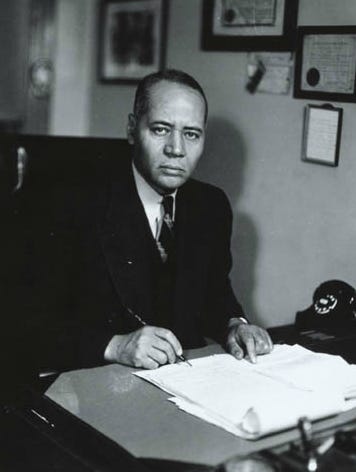
Charles Hamilton Houston, a lawyer, was born September 3, 1895, in Washington, D.C., and died at the age of 54, on April 22, 1950, of a heart attack. He achieved his BA degree from Amherst College and Harvard University (LL.B., D.J.S.)
Houston hailed from distinguished beginnings where his father, William Le Pre’ Houston, was an attorney who practiced in the capital for more than four decades, was a son of a slave, and his mother, Mary Hamilton Houston, worked as a seamstress.
Houston was a product of segregated local schools and graduated from Dunbar High School, an academic college preparatory. During his studies at Amherst College, he was elected to the Phi Beta Kappa honor society and graduated valedictorian in 1915, the only Black student in his class.
His credentials led to him becoming a prominent lawyer, Dean of Howard University Law School, and NAACP’s first special counsel, or Litigation Director and were instrumental in dismantling Jim Crow laws, specifically targeting schools segregation and racial housing covenants. His tenacity earned him the title “The Man Who Killed Jim Crow”.
His brilliance afforded him to train and mentor a generation of Black attorneys, including Thurgood Marshall, a future founder, and director of the NAACP Legal Defense Fund who later became the first Black Supreme Court Justice. As a recruiter of young lawyers, he directed these lawyers to work on the NAACP’s litigation campaigns, which fostered a relationship between Howard and Harvard’s university law schools. He also taught English at Howard University, an HBCU, a historically Black college.
During World War I, Houston joined the racially segregated Army as a First Lieutenant and was stationed in Fort Meade, Maryland from 1917 to 1919. The obvious racism against Blacks led Houston to study law as he declined decline to fight a war spearheaded by whites who oppressed Blacks. He stated that it was senseless to die for a war that prosecuted Blacks unfairly and his goal was to change these dynamics, fighting for men who could not fight back against the system of racism.
After his time with the Army, in 1919, Houston enrolled in Harvard Law School, and was the first Black student elected to the editorial board of the Harvard Law School, graduated cum laude, a member of Alpha Phi Alpha fraternity, earned a bachelor’s of law in 1922, and a JD from Harvard in 1923, awarded a Sheldon Traveling Fellowship for the University of Madrid and upon his return to America, was admitted to the Washington, DC bar in 1924 and joined his father’s practice, 1925 admitted to the American Bar Association, founded the National Bar Associaton and was a founding member of the affiliated Washington Bar Associaton.
His impeccable record continued to open doors for him. He was recruited to the Howard University faculty by the school’s first African-American president, Mordecai Johnson. For six years, he served as Vice-Dean and Dean of the Howard University School of Law, making the school a major national training center for Black lawyers as it gained accreditation by the Associaton of American Law Schools and the American Bar Association.
This accreditation led to prominent attorneys being speakers and thereby built a law network for his students whom he mentored for generations. Most notable, he influenced nearly one-quarter of all the Black lawyers in the United States during his legacy. His mission was to build a network of lawyers to fight against racial discrimination and to work for social justice.
Houston as the first special counsel for the NAACP, for five years, created litigation strategies to attack racism everywhere and argued civil rights cases before the Supreme Court, and played a role in nearly every civil rights case that reached the US Supreme Court between 1930 and Brown versus Board of Education (1954).
Other credits include the exclusion of African Americans from juries across the South, defended George Crawford, an African American charged with murder in Virginia in 1933, and saving him from the electric chair, Hollins v. State of Oklahoma (1935), another murder case conviction by an all-white jury, the appeal was won from death sentence to life in prison, and fought for the building of education facilities for blacks equal to whites or to integrate.
Houston was unstoppable and tireless, as he founded a law firm, Houston & Gardner, and later included other partners, who were all later appointed as federal judges.
Houston’s legal fight against segregation in the courts included him carrying a movie camera traveling across South Carolina documenting all the injustices in education from facilities, materials, and salaries disparities.
He also directed young lawyers to work a litigation campaign of court challenges to equalize teachers’ salaries and directed the NAACP’s campaign to end discriminatory housing.
Later he was instrumental in the winning of a United States Supreme Court case, Buchanan v. Warley (1917) that prohibited state and local jurisdictions from establishing restrictive housing by real estate developers and agents. After many setbacks in abolishing restrictive housing during a 22-year campaign, the court ruled in favor of dismantling restrictive housing via the U.S. Supreme Court ruling in Shelly v. Kraemer (1948).
In conclusion, Mr. Houston was a legal game-changer attorney, changed the face of America from Jim Crowism, and mentored countless Black attorneys to being inclusive in the courts fighting against racism and inequalities in the educational and housing systems. Befitting is the name, “The Man Who Killed Jim Crow.” We thank you forever for your service.
For additional readings:


