
The NICE Way and Possible Practice
Expand the Systems Models of Creativity and Contemporary Practice Theories
This post is the section 10 of The NICE Way and Creative Actions. A related article is The 3I Model: Idea, Initiator and Initiatee.
The “Process as Product” approach has a theoretical assumption that creative action is an ongoing and unfolding event with a reciprocal relationship between initiator and initiatee in the context of dynamic platform and other social context.
The 3I model describes the system of creative actions at the micro level, we still need another model for explaining the dynamic historical development of collective culture at the macro level. The above discussion about the social system model of creativity points to some limits of the model. It’s time to expand the model in order to cover more types of creative behaviors.
The Original Systems Models of Creativity
As we discussed early, the sociocultural approach of creativity research highlights the issue of cultural context. Appropriateness is defined by social groups, and it’s culturally and historically determined. In order to understand the impact of social context, Mihaly Csikszentmihalyi and other researchers developed the Social Systems Model of creativity during the 1980s and 1990s. The diagram below shows the model contains three components: person, domain and field. Csikszentmihalyi said, “Creativity occurs at the interface of three subsystems: An Individual who absorbs information form the culture and changes it in a way that will be selected by the relevant Field of gatekeepers for inclusion into the Domain, from whence the novelty will be accessible to the next generation.” (2014, p.166)
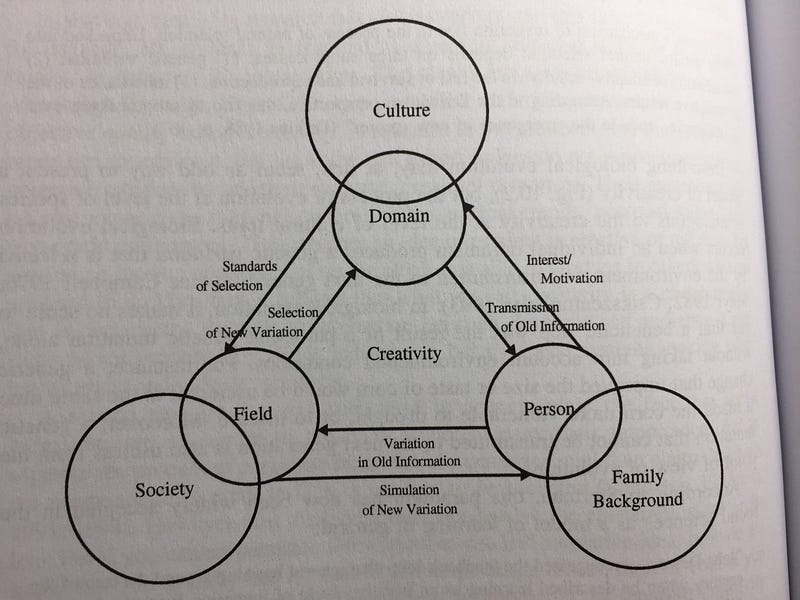
The Systems Model of creativity is suitable for traditional domains such as art, scientific, film, performance, etc. However, the model is reliant on a stable set of gatekeepers as a Field and a bounded Domain which requires a stabilized social structure. For BED Talks and other stay-at-home challenges, it is hard to find Field and Domain for these creative actions. Also, it is obvious that emergent digital platforms are key context for these creative actions. The Field and Domain can’t explain digital Platform.
The section 9 (Domain, Field and Platform) of The NICE Way and Creative Actions provides more details about this argument.
Natural Selection v.s. Niche Construction
We also have to notice the deep assumption behind the social system model of creativity. According to Csikszentmihalyi, the model was inspired by the model of biological evolution, “The systems model of creativity is formally analogous to the model of evolution based on natural selection. The variation which occurs at the individual level of biological evolution corresponds to the contribution that the person makes to creativity; the selection is the contribution of the field, and the transmission is the contribution of the domain to the creative process. Operating within a specific cultural framework, a person makes a variation on what is known, and if the change is judged to be valuable by the field, it will be incorporated into the domain, thus providing a new cultural framework for the next generation of person. Thus, creativity can be seen as a special case of evolution. ” (2014, p.167)
Csikszentmihalyi initially developed the social model of creativity in the 1980s. In the past several decades, evolutionary biologists have developed new theories for expanding the evolution by natural selection and Modern Synthesis which combines Charles Darwin’s theory of evolution and Gregor Mendel’s idea on heredity. One promising theory is niche construction theory (NCT) and its core term was coined by Oxford biologist John Odling-Smee in 1988. Odling-Smee argued that ‘niche construction’ and ‘ecological inheritance’ should be recognized as evolutionary processes. In 2011, Jeremy Kendal, Jamshid J. Tehrani and Odling-Smee published a paper titled Human niche construction in interdisciplinary focus. They claimed, “NCT differs from standard evolutionary theory (SET) in recognizing that the evolution of organisms is co-directed by both natural selection and niche construction…NCT is put to better use when formulating new hypotheses, or building a more general evolutionary framework within which other theories can be subsumed. NCT provides mechanisms by which currently disconnected bodies of theory, such as evolutionary and developmental biology, or human cultural evolution and structuration theory can be united.”
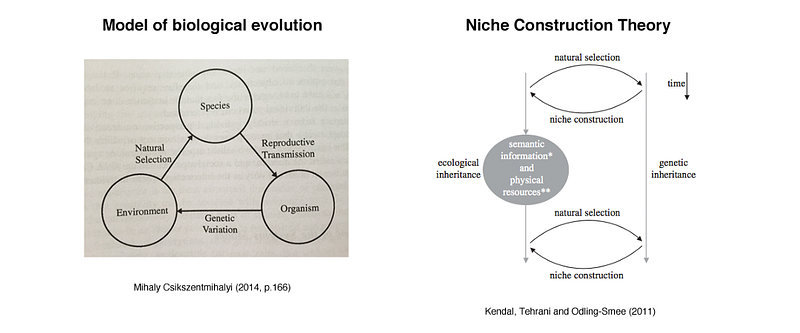
If we adopt NCT to creativity research, then we can modify the original analogy behind the social system model of creativity. The new analogy considers both natural selection and niche construction, therefore, creativity is to cultural evolution as the hybrid process of adaptation and construction. Creators don’t only submit their creations for selection by the Field and the Domain, they also can construct their environment to support their creative activities. This new perspective doesn’t propose an oppositional approach to the Systems Model of creativity, but expands its scope and amplifies its effectiveness.
A New Framework
In order to explain the Action-based Creativity, I developed the following framework to connect individual daily experience at micro level and collective culture at the macro level.
I call it the N.I.C.E. framework. N stands for normal actions, I stands for Imagined actions, C stands for creative actions, and E stands for exemplary actions.
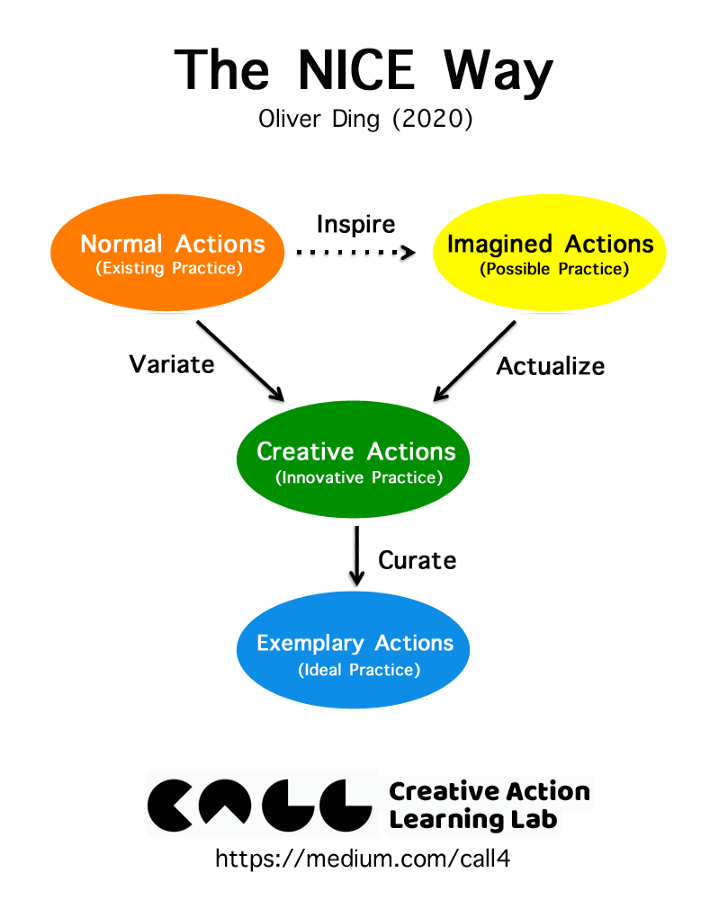
I also identified four types of transformation processes within Action-based creativity.
- Variate: from normal actions to creative actions
- Inspire: from normal actions to imagined actions
- Actualize: from imagined actions to creative actions
- Curate: from creative actions to exemplary actions
The N.I.C.E. way adoptes many theoretical concepts from the tradition of creativity research.
Variate
As we discussed early, the “Variation” is a key issue of creativity research. For example, Dean Keith Simonton developed a theory called chance-configuration theory by adopting Donald Campbell’s (1960) blind-variation and selective-retention model (BVSR) of creative thought.(1988, p.3)
For Action-based Creativity, the focus is the transformation between existing practice and innovative practice. As I mentioned before, “Other’s experience” can be transformed into “Your idea”. We see the variation from above discussion about TED, BED, BIL and many stay-at-home challenges.

In the age of the platform, we can see more actions online (‘other’s experience’) since the rise of video sharing technologies. We have more opportunities to see records of real life shared by people around the world.
Inspire
The difference between imitation and innovation is imagination which is a classic issue of traditional creativity research approach: individual approach and cognitive cognition. From the perspective of cognitive psychology, researchers focus on several topics such as Conceptual Combination, Conceptual Expansion, Metaphor, Analogy, and Mental Models (Ward, Smith & Vaid, 1997).
Outside the domain of psychology, cognitive linguists developed another approach for understanding Conceptual Metaphor and Conceptual Blending. I personally like the Conceptual Blending theory developed by Gilles Fauconnier and Mark Turner (2002, 2014).
The picture below shows a 32,000-year-old ivory figurine called lionman. Mark Turner used it as an example to introduce the Blending theory in his book The Origin of Ideas (2014, p.11).
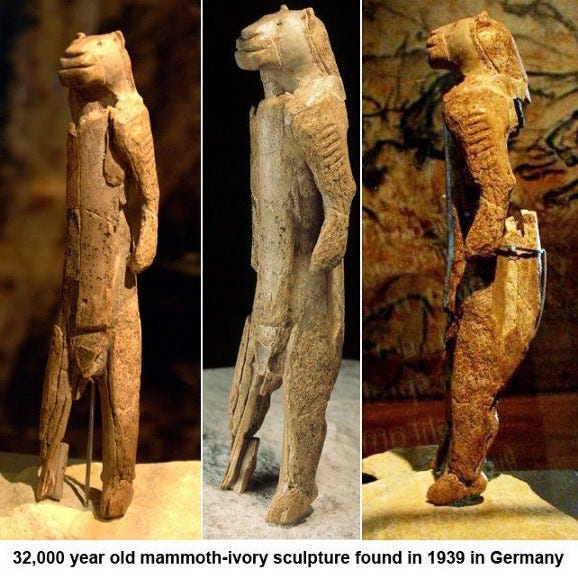
Mark Turner said, “…what the figurine of the lionman most clearly shows us is the mental ability to blend different concepts: Lion and man are not merely held in mind at the same time; they also used to create a new, blended concept, a lionman, which is neither a lion nor a man, exactly.”(2014, pp.11–12). The blending theory was based on Gilles Fauconnier’s Mental Spaces theory (Mental Spaces, 1985). Turner commented on the lionman case, “The mental web for this thinking contains a mental space for lion, a mental space for man, and a mental space for their blend, the lionman. The lionman has elements that belong to neither lion nor man. We can carry that blend with us, hold it in mind, and use it to think about our identity and our place in the world.” (2014, p.13)
It is a challenge to applying blending theory to creative actions because the theory is based on “concept”. As we learned from Barbara Tversky, “there are so many things than names for things.” As Tversky argued in her book Mind in Motion (2019), spatial thinking enables us to draw meaning from our bodies and their actions in the world; from shape, size, and relation; from transformation, trajectory, and speed.
Actualize
The “actualize” refers to two ideas, one is “Prototyping” which means making an early model for testing an idea, another is “actualization of affordances”. The former is popular in design thinking, engineering, software programming and other domains. Since many people are familiar with the concept of “Prototyping”, I’d like to focus on the latter idea “actualization of affordances” which is a concept of Affordance Theory from ecological psychology.
What’s Affordance? Let’s have a look at the original definition made by ecological psychologist James J. Gibson, “The affordances of the environment are what it offers the animal, what it provides or furnishes, either for good or ill. The verb to afford is found in the dictionary, but the noun affordance is not. I have made it up. I mean by it something that refers to both the environment and the animal in a way that no existing term does. It implies the complementarity of the animal and the environment.” (1979, p.119)
The affordance concept describes the possibilities for action that the environment including objects and other people offer for specified persons. The theory is complex, we only need to focus on the “potential” and “real”. Affordance is potential and Action is real, thus, there is a transformation process between “affordance” and “action”, ecological psychologists call this process “actualization of affordances”. Since the environment offers so many affordances, any person has to pick up one or some of affordances from many affordances and actualize them in a particular situation.
For studying creative actions, we pay attention to what kind of affordances can lead to “Novelty” and “Surprise.” The picture below shows an example of “actualization of affordances.”
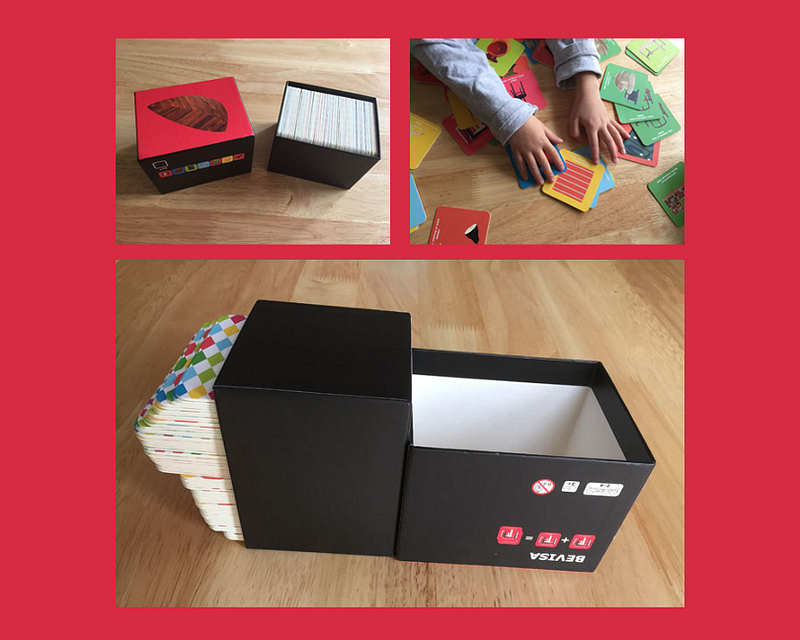
Two years ago, my son came to my office and I gave him IKEA Bevisa memory cards. Usually, people play the memory card for training memory. You turn over any two cards. If the two cards match, then keep them. If they don’t match, turn them back over. If you can remember what was on each card and where it was, you can quickly match many cards and win the game. However, what my son played is not the normal way. He just randomly played these cards as “cards” instead of “memory cards” and turned them into a “truck.”
The side of these cards offers an affordance for shaping, my son actualized this affordances and surprised me. He didn’t know the term affordance but the theory exactly explained his behavior.
Curate
Inspired by Csikszentmihalyi’s social system model, I consider a new type of action called Exemplary Actions which represents Ideal Practice and highlights the morality and ethics for studying creative actions.
The transformation process between Creative Actions (Innovative Practice) and Exemplary Actions (Ideal Practice) refers to Curate, Curation, Curator and Curativity. In the age of platform, the curation issue has become more complex than before. Individuals, organizations and platforms have their own agency of curativity and may compete with each other.
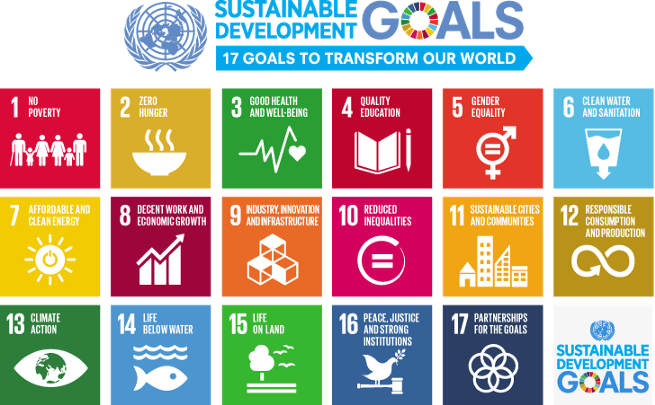
While the Exemplary Actions (Ideal Practice) respects cultural tradition, it also pays attention to the sustainable future of our world. For example, if a creative action can directly or indirectly contribute to one or more of 17 sustainable development goals, we can definedly claim it as an exemplary action.
In 1975, Charles A. Lave and James G. March published a book titled An Introduction To Models in The Social Sciences. They suggested an interpretation of the evaluation of models, “What we present here are some rather simple points of view about truth, beauty, and justice that we, and others, have found helpful in heightening the pleasures and usefulness of model building in social science.” Though they talked about building models in social science, I suggest that we can adopt this simple way to evaluate Exemplary Actions (Ideal Practice).
According to Hans Ulrich Obrist (2014), “curating” means “caretaking”. Obrist reviewed the history of “curate” in his book Ways of Curating, “In ancient Rome, curatores were civil servants who took care of some rather prosaic, if necessary, functions: they were responsible for overseeing public works, including the empire’s aqueducts, bathhouses and sewers. In the medieval period, the focus shifted to a more metaphysical aspect of human life; the curatus was a priest who took care of the souls of a parish. By the late eighteenth century, curator came to signify the task of looking after a museum’s collection. Different kinds of caretaking have sprung from this root word over the centuries, but the work of the contemporary curator remains surprisingly close to the sense in curare of cultivating, growing, pruning and trying to help people and their shared contexts to thrive.” (p.25)
In the age of platform, some creative actions could spread quickly around the world. It is necessary to consider Curativity as an important issue for practice and theory of creative actions. Though the “Creative Actions — Exemplary Actions” part doesn’t use “Field” and “Domain” terms, I believe it still remains the spirit of Curativity which is behind the social systems model of creativity. Thus, I believe the NICE framework can work together with the social systems model of creativity.
The curating of Exemplary Actions (Ideal Practice) is about maintaining and growing both creativity and greatness. In this way, the NICE framework aims to balance the past and the future, the short-term influence and the long-term influence, the local impact and the global impact.
From Existing Practice to Possible Practice
Based on the NICE framework, we can generate a new framework for discussing social practice. The above diagram represents the new framework in which the possible practice is placed in the center.
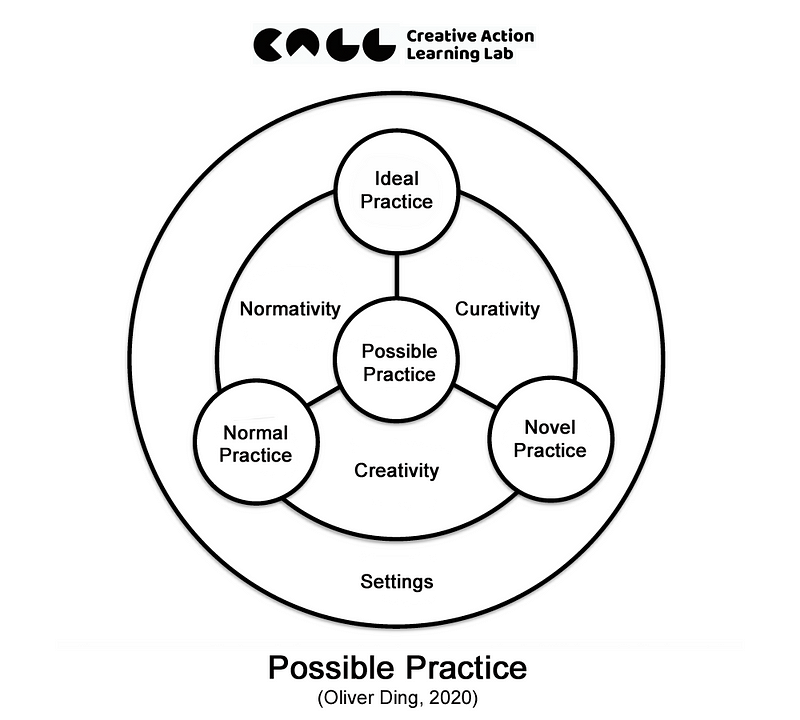
I consider actions at the individual level and practice at the collective level. The four types of actions correspond to four types of social practice.
- Possible Practice — Possible Actions
- Normal Practice— Normal Actions
- Novel Practice — Creative actions
- Ideal Practice — Exemplary Actions
Why do I place Possible Practice at the center of the new framework? I consider the possible practice as the origin of all types of practice. If we trace back to the historical development of any social practice. We can alway find that their sources are possible actions. In order to build the concept of Possible Practice, I use Possible Actions to replace Imagined Actions. I consider affordance and imagination are two sources of possible actions.
If we put Normal Practice, Novel Practice, and Ideal Practice into one category: Existing Practice, then we can get the diagram below.
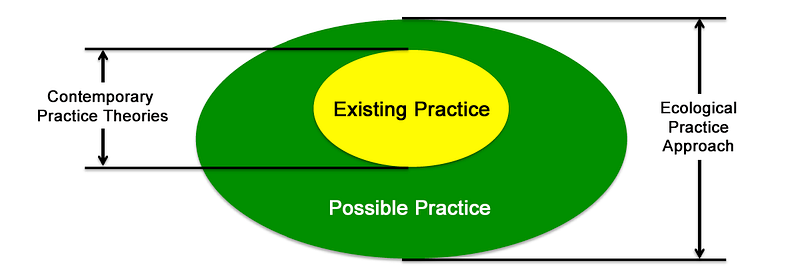
Since 2001, a group of philosophers, sociologists and scientists have rediscovered the practice perspective and used it as a lens to explore and examine the role of practices in human activity. Researchers called it The Practice Turn in Contemporary Theory. As Schatzki pointed out, “there is no unified practice approach”(2001, p.2). Davide Nicolini adopted a way of toolkit to introduce the following six different ways of theorizing practice in his 2013 book Practice Theory, Work, & Organization:
- Praxeology and the Work of Giddens and Bourdieu
- Communities of Practice (Lave & Wenger, 1991)
- Activity Theory / Cultural-historical activity theory (the Marxian/Vygotskian/Leont’evian tradition)
- Ethnomethodology (Harold Garfinkel, 1954)
- The Site of Social (contemporary developments of the Heideggerian/Wittgensteinian traditions, by Theodore R. Schatzki)
- Conversation Analysis / Critical Discourse Analysis (the Foucauldian tradition)
Nicolini also pointed out, “Practice theories are fundamentally ontological projects in the sense that they attempt to provide a new vocabulary to describe the world and to populate the world with specific ‘units of analysis’; that is, practice. How these units are defined, however, is internal to each of the theories, and choosing one of them would thus amount to reducing the richness provided by the different approaches.” (2012, p.9)
I suggest “Possible Practice” as a new term which expands the scope of contemporary practice theories from “actual actions and existing practice” to “possible actions and possible practice”. I consider “Possible Practice” as the special unit of analysis for my approach “Ecological Practice”. Again, the Ecological Practice Approach is not an alternative to contemporary practice theories, but expands their scope and contains more theoretical concepts such as James J. Gibson’s Affordance.
The ecological practice approach claims that the original source of all human actions are affordance and imagination. Affordance refers to material engagement while imagination refers to linguistic engagement. If we accept the ideas from cognitive linguistics which claims that the source of linguistic conceptual metaphor are embodied experience, we can reduce the linguistic engagement (imagination) to material engagement (affordance). In fact, we can learn more from philosophists of embodied cognitive science. They consider affordance as an essential concept for rethinking the mind from the perspective of embodied cognitive science.
My focus is action and practice, not mind and cognition. The goal of ecological approach is building a new unit of analysis for discussing action and practice. The “Possible Practice” is just the beginning.
You are most welcome to connect via the following social platforms:
Twitter: https://twitter.com/oliverding Doowit: https://doowit.co/profile/gm0k2ax9 Linkedin: https://www.linkedin.com/in/oliverding
License
This work is licensed under the Creative Commons Attribution-NonCommercial-ShareAlike 4.0 International (CC BY-NC-SA 4.0) License. Please click on the link for details.


