
The “Jurassic” Saga: A Retrospective
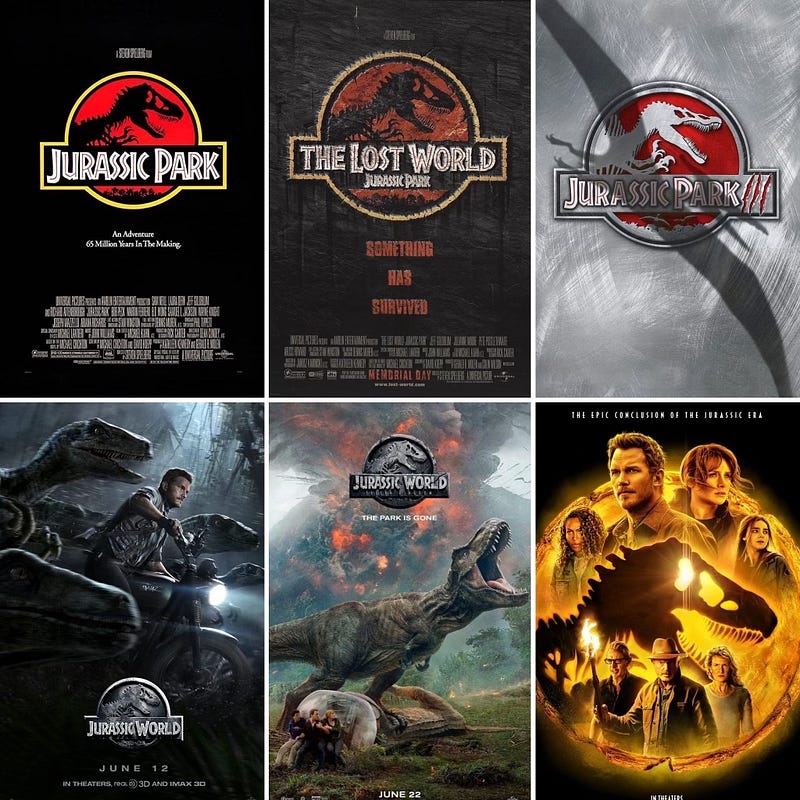
With the final chapter of the second trilogy taking the global box office by storm , I revisited the previous five Jurassic Park and Jurassic World films. Here, I review and rank them all and give my thoughts on the future of the franchise (and my thoughts on whether it should have ever been a franchise in the first place).
A Brief History of the Jurassic Franchise
I still remember seeing Jurassic Park in theaters on its opening weekend. I had just turned 9 years old and my cousin was visiting. The promotional media blitz had won us over and my parents relented and took us to see it despite their concern that it would be too violent for us.
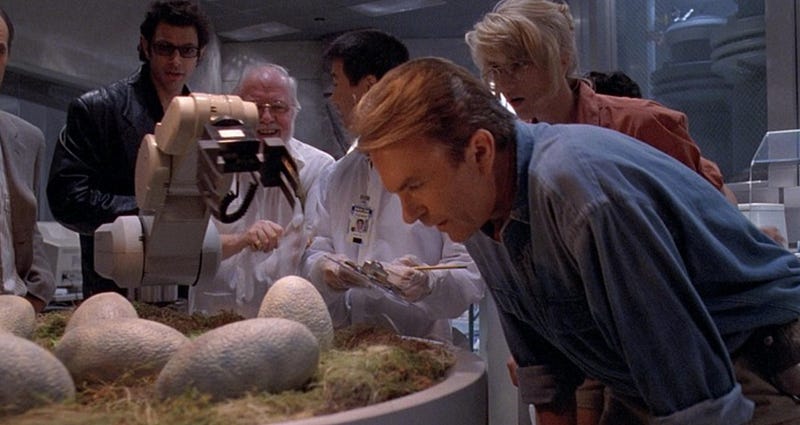
I remember that the theater was so packed that we had to sit in the second row, our necks forced into a sharp and uncomfortable angle. I vividly recall an extraordinary amount of previews that I became increasingly frustrated during. But, most importantly, I remember the utter majesty of what unfolded on screen. Particularly, I still recall how my jaw dropped when Dr. Ellie Satler (Laura Dern) and Dr. Alan Grant (Sam Neill) saw the prehistoric inhabitants of Jurassic Park for the first time. It was pure movie magic unlike anything I had ever witnessed before.
My experience was not unique. Within weeks of its release on June 11, 1993, it had become a formative experience in the development of countless children and adolescents. For some, it was the source of childhood nightmares. For others, it was the start of a lifelong fascination with dinosaurs. For me, it was the moment I truly appreciated the power of cinema.
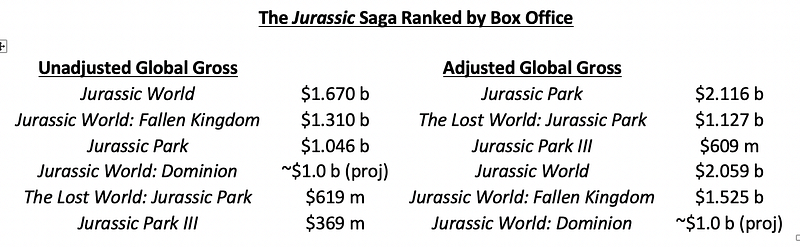
The film, which was directed by Steven Spielberg and based on a 1990 novel by Michael Crichton, was an extraordinary commercial success. It grossed over $400 million domestically and an additional $600 outside the US. for a globally for a tally of $1 billion. (When adjusted for inflation, the film’s gross exceeds $2.2 billion). At the time of its release, it was the second highest grossing film of all time in the U.S. behind E.T.
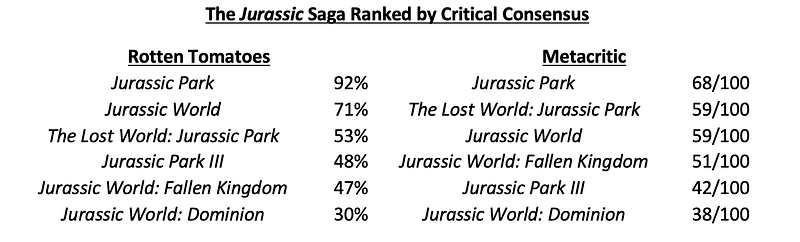
Although critical acclaim wasn’t universal or particularly rapturous, it was well-regarded (the film has a 92% critical approval rating on Rotten Tomatoes, but an unspectacular rating of 68/100 on Metacritic). It also won three Oscars for its sound effects, sound editing, and visual effects. (Fun fact: The film that swept the Oscars that year was Spielberg’s other and decidedly weightier release Schindler’s List.)
Given the film’s enormous success, it is no surprise that sequels were commissioned. In fact, demand for a sequel was so high that Crichton himself wrote a sequel to his original novel in 1995. That book was very loosely adapted into a sequel entitled The Lost World: Jurassic Park by Steven Spielberg in 1997. The sequel was a critical and commercial disappointment relative to the original (53% Rotten Tomatoes, 59/100 Metacritic, $619 million unadjusted global gross), but it was successful enough for Hollywood to decide that Jurassic Park had bona fide franchise potential. However, enthusiasm regarding the franchise significantly diminished with the release of 2001’s Jurassic Park III. That film, directed by Joe Johnston, remains the lowest grossing film in the franchise even when adjusting for inflation and fared even worse than The Lost World with critics(48% Rotten Tomatoes, 42/100 Metacritic, $369 million unadjusted global gross).
After 14 long years, Universal Pictures decided to revive the franchise with Jurassic World. The film, directed by Colin Trevorrow, had an entirely new cast (save a small supporting role for B.D. Wong, reappearing as genetic scientist Henry Wu for the first time since the initial film) but a tried-and-true premise. It was an expectation-smashing box office juggernaut, grossing $652 million domestically and an additional $1.02 billion globally. It also fared better than the previous sequels critically, with a 71% critical approval rating on Rotten Tomatoes and a 59/100 average score on Metacritic. Naturally, sequels were rapidly and enthusiastically commissioned.
In 2018, the first sequel Jurassic World: Fallen Kingdom was released to impressive box office ($1.31 billion unadjusted global gross) but a decidedly weaker critical response (47% Rotten Tomatoes, 51/100 Metacritic). And, just last weekend, the second sequel to Jurassic World (and the sixth film overall in the franchise) was released. Jurassic World: Dominion came with deafening buzz for two reasons. First, it was billed as the closing chapter of the Jurassic World trilogy. Second, it delivered the ultimate fan service by reuniting the original trio of stars (Sam Neill, Laura Dern, and Jeff Goldblum) for the first time and integrating them alongside the new trilogy’s leads Chris Pratt and Bryce Dallas Howard. The film received the worst reviews of the entire franchise (30% Rotten Tomatoes, 38/100 Metacritic). But, unsurprisingly, atrocious reviews did little to deter audiences. Since the film began rolling out across the globe on June 1, it has already grossed $622 million and looks likely to become the fourth film in the franchise to smash the $1 billion mark.
In anticipation of Dominion’s opening weekend, I revisited the original five films. It was the first time I had watched them all together as a franchise and it struck me how scattershot the whole thing is. Unlike the franchises that rather straightforwardly adapted literary series (e.g., Lord of the Rings, Harry Potter, Twilight) or at least attempted to have thoughtfully plotted out a cinematic universe (e.g., the Marvel, DC, Star Wars), the Jurassic franchise plays like a series of unfocused sequels that each takes a slightly different approach at attempting to recapture the glory of the 1993 original. It involves a revolving door of four directors and ten screen writers, and has little consistency among the cast (the most appearances in the franchise belong to Jeff Goldblum and BD Wong with 4, and they are glorified cameos in at least one of their appearances). The only real through-lines of the entire series are dinosaur attacks and scientific quandaries related to genetic engineering.
Despite feeling slightly jaded after revisiting the series as a whole, I was there opening weekend to see the latest entry in the Jurassic franchise. To my great relief, I found much to like in Jurassic World: Dominion despite its admitted ridiculousness. And to my surprise, I found that it actually made some bold (albeit messy and only partially successful) attempts to tie all six films together in a meaningful way.
Here, I briefly review all six films in order, including my picks for the most iconic sequences and best performances in each. Then, I provide my ranking and a few thoughts about what the future holds for the Jurassic franchise.
The Jurassic Saga: A Film-by-Film Review
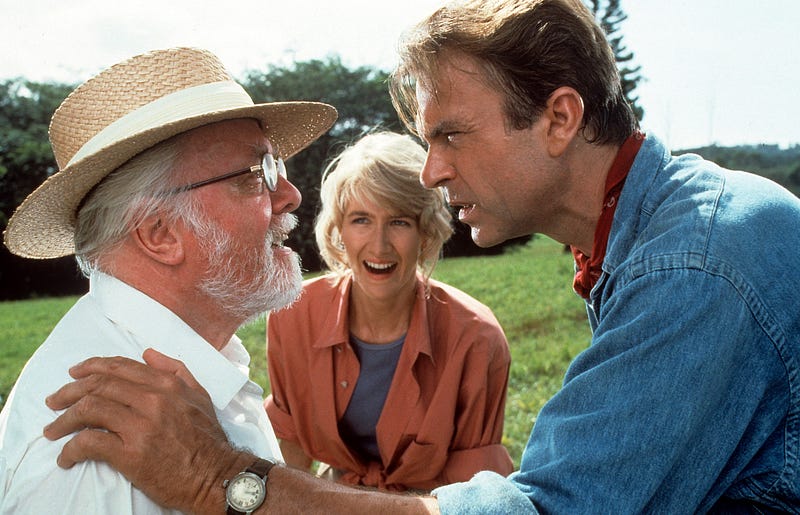
Jurassic Park (1993)
Quite simply, director Steven Spielberg’s adaptation of Michael Crichton’s science fiction novel is as masterful as mainstream filmmaking gets. It set the bar for summer event films — a bar few if any films have reached since. Although the plot is far-fetched, it is nicely detailed, fully realized, and brimming with intriguing ethical and philosophical questions. The characters are by and large multidimensional and grounded in reality, with impressively little of the hammy dialogue or contrived dynamics that often weigh down blockbusters. They are brought to life by a terrific cast, with Sam Neill, Laura Dern, Jeff Goldblum, Sir Richard Attenborough, Joseph Mazzello, Arian Richards, Samuel L. Jackson, and Wayne Knight all turning in strong work. But as good as the writing and acting are, it is truly Spielberg’s direction that catapults this film into the stratosphere. Despite the huge advances in special effects since the film was released 29 yers ago, it still looks stunningly realistic and remains viscerally terrifying. The film features stunning cinematography, one of the most memorable scores in film history (courtesy of the legendary John Williams), and is perfectly paced, with a slow-building first hour that gives way to a breathtaking second hour of non-stop action that ends exactly when it should. Some continue to dismiss the film as a trifle, but I think it is one of the all-time greats.
Best Sequences:
- Dr. Satler reboots the power to Jurassic Park
- The tyrannosaurus rex breaks out of its paddock and attacks the cars
- The initial sighting of the dinosaurs by Dr. Satler and Dr. Grant
Best Performances:
- Laura Dern
- Jeff Goldblum
- Sir Richard Attenborough
My Rating: 5/5 stars
The Lost World: Jurassic Park (1997)
Jurassic Park set box office records, won 3 Oscars, and ushered in a new age of special effects. If that was not enough to make a sequel inevitable, Michael Crichton went ahead and published a sequel to the book! But, alas, The Lost World is no Jurassic Park. At its best, Steven Spielberg’s follow-up is a competent rehash of some of the great elements of the first film. The sweeping vistas of Kauai (posing as Costa Rica), the strikingly realistic special effects, the well-paced action scenes, and beautiful score are all intact. But at its worst, it is lazy and uninspired. There was no need for another child to be abandoned on the island or another lengthy sequence which our heroes stuck in a vehicle during a storm while a tyrannosaurus rex terrorizes them. The film only truly becomes surprising with the absurd, but occasionally thrilling, coda where the tyrannosaurus rex runs amok on the streets of San Diego. It is pure camp, but Spielberg clearly is having a grand time paying serious homage to Godzilla and other monster films of yore. It is worth noting that most of the film’s weakest aspects relate to deviations from Chrichton’s novel and represent a rare display of ill-advised excess from a usually masterful director. Although the acting is fine throughout, it was an exceedingly odd choice to have the only major returning character be Jeff Goldblum’s Dr. Ian Malcolm given that he is the type of wisecracking antagonist best used in small doses. None of the other characters are even remotely memorable, although Julianne Moore, Vince Vaughn, and Pete Postelthwaite are clearly trying. The film is a bona-fide thrill ride and a fun way to spend two hours for action/sci-fi fans, but ultimately it more often than not feels less like a sequel and more like a drab, joyless remake.
Best Sequences:
- The tyrannosaurus rex tries to get her child back from the research team
- The stegosaurus fight
- The tyrannosaurus rex rampages through San Diego
Best Performances:
- Jeff Goldblum
- Julianne Moore
- Pete Postlethwaite
My Rating: 3.5/5 stars
Jurassic Park III (2001)
Steven Spielberg turned over the directorial reigns to Joe Johnston for the third film in the franchise, which clearly tried to be a “return to form” after The Lost World disappointed many. The film has many strong points and, in my opinion, is a step up from the prior film. The return of Sam Neill and Laura Dern, both disappointingly missing from the prior film, is a thrill (although Dern’s screen time is scant). The debut of several exciting species of dinosaurs not seen in the prior films result in some genuinely fresh action sequences. And the film is refreshingly leaner film than the first two, focusing on a simple tale of survival rather than grand philosophical questions and villainous corporate adversaries. But, ultimately, it fails to soar. The film feels a bit cursory with its 90-minute running time (a full 35 minutes shorter than the next shortest film in the franchise) and is bogged down by workmanlike approach to its direction, production, and editing. The screenplay is the biggest problem, with the setup (involving William H. Macy and Tea Leoni as divorcees searching for their son who went missing on the island) being largely unconvincing and uninvolving. I have rarely cared less about a plot line in film history than I did about whether Macy and Leoni’s characters reconciled. It certainly doesn’t help that, again, several of the sequences feel so familiar that they appear to be lifted from the prior films — idyllic scenes of the animals sipping from pools of water, tense scenes of the characters being bashed around in a transport vehicle by an angry animal, chase scenes through enclosures that cannot contain the beasts, and forced moments of family bonding that play a bit treacly. With all of this said, a Jurassic Park retread is still wildly entertaining given the superb special effects, occasionally nerve-racking tension, and true uniqueness of the fictional world.
Best Sequences:
- The plane crash
- The pterosaurs attack in the aviary
- The spinosaurus attacks the barge
Best Performances:
- Sam Neill
- Tea Leoni
- William H. Macy
My Rating: 3.5/5 stars
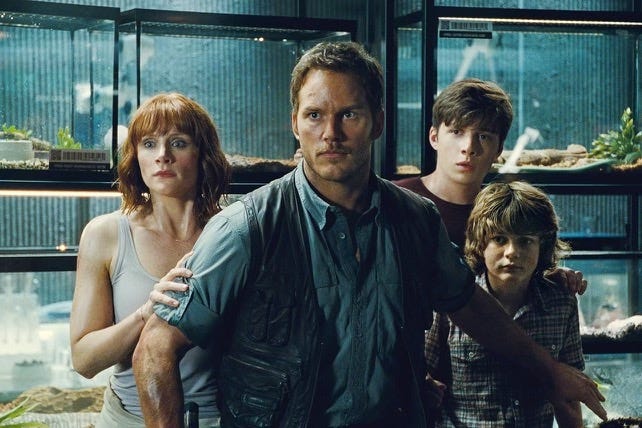
Jurassic World (2015)
The first two Jurassic Park sequels disappointed critically and commercially relative to the first, leading the franchise to remain dormant for well over a decade. When Jurassic World was announced, it was clear from the outset that even though this was technically a sequel, it was designed to be a fresh reboot of the franchise. And boy did it work — better than anyone expected, in fact. The film’s jaw-dropping success is ultimately the result of several promising factors converging. First, the 22-year gap from the original was well timed to appeal to nostalgic parents and their age-appropriate children. Second, it cast Chris Pratt as the leading man, whose star power skyrocketed after Guardians of the Galaxy the year before. Third, it featured a terrific marketing campaign that reminded everyone how much they adored the original. And fourth, it was a spectacularly fun movie. Even most of those who decried it as an uninspired rehash of the original admitted that it was a whole lot of fun. The film, directed and co-written by Colin Trevorrow, is set at an over-the-top amusement park that is essentially the realization of John Hammond’s dreams. But skyrocketing costs and jaded tourists lead the park’s operating manager (Bryce Dallas Howard) to experiment with further genetic modification of the dinosaurs to predictably disastrous results. Howard gives a spirited performance, but her character is utterly ridiculous. She runs from dinosaurs in stilettos, she remains ridiculously steadfast in her decisions long after they have proven destructive, she remains painfully oblivious to her lust for Pratt’s character, and — in a lazy homage to the first film — she has two young nephews loose in the park who she is worried about. Equally ridiculous is Pratt’s character, who is a velociraptor trainer being pressured by a cartoonish villain (Vincent D’Onofrio) into training the raptors to be war machines. However, all of these shortcomings hardly matter. The visual effects are astounding, the set pieces are stunning, the action sequences are perfection, and the dialogue is witty, light, and delightfully self-referential. This is a film of little substance — and even less originality — but it is a technical marvel that is almost obscenely entertaining.
Best Sequences:
- The pterosaurs get loose and attack the tourists
- The Indominous Rex braks out
- The gyrosphere attack
Best Performances:
- Bryce Dallas Howard
- Chris Pratt
- Nick Robinson
My Rating: 4/5 stars
Jurassic World: Fallen Kingdom (2018)
The middle chapter of the second trilogy has striking parallels to the middle chapter of the first trilogy — Jeff Goldblum returns as Ian Malcolm (albeit for a cameo here), pivotal plot points take place at the expansive compound of an old white billionaire (this time James Cromwell’s and not Sir Richard Attenborough’s), the plot begins with the heroes having to return to the island to counter a greedy corporation, and the plot ends with dinosaurs loose in the United States. But, in my opinion, Fallen Kingdom does it all better than The Lost World. In fact, I think it’s actually a hair better than its predecessor Jurassic World. Although he still cowrote the film, Colin Trevorrow handed over the directorial reins to J. A. Bayona here. Bayona shows himself to have a great sense of staging and pacing and creates strikingly memorable sequences from the opening underwater sequence (the best opening scene of the series) to the thrilling montage of the dinosaurs free in the U.S. The plot is admittedly contrived, with an imminent volcanic eruption threatening the island that houses the abandoned theme park and a mystery involving human cloning that never feels necessary. The acting is fairly strong, with Bryce Dallas Howard’s Claire improving immensely as a character from the first film and her and Pratt having better chemistry this time around. Personally, I would have preferred if the film had leaned into its ridiculous conceit by becoming a Jurassic Park-Dante’s Peak mashup that primarily focused on the race to get the dinosaurs off the doomed island. However, after a slight slowdown in the middle, it does rally for a thrilling climax with a black market dinosaur auction that nicely sets up the final chapter.
Best Sequences:
- The volcanic eruption
- The opening underwater scene in the remains of Jurassic World
- The indoraptor’s demise at the mansion
Best Performances:
- Bryce Dallas Howard
- Chris Pratt
- James Cromwell
My Rating: 4/5 stars
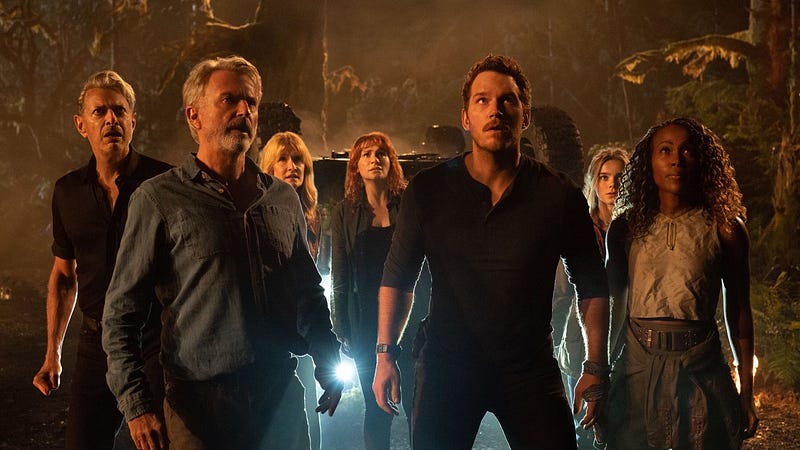
Jurassic World: Dominion (2022)
In addition to the hype surrounding its billing as the final chapter in the Jurassic World trilogy, Dominion boasts the reunion of the saga’s most iconic characters (Sam Neill’s Dr. Alan Grant, Laura Dern’s Dr. Ellie Satler, and Jeff Goldblum’s Dr. Ian Malcolm) who have not appeared in the same film since the original. Thankfully, co-writer and director Colin Trevorrow knew better than to treat the fans to glorified cameos and give all three of them ample screen time and character development. Their chemistry remains further intact and they are integrated into the plot fairly seamlessly as they infiltrate a tech company called Biosyn, which set up a natural reserve for the dinosaurs in Italy while secretly leveraging the genetic sorcery into massive profits with little regard for the massive effect it is having on the global ecosystem. Meanwhile, Owen (Chris Pratt) and Claire (Bryce Dallas Howard) go on a globe-trotting adventure to rescue young Maisie Lockwood (Isabella Sermon), the first known human clone who they took into their care at the end of the prior film. Their plot is decidedly less interesting, although it does lead to the film’s most thrilling action sequence, introduces one of the best characters in the Jurassic saga (pilot Kayla Watts, terrifically played by DeWanda Wise), and eventually intersects with the other plot line fairly cleanly. So, with a solid use of its strong ensemble cast and a clever setup, why was Dominion so heavily derided by critics? Well, the answer to that question is simple. Even more than in the previous five films, suspension of disbelief is absolutely essential to enjoying Dominion. There are gaping plot holes and dumbfounding twists that are so contrived and unbelievable that it elicits unintentional laughter and even anger. Add to this the fact that the film’s central tenet — that dinosaurs and the denizens of the Earth will learn to peacefully coexist if left alone — is so mind-numbingly dumb that it renders the film’s dramatic coda hard to swallow. I thoroughly enjoyed Dominion, particularly the absolutely breathtaking sequences in the black market of Malta, the over-the-top climactic escape, and nearly every interaction of the original film’s trio of iconic characters. I also give it credit for trying to turn a scattershot film series into something more coherent by trying to create synergy between the characters, plots, and themes of the prior five films and actually create some sort of meaningful ending. But I can’t blame people for finding it utterly ridiculous and concluding that much of it was poorly executed fan service.
Best Sequences:
- The black market in Malta
- The climactic escape from Biosyn
- The plane crash
Best Performances:
- DeWanda Wise
- Laura Dern
- Bryce Dallas Howard
My Rating: 3.5/5 stars
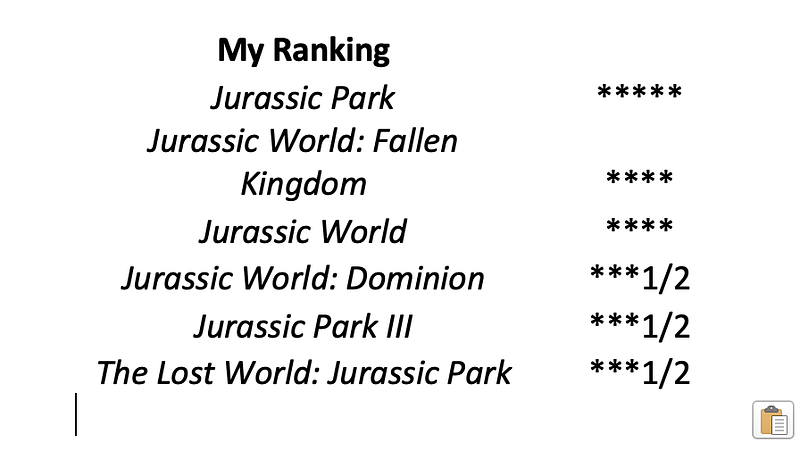
The Future of the Jurassic Saga
After the first film became a cultural phenomenon, it was undeniable that a franchise would be born. Ultimately, however, Hollywood probably should have left Jurassic Park alone. It was simply never possible to recapture the greatness of the first film given the elements of surprise and wonder it had working in its favor and the fact that the plot doesn’t lend itself naturally to sequels. But, the reality is that it did spin off into a franchise and fans have been treated to several wildly entertaining — albeit ridiculous — films as a result. As a film series, it has a striking lack of coherence and each successive film is far too focused on callbacks and homages to the prior ones. But for viewers who go in looking for a nostalgic, thrilling B-movie wrapped in visual splendor they certainly deliver.
Given the fact that Dominion proved critic-proof and is delivering huge box office across the globe, I have almost no doubt that the franchise will be resurrected sooner rather than later and the same cycle of nostalgia and camp will start all over again with another trilogy.
And I have too much self-awareness to deny that I will be first in line when it does.
Follow the author of this article on Medium and Twitter.
Read recent articles about movies and television written by this author:


