
Philosophy & Stoicism
The Glass Is Already Broken
3 Lessons On Attachment: Spiders, Outcomes, & Things
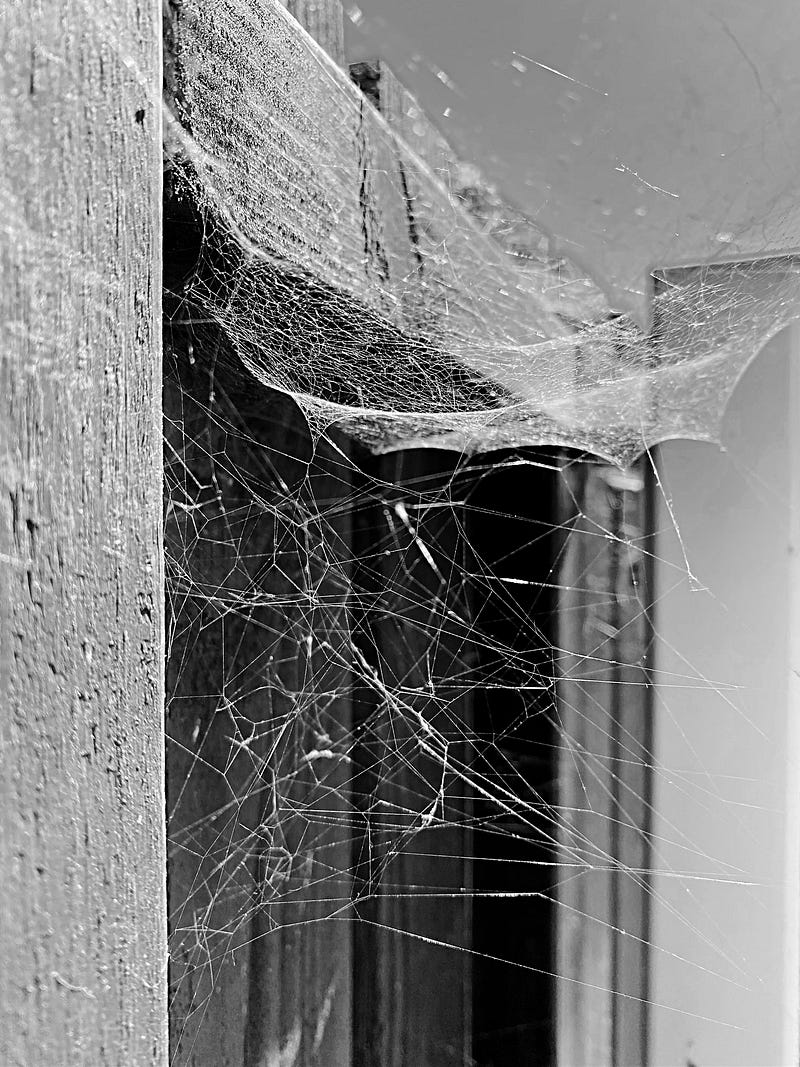
The Spiderweb
On average, it takes 30 to 60 minutes for a spider to weave a web. Even though spiderwebs are robust, they don't' always last very long. They are constantly getting damaged by Mother Nature or people (who walk or run right through them). Some spiders build new webs every day.
Attachment to Outcomes
Devastation — that feeling that we’re absolutely crushed and shocked by an event — is a factor of how unlikely we considered that event in the first place. No one is wrecked by the fact that it’s snowing in the winter, because we’ve accepted (and even anticipated) this turn of events. What about the occurrences that surprise us? We might not be so shocked if we took the time to consider their possibility. — The Daily Stoic, p 147
A young woman recently died and left her two kids in the care of her older sister. The surviving sister is both devasted and shocked by the sudden death. However, if you take a closer look, you will no longer be in a state of shock. The deceased sister was morbidly obese and consequently died of a heart attack.
A young woman ends up dead in an eerie domestic violence case. Friends and family are in disbelief. But if you roll back to all of the instances of turbulent fights, aggressive arguments, and mutual disrespect within the relationship, you might not be so surprised. After all, the violence doesn’t end in many cases; it only gets worse until someone gets away for good or dies.
The feeling of surprise is familiar. We often don't anticipate a situation because we expect a specific outcome will not occur. What is to come often reveals itself to us in many forms (e.g., signs, conversations with friends and mentors, warnings, red flags, and reminders), though. The question is will we listen to those signs when they make themselves visible to us?
Neglect Is Treachery
Whatever issues we avoid and neglect, at some point, it will matter. If we do not fix our issues and allow them to build and become stronger continually, we will not defeat them, and they will take us out.
And when we neglect things, people, and even ourselves, there is no need for an element of surprise when something “bad” happens. Because when you continuously neglect something, someone, and yourself only one thing happens: destruction.
Attachments to Things
There is a story of a Zen master who has a beautiful prized cup. This master would repeat to himself, “The glass is already broken.” He enjoyed the cup. He used it. He showed it off to visitors. But in his mind, it was already broken. And so one day, when it actually did break, he simply said, “Of course.”
This is how the Stoics think too. There is supposedly a true story about Epictetus and a lamp. He never locked his house, and so his expensive lamp was stolen. When Epictetus replaced it, he replaced it with a cheaper one so he could be less attached to it if it were stolen again. — The Daily Stoic, p 147
How we hold onto wealth and things with such fervor is frivolous; their demise is inevitable. Materials, wealth, status, a particular lifestyle, money, etc., all can disappear in an instant.
The rich can be sued for everything they have, but the poor are free of such threats. — Proverbs 13:8, MSG
Attachments to things are self-defeating because we do not control how long things last in our lifetimes. Even if we have insurance, top security, and intelligent processes backing the things in our lives, they can always break, be seized, or be stolen. Hence, the reason why we should not prioritize or develop strange attachments to things we ultimately have no control over.
When you're' feeling extra attached to something, remember this one thing: everything you have will at some point no longer be yours.
A Lesson from the Spider
I walk through spiderwebs frequently. Not only is it annoying, but every time I walk through a spider web, I feel bad for the spider who spent all that time and energy building it. That's potentially a missed meal(s) or opportunity(ies) for the spider. Yet, the spider builds another web. It focuses not on the web that is destroyed but instead on building a new web.
Many attachments to outcomes, people, and things are self-defeating. The spider teaches us this. Resilience and wisdom are the answer.
Destiny S. Harris is a writer, poet, entrepreneur, teacher, and techie who offers free books daily on amazon. Destiny obtained three degrees in political science, psychology, and women's studies. Follow her on Instagram, Facebook, or @ destinyh.com