
‘The Ghost of Oyuki’ and Her Twin
‘Hangonkō no Zu' and other Ghost Paintings by Ōkyo Maruyama templated the genre and defined ghosts in Japan…
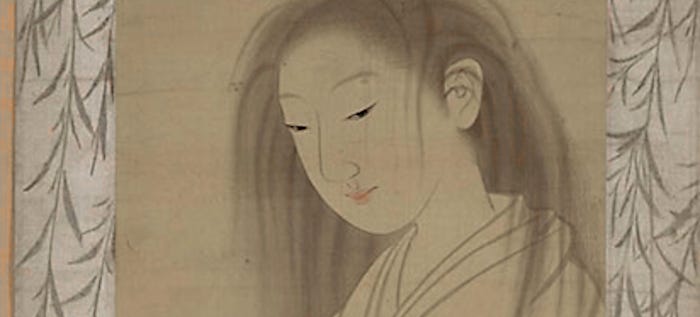
Ghosts are lingering impressions of the dead. Traditionally, they have no substance in this world, existing solely in the form of unresolved feelings that can somehow manifest and affect the living. It’s interesting to note that the common perception of what ghosts are differs between the West and the East. This correlates with differences in dominant religious views surrounding life and death. In contrast to the West, where Christianity has exerted its influence, many in the East follow the Buddhist path. In Christianity, after death the soul can go to heaven, depending on the degree of one’s faith. In Buddhism, each life is a practice and, after death, one is connected to the next life through reincarnation, eternal rest, or rebirth — the very concept of death itself is different.
However, regardless of religious views, there is a popular notion that those who die holding grudges may appear as ghosts. This notion has become a popular and long-established theme across media and there seems to be a consensus understanding of how the dead appear before our eyes. In general, ghosts resemble a person as they were in life but with an appearance greatly influenced by the cause of death. For example, one who died from an illness will appear emaciated and withered, while those who die in an accident or violent incident will appear with injuries. Sometimes the ghost may look unimaginable or grotesquely distorted.
Here, we will consider the representation of Japanese ghosts and how one artist defined the way they’d be depicted for centuries. Perhaps the most distinct characteristic is a lack of legs, where the figure of a ghost fades away before it reaches the ground, implying that they are no longer physically connected to this world. This concept can be traced back to a time when belief in the existence of ghosts was common and to a particular ghost painting by a single artist.
That artist was Ōkyo Maruyama, a prominent Edo-period painter and an early proponent of the naturalistic ‘sketchist’ style that often combined loose calligraphic gesture with landscape painting and, in many ways, prefigured Impressionism. But to understand the visual innovation in his ‘ghost paintings’, we must also consider his training as an artist …and a mysterious story surrounding them.
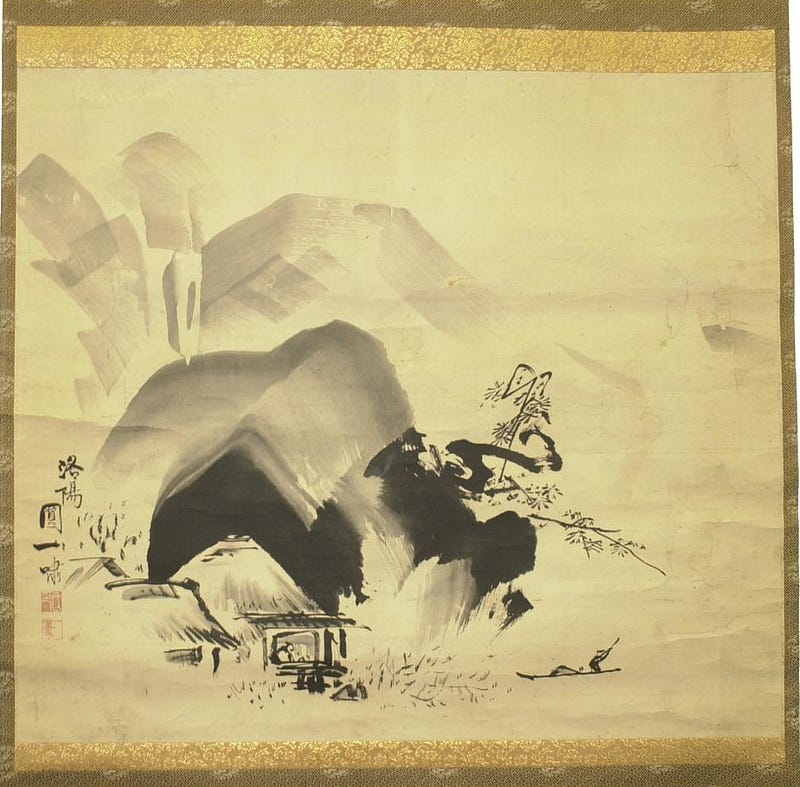
Ōkyo Maruyama (1733–1795) was a painter mainly active in Kyoto during the mid to late Edo period. He’s famous for founding the Maruyama School, cited as the beginning of modern painting in Japan. When painting became his passion, he devoted his life to it and continued to pick up his brush and paint even when battling his own illness until a few months before his departure to heaven, or the next life.
The first significant step toward his emergence as a painter came when he worked for the Biidoro (glassware) tool dealer, Kanbei Owariya. The store also sold dolls, antiques, toys, and rare items. He hand-coloured dolls as part of his duties and became fascinated by the European stereoscopes that were sold there. His aesthetic sense blossomed with this exposure to the objects and styles from different exotic cultures and he studied western-style vanishing-point perspective so he could paint stereoscopic images for use in the viewers. These would develop into a style known as ‘glasses paintings’. The fact that he considered Owariya his mentor makes it clear that his experience at the store had a profound influence on his later paintings.
Although the timing is uncertain, at roughly the same time, Ōkyo became a student of Ishida Yutei of the hugely influential Kano School and a prominent painter of the Edo period, but quit after a short period. Taking advantage of this practical experience, many of the ‘glasses paintings’ that Ōkyo produced in his twenties and early thirties are highly respected masterpieces and a culmination of his sketching techniques and studies of perspective.
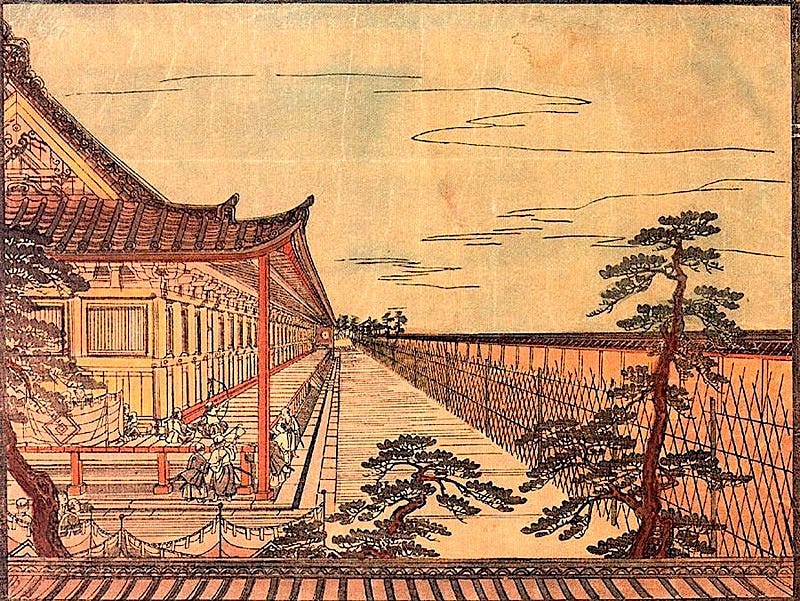
So called ‘glasses paintings’ is a genre of Ukiyo-e that uses a method of viewing pictures using mirrors and lenses. His meticulously detailed paintings were said to overwhelm viewers and made him a household name. His skill in producing precisely observed paintings was highly sought-after and he received prestigious commissions from, among many others, the Shogunate and the Imperial Court of the Emperor.
However, it was his encounter with Yujou-san, head of the Manenin Temple, that established his most distinctive style of painting. Yujou-san came from the historically prominent Nijō family, and would become a patron after a friendship developed while Ōkyo painted the sliding doors of the ‘inner room of Manenin’.
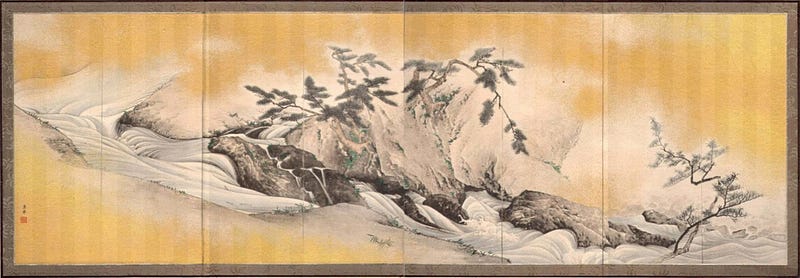
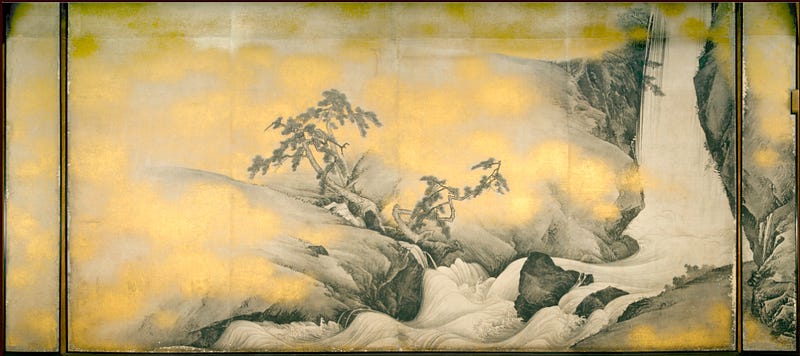
Ōkyo, who had several pseudonyms during his career, took the moniker ‘Ōkyo’ in 1766, when he was in his late thirties. At this time, the Mitsui Family Conglomerate, and Cloistered Prince Shinninho joined as patrons, and he was one of the most respected and prolific painters in Kyoto. He founded a workshop, took apprentices, and exerted a major influence through the Maruyama School. Among his disciples, those with particularly outstanding talent were known as the Omon Jutetsu. In 1795, while suffering from an eye disease, he completed the pair of Hozugawa Folding Screens — shown below — depicting ‘Views on the River Hozu’, painted in ink with slight colour and gold leaf and still considered masterpieces. Just a few months later, he left this material world…
Ōkyo’s most famous Ghost Painting was originally called Hangonkō no zu 反魂香之図. The name derived from hangonkō — an incense believed to summon the dead back to the realm of the living. As the mythic incense is burned, ghosts will appear in the smoke or the dead may even be resurrected by it. It originates from a Chinese legend, passed down since the time of the Former Han Dynasty and is described by the fifteenth-century zen poet Haku’Kyoi (aka Bai Juyi) in his poem Madame Li. In Japan, when the culture of telling ghost stories blossomed during the Edo Period (1603–1868), they were adopted as the subject matter for books, paintings, and kabuki. A story of a man using hangouko is included in the Ukiyo-zōshi collection Koshoku Haitdokusan published in 1703.
The ghosts mentioned were usually yūrei, grudge spirits, yōkai, and other monstrous creatures that were depicted with the intention of requiting or deifying them. The clear difference between all these paintings and the ghost paintings of Ōkyo is “whether or not depicted from the leg down,” as he did not depict the feet of supernatural spirits. These distinctive paintings by Ōkyo became the template for ghost paintings, and it became accepted that “ghost paintings do not depict from the leg down.” Depictions of legless ghosts had appeared in some earlier illustrations since the late seventeenth-century, such as the Jōruri book, Kazan-no-inkiarasoi, published in 1673. So, Ōkyo’s works embodied a common perception of ghosts, establishing the accepted visual representation of them in fine art and the genre of ‘ghost paintings’.
To better understand the innovation introduced by Ōkyo it helps to know the context in which he received his early commission to create Ghost Paintings. There were various theories about how he came to embrace the ghost paintings genre but the truth was finally revealed by an investigation by the Hirosaki City Cultural Property Deliberation Committee, concluded in 2021. An overlooked work was found along with its wooden box bearing an inscription and seal that indicated it was an authentic work by Ōkyo. Part of the inscription, added during the Meiji Period, warns that there is a “danger of emanation or escape”…
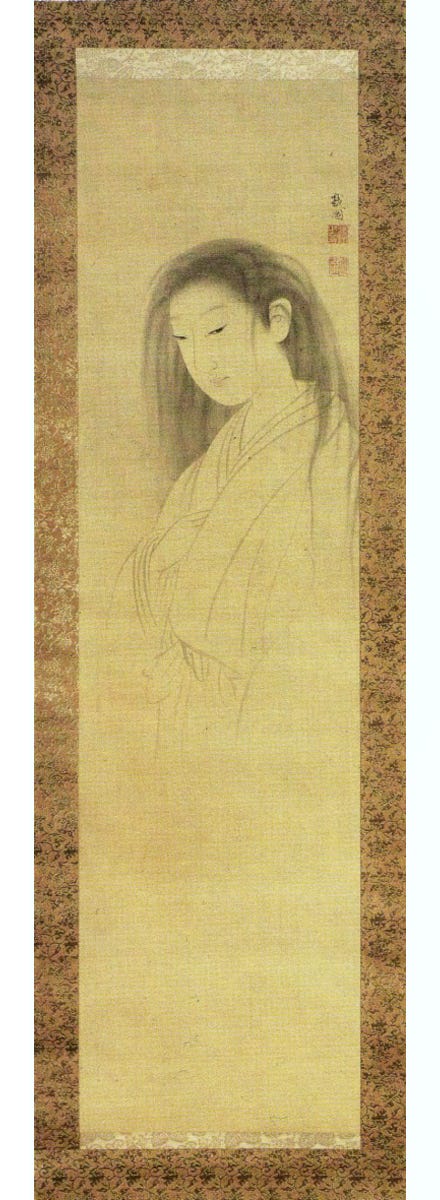
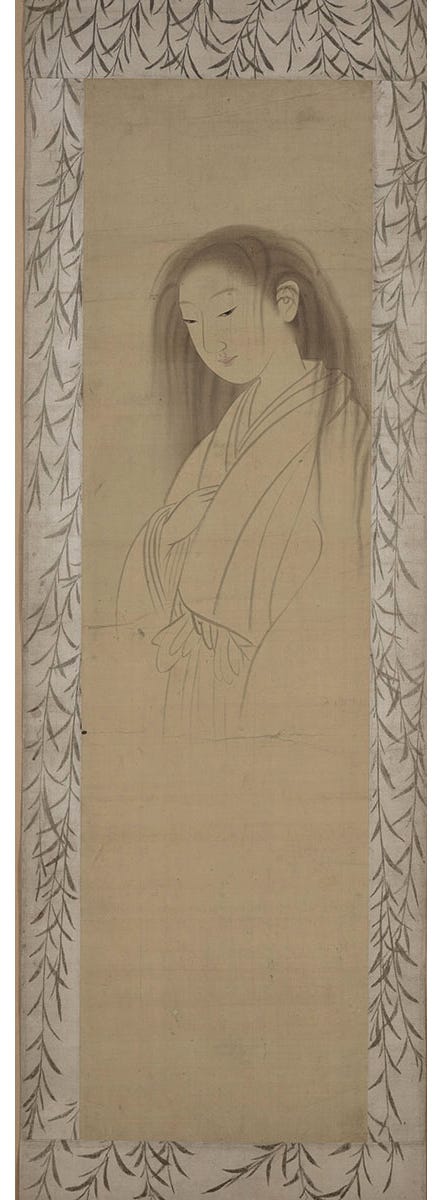
The painting closely resembles the more famous The Ghost of Oyuki, painted between 1776 and 1777, now in the collection of the University of California’s Museum of Fine Arts, Berkeley, USA. The similarity between the two paintings is striking and the research found that this later work from around 1781 was most likely an improved version of the The Ghost of Oyuki.
The painting was created when the samurai Motonori Shozen Morioka, a retainer of the Hirosaki clan (present-day Aomori Prefecture), commissioned Ōkyo Maruyama to create the painting as a memorial for his deceased wives. His first wife died in 1757 and his second wife in 1780 and, in 1781, he lost his beloved concubine. A little later, in 1784, he donated the painting to Kudoji Temple. He took his own life in April of the following year. This is said to be because he regretted a mistake. So, what crime did he commit? Why the three-year blank space? The terrible Tenmei Famine was a factor in all this, and closely related to the origins of Ghost Paintings.
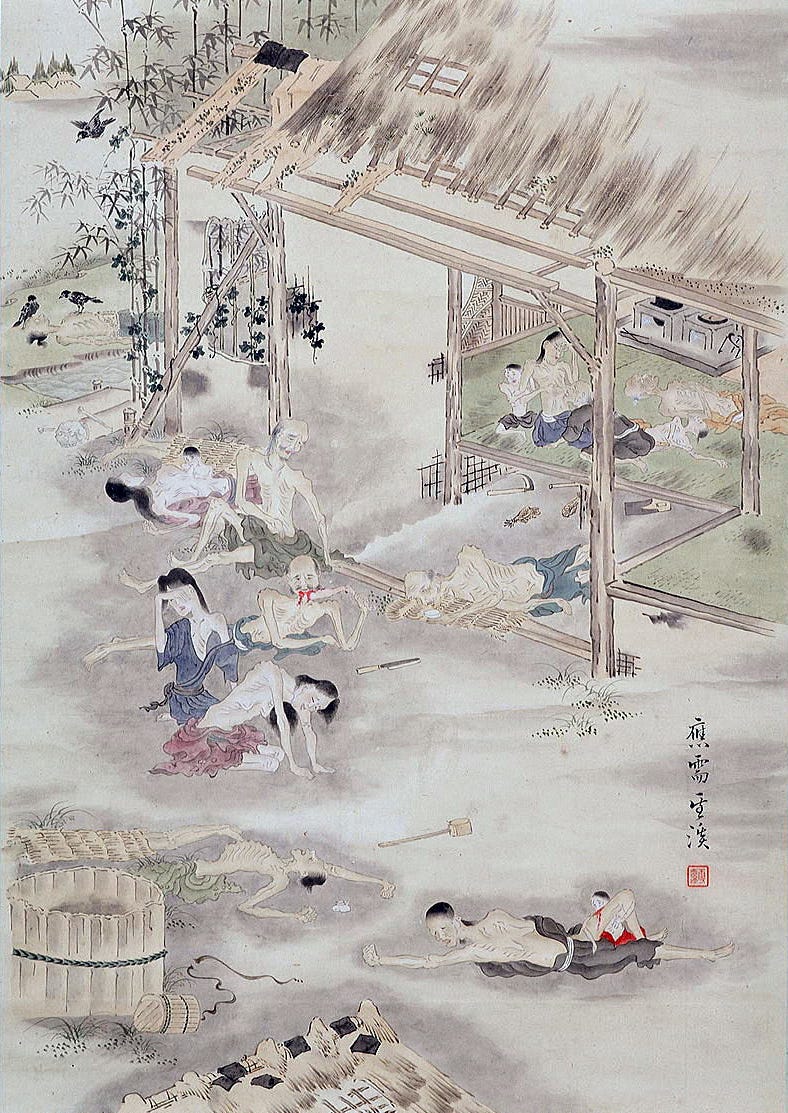
The Tenmei famine was a natural disaster that struck Japan in 1783 and lasted for the next four or five years. It was one of four major famines of the Edo Period, and one of the worst and widespread famines in Japanese history. In the late eighteenth-century the world fell into what is known as the ‘Little Ice Age’ following the eruptions of Japan’s Mount Iwaki, Aomori Prefecture, in April 1783, and the catastrophic eruption of Mount Asama, Nagano Prefecture, just three months later, in July. The following year, Iceland’s Mount Laki erupted, affceting global weather systems. So much dust was ejected into the atmosphere that it reduced the warmth of the solar radiation reaching the land and triggered the unusually cold climate.
During this period, crops failed, vegetables withered away, and fishing for herring was poor. Due to poor nutrition, starvation, and severe cold, epidemics and fever increased, and the death toll mounted: for the Tohoku region, 30,000 people in Hachinohe, and 65,000 people in Moriok. According to records, in the Hirosaki clan territory, 82,000 people were reported to have died — one third of its population. The climate was not the only factor that contributed to the spread of this unprecedented famine for the Hirosaki clan.
Unfortunately, Motonori, who was in charge of famine control, neglected his duties, taking advantage of the situation to line his own pockets. Eventually, he was held accountable and dismissed from his position. His grandson, Tamjiro, had died in 1783, and mounting misfortunes affected his duties and, finally, he apologised and chose to end his anguish. It was a few months after the famous ghost painting was dedicated, as if he felt his mission had been completed… He may have been consumed by loneliness and grief over the loss of loved ones, or felt the burden of consequences for mishandling his duties. Perhaps remorse drove him to repent and seek atonement. Either way, it is no less tragic an ending.
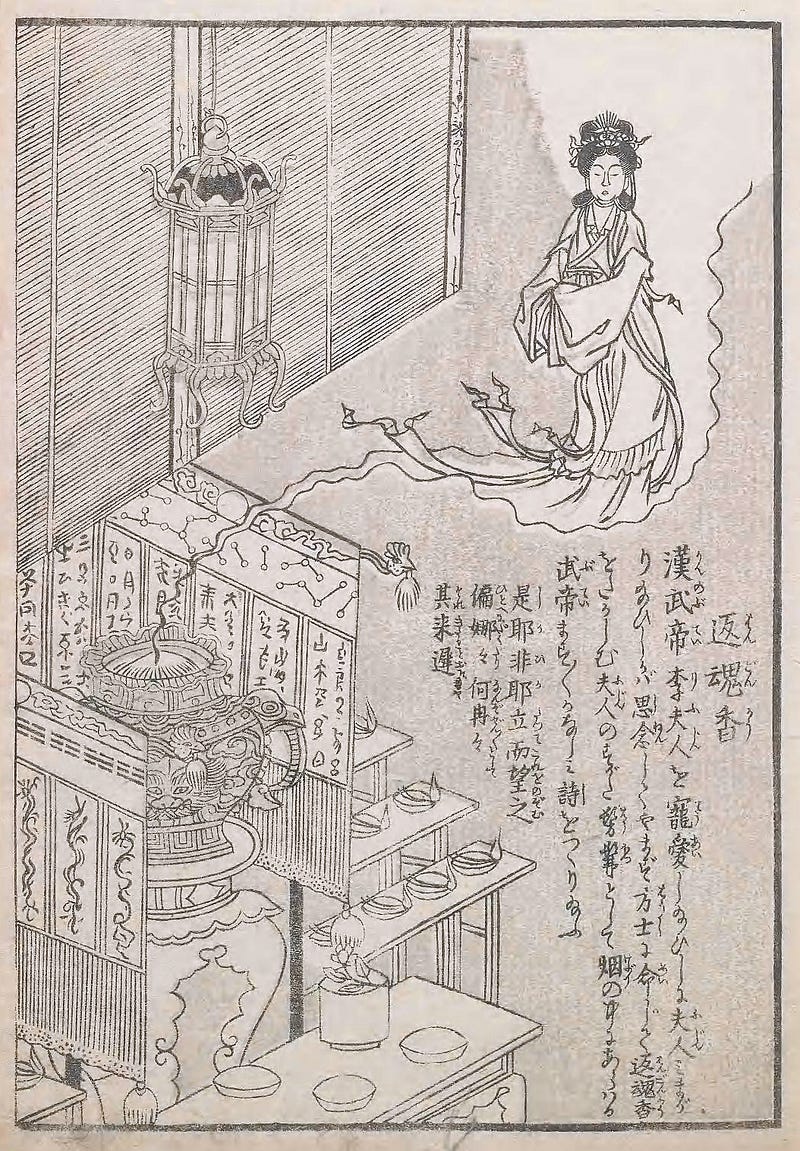
There are numerous theories as to why Ōkyo did not paint the feet of ghosts. A story persists that one of his ghost illustrations was so well rendered that it walked off its scroll, leaving it blank. So, perhaps omitting the feet was connected with such a superstition to prevent the spirit from walking across the threshold into this world...
There are two other explanations given the most credence. The first suggests that the smoke from the burning of the hangouko either hid their feet, or the rising smoke only became thick enough to suggest substance above a certain level. This makes sense when one considers that the ghost painting was called Hangouko no zu in the first place, and seems like a logical conclusion especially when one remembers belief in ghosts was accepted at the time or, possibly, the incense had hallucinatory effects. However, as most ghost paintings are commemorative offerings, would Motonori have been pleased with images that reminded him of death instead of the person as they appeared in life? It seems unlikely that Ōkyo would create a painting that would go against the client’s wishes.
The second and more popular theory is that Ōkyo’s late wife — or one of Motonori’s wives, concubines, or daughters — appeared to him in a dream. Even without any supernatural connotations, it’s highly likely that when planning a painting the artist became so engrossed that he dreamt of the subjects. For example, a somewhat romantic story could be that Motonori’s late wife or concubine appeared to him in a dream, foresaw Motonori’s grief-stricken suicide, and urged the painter to complete the painting to comfort and save Motonori. So, perhaps Ōkyo did not draw the lower part of the figure because his sketching was rushed and remained incomplete as the dreams faded.
Or, being a realist, perhaps he portrayed the ghost exactly as they had appeared to him. The negative space he left on the lower halves of the scrolls, without cropping closer, indicates a deliberate compositional choice. The mark-making, especially for Hanagouko no Zu, is refined and doesn’t seem at all rushed. There’s no sense of panic or urgency, and the women’s facial expressions in Ōkyo’s ethereal ghost paintings are calm and full of affection.
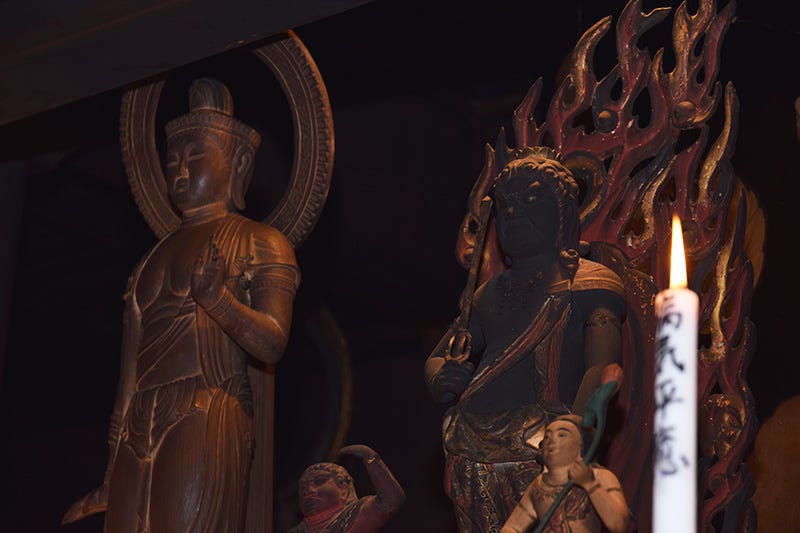
Ōkyo’s Hangouko no Zu is currently owned by Kudoji Temple of the Chisan school of Shingon Buddhism in Hirosaki City, Aomori Prefecture. This work is open to the public for one hour only from noon on the day that falls on 18th May according to the lunar calendar each year, which is between late May and early July. The temple has a tradition that it always rains on the day it is open to the public. Is this rain a cleansing rain that washes away all the sorrow and sins of Motonori Shozen Morioka, or are they tears of sorrow shed by him and his wives? Or maybe tears of joy at being reunited in the next life? They say, “After a storm comes a calm.” I sincerely hope it is a blessed rain.
He now rests at the Umebayashi Temple in the same city, his tomb next to that of his concubine and surrounded by his loved ones on both sides. It appears that, despite his faults, he had loved them from the bottom of his heart and the tragically poignant, fragile, love story still lies quietly with the painting, eagerly awaiting its annual awakening…
Books referred to and cited in this study
・More about Ōkyo Maruyama (もっと知りたい円山応挙) by Kazutaka Higuchi
・Illustrated Ghosts of Edo, Edo Ghost Stories and Ghost Paintings (図解 江戸の幽霊 江戸怪談と幽霊画) by Yasuhiro Uchida, et al.
・Aomori Prefectural History General History, Part 2
・History of Aomori Prefecture by Seiichi Hasegawa
・Japan History Series Hirosaki Clan by Seiichi Hasegawa
・Famine in the Early Modern Period (近世の飢饉) by Mr.Ishao Kikuchi
・National Flower (國華) / National Flowers Editorial Board
The video below, in Japanese, introduces ‘ghost paintings’ by Ukiyo-e artists representing the Edo period, including Ōkyo Maruyama. Take a peek into their supernatural world…
Finally, I would like to express my heartfelt gratitude and respect to all the librarians who gave me kind advice, careful research, and cooperation in researching ghost paintings.


.jpg)

