
Ghost Paintings of Ubume
Considering a recurring motif in traditional Japanese art: ‘Ubume’ is a ‘strangeness’ with the dual nature of an apparition and a ghost.
“Mother love is the fuel that enables a normal human being to do the impossible” — Marion C Garretty
Ghost Painting is an ancient and enduring genre of art closely linked with literature, regional folklore, and religious beliefs. It’s so interwoven with the cultural fabric of Japan that it’s impossible to discuss with brevity so, as a way in, we shall focus on the beauty, horror, and poignancy of Ubume paintings which, across the centuries has developed into a subgenre of its own that still has a place in today’s art and media… They are useful in building an understanding of the enduring influence and social usefulness of such images.
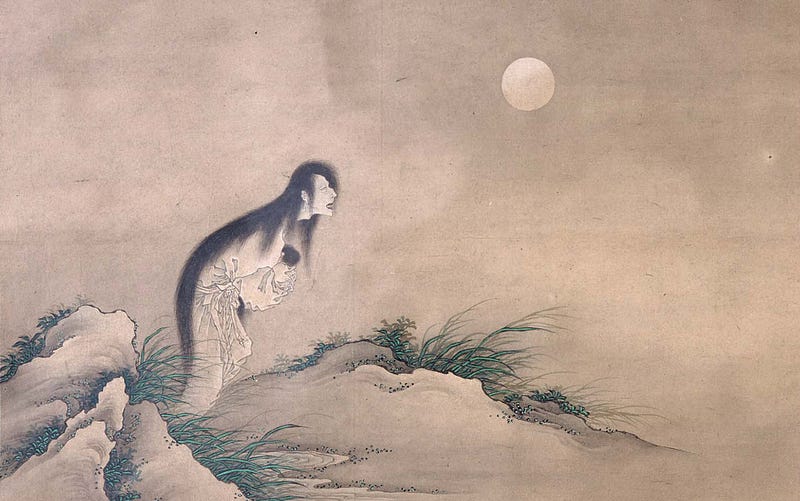
What gift could be purer than a mother’s love for her child? In an ideal scenario, it is a love passed on from generation to generation, for such a mother used to be a child and once received that love from their mother. When they change from girls to women, they take off the swaddle wrapped around them by their parents and choose their own clothes to wear, but hopefully that love lingers on.
Then girls may get into girlish things… makeup, gossip, friends, and ‘special friends’… and slowly but surely the time for leaving the nest will come. They may leave the reach of their parents’ hands and act on their own initiative, and one day they may even find happiness with a partner, having a child of their own — the journey of adventure continues from girl, to women, perhaps to mother. From the moment she finds out she is pregnant, a new adventure begins. The dynamic of a child’s life is the starting point of the incessant life cycle — universal, regardless of time.
Ideally, from the moment they receive life, they are infused with love — mother’s love and the child’s love for the mother. That is the hope but, sadly, mothers sometimes run out of strength without seeing their children grow up. According to the World Health Organisation figures (2015), the global average maternal mortality rate is 0.216%, which is approaching zero but will not disappear. Needless to say, the further you go back in time, the higher the risk of death.
Legends from long ago persist, perhaps beginning as a comfort for children without mothers that couldn’t know their affection? Reassurances came in stories and art that suggest that perhaps mothers try to protect their children, even if they themselves have died.
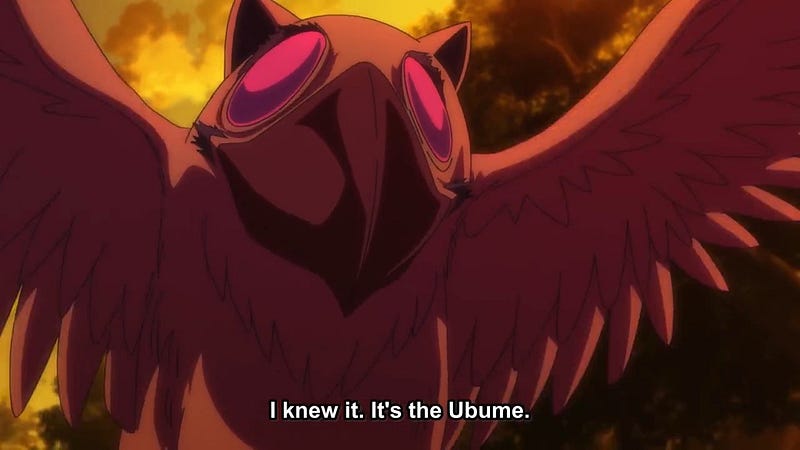
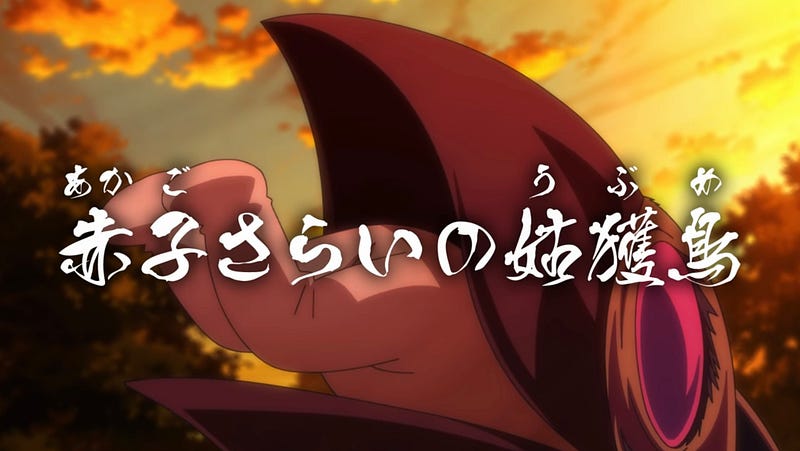
Ubume refers to a woman who died while pregnant or during traumatic childbirth and, unable to pass on, lingers among mortals as a ‘strangeness’ sometimes grouped within the broad umbrella terms of yūrei and yōkai. The same Ubume may manifest with distinctly different appearances and natures — the term can be written as 産女 and is a female ghost, or 姑獲鳥 which is an apparition in the form of a bird. Both translate as ‘ubume’.
Although this particular maternal strangeness has existed for a long time, it became famous and widely recognised by the public when popular authors such as mystery novelist, Kyogoku Natsuhiko and manga maestro, Shigeru Mizuki, drew works on the theme of Ubume and it began to recur in our contemporary mainstream media.
So, which of the two is most often recognised as the Ubume?
Probably, it is 姑獲鳥 — the bird-form. This is largely due to the influence of the manga book series and subsequent animated versions of Hakaba Kitarō / GeGeGe no Kitaro, originally written and illustrated by Shigeru Mizuki who has been a major influence in bringing traditional ghost tales back into the public imagination since the 1960s with his long-running manga series featuring a plethora of yōkai. Above all, entertainment in the form of anime and manga further accelerated the apparition boom of the time, which spread mainly among children and young-adult readers and remains popular.
However, this is not a contemporary creation, and the strangeness that served as its model is described in the Xuanzhong Ji, which is a collection of many mystery stories — some featuring magic and supernatural happenings— written as early as the third-century, during the Western Jin Dynasty in China. It describes a “kokakuchou” as a strangeness that turns into a bird when it wears its ‘fur and feathers’ and into a woman when it takes it off. This yōkai is known for taking the child of another and making it its own. The legend was adopted in Japan and was described in the 105-volume Edo period encyclopedia Wakan Sansai Zue, first published in the early eighteenth-century. It says that the kokakuchou is called Ubume, and as a result of the confusion of “産女” and “姑獲鳥” they have come to be irrevocably identified with each other.
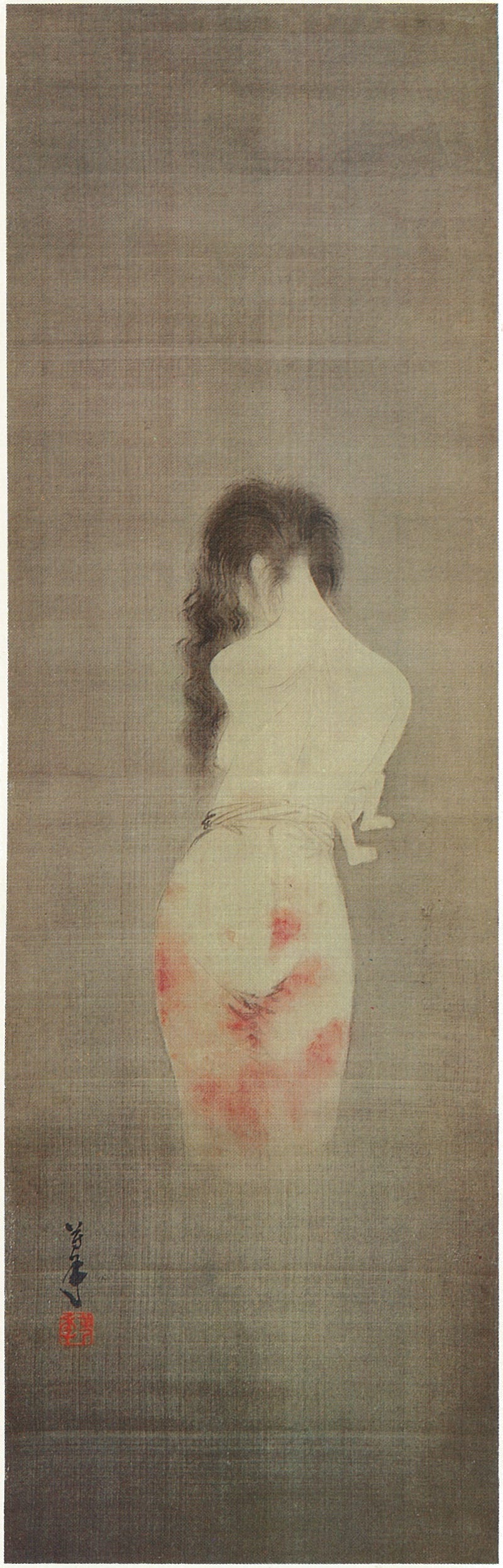
This ethereal painting is Yūrei no Zu Ubume by ukiyo-e artist Yoshitoshi Tsukioka (1839–1892) and is one of the most famous paintings of Ubume as a ghost. Its delicacy suppresses the horror of what is depicted, instead encouraging the viewer to have sympathy for the spirit. The deep regret of having to leave the material world before the child is implied by the back view, which poetically implies the mothers staunch reluctance and conveys emotional tragedy.
The traditional way of showing the figure fading out before the feet are illustrated indicates that the ghost is no longer tethered to this material world and, here, she seems to be heading into a formless void. The artist has left many anecdotes and fables as themes in his work. This may be based on his experiences with the ghosts he claimed to have encountered...
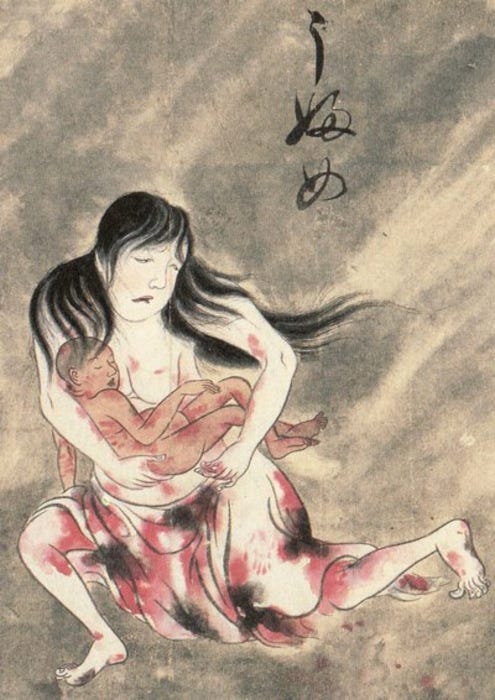
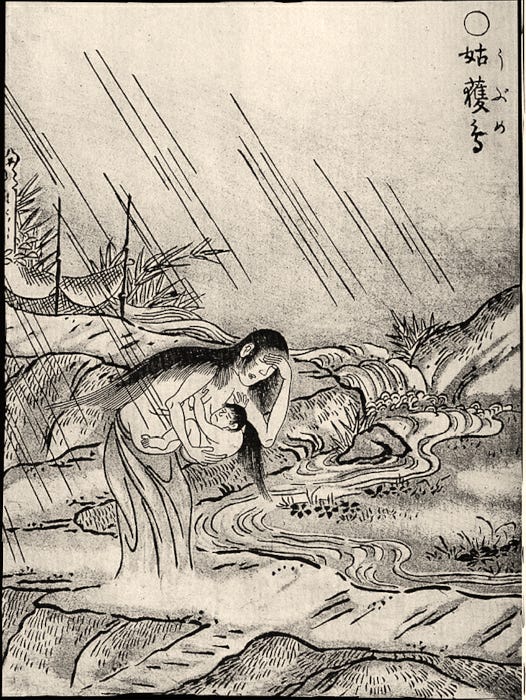
Two famous picture scrolls from the Edo period depicting women as Ubume are Hyakkai Zukan by Sūshi Sawaki and Gazu Hyakki Yagyo by Toriyama Sekien. These female figures are holding their own children with the upper half of their bodies exposed, implying their willingness to nurse the babies, but the sad expressions on their faces convey confusion and desolation. As ghosts, they are relinquishing their own chances of reincarnation so they can linger and watch over the child.
The influence of these images on the representation of female ghosts can be detected in many similar works that followed, and is still tangible today in modern media and J-horror. Shigeru Mizuki depicted Ubume as a “child-raising ghost” in his book Ghost Painting Discussion and in the tradition of Yurei no Zu Ubume by Yoshitoshi Tsukioka, this one also depicts a rear view.
Are these mere figments of creative imagination? Or do they also serve a spiritual, social, and psychological function?
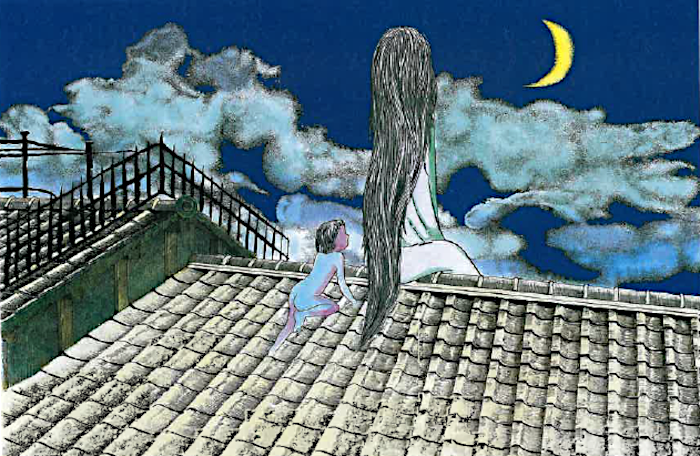
The existence of the Ubume tradition is confirmed in Konjaku Monogatarishū / Tales from Times Past, a collection of 1,000 stories written and compiled during the late Heian period (794–1185) and Kunio Yanagita’s The Legends of Tono, published in 1910. This means that Ubume belief persisted at least until the Heian period, and associated traditions remain prevalent throughout Japan, particularly concentrated in the Kyushu region.
In Nishimatsuura-gun, they are called in different ways, in Saga Prefecture, and Aso City, Kumamoto Prefecture, it is called “ugume”, and in Iki, Nagasaki Prefecture, “unme” or “umme”. Other traditions are also preserved in Shimabara and Nagasaki, both cities in Nagasaki Prefecture. A famous folktale has been handed down at Kogenji Temple in Nagasaki City, and the ghost painting is enshrined there.
Kougenji Temple in Nagasaki City, Nagasaki Prefecture, was built in 1637 and the story of The Ghost of Ubume has a history of nearly 400 years there. The following retelling is translated from a notice at the Mt. Gigi Kougenji Temple which is accompanied with the information: “This ghost painting is open to the public every year on August 16, and a picture-story show on the theme of the Ubume legend is performed on that day. The well that appeared in the folktale is called ‘Ghost Well’ and still exists in Kojimachi, Nagasaki City. It is no longer in use, but the pump foundation remains, offering a glimpse of what it was like in those days.”
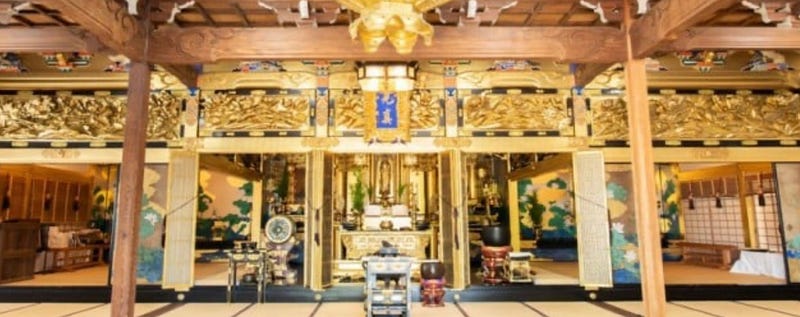
A synopsis of the Folktale known as The Ghost of Ubume:
There was a candy shop in Kojiya-cho, Nagasaki. One evening, as the owner was closing the store, there was a knock on the door. When the shopkeeper opened the door, a pale-faced woman stood there and said, “I want you to sell me one candy.”
The owner thought she was creepy, but sold her candy. Then, every night she returned to buy candy until, on the seventh night, she said, “I don’t have any money, so I need you to bless me with candy.” The owner handed over the candy free of charge. She thanked the kindly proprietor and left. The shopkeeper was puzzled by her behavior and quietly followed her. She went to the cemetery behind the Kougenji temple and disappeared like smoke. The owner was startled and ran back.
The next morning, the owner dug up the grave where she disappeared with the chief priest of Kougenji Temple. There was a woman there who died while holding her newborn baby in her arms. She had bought candy using the funerary money which was put in at the burial and used it to raise her baby. (In Buddhism, there is a custom of putting money in the coffin of the deceased. This is said to be the money needed to cross the Sanzu River. It is also possible to put things in that the deceased liked while alive.) After the chief priest investigated the baby and her identity, he discovered that a carpenter named Kiyonaga Fujiwara was the father.
Kiyonaga fell in love with her in Kyoto, but had to return to his hometown of Nagasaki. Upon returning to his hometown, he was forced to marry the woman his parents had selected for him. His true love died of grief upon learning of this fact. When Kiyonaga learned of this, he was deeply saddened and decided to take the baby in and raise it.
A few days later. The woman’s ghost appeared at the candy shop once more and said, “I want to thank you for saving my baby, how can I pay you back?” The owner said, “We are in need of water.” Then, she took out a comb and dropping it said, “Tomorrow, I want you to dig where this comb fell,” and disappeared. The next day, the shopkeeper dug where the comb had fallen, and water gushed out. Wells were built, and their fresh waters quenched the inhabitants’ thirsts for a long time…
Painting, like comics and animation, is a visually appealing medium and is superior in its ability to disseminate a depth of information in a short time. The greatest advantage of images, such as revered paintings, is that they are direct media and provide a common perception to those who see them. If this concept is described through hearsay or in writing, then as many Ubumes are created as there are readers. Both channels of communication have their advantages and disadvantages but, obviously, visualisation makes it easier to share subtle images. At the same time, it is possible for the gifted artist to share associated emotions as well.
Ubume as a child-rearing ghost is a persistently recurring theme in many paintings and performed Rakugo stories. Ghost stories are a popular form of entertainment but are often told as a moral lesson. The Ubume story is taught in the Jōdo Shinshū (浄土真宗) sect as “a sermon that teaches the importance of parents,” and at the same time it is retold with purpose of proselytizing the sect to attract new adherants. In classical ghost stories, whether paintings or books, it would be difficult to exclude religious factors in the process of their creation, not least reinforcing the concept of an afterlife. So are these roles the only ones?
The common denominator of the Ubume paintings that depict ghosts is the regret of women who have died, leaving behind their own children. The mother’s grief is immeasurable, unbearable to imagine, though it is the intense feeling of love that brought them back as Ubume. I think this is why it makes the viewer feel sympathetic sorrow rather than dread. Ubume paintings may have been intended to remind people of their mother’s love for them, regardless of gender or age… and the Ubume ghost paintings continue to sleep quietly, peacefully at Kogenji Temple today.
Please note, the YouTube video below is in Japanese. It features an interview with a monk discussing female ghosts and Ubume within a Buddhist context and includes a retelling of the Ubume and candy tale recounted in the article above…
* All images are used with license, or presented here for educational purposes under fair usage policy. Signifier and the author cannot be responsible for third-party content on external sites which may contain advertising and are subject to change without notice.


