
Student Loan Forgiveness Will Never Happen
The insidious reasons why this plan is Dead On Arrival
Last Updated: April 13, 2022

Mass student loan cancellation has been talked about a lot over the past few months and will only be discussed more as election season progresses. Given all the interest, it might seem as if mass forgiveness is just over the horizon, on the other side election night.
I’m here to tell you that’s not the case.
Quick Note: This article isn’t me preaching from the ivory tower of a debt-free life. I’ve got skin in this game, with $135,000 in student loan debt. Sure, that paid for an engineering undergrad and my MBA, but I’m also a civil servant trying to keep my head above water.
Now that is out of the way, on with the story.
There are three main obstacles to any mass forgiveness plan;
- Probability of the election outcomes
- Political priorities after the election
- Push-back on mass forgiveness
Election Outcomes
While election day is over a year away, there are only 3 possible outcomes on the night of November 3, 2020.
1. President Trump Wins
In this case, there will be no mass student loan forgiveness. Period.
Trump’s Education Secretary, Betsy Devos, has been openly hostile to student borrowers, calling on PSLF to be eliminated for three straight years, scrapping the Gainful Employment rule, and killing subsidized loans.
She is also the defendant in two separate lawsuits.
- The first lawsuit was filed by the American Federation of Teachers regarding the lack of transparency in the PSLF program. Below is a snippet from the lawsuit:
Plaintiffs seek to hold ED {Education Department} accountable for its gross mismanagement of the Public Service Loan Forgiveness (“PSLF”) Program and the Temporary Expanded Public Service Loan Forgiveness (“TEPSLF”) Program in violation of the APA and the Fifth Amendment’s Due Process Clause.
- The second is a class-action lawsuit by almost 160,000 former students of for-profit colleges who claim that the Education Department’s lack of decisions on “borrower defense” forgiveness claims since June 2018 is illegal. From the suit:
The Department’s failure to properly oversee the for-profit college industry on the front end, and its refusal to remediate the fraud that occurred on its watch, has eliminated any pretense that the government will protect these students.
Given the approach of the current administration to student borrowers, there is no indication that any new mass forgiveness programs are on the horizon.
2. A Moderate Democrat Wins
In this case, there is some hope for new college students, in that pretty much every candidate has campaigned on some form of “free” college. That may be a combination of increased Pell grants to eliminate the need for student loans or making community/two-year college completely free.
For current borrowers, we can anticipate some new iteration of the existing plans, such as:
- Interest-free deferral for starting a business (Harris)
- Refinancing at lower rates (Gillibrand, 4%)
- Higher “disposable income” calculation (Castro, 250%, up from 150%)
- Refinancing private loans through the federal government (Delaney)
- Public school teachers’ debt forgiven after 5 years at 20%/year (O’Rourke)
These plans are nicer than what we currently have, but note that moderate Democrats do not back a mass student loan forgiveness program.
3. A Progressive Democrat Wins
Senators Warren and Sanders have called on mass student loan forgiveness during their presidential campaigns, though there are some key differences between them.
Warren’s plan calls for borrowers with household incomes under $100,000 to receive up to $50,000 of federal student debt cancelled, no questions asked. It doesn’t matter if they are subsidized or not, on an IDR plan or 10-year, undergrad or grad. Even parents could get their Parent PLUS loans for their kids forgiven.
Borrowers with household incomes between $100,000 and $250,000 would get a tapered amount, and there would be no cancellation for borrowers in households above $250,000
By contrast, Sanders is calling for “universal” cancellation. Rich, poor; a little or a lot. It doesn’t matter. All borrowers receive full forgiveness.
While no one can see the future, the odds are low that either Warren or Sanders goes the distance and wins the general election given the massive Democratic field and the long haul to election night. I could be wrong but bear in mind that winning the election is only the first hurdle.
Political Priorities

Even if a progressive wins, student loan cancellation will not be their priority; that will be a healthcare proposal (some form of Medicare for All). Recent political history shows us that only one piece of major legislation gets passed in a new president’s first term.
The West Wing summed it up best.
Forget about a 4-year term. The Presidency is 18 months, that’s your window. After that there’s mid-terms, and no one on the Hill’s got time to do business with you. They’re too busy getting re-elected. And then, suddenly, you’re running again.
Take the past three presidents and their signature legislation as examples.
George W. Bush — No Child Left Behind
Bush became President in January 2001. He was already dealing with the economic aftermath of the dot-com bubble, but he had a slew of domestic programs he wanted to be passed.
His administration chose the economy and education as their priorities and proposed the first Bush tax cut (formally, Economic Growth and Tax Relief Reconciliation Act) and the No Child Left Behind Act to Congress soon after inauguration.
The House and Senate passed both bills quickly. The tax cut was signed in June 2001 and No Child Left Behind was signed in January 2002.
The terror attacks of 9/11 completely derailed the rest of Bush’s plans, and the rest of his was presidency comprised of the wars in Iraq and Afghanistan, with the only other major piece of legislation passed being the second Bush Tax Cut.
Barack Obama — Affordable Care Act
Obama became President in January 2009 and had stated that one of his top priorities was healthcare reform. However, like Bush, he was dealing with the aftermath of a bubble, this time in housing.
After introducing his healthcare plans in February, his administration was a little sidetracked while working to stem the worst effects of the Great Recession. However, the Affordable Care Act was passed in March 2010.
With the economy in shambles, Afghanistan and Iraq becoming even worse quagmires than under Bush, and Republicans warning of death panels, the rest of the Obama presidency was reduced to parrying the opposition and issuing executive orders, which were quickly reversed under Trump.
Donald Trump — More Tax Cuts
Trump surprised the world and became President in January 2017. His main domestic priorities were repealing and replacing the ACA, welfare reform, immigration, and a new infrastructure plan.
While those plans have been either landed with a thud (infrastructure) or had extreme push-back (immigration), Paul Ryan was working in the background to create a new round of tax cuts.
Two years into the midst of a chaotic presidency, only the Tax Cuts and Jobs Act was passed, way back in December 2017. Not much has come from Trump’s presidency since, except for his penchant for executive orders, just like his predecessor.
Overblown Severity of the Student Loan Situation
The strain of student loans has reduced retirement savings, wrecked credit scores, delayed a generation from starting a family, and played havoc with mental health.
However, in the grand scheme of things (and political capital), the student loan crisis is a distant second to the pension crisis, the long-term trade conflict with China, the impacts of climate change, endless foreign military interventions, election cybersecurity and cyberterrorism, food and water insecurity, and the wealth gap.
Overcoming the morass of competing political agendas is yet another hurdle to mass student loan forgiveness, and that fight won’t happen until a Democrat’s second term (if there is one).
For the sake of argument, let’s assume that forgiveness is next on the legislative table after healthcare reform. Just because the President wants it to happen doesn’t mean that it will happen.
Tailwinds and Headwinds
Many good things would come of forgiving every single cent of student loan debt. The Levy Institute provides the best overview of these benefits, including
- Increasing GDP
- Decreasing the unemployment rate
- Reducing vulnerability to economic downturns
- More small business creation
Like all things, there are two sides to the story. Most of the negative consequences of mass student loan forgiveness are unintended, but they should not be ignored.
Disproportionate Benefits
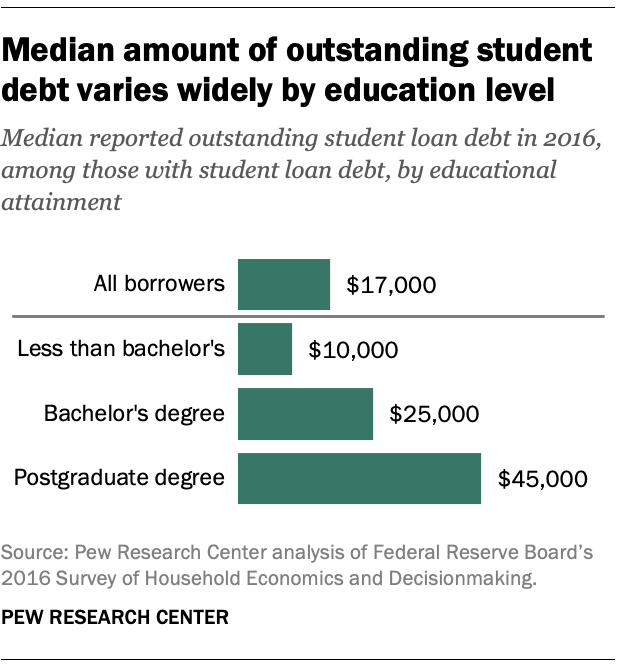
There is a correlation between higher debt and higher education, especially among graduate students. While student loan forgiveness is great for so many people, it would have a disproportionately positive impact on those with graduate or professional degrees.
These borrowers would have zero debt, much higher education, and the ability to out-earn other borrowers, which would only increase the wealth gap. Voters and politicians will have a hard time supporting a plan that erases debt for rich kids with MBAs and JDs.
Continuing in this vein, mass student loan forgiveness would only exacerbate racial wealth inequality.
While eliminating student debt for all households regardless of income increases median net worth for young white and Black households, white families see a greater benefit likely due to a higher likelihood of completing college and graduate degree programs.
Policies which eliminate all student debt for young households would expand the divide between median Black and white wealth by an additional 9 percent. (emphasis added)
Financial Cost
The price tag of forgiving student loan debt is estimated to be between $640 billion and the entire $1.5 trillion in student debt, but no one knows. Yes, funding is proposed by increasing taxes on investment transactions or other such mechanisms, but that is not a political antidote to the big, scary, upfront cost.
Unjust to Past and Future Payees
Finally, people who already paid off loans will feel cheated. Personally, people already resent me for enrolling in PSLF, and that takes 10 years of payments. Imagine how people will feel if there is no requirement other than borrowing vast sums of money.
Additionally, what about future borrowers? Do these plans intend on forgiving those loans as well, or just the ones currently in repayment? There seems to be no reason for the arbitrary decision to forgive student loans now rather than 5 years ago or 5 years from now, other than political convenience.
Political reality makes it hard to convince both Congress and the voters that mass forgiveness is the right option. Combined with the other two hurdles, we can conclude that banking on your loans being completely forgiven in an instant is just not an option.
The Takeaway
In the end, no politician is going to forgive your student loans. This means that you need to realize that the only person who can help you out of this mess is you.
If you are aiming for forgiveness, then PSLF, TEACH, and the other current programs will almost certainly still exist with a new President, especially for borrowers currently pursuing those programs. Even Trump’s plan to cancel PSLF would only eliminate it for new borrowers.
Also, research what other forgiveness plans are out there. Even if they only get you halfway there, that’s still 50% of your loan you didn’t need to pay.
If you have decided to pay off your loans, then pay them off as soon as you can. Sure, the 10-year plan is fine, but if you can pay everything off in 7, go for it. (I suggest this only if you can pay off your debt in 3 years or less.)
Either way, only you can help you. The sooner you accept this as a fact, the sooner you can move forward with your life.
Find the best repayment plan, then work that plan until you’re done.


