
Hacks and Variants
The Dark Art of Remixing Board Games
I am not a fan of following the rules. It’s a good thing that board games are just piles of components held together by rulebooks and boxes. I make screw-you variants for cooperative games. I mash up Chess variants. I add challenges to solitaire games. I make bizarre Frankenstein wargames out of designer toys and weird pogs. I paid good money for my games. They’re mine to abuse as I see fit.
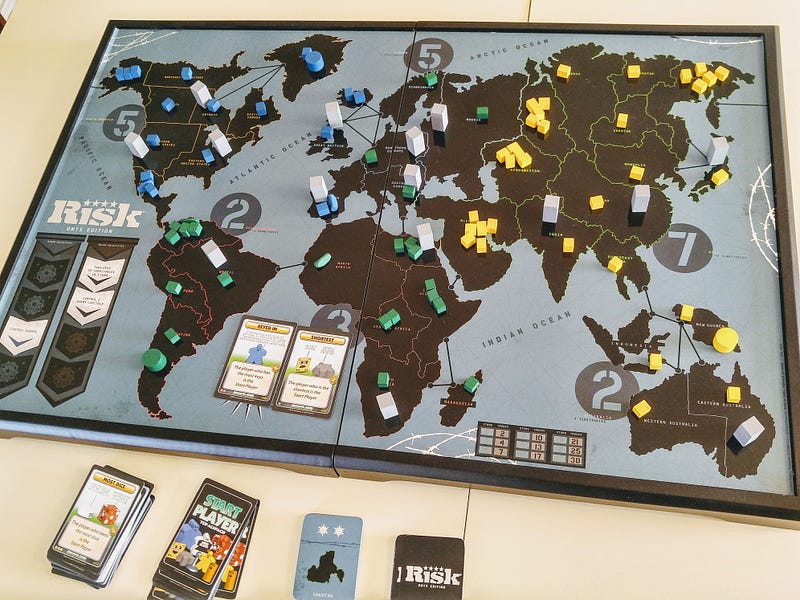
Born to be Kings: A Mashup of RISK and START PLAYER
“Some fellas are lucky and some ain’t.”
— Mr. Pink, Reservoir Dogs
I am a religiously dedicated pessimist. I always plan for the worst and never hope for the best. Research shows that this isn’t the best way to live, but old habits are hard to break. Even when I know the chances of winning or losing a battle in Risk, I remind myself that God hates me. He will fuck my roll every chance he gets. So I took the chance out of his hands.
I replaced Risk’s dice mechanics with a universal add-on called Start Player. It’s a deck of cards that determines who the first player is. It was obviously designed for anxious gamers. For example, one of the cards reads, “The player who has the coolest cell phone is the Start Player”. Whoever has the coolest looking phone goes first. Unless you take Schrödinger’s Cat literally, the Start Player is determined before the player draws a card. It may be random, but the outcome is set in stone once you’re done shuffling.
There’s no reason you can’t use this to determine other outcomes. So, I applied it to battles in Risk. My original rules were:
- Battles are all-or-nothing. One card determines the outcome, regardless of how many armies are involved.
- Attackers and Defenders select armies exactly as they would in traditional Risk.
- After attacking and defending armies are determined, the Attacker draws 1 Start Player card.
- That card determines who wins the Battle.
- If the card applies equally to both the Attacker and the Defender, the Defender wins.
- If the card doesn’t apply to either the Attacker or the Defender, draw another card.
- If the Attacker wins, the Defender loses a number of defending armies equal to the number of attacking armies.
- If the Defender wins, the Attacker loses a number of attacking armies equal to the number of defending armies.
- If all defending armies are destroyed, the Attacker conquers the Territory as they would in traditional Risk.
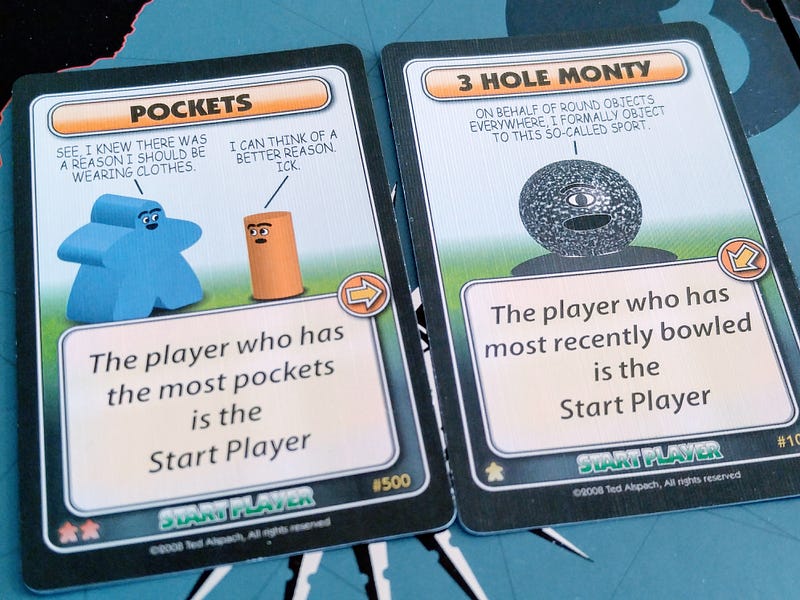
When I tested all this, I found that it didn’t help to attack with more armies than the defender could possibly defend with. The winner-take-all nature of the Start Player cards eliminated the advantage of rolling additional dice. This made the game more of a slog, since the Defender still won all ties. Even if there were fewer actual ties, this variant favored defensive players.
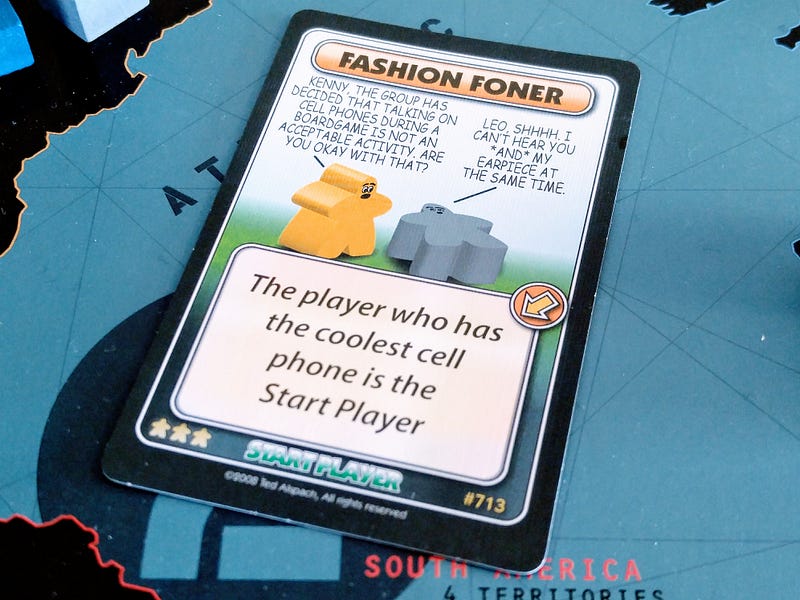
I also noticed that it didn’t work with versions of Risk that included Bonus Dice, like my Onyx Edition. We played the Basic Training mode, which does’t use those rules, but the more advanced versions do.
Finally, I discovered that the game wasn’t longer overall. The cards resolve battles faster than matching up dice. Multiply that by all the battles in Risk and a you shave off a lot of time.
I’ll eventually get around to refining the rules. I’ll probably allow Attackers to destroy as many Defenders as they attack with, but still limiting defense to two armies. Or I could mash Risk up with TieBreaker instead. Or use Matrix wargame rules. Or add Thunderbird vehicles as specialty armies like in Axis and Allies. Etc.
Let Them Fight: A Variant for RAMPAGE (aka TROUBLE IN MEEPLE CITY)
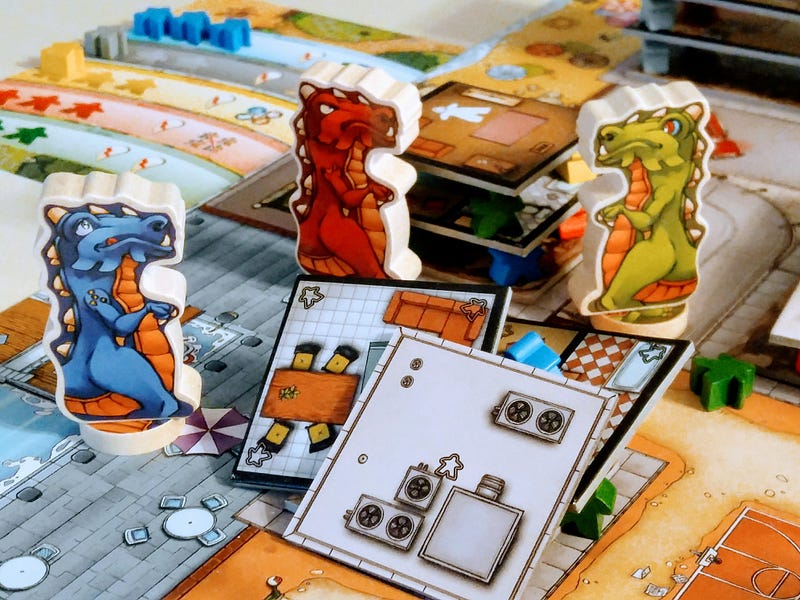
This one started life when I was flirting with a completely different idea. I was trying to mash Rampage up with Bottle Cap Throttle, but somewhere along the line I started thinking about the 2014 Godzilla movie. I have no idea why, but I put the autodueling idea aside and made something else.
Here’s the gist. One monster is good, the other two are bad. The Bad Monsters start with the normal number of cards, drawn randomly. The Good Monster selects:
- 3 Power Cards
- 1 Character Card
- 0 Secret Power Cards
The logic is that the Good Monster is stronger and customized to the player’s liking, but has no tricks up its sleeve.
- The Bad Monsters score points per the normal rules.
- The Good Monster scores points based on meeples that escape the board, (instead of chowing down on them), as well as Teeth broken off of Bad Monsters. It does not score building tiles.
- Escaping meeples are still placed on the Runaway board. Runaway effects only apply to the Bad Monsters. The Good Monster ignores them.
- The Bad Monsters win or lose as a team, but only the highest score among the two is compared to the Good Monster’s.
- Unlike the original rules, monsters can kill each other. If a monster is reduced to two Teeth, then get knocked down again (or knocked out of the city), they are dead.
- If one side is killed off, the other side automatically wins.
- If neither side is killed off when the final building is destroyed, compare the highest score among the Bad Monsters to the Good Monster’s score. The side with the most points, wins.
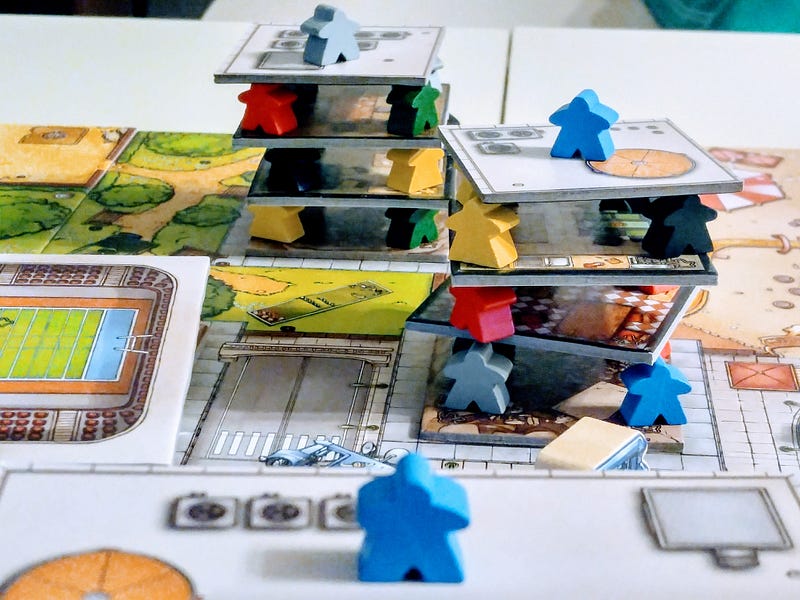
It wasn’t a big departure from the normal rules, but the monster-on-monster action changed the experience a lot. The Good Monster had to knock one of them away from buildings, then do the same to the other, going back and forth without getting dragged into a committed brawl. The Bad Monsters wound up focusing on either fighting the Good Monster or Chowing Down on meeples.
The resulting variant wasn’t great. Making Rampage Rumble-centric made it less fun. The Good Monster just made a beeline to whichever Bad Monster was closer. Knocking down buildings, which is the most fun thing you can do in Rampage, took a back seat. The Bad Monsters could still ignore the Good Monster to score points, but that wasn’t very fun either. Rumbling is great, and beaning another monster with a well aimed school bus is always a hoot, but smashing buildings is the bread and butter of Rampage. I probably won’t revisit this variant.
Most of the variants I think up turn out to be crap once I fiddle with the components for a bit. And most surviving variants wind up being crap once anyone else plays them. That’s fine. I don’t replay most of them, but that’s not really the point. The point is creation for the sake of creation.
Board games should be treated like boxes of LEGOs. Every tabletop game ever conceived is little more than a collection of plastic and wood and cardboard and rules. Sure, you can mod video games too. Some video games even encourage that. But it’s way more interesting to add D&D dice to Monopoly or combine Jenga with Hit A Dude.


