
The Argument Against the Argument Against Facemasks
Resistance rooted in liberty clashes with the unalienable right of life
Never has it occurred to me to question the ubiquitous “No Shirt, No Shoes, No Service” signs at restaurants. I mean, who wants to eat next to… well, you get the idea. In fact, no state has a law requiring shoes or shirts in dining establishments. It’s a regulation set by individual businesses that, according to some accounts, became more widespread during the hippie era. It’s since become a societal norm.
Now Americans are being asked to wear facemasks in crowded public places, for the greater good. About a dozen states are requiring it. There are, of course, vocal pockets of resistance. Yet the vast majority of Americans— 80% based on a recent survey — think masks make sense (whether they actually wear them is another question).
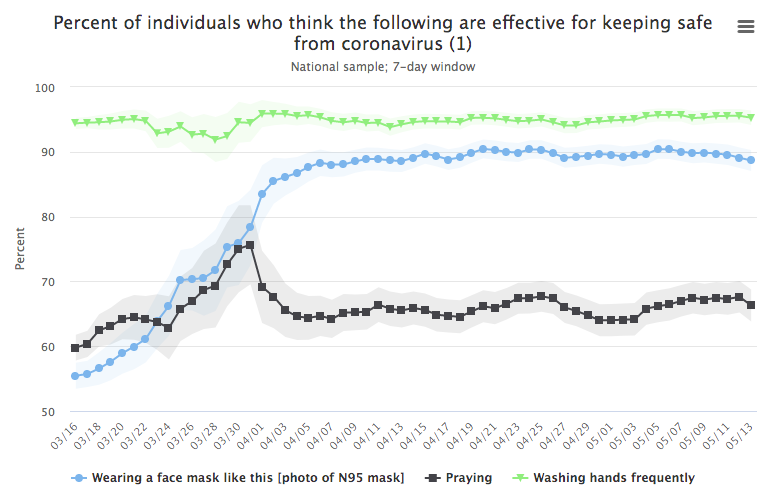
As people begin heading back to work amid justifiable concerns of additional waves of infection, amid a lack of effective testing procedures and only limited abilities to trace and contact people who might have been exposed to the virus, facemasks will (or could) play a vital role in slowing or stopping the spread of Covid-19.
So what’s the problem?
It’s my right
Among people resolutely committed to masked resistance, reasoning often centers around personal liberty. This resistance can get nasty. You may have seen videos or heard stories about the unmasked purposely and belligerently violating the personal space of masked people. Certainly, this is a small percentage of individuals.
Meantime there are countless lesser offenses among the mask-averse, perhaps rooted in a sense of entitlement but also disbelief of just how dangerous Covid-19 is as U.S. deaths approach 100,000.
The other day, I watched an older guy at the grocery make fun of the checkout clerk’s mask, joking about protective gear in general. She, younger and less likely to suffer the worst effects of Covid-19, was protecting him, and he couldn’t have cared less.
I’m not a mask absolutist. I don’t wear one at home. I don’t wear one at the gas station, where I’m a good 10 feet or more from others and we all pay at the pump. I don’t wear one on walks around my low-traffic suburban neighborhood though I give wide, respectful berth to anyone I happen upon. Crossing the street is not hard to do. This follows general advice given by ethicists like Daniel P. Sulmasy, MD, the acting director of the Kennedy Institute of Ethics. He tells runners to wear a mask if they’ll be running in a crowded area, but not if they’ll be out in wide-open spaces where it’s easy to keep a respectful distance.
“If you find wearing a mask while running insufferable,” Sulmasy says, “then you’ll have to find a safe time or a safe place to run.”
The advice keeps changing
Early on in the pandemic, before outbreaks in the United States, facemasks were not advised for the general public here. The gradual change in advice is understandably confusing, even frustrating. But there were legitimate reasons in early March not to advise masks. An analogy explains why the advice changed:
If there’s an early afternoon storm brewing well west of Toledo with the potential to cause tornadoes in the evening, you don’t want the scientists to scream at everyone to get in their cellars. You want them to let you know that some preparation and awareness would be wise. If the storm approaches that evening, and a tornado shows up on radar 2 miles outside Toledo and barreling down, you hope the scientists scream. Then it’s up to Toledoans to do whatever the hell they want, so long as it’s legal. They don’t have to go into the cellar.
So yes, the advice on masks evolved, as it should have (even top health officials have come to better understand their benefits; more on that below).
But masks are different in this loose analogy. They don’t represent your cellar. Your mask is more akin to your neighbor’s cellar, and it’s not exactly your decision whether your neighbor chooses to be protected or not.
“I think the ethics always weigh in favor of wearing facemask,” Jessica Berg, dean of the Case Western Reserve University School of Law and a professor of bioethics and public health. “Wearing a mask is a small burden to protect others. If you want to go into an indoor public space where people are in close proximity… you should wear a facemask.”
I asked Berg if there could be legal implications to not wearing a mask. That’s more complicated, she says.
“Right now we assume the risk that when we go into public spaces someone may be less careful and infect us (whether they do not wear a mask, do not wash hands, ignore signs of sickness, or simply infect us despite all efforts, etc.),” Berg says. “To make a legal case for negligence, you would have to establish a legal obligation to protect the other person. We don’t have this standard at the moment related to general public interactions sans face masks.”
Confusion over effectiveness
People may be confused by the lack of consensus on whether masks are helpful. The knowledge on this, and the communication of it, have both changed since March, as scientists who study these things have spoken up like never before, and as new research specific to Covid-19 was conducted. They call it a novel disease for a reason.
It’s now well established that droplets infected with viable coronavirus particles, emitted by coughing, sneezing, breathing, singing or even just talking, can travel several feet in the air, and smaller droplets, called aerosols, can go even farther and likely also carry viable virus particles.
A properly worn N95 surgical mask is very effective at helping an infected person keep a virus to themselves, though not 100%. Homemade masks are generally thought to be less effective, but better than nothing, just as coughing into your elbow is better than coughing into someone’s face.
But, and this is important, masks are most effective at stopping an infected person from infecting others. Masks are not as effective at protecting the wearer, in part because we stick our filthy fingers up in there to scratch, or maybe rub our eyes, ruining whatever protective effect the mask offered.
Recent mathematical modeling has suggested that if everyone wore facemasks, we could stamp out Covid-19 (data scientist Jeremy Howard at the University of San Francisco makes the case here).
But I’m not sick!
Yeah, maybe not. There’s no reason to suspect that I have Covid-19 right now, but given the long incubation period for the coronavirus, I could have picked it up as long as two weeks ago from a family member, or from the grocery store, or the hardware store, and not know it yet because the symptoms haven’t emerged. They might never emerge, should I be so lucky. Either way, I’d be infectious. This is exactly why Covid-19 has spread so widely, so quickly. Many of the outbreaks have been started by or facilitated by silent spreaders.
Wouldn’t it suck if I spread the bug around and killed someone because I value my “freedom” to not wear a mask over their desire to be healthy?
Out of respect for the grocery checkout person, my octogenarian relatives, somebody else’s grandma, my neighbors, I’ll choose to wear a mask when I go to places where there are other people in close proximity, so I don’t become “that guy” who infects 4 who infects 16 and so on (we don’t know the reproduction rate of Covid-19, indicating how many people the average infected person infects, but 4 is a fair estimate, the epidemiologists now say).
Finally, many people make the case that we have to get the economy going again. No disagreement there.
So let’s root for the economy.
A robust economy depends on workers and customers — healthy workers and healthy customers. Wearing a facemask is actually a way to contribute to the rebooting of the economy. It says to others, “I want to get back to work and I want you to be safe.” Not wearing a mask when in public and in close proximity to strangers says, in effect, “I don’t care about your health, and I don’t care about the economy.”
As we start to get out more, wearing a mask when and where called for is not some symbol of governmental tyranny or overreach by scientists. It’s simply one small step for humankind. Perhaps we should wear shoes and shirts while we’re at it.