

Can You Catch COVID-19 in the Air?
Coronavirus stays airborne and viable for minutes or hours after someone coughs, sneezes or just talks, evidence suggests
One big question that has vexed health officials since coronavirus first hopped from animals to humans back in December is how exactly it is transmitted between people. It was never in much doubt that like other viruses, this one could land on a hard surface or the hand of an infected person, in a cough or sneeze, and be picked up by the hand of another person, via a handshake or the turn of a doorknob, then transmitted to the face where it sneaks in through the eyes, nose or mouth.
What’s been far less clear is whether this coronavirus, called SARS-CoV-2, gets airborne and stays suspended in the air long enough, while remaining viable, for someone else to get it in their eyes or inhale it and thus be infected.
The answer seems to be yes, yes, yes and probably. If it does, that would help explain why COVID-19, the disease caused by the SARS-CoV-2 coronavirus, is so highly transmissible.
3 hours in the air
Key evidence emerged March 17, when researchers reported in the New England Journal of Medicine that the coronavirus can remain viable not just in droplets that tend to fall relatively quickly, but in tiny droplets called aerosols that can waft about for many minutes or hours.
“SARS-CoV-2 remained viable in aerosols throughout the duration of our experiment (3 hours),” they report, indicating that aerosol transmission “is plausible, since the virus can remain viable and infectious in aerosols for hours.”
“Can” and “plausible” are, of course, qualifiers that stop short of “does.”
Lisa Brosseau, ScD, an expert on respiratory protection and infectious diseases and retired professor from the University of Illinois at Chicago, leans toward “does.”
“This is adequate time for exposure, inhalation, and infection to occur both near and far from a source,” Brosseau writes in a commentary published by the Center for Infectious Disease Research and Policy at the University of Minnesota. She offers a visual:
“Have you ever used hairspray or aerosolized cooking oil? Many of those droplets remain airborne nearby as you inhale particles and smell hairspray and cooking oil for several minutes,” she writes. “The same thing happens when someone coughs or sneezes. Talking, breathing, coughing, and sneezing create an aerosol (a suspension of particles in the air) containing particles in a range of sizes, with viable infectious organisms present in both small and large particles.”
Other scientists agree.
“In the mind of scientists working on this, there’s absolutely no doubt that the virus spreads in the air,” says aerosol scientist Lidia Morawska at the Queensland University of Technology in Australia, in an article published by Nature. “This is a no-brainer.”
Nobody has figured out how far coronavirus might travel or for exactly how long it might remain viable and truly infectious, especially from aersols created by talking or breathing. But one thing is clear: You do not want to be in the direct line of a cough or sneeze.
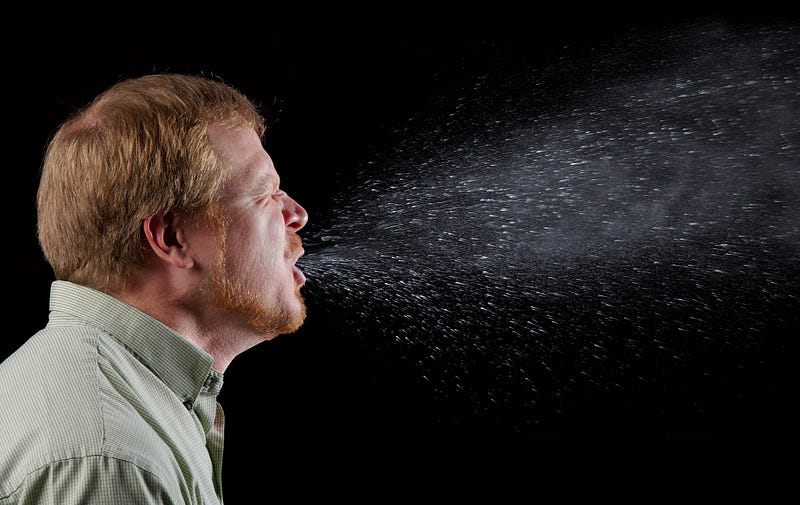
A sneeze can transport flu virus particles across an entire room, a 2013 MIT study found.
WHO is still not convinced
The science, which informs vital decisions and directives about physical distancing, whether everyone should wear facemasks and other preventive measures in hospitals and homes, is not settled among health officials, however.
The World Health Organization points out that the study in the New England Journal of Medicine was done using lab equipment, not real people coughing or sneezing. WHO maintains there is not sufficient evidence to conclude that the coronavirus can be transmitted through the air, except when someone infected with COVID-19 “coughs or exhales producing droplets that reach the nose, mouth or eyes of another person” directly while the two are in close contact.
The U.S. Centers for Disease Control and Prevention, however, does recognize that COVID-19 spreads “through respiratory droplets produced when an infected person coughs, sneezes or talks,” hence the advice to stay at least 6 feet away from others. That notably stops short of mentioning aerosols, however, which stay suspended longer than droplets.
The White House has been advised of all this.
“Currently available research supports the possibility that SARS-CoV-2 could be spread via bioaerosols generated directly by patients’ exhalation,” writes Harvey Fineberg, president of the Gordon and Betty Moore Foundation and chair of a White-House committee on Emerging Infectious Diseases and 21st Century Health Threats.
Meanwhile, as if often the case with science, “It’s OK to say that we’re still gathering evidence,” Brosseau writes.


