avatarRobert Roy Britt

Free AI web copilot to create summaries, insights and extended knowledge, download it at here

1574

Abstract

us events occurred. The chart, which shows death rates as a percentage of the entire population at the time, is not intended to shed light on how or when physical distancing and other <a href="https://coronavirus.medium.com/">Covid-19</a> preventive measures should be relaxed or strengthened. It is, rather, just a different way of looking at the numbers on a per capita basis, and only at a moment in time. (Note that <a href="https://elemental.medium.com/its-not-just-sick-old-people-who-die-from-covid-19-bc9251989bc8">mortality rates</a> can be calculated as a percentage of the population but are also sometimes expressed as deaths per 100,000 people or as a percentage of those who were infected.)</p><p id="925b">The 1918–19 flu pandemic remains by far the deadliest single-event infectious disease outbreak in U.S. history, in total numbers and on a per capita basis. Only <a href="https://www.kff.org/hivaids/fact-sheet/the-hivaids-epidemic-in-the-united-states-the-basics/">HIV/AIDS</a>, which has killed more than 700,000 Americans, has had a higher death total among infectious diseases, though playing out across four decades.</p><p id="81ca">The actual total of Covid-19 deaths <a href="https://www.cidrap.umn.edu/news-perspective/2020/04/cdc-us-covid-19-death-toll-likely-higher-reported">is likely higher</a> than the tally presented here, given that as many as 9,000 deaths in the country which were likely due to the disease but were not recorded as such, according to a <a href="https://www.cdc.gov/nchs/nvss/vsrr/covid_weekly/">CDC study</a> published Ap

Options

ril 28. And on May 11, the CDC said <a href="https://www.cnbc.com/2020/05/11/cdc-finds-additional-5000-nyc-deaths-possibly-linked-to-coronavirus.html">another 5,000 deaths</a> in New York City, from March through May, may have been caused by Covid-19 but not officially counted as such.</p><figure id="b330"><img src="https://cdn-images-1.readmedium.com/v2/resize:fit:800/0*VPu-d21XnMEFzSQu"><figcaption><i>A makeshift hospital set up in Brookline, Massachusetts, during the 1918–19 influenza pandemic. Photo courtesy of National Archives.</i></figcaption></figure><h2 id="80b3">Flu deaths overstated</h2><p id="04f3">Another important number behind the numbers, one that is sometimes stated incorrectly: The average number of U.S. flu deaths for the <a href="https://www.cdc.gov/flu/about/burden/index.html">past nine seasons</a> (2010–11 through 2018–19) is 37,461. The range is 12,000 to 61,000. But annual flu deaths are always <a href="https://www.cdc.gov/flu/about/burden/index.html">estimated by the CDC</a>, rather than involving firm numbers. The reported figures involve complex math and assumptions about unreported cases.</p><p id="5281">A more recent analysis by Jeremy Faust, MD, who practices emergency medicine at Brigham & Women’s Hospital, suggests that the CDC <a href="https://blogs.scientificamerican.com/observations/comparing-covid-19-deaths-to-flu-deaths-is-like-comparing-apples-to-oranges/">grossly overstates flu deaths</a>, and therefore Covid-19 has so far “killed between 9.5 and 44 times more people than seasonal flu.”</p></article></body>

The Coronavirus Has Killed More Americans Than Any Flu Season Since 1918

We’ve reached a grim coronavirus milestone

Photo: Terry Vine/Getty Images

By surpassing 116,000 this summer, Covid-19 deaths in the United States officially exceeded the number of total deaths from flu outbreaks or any other infectious disease outbreak in a single year or season since the 1918–19 influenza pandemic. And the Covid-19 death toll has also now exceeded the total number of Americans killed in WWI.

Already, the pandemic had surpassed the combined U.S. deaths from the entire Vietnam and Korean wars, on both total numbers and per capita. And while deaths per capita were higher in the 1957–58 flu season than in the current pandemic, this one is far from over, experts say, and if the current wave continues into fall, as health experts expect, that per capita milestone will be surpassed, too.
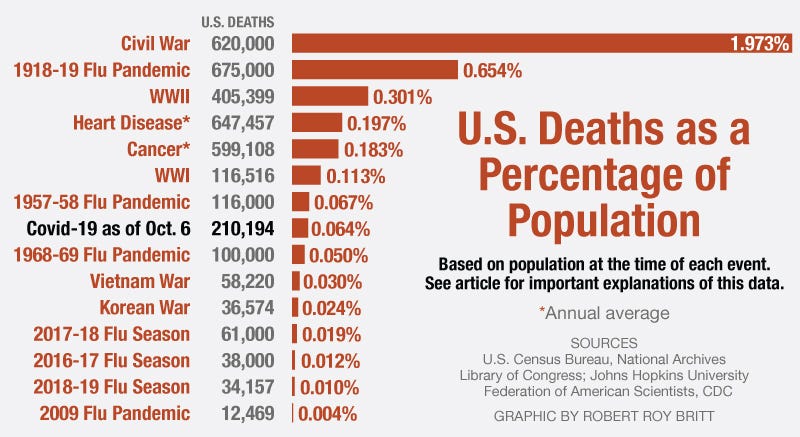
Article updated September 18. Graphic updated October 6.

While no single statistic tells the tale of Covid-19, I sought some perspective on deaths in relation to total population figures at the time various events occurred. The chart, which shows death rates as a percentage of the entire population at the time, is not intended to shed light on how or when physical distancing and other Covid-19 preventive measures should be relaxed or strengthened. It is, rather, just a different way of looking at the numbers on a per capita basis, and only at a moment in time. (Note that mortality rates can be calculated as a percentage of the population but are also sometimes expressed as deaths per 100,000 people or as a percentage of those who were infected.)

The 1918–19 flu pandemic remains by far the deadliest single-event infectious disease outbreak in U.S. history, in total numbers and on a per capita basis. Only HIV/AIDS, which has killed more than 700,000 Americans, has had a higher death total among infectious diseases, though playing out across four decades.

The actual total of Covid-19 deaths is likely higher than the tally presented here, given that as many as 9,000 deaths in the country which were likely due to the disease but were not recorded as such, according to a CDC study published April 28. And on May 11, the CDC said another 5,000 deaths in New York City, from March through May, may have been caused by Covid-19 but not officially counted as such.

A makeshift hospital set up in Brookline, Massachusetts, during the 1918–19 influenza pandemic. Photo courtesy of National Archives.

Flu deaths overstated

Another important number behind the numbers, one that is sometimes stated incorrectly: The average number of U.S. flu deaths for the past nine seasons (2010–11 through 2018–19) is 37,461. The range is 12,000 to 61,000. But annual flu deaths are always estimated by the CDC, rather than involving firm numbers. The reported figures involve complex math and assumptions about unreported cases.

A more recent analysis by Jeremy Faust, MD, who practices emergency medicine at Brigham & Women’s Hospital, suggests that the CDC grossly overstates flu deaths, and therefore Covid-19 has so far “killed between 9.5 and 44 times more people than seasonal flu.”

Covid-19
Coronavirus
Death
Science
History
Recommended from ReadMedium