
The Anchor: Stan Soffin Steady Father Figure to Generations of Journalists
Any time we worried, he reassured and guided us
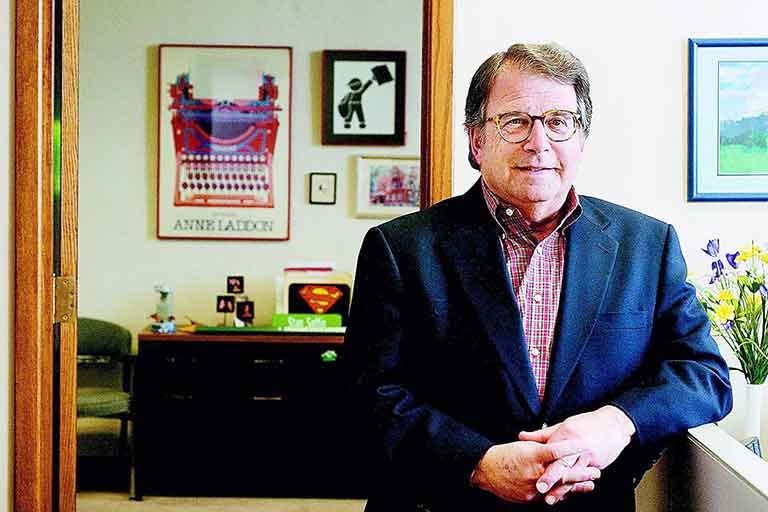
Stan Soffin, honoring one of the founding fathers of journalism, heard ancient alumni say they were “Bert’s Boys.”
Stan, the same age as my parents and father to three beloved daughters, chuckled, wondering if any of his students might say they were one of “Soffin’s Sons.” We are truly living parts of his legacy. We lost him on July 9 at age 78.
“My life has been a poor attempt to imitate the man. I’m just a living legacy to the leader of the band,’’ Dan Fogelberg, “Leader of the Band / Washington Post March.”
Journalists write the first draft of history
The most successful of any age have older mentors showing them the way. Stan Soffin was our anchor: confident, content, and steady even when the world was awash in turmoil.
Journalists write the first rough draft of history, which is often messy, exaggerated, not what it seems to be, and chock full of holes. We came to him often full of those crazy mixed emotions of youth, doubt, and uncertainty.
Stan championed all sides of the stories of life, earning his bachelor’s from the University of Michigan and two advanced degrees from Michigan State University, where he served students for 43 years (1968–2011).
No matter how much life battered us, pounding our pride back and forth, his voice was stable. Stan (he always let us call him Stan) settled us down.
Our mentor offered a mild-mannered Clark Kent chuckle along with words of confidence and the wisdom of a thoughtful intellectual and the reassuring voice of experience and comfort.
Like a true father, the relationship was for life and unconditional.
If you needed help with classes or getting (or keeping) a job or advice, he was there. Journalism reached its all-time zenith during his career:
- In the 1970s, the Pentagon Papers and Watergate showed the best of what journalism could and should be. The Janet Cooke scandal taught us about fake news, journalism at its worst. A record number of young people rushed to his school to make truth-telling their calling.
- Proudly saying he ran “the only accredited School of Journalism in Michigan,” he helped journalism blossom at all levels.
- Shaping a fantastic network of high school newspapers (at the very time courts granted free speech rights for school papers), he brought the Michigan Interscholastic Press Association to MSU to be a hub for high school journalism. I was one of the kids attending “journalism camps.”
- He made MSU’s journalism program so strong that the mighty world-beating “Leaders and Best” at the University of Michigan dropped their journalism program. They simply couldn’t compete with Soffin’s kids.
- The State News, where he served on the board of directors, became the largest college daily in the nation with readership numbers that “professional papers” would learn to envy.
- Seeing his power to mediate any concern, MSU promoted him to ombudsmen for the entire university so he could apply those skills to the whole University.
We met when I was a teenager, and he was in his early 40s. Twenty years later, he seemed the same: Younger looking because he shaved away the beard newsmen like him sported so often in the early 1980s.
“Stan has been the pebble in the pond (boulder in the ocean?), making ripples across the journalism industry,’’ one of his successors, Lucinda Davenport, wrote in 2010. “He was the mentor, advisor and class instructor for hundreds.’’
I first saw him regularly in the fall of 1983, about a year after Stan became director of the Journalism School. He’d gone out and recruited Bill Giles, the Executive Editor of The Detroit News, to be Editor in Residence at MSU.
The Detroit News was a very different paper in those days. Giles was editor during an era when the News was the leading newspaper in Michigan with afternoon and morning editions. The News had just won Pulitzer Prizes and had a circulation of more than 700,000.
Giles was so sharp and had so many good stories to tell that Stan was there in every class, taking notes and learning with all the rest of us. Stan always was one of us, a reporter, a colleague, a friend, a wise mentor, and one of the best board members The State News ever had.
At The State News and the Journalism School, Stan demonstrated the main reason the Legislature created MSU in 1855.
When the idea for a new Michigan Agricultural College was born, our friends and family at U-M suggested there was no need for a new college, that U-M could take on agriculture as a new department.
MSU’s founders envisioned a new kind of institution emphasizing hands-on experience. Hence, those original students lived and worked on a giant farm, milking cows in the agricultural equivalent of a living-learning lab, getting real-life experience before and after they went to class.
Stan similarly built a program where students went to class, where students could go to places like The State News and Capital News Service and Focal Point and the MSU London Reporting program and get real-world, hands-on experience while they earned their degrees.
But he was also the consummate researcher, always testing new ideas and innovations, recognizing MSU is a major research university.
One night he and a team of students came into the newsroom and got access to all our content to make an alternate version of The State News that removed all editor’s cues that told readers which stories were most important.
Yahoo stole the earliest web ideas from Stan
All headlines were re-made to become the same size, and the front page featured a gigantic index box outlining all the day’s stories. We mostly thought it was ugly, a crazy idea.
But years later, when Yahoo was born, I marveled at how much “My Yahoo” looked like that Stan Soffin research project.
Stan spent 16 years as director, literally taking the Journalism School from manual typewriters to Compugraphic VDTs, to Macs to the Internet. Two of his best successors, Steve Lacy and Lucinda Davenport, both came to MSU during the Soffin years.
The last day we worked together
On my last day as editor of The State News, our old Compugraphic VDT system crashed. It was a Sunday afternoon, the computers were dead and we had no spares in those days.
Finals week started the next day, but we had remarkable stories to put out, including incredible photos of firefighters carrying students out of Hubbard Hall after a big fire.
Should we just not put out a paper, some asked?
“No, let’s call Stan and ask if we can use his computer lab at the J-School.”
You didn’t think of calling any professors at home on a Sunday in those days (they had something called “office hours”).
But everyone just inherently trusted Stan Soffin because he always let us make our own mistakes, push the envelope and try new things.
Stan came in on his day off, having as much fun as the rest of us as we bugged out. We moved the entire paper from our newsroom to the Journalism School for a day. A crazy and glorious Sunday afternoon.
When we heard the news of his death, many posted on Facebook about how “Stan Soffin changed my life.”
Albert A. Applegate was one of the legends of Michigan State journalism in its earliest days, and Applegate’s students used to call themselves “Bert’s Boys.” Stan beamed when he heard that, wondering if anyone would ever want to be known as his son.
Stan’s former students do indeed consider themselves Soffin’s sons and daughters. As Fogelberg wrote:
“I thank you for the music and your stories of the road. I thank you for the freedom when it came my time to go. I thank you for the kindness and the times when you got tough and papa, I don’t think I said I love you near enough.’’


