
When You Can’t Touch — But Know You Must
Grief (post-pandemic) still falls into seven phases and three vital needs

The need to say “goodbye” is instinctive but new rules are keeping people apart.
“I had to sit on the porch and watch my wife die on a cell phone … I couldn’t even say goodbye, except … over a screen,” Stephen Suida explained. “This was the only time in our whole marriage that I was not able to be there for her.”
His wife died after a brain aneurism and multiple strokes. Hospitals, crowded with infectious patients, have changed rules. Suida watched his wife die via FaceTime because only one visitor at a time was allowed so Suida let their daughter be at her side.
How to love during a pandemic that changed everything
Funerals have been limited to a select few or put off. In South Carolina, six people who attended a March 16 funeral died of COVID-19. Zoom funerals have begun.
We need to touch, to hold each other. But we can’t.
Burials without funerals can mean “grief without hugs,’’ USA Today reports. The Archdioceses of New York and Newark, New Jersey, where the deaths are the highest, have canceled funerals and limited grave-side services to 10.
The price of love? The need to grieve
“Our brain responds like a soldier stunned by a loud, nearby explosion,’’ Karl Jennings writes. “Almost immediately, the heart receives the news and snaps the brain out of its temporary amnesia.’’
Jennings, author of When We Must Say Farewell, developed Acute Loss Management, research showing how grief is a seven-part process dominated by emotional, relational and spiritual needs.
“Grieving is the price we pay for loving,’’ Jennings explains. “Failure to grieve reduces our capacity to invest in love… We do this so we may love deeper, experience joy more completely, and to know in its totality the beauty found in the temporal, finite moments we share on earth with those who call us ‘friend’ and with those who call us ‘family.’ So, in the end, your death does not belong to you; it belongs to anyone who ever cared for or loved you.’’
The Dick Clark Effect: Some old friends seem “forever young”
Some people seem “forever young.’’ They never seem to age. We used to call this “the Dick Clark effect” of never seeming to age. They laugh more, love deeply, knowing who they are and why they’re here.
But as Dick Clark himself taught us: someone gets sick and decades of aging accelerate all at once.
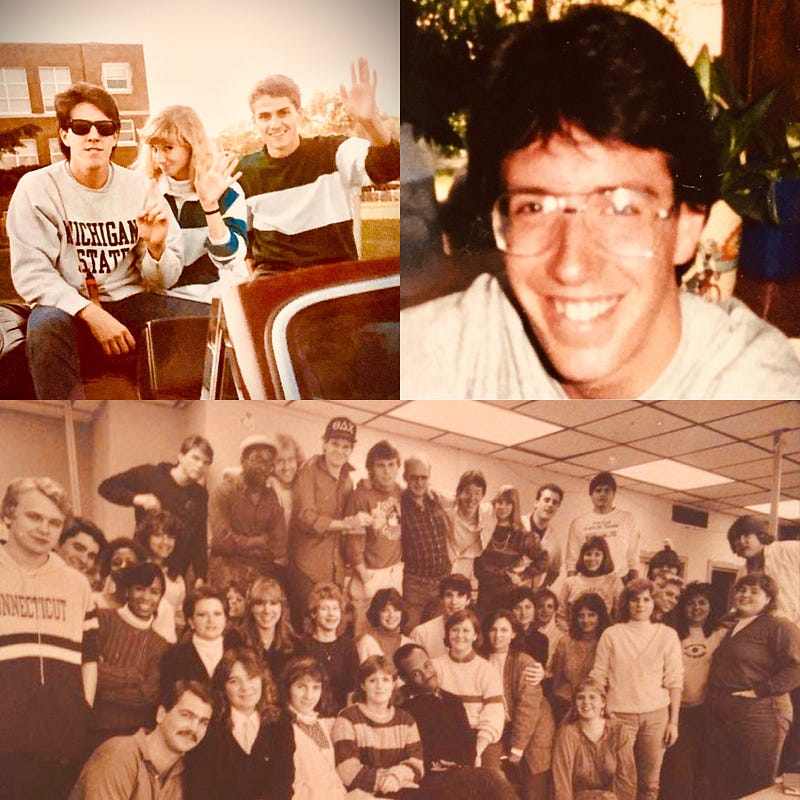
Kevin Roberts was like “Dick Clark’’ to me. He always seemed the same: happy, content, forever young. Little phased him. We met 35 years ago, when we were kids writing for The State News, our college daily at Michigan State. We lived in that newsroom, becoming family in the process.
We were storytellers long before the term became a marketing buzz word. We spent lifetimes telling and sharing stories. We ate together and drank together. We laughed a lot. We loved. We drove each other crazy. Our main mission as journalists: we sought and revealed truth in whatever way we could.
The Seven Phases of Grief
Hearing
We all need to hear news and journalists feel called to break stories. Ricardo “Rico’’ Cooney, another forever young, laughing and content State News friend like Kevin, sent me a Facebook message. Kevin had been “placed in hospice after losing a valiant battle against the spread of his bladder cancer. I don’t know how much time he has left but…’’
The news spread faster than any virus. As John Donne wrote: “All mankind is of one author, and is one volume… No man is an island, entire of itself… any man’s death diminishes me.”
Sharing
A few minutes later, a Facebook “group message” started. Several people added friends and soon the group swelled to 45. Every one of us was sharing memories, feelings, and photos. My laptop kept blowing up with new notifications, memories, photos of us in ’80s clothes.
Our friend Tracey, who grew up in the same small suburb as Kevin and I, suggested we pray so I typed out some words of gratitude for Kevin.
Friday morning, the fifth day of this online conversation, we got the word that Kevin had died. He was 53. As soon as you learn about the death of someone you care about, it’s instinctive to need to share the news with others.
“Sharing is to healing like oxygen is to the body,’’ Jennings writes. “Without it, we shrivel up and die. As we begin to connect and attend to our emotional needs and those around us, we initiate the first in a series of moments where our hearts will be comforted by the knowledge that we have suffered a loss but we are not alone.’’
Seeing
Seeing is an emotional need and vital to every relationship. As soon as I saw the news Kevin was gone, I wanted to see his obituary as soon as possible. I wanted to see Kevin, his family, and friends. I wanted to talk about the difference he made with his life.
“Seeing is what puts everyone all at the same emotional level; seeing makes it real,’’ Jennings explains. “Intellectualizing loss is to grieving what imagining being in love is, without having a lover: shallow, pointless, detached and self-centered.’’
Without seeing, it’s easier to avoid processing your grief, meaning it’s actually healthy to see someone after they die, to attend their funeral or at least a visitation.
But I wanted to see Kevin’s story too. He and I both grew up in the same home town (Grosse Pointe, Michigan), we both served on The State News together and both wrote for dailies in Pennsylvania. Like many journalists, we watched our industry collapse and both took those journalism skills to post-newspaper careers serving nonprofits, trying to help others.
Thirteen hours after hearing Kevin had died, one of our former State News colleagues shared a tribute to him written by Philadelphia Inquirer reporter Bob Brookover.
“The first impression was always the same for anyone who met Kevin Roberts: Boy, is that guy happy,’’ Brookover wrote. “The second impression: Is it really possible to be that happy?’’
Gathering
As kids, we needed to celebrate our victories and drown each other’s sorrows. As students and for decades afterward, we would return like salmon to places like El Azteco to gather together, share stories and eat the best cheese dip ever invented.
If we can’t meet his family, the way we would at a funeral, I’m already certain someone from our old team will want to gather people together at one of our old haunts to remember him and reconnect with each other.
The need to gather is the primary reason people need to have funerals (and the “after funeral meal”), to gather family and friends together to share stories and properly say goodbye. We tried our best to replicate this need in our Facebook message chains and it was comforting but it wasn’t enough. Many posted their own tributes online.
“We are physical beings and grief is a physical experience,’’ Jennings explains. “We must engage as many senses as possible in the experience as soon as possible to begin healing… We gather as a family at the time of loss or tragedy because the story of our lives share their meaning as they are woven within the words, sentences, and chapters of those who know us best.’’
Connecting
The need to connect is both relational and spiritual as well. Weddings, baptisms, and funerals are turning points in our lifetimes. As we shared photos on social media, many were taken at weddings.
Funerals are turning points too. We reconnect with people we haven’t seen for years or meet people we never knew but should have known because they are pieces in the bigger puzzle of our lives.
“The death of a loved one can offer a time for life transformation or regression,’’ Jennings argues. “One thing is for certain, it will not leave us unchanged.”
Reflecting
There are fewer better ways to reflect on your life than to write your own “life story.” During my newspaper jobs, many reporters wrote pre-written obituaries about ourselves because we wanted to make sure the story was “right’’ in case something happened to us while on assignment.
This is what writers do. If I write your life story at the end of your life, it’s called an obituary. But it’s often the same story if I write “a profile” of your life during your lifetime. Either way, it’s reflecting on the meaning and purpose of your life, how you made a difference.
People loved Kevin because he always knew what he wanted to do. Soon after I turned 21, ready to end my year as editor of The State News, Kevin was one of five applicants to succeed me. He was one of two sophomores who applied and the board and staff didn’t think he was ready (just a few months after joining us) but his interest sent a message: he got the job the following year. The overwhelming consensus was that Kevin always knew who he was and what he wanted to do. Everyone just liked him. Kevin was a giver.
“…reflection is the starting point,’’ Jennings believes. “Takers never get enough of what they need; givers always have more than enough to give away… One seeks happiness in their pursuit; the other uses their pursuit to help others.’’
Celebrating
No matter how hard life gets, we often say we are fine. But Jennings stresses, “The dead don’t lie to us about their condition. They don’t say they are doing fine… It seems the dead don’t move but can move us to tears.’’
Celebrating, like the need to reflect, is a spiritual need answering all your “why’’ questions. But it’s also relational, focusing on the need to love others and be part of something bigger than yourself. Because Kevin knew exactly who he was, he had a clear identity that shaped his life’s mission and purpose.
Kevin’s wife Kim told the Inquirer: “His mom was kind of a saint. She worked in a drug rehab facility and Kevin just always wanted to make a difference. Through his contacts, he was able to help so many people. He was still working up until about two weeks ago and even then he had brought his computer to the hospital.”
Resources for People in Grief:
When We Must Say Farewell by Karl Jennings.
COVID-19 and the Grief Process.
American Psychological Association: Mourning Our Bygone Lives.


