2 Helicopter Crashes Rewrote History
John Heinz had the makings of a President. Two helicopter crashes — 18 months and 66 miles apart — altered national politics for decades
The warning panel said something was wrong with the plane’s landing gear, so a helicopter volunteered to fly up close to check.
The plane, carrying U.S. Sen. John Heinz, R-Pa., and the copter trying to help, crashed. Both slammed into a suburban Philadelphia schoolyard below. Seven people, including the crews, school children below, and Heinz, died instantly. He was just 52.
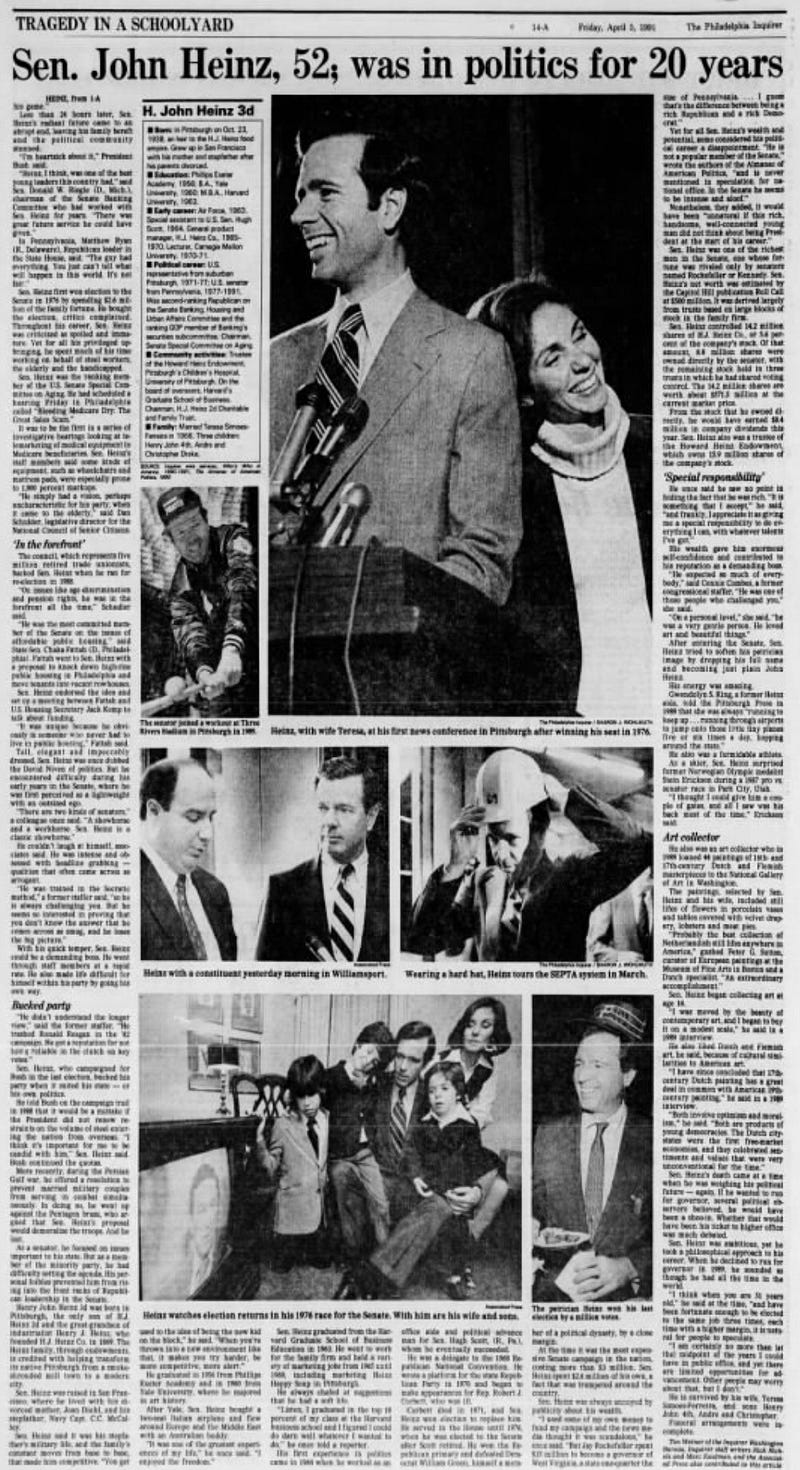
That single, shocking April 4, 1991 event would change history, careers (mine included), and Presidential politics for literally decades to come.
In “It’s a Wonderful Life,’’ we see how a single man’s life changes a whole town.
In the story of the two copter crashes, we see how one man is lost and another being spared changed America. Every action created a ripple effect.
The Republican JFK
The beloved John Heinz, heir to the massive Heinz empire (including ketchup, 57 varieties of pickles, and everything from baby food to beans) was adored in Pennsylvania and popular in Washington, D.C., considered a Republican John F. Kennedy.
Many were certain he would run for governor in 1994 and for President in 1996. His death and the vacuum it created continue to impact history.
Everything happens for a reason: Events from 1989 and 1991 continue to impact life today. Seemingly unrelated events each impact the other.
My own connection to this interconnected story
When the news broke, ambitious reporters in our Harrisburg, Pa. newsroom wanted a piece of that story. Teams rushed to the crash site in suburban Philadelphia. Others swarmed the state Capitol a couple of blocks away.
I volunteered to get a local reaction, calling the mayor of Harrisburg (who noted Heinz brought in grants to pay for a local senior center. The mayor said the center should probably be named for Heinz and it later was).
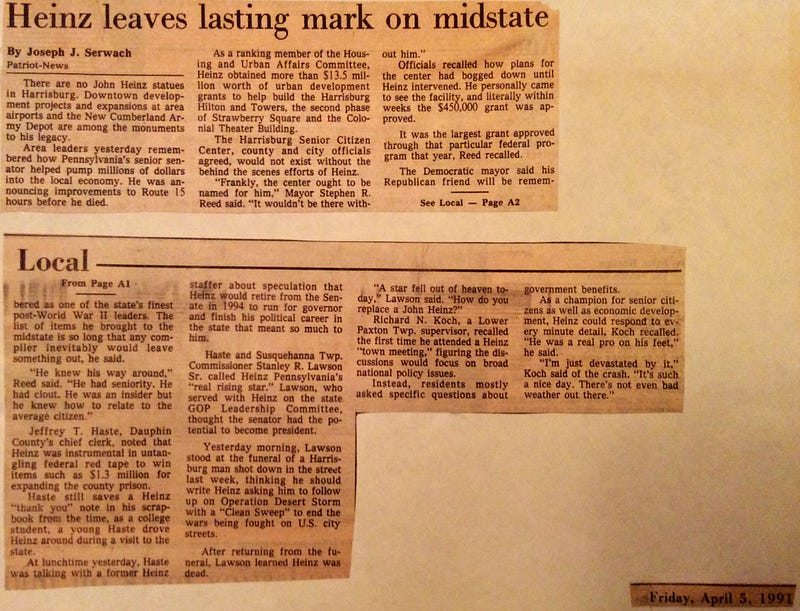
Local pols expressed great admiration, talking about his accomplishments. The editors were only looking for short comments for “quote boxes.” The words I heard were moving.
I submitted a story that made it onto page 1 by coming up with an original lede (the first sentence of a news story) that said something different than the rest of the coverage:
“There are no statues of John Heinz. His monuments include Harrisburg’s new senior center, the expanded Strawberry Square downtown, and the widening of Route 15 he announced yesterday before his death.”
America watched the 1991 special election
In short order, Democratic Gov. Robert P. Casey asked Chrysler CEO Lee Iacocca, a Pennsylvania native, to take the seat. Iacocca said, “No thanks.”
Casey then appointed a friend and former college president, Harris Wofford, to fill the Heinz seat. President George H.W. Bush asked his attorney general, former Pennsylvania Gov. Dick Thornburgh, to challenge Wofford in the November special election, seven months away.
It was the only U.S. Senate race in the nation in 1991. Pennsylvania was the fifth largest state, close to Washington, D.C.
Conservative commentator Bob Novak predicted that the politically experienced Thornburgh would crush the academic Wofford, making the race look like “Bambi vs. Godzilla.”
My newspaper, the Harrisburg Patriot-News, decided to create a new beat: political writer. At age 26, I managed to land that role, covering the race full-time. Today it seems unlikely any reporter would cover a Senate race full-time, but those were different times.
Wofford began the race trailing by double digits. Pennsylvania’s U.S. Senate seats had been held by Republicans for decades, and Thornburgh had been a popular two-term governor from 1978–1986 before he became U.S. attorney general for both Ronald Reagan and the first President Bush.
Enter James Carville: The Ragin’ Cajun
Thornburgh looked as unbeatable as Bush. But Casey sent political consultant James Carville, who helped Casey win two tough elections (breaking a losing streak where Casey ran and lost three times for governor before finally winning in 1986) to work the same magic for Wofford.
Carville had been dubbed “the Ragin’ Cajun” for playing political hardball and pushing the boundaries of what had been done in campaigns, including artful uses of mocking negative ads, solid opposition research, and a well-written political case melting the opposition’s arguments.
“If your opponent is drowning, hand him an anvil,” Carville said.
National Democrats weren’t used to such aggressive and energetic campaigns. But again, times were about to change.
Carville masterminded a pro-change, anti-insider, and pro-fair trade campaign that also pushed national health insurance (influencing 1994’s Hillarycare and 2009’s Obamacare).
Nearly three decades later, Wofford’s anti-NAFTA ads sound much like the fair trade talk that propelled Ross Perot to 19 percent of the vote one year later. The Wofford trade ads also sound quite a bit like the same arguments Donald Trump uses against Mexico and China.
Carville’s team mocked Thornburgh for saying he’d “walked the halls of power’’ and forcefully ran an anti-Washington campaign (though Wofford had actually been an adviser to John F. Kennedy, Bobby Kennedy, and Martin Luther King before advising Casey).
Wofford came from behind to win a shocking 10-percentage-point upset landslide.
1991 helped Clinton discover Carville
Arkansas Gov. Bill Clinton quickly hired Carville and his partner Paul Begala. I wrote a page 1 story leading with the words “President Bill Clinton?” I asked whether that phrase sounded strange but assured readers Carville and Begala had toppled giants before and would be obsessed with doing so again.
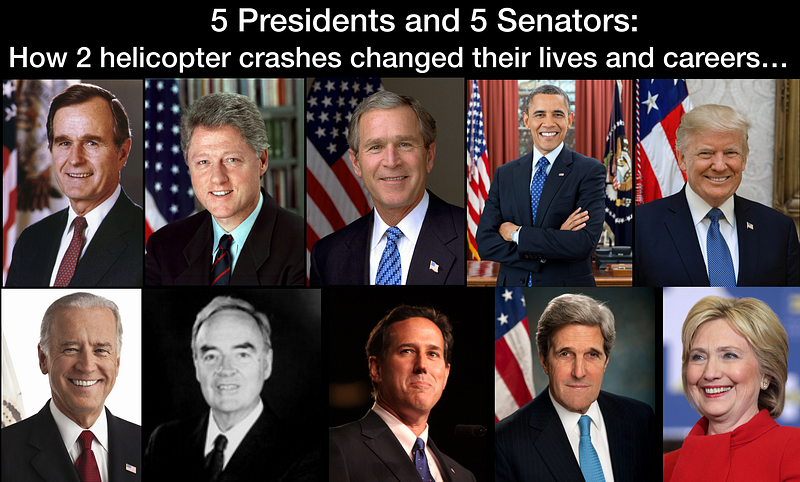
Here are several ways the Heinz crash changed everything for George Bush (and his sons), the Clinton family, the 1994 Republican Revolution, John Kerry, Barack Obama, Rick Santorum, and Trump:
Bush was defeated in 1992 — so his sons avenged him
The first President Bush had a 91 percent approval rating after the end of the 1991 Persian Gulf War (at the time of the Heinz crash). Bush still looked unbeatable in fall of 1991 when “top tier” Democratic candidates like Mario Cuomo, Sam Nunn, and Al Gore stayed out of the race.
Clinton in 1991 was best known for bombing
Clinton was booed when he delivered a long-winded Democratic National Convention keynote address in 1988 (something he had to apologize for on “The Tonight Show starring Johnny Carson”).
The November 1991 defeat of Thornburgh, who was so similar to Bush, sent shock waves and a “wakeup call’’ through Washington, showing reporters and pols Bush might be vulnerable. The Clinton 1992 campaign was largely modeled after the Wofford 1991 race (with one difference: Clinton didn’t fight NAFTA and got it approved).
If Bush had been re-elected in 1992, his party would have been unlikely to gain seats in 1994 (parties controlling the White House historically lose seats in mid-terms).
So with a second term for the elder Bush, there wouldn’t have been a 1994 Republican Revolution (when the GOP regained both houses of Congress after 40 years out of power and when Bush sons George W. Bush and Jeb Bush ran for governor of Texas and Florida.).
W. presidency without 1992 Bush loss?
If Bush senior had won a second term from 1992–1996, it seems far less likely that George W. Bush would have been elected governor of Texas in 1994 or President in 2000. Jeb Bush lost the Florida governor’s race in 1994 but won in 1998 and ran unsuccessfully for president in 2016 when he was declared “low energy” by Trump and promptly neutralized.
Clintons without Carville?
Without Carville and Begala’s famous 24–7 rapid response campaign team (at the dawn of the 24-hour news cycle) would Clinton have made it past the primaries when scandals hit him just before New Hampshire?
Without Carville and Begala and their well-rehearsed strategy, would Clinton have made bold moves like playing his sax on the Arsenio Hall show, considered one of the first times when news and entertainment began to blur together?
If Clinton, then governor of Arkansas, hadn’t won in 1992, it seems far, far less likely that his wife, Hillary Clinton, would have become a senator from New York, Secretary of State, or a 2008 and 2016 Presidential candidate.
After the Heinz crash, Teresa Heinz married Kerry
After losing her husband in the 1991 crash, Teresa Heinz married U.S. Sen. John Kerry, D-Mass. Pennsylvania Republicans were certain the long-term plan of John Heinz prior to his death was to run for governor in 1994 and for President in 1996.
Instead of a John Heinz presidential run, Teresa Heinz wound up being a major part of Kerry’s 2004 race for President, when he was the Democratic nominee challenging incumbent President George W. Bush.
Kerry picked a virtually unknown Democratic state senator from Illinois as his keynote speaker in 2004: that is how Barack Obama landed on the national stage. Kerry later became Obama’s Secretary of State.
But if Kerry hadn’t married Heinz, would he have been the Democratic nominee, and would he have picked Obama as his keynote speaker? Like Obama, Teresa Heinz, had her own story about being uniquely African American because she was born in Mozambique and immigrated to America.
Heinz and Rick Santorum
In 1994, Teresa Heinz briefly considered challenging Wofford for her husband’s seat. I drove to her home expecting the news conference meant she was running. She instead bowed out.
Young Congressman Rick Santorum (barely 35 at the time) ran for the seat, defeating Wofford. Santorum became the youngest member of the Senate and held the seat until losing to Casey’s son in 2006. Santorum ran for President and was the second-highest vote-getter in the 2012 GOP Presidential primaries.
The Biden and Heinz connection
In the 2020 race, former Vice President Joe Biden is the Democrat frontrunner. Numerous stories written about his son Hunter Biden, refer to Biden partnering with Christopher Heinz (the son of John and Teresa Heinz) and the stepson of Kerry. Heinz later canceled their partnership.
Donald Trump
Trump first openly talked about running for president as an anti-establishment candidate in 1988 but quickly decided to instead campaign for Bush.
After Bush was defeated in 1992, the Trump for president talk resurfaced with Trump always saying he wouldn’t run until the timing was right.
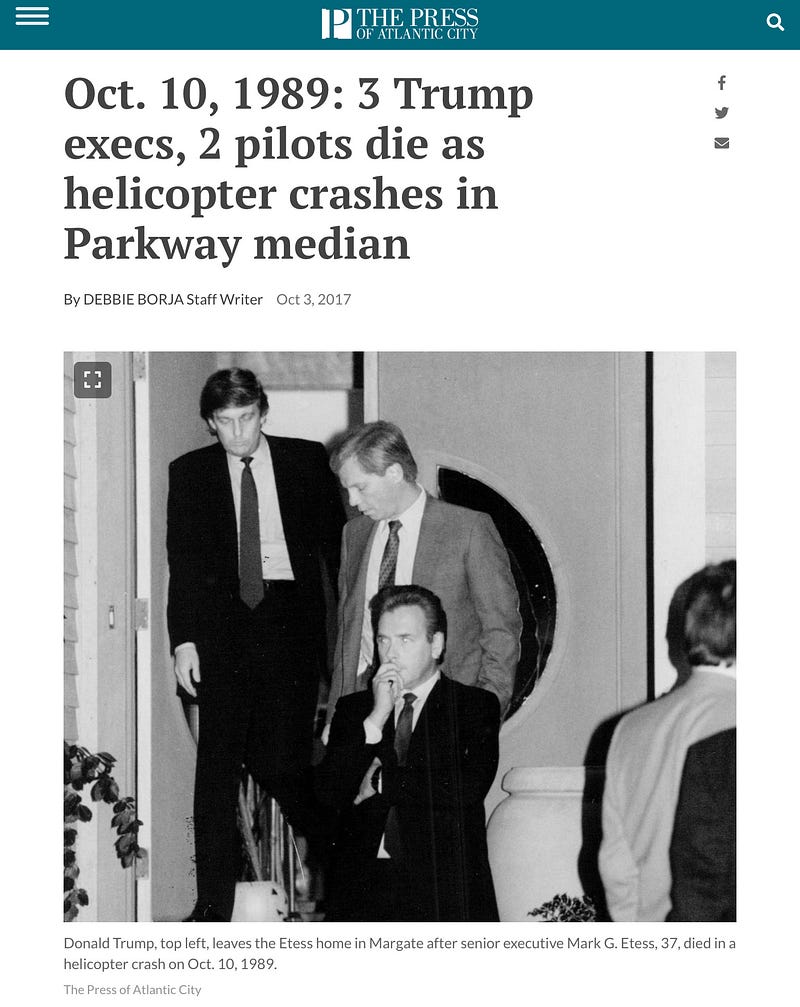
A story few remember or report occurred just 18 months before the Heinz crash:
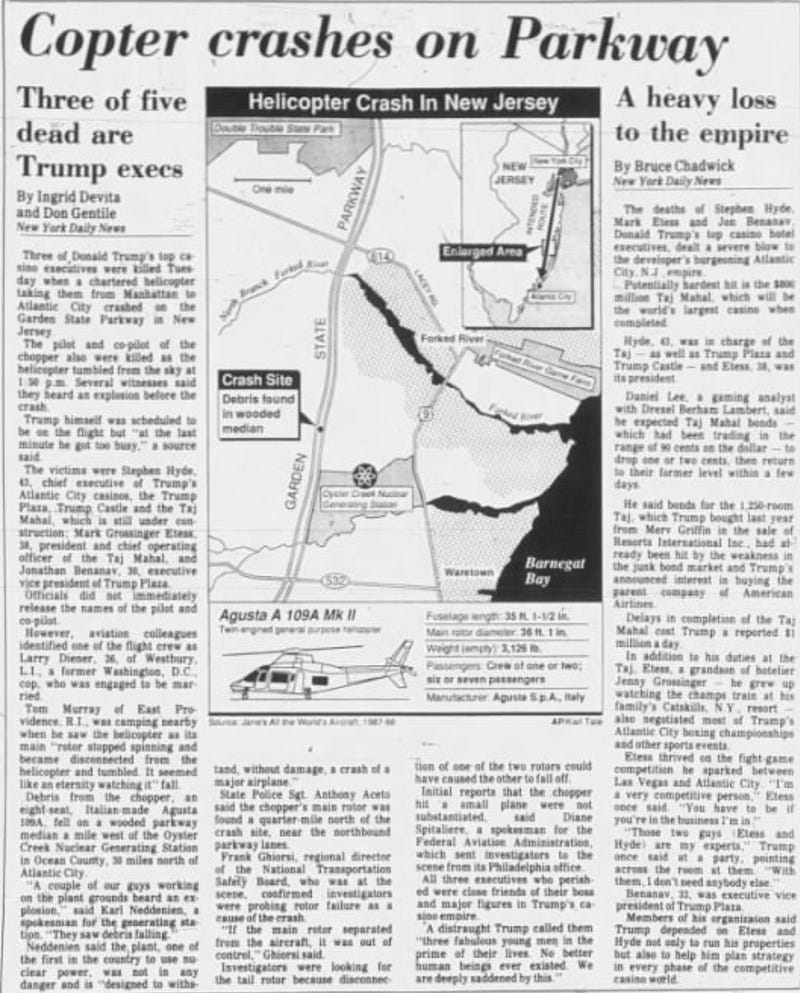
In October 1989, Trump, then nationally known and just 43, was supposed to take a different helicopter from his New York Trump Tower to his Atlantic City, N.J. casinos with his top executives.
Roger Stone, the Republican operative who was involved with Trump political activities each time he talked about running for president from 1988 to 2016, asked Trump if they could meet.
Trump agreed and didn’t get on the helicopter as planned — which crashed in an accident that killed three of his executives and two others on board.
When Stone arrived for his meeting, Trump was already phoning the survivors of the victims, knowing he had planned to be on that flight.
“This was the point at which I realized that Trump had been put on Earth for this larger purpose,” Stone wrote in his 2017 book, The Making of the President 2016. “This was the point that I realized he would be President.”