
When Peers Die: Last of the Old Style Newspapermen?
Arthur Bridgeforth Jr. was a truth-teller, a class act, a gentleman
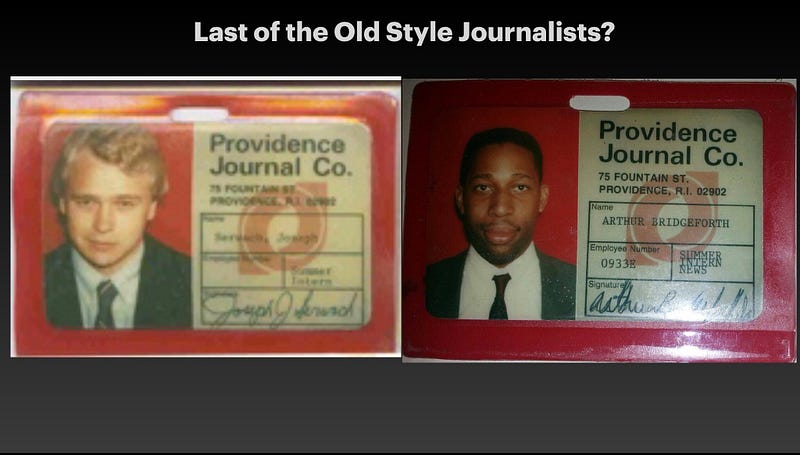
For the fourth time in two months, a beloved, good soul truth-teller in my life died: my Uncle David, Deacon Dave Lawrence, and two journalism peers: first Kevin Roberts and now Art Bridgeforth.
The unexpected deaths of peers remind us of our own mortality.
“COVID?” everyone asks. No, not at all. No connection to the news of the year made their sudden deaths — two on Sunday — that much more jolting. Each was a classic original who did it all well. One kept coming back into my life:
Arthur Bridgeforth Jr., I am now reminded, was my age (he was a few months younger than me), working at three of the same newspapers I did:
- I hired Art at The State News at Michigan State University. He immediately struck everyone for his kind heart and dedication to a higher calling: truth.
- We both had summer internships (a year apart) at the mighty Providence Journal in Rhode Island.
- A decade later, we started on the same day in April 1996 as reporters for Crain’s Detroit Business.
The Best thing about working with Art
He was a real journalist, a true gentleman, and a good, good guy. Today, you can see a reporter on TV, look at their Facebook, or even review their work and guess fairly quickly “whose side” they advocate. Many journalists leave newspapers or broadcast stations and become advocates for someone or some cause. Others do that while still in the media.
Art, instead, always put one thing first: Truth. Thirty-four years after our first meeting, I have no idea what his politics were. I just know that his work was always real, enlightening, and authentic — a journalist’s journalist.
The last day we worked together at The State News in June 1986, the computer system crashed, and we made an emergency decision to move our whole operation to the Michigan State Journalism School, using unfamiliar computers.
The typefaces and “look” of the paper were also different that day. When we typeset the pages returning to the composing room, everything looked a little “off,” and that included Art’s byline. One entire line had his name. A second line only said, “Jr.” Jerry, the composing room chief, asked me what I wanted to do.
I told him he could use a razor blade to remove the “junior” and added, “Let’s give his dad some credit.” Art loved that story. He loved his dad and family too.
You see what a great father he was on his Facebook: a beautiful long marriage, beautiful family. He got all the essentials and did it all well. So it was no surprise his peers would elect him president of the Detroit chapter of the National Association of Black Journalists.
My favorite Art story
In April 1996, after nine years of living and working out-of-state, I returned to a journalism job in my native Detroit. I was told I could start that first day at nine a.m. and arrived at Crain’s Detroit Business just as the electronic gates shut, sealing the parking lot (which had barbed wire fences) shut. I couldn’t get into the lot.
Now what? I was brand new, so I didn’t have a key card or ID yet. So I drove around back to the other lot and eventually, another car exited, allowing me to slip in without a keycard. I parked, and the electronic gate sealed me in.
I now couldn’t get out of the other lot or into the building. Someone else came out of the building, allowing me to walk in to row after row of unfamiliar offices and people. Where the heck was I? Nothing looked familiar. I asked for help.
I soon realized I’d entered the building on the ground floor, that my job (the place I’d been before) was on the first floor, one floor up. The front lot went to the first floor, and the backlot entered the lower ground floor.
Finally, I was in our first-floor newsroom, and suddenly no one was around. Every cubicle was empty. I felt like I was in a “Twilight Zone” episode.
Finally, the door to the meeting room opened, revealing where the entire staff was, and everyone laughed and welcomed me in. I went from being alone to being surrounded by people. Phil Nussel, the managing editor, then said, “I think you already know Art.”
And there he was: I hadn’t seen Art in a decade (when we were in our early 20s), and here he was in a three-piece suit with suspenders, now in his early 30s, with the biggest smile on his face.
Sometimes, he added a very cool “old school’’ hat to complete the look. Everyone loved Art.
We hugged. Art welcomed me home.
That was Art’s gift: He always made everyone feel respected, loved, and at home. I miss you, Art, but have a feeling we will see each other again.